

Ambi Robotics is an AI and robotics company developing advanced solutions that scale ecommerce operations to meet demand while empowering humans to work smarter
Berkeley, CA
Joined March 2021
- Tweets577
- Following11
- Followers1.7K
- Likes385


AmbiRobotics retweeted

Here's how cloud agents are improving production robot performance today.
(Side note: I love these @AmbiRobotics blog posts. Ambi is one of the few production robotics companies willing to go deep on its technical work in public.)
One problem that Ambi noticed for their sorting robots is that some packages barely fit the bag opening. Deformable shapes or sensor noise can cause the robot to misjudge the package size, so it can place them in the wrong orientation. This means the package doesn't fit, the task fails, and the system has to retry. Ambi estimates that this costs about 31,000 sorts per year.
Obviously, solving these failure modes is highly attractive; reducing 31,000 extra sorts creates significant value through faster throughput. Unfortunately, engineers still need weeks to analyze failures, propose fixes, and test them.
Instead, if Ambi can plug AI coding agents into the loop, they can iterate much faster.
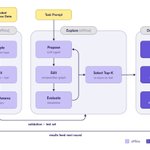
So they built the AmbiOS Agentic Robotics Harness. The agents don't solve the problem by writing arbitrary code. Instead, they can edit a bounded computation graph composed of existing robot skills. This means the agents can move quickly while still keeping safety checks and error handling intact.
The harness gives the agents two key pieces of infrastructure:
1) A cloud dataset of real production events, filterable by known success and failure modes
2) A simulator that replays those events with the agent's proposed changes
So the agents pull failures → hypothesize → edit the skill graph → test in sim → ship to a production A/B test.
In their experiment, these agents proposed three candidate fixes in just 10 hours. Of the three, one added 4.2 packages per hour, about 15k more sorts per robot per year, and now runs on 30% of Ambi's U.S. fleet.
I love how simple yet powerful this harness is. I think every robotics company with robotics in production should strive to accomplish such a loop.


AmbiRobotics retweeted
What does it take to build a robust harness for a robot foundation model?
A foundation model takes in images or video, sometimes with language instructions, and outputs robot actions.
The model is a black box, and you can't guarantee its output is safe to run on real hardware. That's why the harness is important. It conditions what goes into the model, then checks and sometimes modifies what comes out, so the robot can act safely, reliably, and quickly.
In conversation with @jmahl42 on the latest Scaling Robotics episode, we walked through PRIME-1 by @AmbiRobotics , a foundation model for picking.
PRIME-1 takes in images and outputs a pick action, roughly an end-effector pose. The harness takes it from there:
→ Builds the full motion plan from that pose and optimizes it for speed
→ Checks that the robot stays in bounds and won't collide with anything
→ Throws out actions that fail those checks
→ Knows when to stop and hand a problem to a person
The human-in-the-loop makes the system robust to edge cases. When a pick fails, it's not always optimal to send the problem back to the model. Sometimes the harness needs logic to exit the AI loop and bring in a human.
Models predict what to do, and the harness dictates what the robot actually does. Harnesses are how we will get foundation models from demos to production!
AmbiRobotics retweeted
Here's how @AmbiRobotics thinks about deploying robots into existing warehouse systems.
1) Keep integrations simple
A robot shouldn't need ten pieces of information from upstream systems at ten different moments just to function. Whatever touchpoints are put in place need to be small and well-defined.
This allows a robot to unlock generality.
2) Rate matching
Warehouses run at a cadence. Items get picked at a rate; boxes move at a rate. If your robot is too fast or too slow, the rest of the system is out of whack.
Ambi often connects to sorters, the big conveyor systems that carry packages across a room and divert them down slides. If a burst comes in faster than the robot can handle, that's a problem for the entire line. To solve for this, they introduced buffering
3) Design around line conditions
Ambi has a blue bin they cart around next to AmbiSort. This is sometimes odd to customers, who ask if they can just connect it to the conveyor. But at deployment, bins are more optimal.
The bin decouples the robot from the line. They can put the robot anywhere in the building, fill a bunch of bins, queue the work, and run it when ready. This builds in the buffer that makes rate matching possible.
--
In conversation with @jmahl42 in the latest episode of Scaling Robotics!
AmbiRobotics retweeted

Warehouse robots are getting a lot more capable and collaborative. Our latest feature covers where robotics and Physical AI are headed across the warehouse floor:
🤖 @amazon's next-gen #AmazonProteus now takes natural language commands and is headed to European fulfillment centers in 2027.
🤝 ShipLab is rolling out @RobustAI's Carter cobots in phases, only paying once performance targets are met at each stage.
🔗 @AmbiRobotics and @pickle_robot integrated their systems for a continuous dock-to-warehouse workflow, a glimpse at what interoperable automation looks like.
🥶 @CorvusRobotics launched drones built for cycle counts in sub-zero cold storage. @kroger's already using them in live freezer ops.
🦾 @Accenture, @VodafoneGroup Procure & Connect, and @SAP piloted humanoid robots doing autonomous facility inspections in Germany.
Plus new safety sensors, higher-payload robotic arms, and more.
Learn more 👉 inboundlogistics.com/article…

AmbiRobotics retweeted
I've enjoyed getting to know Jeff because I love his balanced approach to building and deploying Physical AI systems.
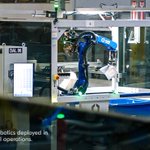
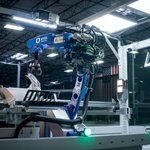
On one hand, he is a pragmatic technologist. @AmbiRobotics has deployed 100+ robots that do real work for some of the world's biggest logistics operations.
On the other, he's a PhD from @UCBerkeley, and his team's academic roots mean they're constantly pushing the frontier of end-to-end models.
The result is a harmony of both rapid deployments and rapid progress on Ambi's autonomy stack.
More companies and leaders should operate like this, and I'd encourage you to check out this episode with Jeff, out now.
AmbiRobotics retweeted

Excited to share our Physical AI reasoning model for item stacking, CARGO!
CARGO is trained with sim-to-real reinforcement learning to plan high-level actions, such as which item to pick next and where to place it, in order to maximize packing density on real-world robots.
CARGO is already deployed to robots in customer operations, building stacks at over 72.5% density at over 340 sorts per hour.
Read more in our technical blog: ambirobotics.com/blog/cargo-…
#HandleMore
AmbiRobotics retweeted
Another harness for a learned robotic policy in production. We've seen a lot of cool demos of these policies in the last 10 days. The thing that companies are trying to solve is how to deploy them in production.
@AmbiRobotics CARGO is one such answer.
CARGO is a planning model. It decides which box to stack next and where to place it, so the container fills as densely as possible. The picking and placing are handled by manipulation skills that already exist in Ambi's capabilities. CARGO is the director that tells the manipulation what to do.
We've seen other companies pair a learned manipulation policy with classical controls as a safety harness. Ambi moves the learned policy up a layer. Here it does the planning, and the harness keeps that planning physically grounded.
CARGO only gets to choose from placements that are already deemed "feasible", meaning they are collision-free, stable, and executable given the real limitations of the hardware. It can't propose a more optimal solution that the robot can't physically reach, or one that would topple the stack.
Whether the learned policy is for manipulation, planning, or both, there is a clear trend of classical harnesses being used to ensure movements are safe and physically grounded.
@ambi
AmbiRobotics retweeted
This is an important, trailblazing collaboration between @pickle_robot and @ambirobotics that more teams should pay attention to:
Any Physical AI company that has sold into logistics knows how hard it is to get systems onto a production warehouse floor.
Autonomy and reliability are, of course, important, but the conditions around the existing warehouse are often the bigger obstacle:
- Do you integrate with my WMS?
- How will I have to rearchitect my warehouse to fit your system?
- Do you play nicely with the systems I've already sunk a ton of money into?
Clearing these objections takes huge effort that has nothing to do with your product, and it usually means fighting legacy systems and incumbents who don't want to interoperate.
When two Physical AI companies pre-integrate, they reduce that friction for the customer and cumulatively solve a larger share of work. The buyer gets systems that interoperate out of the box, which makes "saying yes" a lot easier.
Great work by both teams. I want to see more of this across the industry!

Big news: we've integrated AmbiStack with @pickle_robot to fully automate inbound logistics.
First-of-its-kind: two specialized robotic systems from two different companies, operating as one continuous autonomous inbound logistics workflow.
#HandleMore
AmbiRobotics retweeted

Pickle Robot Co. and Ambi Robotics are combining their AI systems to automate warehouse loading docks for major retail and logistics companies. bizjournals.com/boston/news/…

AmbiRobotics retweeted

How robot companies can overcome 5 barriers to commercialization, by Jeff Mahler, savvy and experienced CTO of @AmbiRobotics:
forbes.com/councils/forbeste…

AmbiRobotics retweeted

AmbiStack: AI-Powered Robotic Stacking for Warehouse Operations
AmbiStack is a multi-purpose warehouse solution that combines reinforcement learning and AI vision systems to optimize sorting and stacking in logistics. Using Sim2Real reinforcement learning, the system can reason on-the-fly to stack unfamiliar items and maximize container space, much like a 3D version of Tetris.
Video source: @AmbiRobotics
#robotics #AI #logistics #technology #engineering #stem #innovation #robots #automation
--------------------------------
Stay ahead of the curve!
Follow us now on our WhatsApp (wevlv.co/wevolver-whatsapp) and Telegram (wevlv.co/3sJlFn5) channels and stay updated about the cutting edge.
AmbiRobotics retweeted
Looking fwd to speaking and discussions on “Good Old Fashioned Engineering Can Close the 100,000 Year 'Data Gap' in Robotics,” this Tues 3:30pm @Penn, then @Columbia on Wed, @BostonDynamics on Thurs, and @MIT on Friday:
cis.upenn.edu/events/
AmbiRobotics retweeted

@AmbiRobotics , we've sorted hundreds of millions of packages across our growing fleet of #AmbiSort systems.
But what I'm most proud of is the hundreds of certified Robot Operators who are upskilled, working alongside our AI-powered robots every day.
#HandleMore
AmbiRobotics retweeted
AmbiStack: AI-Powered Robotic Stacking for Warehouse Operations
AmbiStack is a multi-purpose warehouse solution that combines reinforcement learning and AI vision systems to optimize sorting and stacking in logistics. Using Sim2Real reinforcement learning, the system can reason on-the-fly to stack unfamiliar items and maximize container space, much like a 3D version of Tetris.
Video source: @AmbiRobotics
#robotics #AI #logistics #technology #engineering #stem #innovation #robots #automation
-----------------------
Wanna get your company on Wevolver too? Learn how: wevlv.co/get-your-company-on…
AmbiRobotics retweeted
Thx John for this excellent summary. Data quality vs data quantity is a crucial issue; that’s why data flywheels like @AmbiRobotics can be effective: they collect real production data from real packages in real logistics environments.

How to close the 100,000 year data gap in robotics? (1/3)
I attended @Ken_Goldberg's talk yesterday without knowing much about robotics, and I found it super interesting!
Apparently, the bitter lesson follows you everywhere...
Data has solved language and vision. Does it also solve robotics?
Yes, it will but with some caveats.
Building effective robotic systems comes down to two things:
1️⃣ Data (there is so little in comparison to what's used to train LLMs)
2️⃣ Good old fashioned engineering (GOFE) - modularity, algorithms, and metrics → just designing good systems
We've seen GOFE in AI systems shifting to modular systems (like DSPy!) and biological control systems like the brain.

AmbiRobotics retweeted

@WSJ features @AmbiRobotics for tackling one of the toughest challenges in logistics.
What started as a Berkeley research spinout incubated at The House is now serving the biggest logistics companies in the world!
🦾 @jmahl42 @Ken_Goldberg @Cthephen @JoeRuck cc @thehousefund
wsj.com/business/logistics/t…
AmbiRobotics retweeted

The holy grail of warehouse automation has been solved.
@AmbiRobotics is featured in @WSJ for their breakthroughs.
AmbiStack uses AI + robotics to lift, sort, and stack like a 3D Tetris champ.
The future of logistics is here TODAY. Go Bears!
wsj.com/business/logistics/t…
AmbiRobotics retweeted

We discussed @AmbiRobotics technology, but the business case is even more exciting! 💰
The focus on return on investment is crucial for decision-makers, especially CFOs.
AmbiStack addresses a significant cost challenge in warehouse operations, which makes the business case compelling.
Its ability to optimize pallet and container density to reduce transportation costs directly affects the bottom line.
One of the primary benefits of AmbiStack is that it removes repetitive, injury-prone tasks, allowing workers to transition into higher-value roles. This challenges the myth of robots stealing jobs by instead enhancing the workforce’s skill set.
AmbiStack leverages AI to optimize stacking in containers, maximizing space utilization. This directly impacts shipping costs by increasing the efficiency of container loading,
Results? Reduced transportation expenses. 📉
The system adapts to current workflows, whether it's building inbound pallets or stacking containers for parcel transport, minimising implementation disruptions and capital expenditures.
Their scalability model offers a low-risk way for companies to test the solution, starting with one application, proving the ROI, and then expanding.
This is especially valuable in a fast-growing market like warehouse automation, which is projected to reach $55 billion by 2030. Early adopters stand to gain a competitive edge.
AmbiRobotics retweeted
@AmbiRobotics Sells Out AmbiStack for 2025 as Fortune 500 Customer Demand Accelerates.
Read the press release: businesswire.com/news/home/2…
AmbiRobotics retweeted

Scaling Physical AI to Unlock Global Supply Chain Efficiency
Jim Liefer, CEO, @AmbiRobotics joined @gbrulte on The Road to Autonomy podcast to discuss how physical AI is transforming warehouse automation and redefining global supply chain efficiency.
Episode Chapters
0:00 Future of Robotics
1:56 Training Data
3:50 AmbiSort
6:42 Unlocking Efficiencies
7:58 Deploying an Ambi System
10:06 Customer Data
13:13 Fully Automated Warehouses and Jobs
18:33 Humans in the Loop
22:46 Packaging
25:50 Warehouse Trends
27:58 Investing in Automation & Autonomy
29:54 Business of Ambi Robotics
34:48 Future of Ambi Robotics