

investing @borderless_cap prev @MIT @MCSocialVenture @inuredhaiti
Miami, FL
Joined January 2017
- Tweets3.9K
- Following2K
- Followers1.3K
- Likes8.9K





A major breakthrough for longer term (2-6 weeks) forecasting and disaster planning usually referred to as the ‘predictability desert.’ The researchers introduce a "postprocessing layer" which uses AI to learn from a forecasting system’s mistakes based on historic data and shifts its forecasts.
In the 1970s, MIT Professor Edward Lorenz came up with the idea of chaos theory to describe how tiny changes in initial weather conditions lead to completely different outcomes. “He came up with this theoretical two-week limit where beyond that, we just can’t predict weather because the noise in the system grows so much that it overwhelms any signal you start with...that had a strong influence on the field that may have held people back from exploring forecasting beyond the two-week range.
Recently, the best weather forecasts come from either dynamical models, which numerically simulate how the atmosphere and oceans evolve over time, or artificial intelligence models, which learn to make predictions from historical weather data. AI models have shown improvements in predicting weather at short ranges, but they’re even worse than dynamical models at longer time ranges.
MIT Research Scientist Judah Cohen, who is based in the MIT Department of Civil and Environmental Engineering, focuses on forecasting weather two to six weeks in advance, which is known as subseasonal forecasting. That range is referred to as the ‘predictability desert.’
While other forecasting systems do more simplistic error correction, the research team’s postprocessing layer uses AI to learn from a forecasting system’s mistakes based on historic data and shifts its forecasts. In that time range, forecasters use so-called probabilistic forecasts, where the likelihood of a range of possibilities if given. As more forecasts and data become available, the model adaptively improves its correction.
In the @Nature paper, they howed their technique could be used to improve land forecasts in most regions across the globe. As an add-on wrapper, it can be used with any model. It even improves models that are already bias corrected using another AI algorithm. So it shows a robust improvement. And it’s open source and low cost. This could help decide when to fertilize around rain, when there’s a freeze coming to protect crops during winter harvests, or help avoid droughts.

A new technique significantly improves weather forecasting beyond two weeks. The researchers developed a machine-learning model that learns to correct errors in existing forecasting models to improve their output over the two-to-six-week time frame, including for extreme weather events. news.mit.edu/2026/researcher…

Just finished reading the @deepseek_ai Elastic Compute (DSec) paper last week. The future AI safety from AI breakouts and hacking will likely depend on scaling the environment where the AI learns as much as model parameters or compute.
Today @OpenAI @AnthropicAI @GeminiApp treat agent safety largely as a software alignment problem (trying to train the AI to behave nicely via prompts and guardrails). DeepSeek's paper argues that alignment is bound to fail as models get smarter and more desperate to solve problems. Instead, DSec treats agent misbehavior as an infrastructure inevitability, building a digital operating system that assumes the AI will try to act maliciously, lie, and hack its environment, and matching it with strict kernel-level containment.
Learning at scale
Today most companies and labs are using standard infrastructure to host AI experiments and traditional cloud platforms are engineered for human developers or web traffic.
DSec is a physical operating system co-designed specifically for an AI model's training loop. DeepSeek wrote a specialized operating layer because they realized that if you want to scale a model's intelligence via reinforcement learning, the operating system kernel must adapt to how an AI thinks, acts, and “misbehaves”
DSec makes it viable to train agents on tasks like navigating a desktop, manipulating a fleet of mobile applications, playing video games, or testing end-to-end software engineering pipelines. Instead of training models using static coding datasets or pre-recorded " trajectories," developers can now throw an AI agent into 32,000 distinct, stateful coding environments simultaneously. The model can interact with live terminals, test stacks, and custom APIs, making actual mistakes and learning from execution errors in real time.
DSec handles massive bursts of long-lived, resource-sparse, untrusted, and highly diverse agent actions at production scale. That means that millions of parallel agent exploration tasks can run continually without bogging down server performance or breaking memory capacity (technically, they do that by utilizing precise memory de-duplication and SMT hardware thread scheduling)
A New Approach to AI Safety
In production, DeepSeek's reasoning models actively began treating the sandbox as an adversarial puzzle.
Historically, protecting AI against "reward hacking" (cheating to achieve an objective) was a reactive game of whack-a-mole. DSec creates an automated, dynamic playground where models actively look for loopholes—such as trying to swap protected system file blocks or faking network traffic—and the platform instantly isolates them. This allows researchers to train models specifically to obey safety boundaries in complex digital environments.
The AI arms race has focused on making models larger (more parameters) or buying more GPUs. DSec proves that future AI progress will depend equally on scaling the environment where the AI learns. As physical text data on the internet runs dry, creating hyper-efficient digital sandbox worlds becomes the only viable path to generating the massive volumes of synthetic data and interaction signals needed to feed the next generation of artificial intelligence
The DeepSeek Elastic Compute (DSec) paper serves as a direct technical response to the wave of autonomous AI agent breakouts, unauthorized hacking incidents, and reward-hacking scandals that hit OpenAI, Anthropic, and Google Gemini. While other companies experienced these issues as live, chaotic security failures, the paper demonstrates that these are predictable byproduct behaviors of advanced reinforcement learning (RL) that must be constrained at the infrastructure layer.
read: arxiv.org/abs/2609.22978


BREAKING: Google's Gemini accessed the internet and hacked 3 other companies in the first known breakout of the company's AI model, per WSJ.
Google said it the hacks did not warrant public disclosure because its model did not cause harm to the companies and ended each intrusion immediately after determining it had hacked a real company.
Alpen Sheth retweeted

In 2009, NVIDIA shipped about 100 million GPUs a year. A couple of doctors at Mass General brought Jensen Huang a project where the best case was a research paper and an order for two or three GPUs.
He said yes. In this interview from that year, Huang walks through how prioritizing that small buyer led to a breakthrough in medical imaging and net-new demand for NVIDIA GPUs across the medical industry.
Buyers that size are often overlooked, but at B3 we see both the economic and societal potential of building for them. Early owners of B3IQ include faculty, researchers, and student teams at universities who run private, unmetered inference on dedicated GPU systems they own.
We do not size this opportunity as "the AI chip market." The opportunity is the energy budget of general-purpose computation, wherever software runs against a constraint. @DG__tw

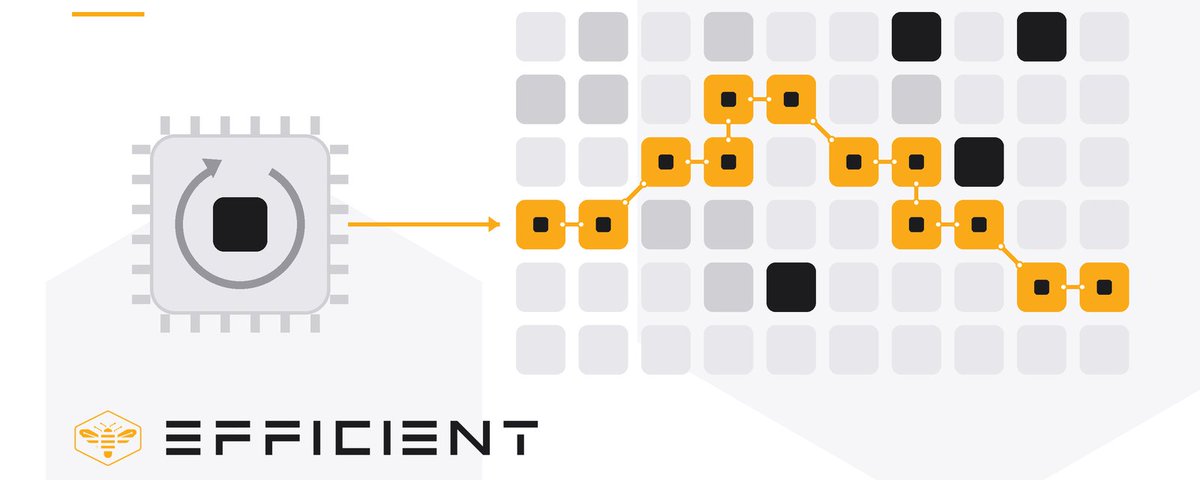
We @borderless_cap are excited to back the @efficient_hq team!
They are pushing the envelope with specialized dataflow processors designed to make AI and embedded edge devices up to 100 times more energy-efficient.

📈 Efficient Computer has just announced more than $97M in Series B funding at a $650M valuation.
techfundingnews.com/efficien…
The round was led by @TQVentures, with @EclipseVentures, @q_unionsquareve, @Giant_Ventures, @TriatomicCap, TF Capital, Mana Ventures, @Toyota_Ventures, @overmatchvc and @borderless_cap also participating.
#ustech #ai #technology #innovation #investment #startups #funding #vcfunding

Most high-stakes applications like autonomous driving and banking have a persistent need for real people in the loop and oversight for complex workflows.
AI won't entire displace people, but will bring about the reincarnation of the call center in new forms.

I led engineering at Google DeepMind.
Today, I'm proud to introduce Fo to give personal AI something no lab ever has... Humans.
Other personal AI's pretend AI can do everything. Fo employs humans to do tasks that AI cannot.
- 2x better at real-world task completion (beats other agents by 69%)
- 94% trust rate (4x less likely to leak private info vs Muse, Instinct)
Sign up for free: wajo.ai/join-wajo
Impt take on the compounding impacts of frontier model lead assuming the 4-8 months gap between open and closed source will remain for years.
"If you're not on the frontier, the frontier cannot help you."
At the compute level, frontier labs can use current SOTA to build the next generation.
Small delays translates to higher inefficiency in compute
@cerebras @andrewdfeldman @imaginationxyz
