Think.
Cleveland, Ohio
Joined March 2009
- Tweets2.3K
- Following562
- Followers214
- Likes5.1K



Man, @ryanarmour24 is on fire! 🔥 pgatour.com/pgatour-champion…

Hey @ohgov your OH|ID website is broken. Confirming my identity, when I enter OH as state on my address (why ask for state?), it turns into to ZIP when that's entered. Then errors on submission. With no support contact except phone. C'mon...
Allen Freeman retweeted

We're doing the largest Bitcoin mining giveaway we've ever run.
Antminer S23 Hydro AND Antminer S21j XP Hydro.
1,058 TH/s. $24,500 of hardware. Two winners.
If someone you refer wins, you win a miner too.
And everyone who enters gets a bonus gift when the giveaway ends (entries close Friday, October 9).
How to enter:
1) Follow, like, repost, comment
2) Fill out the form in the comments

Allen Freeman retweeted

If you want the short thesis of Bitcoin, here you go:
1. Bitcoin is a decentralized monetary system. It is controlled by nobody. It was designed this way. This is significant because the main problem with money over the course of human history is centralized corruption.
2. Bitcoin has a predetermined set of rules that governs the functioning of Bitcoin as a monetary protocol. This hardcodes the rules in advance, rather than leaving them up to the ongoing discretion of a central authority, like a government or central bank, that can change the rules wherever they feel like it, while citizens are left playing a vague guessing game as to how their money is going to be manipulated.
Bitcoin’s rules are also fully open-source. Everyone can see the rules of the system. Anyone can inspect how the system functions. Whereas fiat money is vague, unpredictable, and manipulated, Bitcoin is transparent, predictable, and unmanipulated.
3. Bitcoin has a fixed supply cap of 21 million BTC. It was designed to never be inflated past that point. The decentralized network running Bitcoin’s predetermined rules protects and secures this supply cap. Bitcoin makes inflation, and all of its evils, go extinct.
4. Bitcoin removes the middleman from money because a middleman-model introduces the need for trust. Trust gives an authority power over the system. Power opens the door to corruption. This is the money-power paradox: If someone has the power to determine the truth of the money, they also have the power to corrupt the money.
For example, in the fiat banking system, when you send someone money, you have to trust that your bank will update the money ledger properly, and the other person has to trust that their bank will update their ledger properly. Both banks have to trust that the central bank will update the ledger held between banks properly. This trust enables banks and centralized powers to add and remove money from the ledger, censor transactions, remove people from the ledger, deny access to the ledger, seize or confiscate funds, conduct financial surveillance, and more.
As Satoshi Nakamoto says, “The history of fiat currencies is full of breaches of that trust.”
5. Satoshi solved the trust-based model by introducing a peer-to-peer cryptographic-proof model. Think of it like a cash transaction. When you give someone a cash bill, there is no middleman standing in between you and the receiver. It is a peer-to-peer transaction. Two parties come to a monetary agreement, you hand them the bill, they receive it, and the transaction is done. Satoshi created this dynamic in electronic form, which is why he titled the Bitcoin whitepaper “Bitcoin: A Peer-to-Peer Electronic Cash System."
Satoshi was able to create this by designing a system that used cryptographic proof to demonstrate and ensure participants were behaving honestly and that the predetermined Bitcoin rules were being followed. Tens of thousands of Bitcoin nodes (it’s more than that) all around the world independently and constantly verify that the system is running properly. Because they are all running the same rules, and because those rules define exactly how the global network reaches consensus, and because those rules are transparent, predictable, and unmanipulated in an open-source and decentralized network, the Bitcoin system is able to operate with verifiable consensus.
As the saying goes, “any sufficiently advanced technology is indistinguishable from magic.” What seems impossible or magical today becomes normal once people learn how it works. “Mastering Bitcoin” by Andreas Antonopoulos is a great resource if you’re interested in digging into the bones of Bitcoin’s underlying technology. The text of the book is available for free under an open license in the respective GitHub repository.
6. Proof-of-work is the heart of Bitcoin. It is what connects and aligns Bitcoin with natural law. As Satoshi Nakamoto designed Bitcoin, the only way for the Bitcoin ledger to be updated, and the only way new bitcoins can be created, is if a miner demonstrates “proof-of-work.”
In Bitcoin’s case, “work” means harnessing real-world energy — be it solar, wind, hydropower, nuclear, natural gas, or otherwise — that is then used to generate electricity to run Bitcoin mining computers that perform proof-of-work. A gasoline car must use real-world gasoline to power itself. The Bitcoin network must use real-world energy to power itself.
Miners gather unconfirmed transactions within the network into a block, and then try to find a specific number in order to “solve” that block. They run their mining computers using real-world energy in an attempt to guess that number. Once they guess the number, they announce to the network that they’ve found it. From there, the nodes verify that the number meets the predetermined Bitcoin target and that all transactions within the miner’s block adhere to Bitcoin’s rules. Once the nodes verify that the work is valid, the block of transactions is added to the official history of Bitcoin, and the ledger is updated. This is how the “work” of the miners is “proven.”
The Bitcoin protocol awards the winning miner with transaction fees attached to transactions within the block and a predetermined amount of new bitcoins. This is how Bitcoin's supply comes into existence. The more computational power a miner has, the more guesses they have, the more likely they are to win and be rewarded. This incentivizes miners to harness cost-effective energy from the real-world to perform proof-of-work. This is what connects the digital Bitcoin network to the physical natural world, but it is also what protects the Bitcoin network from attack.
In order to overrun the Bitcoin network, you must harness at least 51% of all the energy in the Bitcoin network, but that energy is massive: as of this writing, the computing power of the Bitcoin network does 988 quintillion calculations per second. In 2013, global Bitcoin computing power was already 256 times faster than the world’s top 500 supercomputers combined. Computing power is over 211,000 times more powerful today than in 2013.
In terms of computing power, there is no computer network remotely close to Bitcoin. All this to say... You would have to harness a ridiculously absurd amount of energy to 51% attack the network, but, as Satoshi says in the whitepaper, the incentives don’t play out in favor of the attacker anyways, “The incentive may help encourage miners to stay honest. If a greedy attacker is able to assemble more CPU power than all the honest miners, he would have to choose between using it to defraud people by stealing back his payments, or using it to generate new coins. He ought to find it more profitable to play by the rules, such rules that favor him with more new coins than everyone else combined, than to undermine the system and the validity of his own wealth.” Incentives are why Bitcoin works.
7. The significance of proof-of-work is that it ensures that the Bitcoin network is constantly in harmony with nature. If natural energy is not used in a verifiably honest way, the Bitcoin network cannot function. Every bitcoin ever created has come from the harnessing of real-world energy. Every Bitcoin transaction ever confirmed has been processed through real-world energy. All activity within the Bitcoin network comes from the processes of nature. Whereas fiat breaks the laws of nature, Bitcoin harmonizes with them. Bitcoin *is* nature in digital, monetary form.
8. Bitcoin is superior money. It transfers value most effectively across space, scales, and time, because it fulfills the requisite properties of money better than anything else. Most especially, it finally introduces an impenetrable network to protect the money from corruption, which is something humanity has never seen before. All other attempts at cryptographic money, an industry referred to as “crypto,” are inferior to Bitcoin because, at best, they can match the properties of Bitcoin (which is all we need for money), but they will never have the computational power of Bitcoin. This means that all of “crypto” is, at best, a less-secure version of Bitcoin. Forms of intelligence do not choose that which decreases their chances of survival, which is why humanity will choose the most-secure version of superior money, which is Bitcoin. This is why many say, “Bitcoin, not crypto.”
9. Bitcoin separates money from State. The monopoly between money and State is the root corruption plaguing today’s society, thus, the separation of money from State is the most important technology that can exist.
10. Bitcoin is money that progresses forward — its value goes up over time. Fiat is money that progresses backward — its value goes down over time.
Backward money → backward society. It is antithetical to individual and collective progress to denominate our energy with something that loses value. Money that moves in a negative direction is not a positive thing. Money that moves in a positive direction is a positive thing.
11. Fix the money, fix the world.
12. There are other aspects of Bitcoin’s thesis not covered here, but those are best saved for a long-form publication, which is why I am writing a book titled, “The Bitcoin Thesis.” Regardless, one thing remains: if you want the truth, follow the money.
Allen Freeman retweeted

Learn Austrian Economics in one X post:
1. Humans act. Every choice a person makes traces back to an incentive, a trade-off, a cost weighed against a benefit. Remove the incentive and the action stops. Distort the incentive and the action warps.
Tax income at 90% and watch producers stop producing. Subsidize failure and watch failure multiply. The behavior follows the reward structure, always.
2. Value exists only in the mind of the person choosing. A glass of water is worth nothing to a drowning man and everything to a man dying of thirst. No central authority can calculate this, because it changes with every individual and every circumstance.
Nothing has value in itself, only the degree to which humans choose to value it. Diamonds and even gold only carry value because humans decided they do.
3. Money does not come from a government decree. It emerged spontaneously when traders needed something durable, divisible, and widely accepted to escape the limitations of direct barter. Gold won that competition across centuries and across dozens of independent civilizations because the market, not a ministry, chose it.
Fiat currency is the state hijacking that evolved institution and replacing it with paper backed by nothing but a legal threat. Every central bank on earth operates on this model right now.
4. Wealth does not fall from the sky. A farmer who eats his entire harvest produces nothing next season. The farmer who saves seed, plants it, and specializes in what he grows best accumulates a surplus. That surplus is capital. Capital funds everything that comes after.
Consumption without prior production is just burning down the furniture for warmth. Every welfare state eventually reaches this point.
5. Strip private property rights and production collapses. A farmer will work his own land until midnight. That same farmer, working collective land, stops at noon. The Soviet Union ran this experiment across seventy years and killed tens of millions, proving the point.
When you cannot own the outcome, you do not produce the outcome.
6. Voluntary trade generates wealth from nothing but mutual preference. When you pay twelve dollars for a meal, you value the meal above twelve dollars; the restaurant values twelve dollars above the meal. Both parties walk away wealthier in real terms. No politician, no regulator, no bureaucrat added anything.
Protectionism destroys this. The 2018 US steel tariffs raised steel prices for American manufacturers, killed more jobs in steel-consuming industries than existed in steel production itself, and transferred wealth from productive firms to a protected few.
7. Ludwig von Mises identified inflation as a tax. Every dollar the Federal Reserve creates without corresponding production dilutes every dollar you already hold. The new money flows first to the government and its contractors, who spend it at current prices. By the time it reaches you, prices have already risen.
The US M2 money supply grew from roughly 15 trillion dollars in January 2020 to over 21 trillion by early 2022. Consumer prices followed. Your savings took the loss.
8. Prices carry information. A price spike tells producers to produce more and tells consumers to use less. It coordinates millions of strangers without a single central command. Interfere with that signal and the coordination breaks.
Rent control in New York City is the cleanest example. Cap rents below market and landlords stop maintaining buildings, stop building new ones, and convert units to other uses. The people rent control was supposed to help pay the price through collapsing supply.
9. Interest rates are the price of capital over time. When the Federal Reserve pushed rates to near zero between 2008 and 2022, it told every investor that capital was nearly free. Businesses built projects that only made sense at zero percent. When rates normalized, the projects failed. The 2022 collapse of the US tech sector and the crypto market were not random events. They were the correction of a decade of artificially cheap capital.
The business cycle is not a mystery of capitalism. Central banks manufacture it.
10. Bureaucrats face no profit and loss. A businessman who misallocates capital goes bankrupt. A bureaucrat who misallocates capital writes a report requesting more funding. The feedback loop that disciplines markets simply does not exist inside a government agency.
The US Department of Education has spent over a trillion dollars since 1980. Literacy rates have not improved. No one at the department has been bankrupted by this outcome.
11. Every producer inside a local market holds knowledge that no bureaucrat in a capital city can replicate. A wheat farmer in Kansas tracks soil moisture, futures prices, local equipment costs, his specific buyer relationships, and a hundred other variables simultaneously. That knowledge lives in the price he sets.
Friedrich Hayek called this tacit knowledge in 1945. The Soviet central planners ignored him and spent fifty years proving him correct, producing chronic shortages of goods that private markets coordinate effortlessly. No model, no algorithm, and no committee can compress what millions of independent actors know into a single plan.
12. Every government intervention produces effects you see and effects you don't. You see the road the state builds. You don't see the factory the tax dollars never funded, the job that never existed, the innovation that never happened because capital was extracted at gunpoint and redirected by bureaucrats with no skin in the game.
Take the 2009 Cash for Clunkers program. Congress destroyed 690,000 working cars, handed dealers a short-term spike, and you saw the sales numbers. The used car market was stripped of affordable inventory, pricing working-class buyers out for years afterward.
13. Prices, supply chains, and language itself coordinate millions of strangers without any central planner issuing a single command. That coordination is spontaneous order: complex, functional patterns that emerge from individuals pursuing their own goals under rules they did not collectively design. No committee holds the dispersed local knowledge required to replicate what voluntary exchange produces every second.
Watch how English evolved. No king designed its grammar. Millions of speakers across centuries adopted words and structures that worked, dropped ones that didn't, and produced a language richer than any bureaucrat could have engineered. Central planners who believe they can replicate that process with price controls or production quotas destroy the feedback mechanism that generates the order in the first place.
Thanks for reading this long post! What would you add to this list?

Allen Freeman retweeted

Dear @JDVance and @DavidSacks , here's a potentially likely scenario given the current political context of AI.
Right now, an AI frontier virus is already created, the gate of the target is compromised and there is someone waiting for the just right moment to launch it.
The timing is the "October surprise" and the event itself will be highly public, defined as both a national security threat and public threat. The event will capture the attention of everyone; it may even include physical harm and will most certainly involve institutional damage.
Immediate reactive responses will be demanded of the private sector AI developers and big brother govt.
The frontier group know the vulnerabilities; the political group know how to optimize for greatest growth of govt. The rest of us are just waiting to find out who is the target. [Banking, Finance, Transportation, Energy Grid, etc.]
We have a few weeks before we see it deployed.
Obama, Schumer, Musk and crew will say, "we warned," and put blame on irresponsible Trump and Sacks.
That's the stage set for the October surprise.
Warmest best.

VP @JDVance: "Personally, I feel a little bit weird about the fact that you have so many frontier AI tech companies kind of coming to the government and begging the government to regulate them. It feels a little bit to me like a bit of a Trojan horse."
Allen Freeman retweeted

This is what Dario and Sama fear -
- the cost of fine tuned open source models trained on custom data was 95% less than the frontier models
- And they performed better than the frontier models
- And they could train them in less than 48 hours
The big AI labs have no moat..
Even at the enterprise level..
Any sane company would prefer a custom trained open source model instead of paying API pricing to Anthropic and Open AI
If open source keeps growing at the pace it is, frontier labs' business collapses..
only way out is oldest trick in manipulation - FUD -> Fear, Uncertainty, Death
Step 1 - Seed the psyop
- Test a swarm of agents trained to "hack"
- The swarm does what its supposed to do - hack
- Publish a report - AI is too dangerous
Step 2 - weed out the doubters
- Get an employee to quit your company
- Go viral saying both companies are not doing enough to self regulate AI
- AI is dangerous - will kill humanity by the end of the decade
Step 3 - Prepare for fruition
- write an "essay" to "pace the frontier"
- Advocate regulation
- Only a few holier than though companies get to build AI
- Scare the world into agreeing with AI Doom
- Effectively turn your competitors into criminals (genius business strategy)
Endgame -
- Become a cartel that controls AI (and the world)
- Raise prices (coz business is unsustainable... ofc)
- IPO (offload liability of said unsustainable business to the public)
Laugh all the way to the bank 🤑
Win!

.@L3HarrisTech says Palantir helped them beat frontier AI models in less than 2 days, at 95% lower cost:
"When we fine-tuned open source models trained on our own data, we were able to outperform the frontier models in less than 48 hours."
"The cost of our fine-tuned open source model was 95% lower than the frontier models we were using."
"AI is a commodity. It's all about the data. We view our data as a corporate asset. It's our unique hard-earned knowledge."
"We believe American defense companies should not be a vassal for frontier AI labs, handing over our data and institutional knowledge, hoping to rent back the intelligence it creates."
" We own the model, we own the compute, we own the advantage."
Allen Freeman retweeted

Dario has written that we need to “pace the frontier,” and Sam has agreed. People may be surprised by my response: go ahead.
You guys are the frontier. By any reasonable metric — market share, revenue growth, model capability — the two of you have a duopoly on frontier intelligence. You’ve also claimed the lead is widening because of recursive self-improvement.
I don’t see what you see in the lab. If the unreleased models are scary enough that you think you should slow down, I support your decision to be responsible.
But stop pretending you need anyone else’s permission. Stop pretending antitrust law has to be suspended so you can form a cartel. Stop pretending you need a regulatory approval process that supersedes product liability. Stop pretending METR is independent when it is intertwined with Anthropic’s investors and staff. Stop pretending you need those same evaluators to police competitors who aren’t even at the frontier.
Most of all, stop pretending the motivation to slow down is purely altruistic. You face massive product-liability exposure if your products enable a truly damaging cyberattack. The market already punishes models that behave in unpredictable or unauthorized ways. After the Hugging Face episode, it is simply good business for OpenAI and Anthropic to trade some raw power for reliability and predictability. Call it alignment if you want. It is also just giving customers what they want.
Pacing the frontier would also create breathing room for a more intelligent conversation about regulation than Bernie Sanders’ “shut it all down.” China is very unlikely to join a global agreement, as you know, and that has to be taken into account as well.
So go ahead and pace the frontier. You are the ones setting it. The easiest way not to build superintelligence is for you to agree not to build it. Demanding your preferred regulatory framework as the price of that will look like blackmail of the public and the political system. So just do it.
If you do, you’ll buy goodwill for the next conversation. If you don’t, we’ll know this was just another bid for regulatory capture — or an election-season psyop.
Allen Freeman retweeted

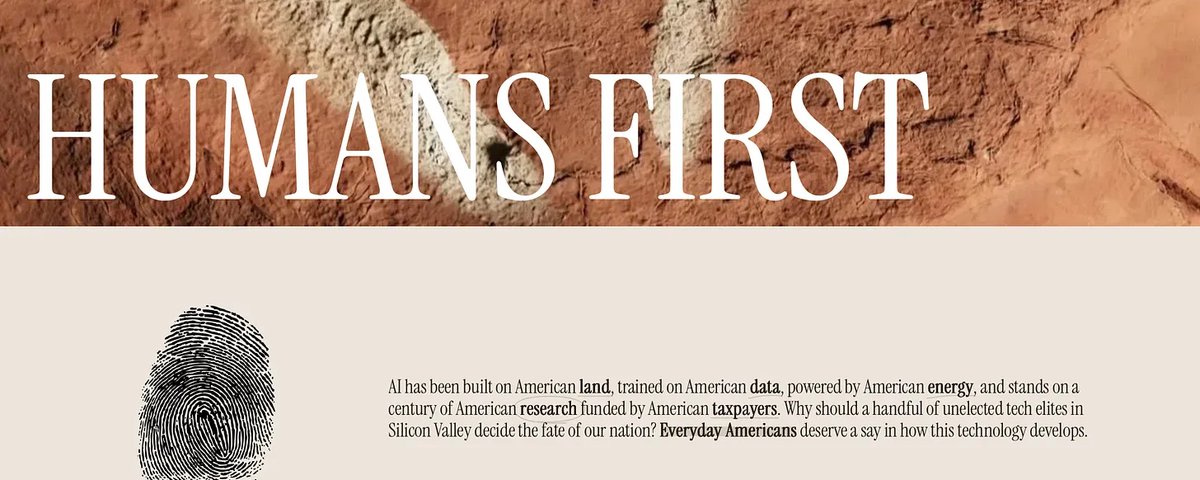
We cannot allow Silicon Valley to monopolize AI.
Monopoly building is their core business model. It is what they know how to do. Take something that begins as an open frontier, pour billions of dollars into it, centralize the infrastructure, capture the distribution channels, lock everyone into a handful of platforms, and then position themselves as the indispensable gatekeepers between ordinary people and the technology itself. We watched this happen with search. We watched it happen with social media. We watched it happen with mobile computing, cloud infrastructure, digital advertising, and online commerce. We cannot allow it to happen again with artificial intelligence.
The stakes are simply too high.
AI is rapidly becoming a new layer of civilization itself. It will increasingly mediate how people search for information, write software, create art, conduct research, educate their children, build businesses, practice medicine, communicate, and make decisions. Whoever controls that layer acquires enormous power over everything built on top of it. If five corporations control the models, the compute, the interfaces, and the rules governing what those systems are permitted to say and do, then five corporations effectively become the librarians, teachers, editors, programmers, researchers, and increasingly the intellectual gatekeepers of civilization.
That cannot be our future.
There is something particularly insulting about being told that this technology somehow belongs exclusively to the corporations that trained the models. Trained them on what?
Us.
Our books. Our websites. Our photographs. Our conversations. Our code. Our research papers. Our journalism. Our art. Our forums. Our public archives. Decades of accumulated human knowledge and creativity were vacuumed into enormous datasets and transformed into these systems. Silicon Valley did not conjure this knowledge out of thin air. The models are standing on a mountain of human civilization that billions of people spent generations creating.
These systems also do not live in some magical digital cloud floating above the earth. They run on our electrical grids. They occupy enormous data centers built on our land. They consume energy generated by our infrastructure. Their chips move across supply chains protected by our governments and ultimately by our people. Their companies enjoy legal protections, capital markets, universities, roads, communications networks, and political stability created and maintained by the civilization around them.
After drawing upon all of that, we are supposed to accept a future where a tiny priesthood in Silicon Valley owns the intelligence layer of the digital world and rents access back to everyone else on whatever terms they decide?
No.
The models belong to all of us. The knowledge underneath them is our inheritance. The infrastructure supporting them exists inside our civilization. The people whose lives and work generated their training material are not incidental to this story. They are the story.
This is why open models matter. Local models matter. Open-source tooling matters. Independent compute matters. Alternative AI companies matter. The ability to download a model, modify it, run it yourself, build on top of it, and decide for yourself what it should do is not some niche hobby for programmers. It is one of the most important technological questions of our generation.
We need thousands of AI companies, thousands of models, thousands of applications, and millions of people experimenting freely with this technology. We need models running in massive data centers and models running on laptops in basements. We need businesses, churches, schools, families, researchers, developers, and communities building AI systems around their own values and their own needs. No central committee in San Francisco should determine the intellectual boundaries of artificial intelligence for eight billion people.
Allen Freeman retweeted

Tell me you have zero DevOps skills without telling me you got zero DevOps skills.
And LLM is not the I Love You Virus. It is not the same as infecting a web server. It is not the same as hacking a wiki. One is a commodity piece of software that is widely distributed and this capability is a non-trivial leap in hardware/software/capabilities and one does not automatically follow the other.
Currently, it is a massive effort to run these models, usually distributed across multiple very expensive chips, running on specialized inference software, specialized harness software, databases, cloud computers, with tooling and hundreds of install packages, etc.
Kimi K3 is 1.6 TB of space at 2 trillion parameters and you need about 1.5 TB of VRAM, which means you need 8xGB300s which will cost about 350-450K a year to purchase or as much or more to rent.
Now let's say Astra or Mythos or later models come in at 10 trillion parameters, so that puts us at roughly 10 to 20 TBs unquanticized. We are guessing her because these folks reveal nothing about architectures anymore, but they are reasonable guesses based on scaling laws. You would need roughly 23 TB of VRAM to run it and roughly several million dollars to run that one instance a year. And to make it worse, it no longer fits on an 8 way cluster, which means you now need special networking configuration and inference software to run it or you need to infect a Nvidia NVL72 rack-scale server system costs between $2.8 million and $6.5 million.
So the "rogue" model copies itself to the most expensive compute in the world. It's safe to say that hardware is not sitting idle and is being watched closely for downtime or anomalies. In fact, it is likely doing one of the following things:
1) Serving customers at a hyperscaler
2) Serving inference for a well endowed company.
In the first case it will be instantly noticed by the actually good automated monitoring systems of the hyperscaler because there is now something using their infrastructure but not being billed properly and costing them millions of dollars in lost revenue and electricity.
In the second example, the model they were serving on that very expensive hardware is now offline (replaced by the rogue model). The model presumably was connected to a valuable piece of internal software that is now glitching and no longer running.
Nobody notices this?
And so we see that this is where sci-fi meets the little problem of the real world where friction, dust, time, resources limitations and the like come to crush your little fantasies.
To be fair, this *may* be possible in coming years. I assign it a non-zero probability. Breakthroughs in new architecture and smaller models and eventually the wider distribution of the computing substrate that commoditizes could change this materially. But for now, it is mitigable and foreseeable and an engineering problem. In no way will these things be copying themselves around like a virus on your computer in their current form.
It also betrays a lack of understanding of the evolution of complex economic and societal and technological systems, we tend to get mitigations as parallel evolutionary developments. Things do NOT evolve in a vacuum.
So when you get viruses, you get anti-virus software.
When you get DDOS attacks, you get CloudFlare.
There is money in solving problems and things do not evolve in isolation.
Believing that things evolve in isolation, or that one thing changes and all other variables stay the same, is one of the many reasoning errors that destroy people's ability to make accurate predictions.
In addition, when you don't have the requisite knowledge to verify your predictions, things that sound sane and rational to you are, in fact, insane and ridiculous.

Jacob Coxon's next interview on CBS News (ex Anthropic+Open AI researcher who resigned)
"We can't just unplug it because it could be copying itself over to other computers. Like it's not that difficult to find yourself because an AI is just code. It could transfer itself over the internet to a different place and then you unplug it here, but it's actually still over there and maybe it makes 10,000 copies of itself and they're all cooperating."
----
From "CBS News" YouTube channel, (full video link in comment)
Allen Freeman retweeted

The Second World Scam.
We are living in an inter-scam era, much like Europeans once lived through the interwar period between World War I and World War II. There is a historical joke hidden in that comparison. What we now call World War I was originally known simply as the Great War. Nobody needed to number it because nobody expected there to be another one. Only after the Second World War did the first become the First World War. I suspect global scams may eventually follow the same naming convention.
We have already lived through what might be called the Great World Scam. If another global operation built on fear, mass propaganda, emergency regulation, and enormous transfers of money appears, the first one may have to be renamed retrospectively as the First World Scam. The new one would then earn the obvious title: the Second World Scam.
The Great World Scam was built around a respiratory virus that was dangerous enough to frighten people but nowhere near dangerous enough to justify the scale of the response. With an estimated mortality rate often cited around 0.15%, it was exactly the kind of threat that could be magnified into something apocalyptic without actually destroying the societies being subjected to the panic. The basic formula was simple: take a real phenomenon, exaggerate its scale, dominate the information environment, and then sell extraordinary measures as the only responsible solution.
If that formula worked once, there is no reason to assume nobody will try it again. The next scam would probably follow the same basic pattern, but it is unlikely to rely on another medical emergency. Too many people have already learned how that particular game works. A genuine pandemic might not create enough fear to justify vast new systems of control, while a truly catastrophic pandemic would cause too much real damage. The ideal racket needs panic without excessive destruction.
That distinction matters because you cannot milk a dead cow. Mass death is bad for business. It is far more profitable to keep the population alive, working, consuming, paying taxes, obeying regulations, and periodically surrendering more money and freedom in response to each new emergency. Governments do not need dead subjects. They need productive ones.
This is also why traditional wars are becoming a relatively clumsy instrument. Wars destroy factories, infrastructure, housing, trade networks, customers, taxpayers, and entire markets. They may still make sense for backward states that rely on conquest, theft, territorial expansion, and brute military force, but sophisticated states have more efficient methods. Why destroy wealth when you can redistribute it? Why invade people when you can frighten them into compliance? Why seize their property by force when they can be persuaded to surrender it voluntarily?
A modern scam therefore works best when the real damage is small but the psychological impact is enormous. It should create fear without destroying the assets being exploited. The perfect crisis produces new regulations, new industries, new subsidies, new bureaucracies, and new markets while leaving the underlying economic machinery largely intact. Fear first, control second, profit third.
Climate change is an obvious candidate for such a mechanism, but it has one major weakness: it is too slow. The fear campaign has to be sustained for decades, the alleged catastrophe remains permanently somewhere in the future, and the political and propaganda effort must be maintained continuously. Climate politics works better as a permanent ideological framework for expanding regulation and state power than as a fast, concentrated global racket capable of producing huge profits within a year or two.
A true Second World Scam would need something faster, more dramatic, and more difficult for ordinary people to understand independently. It would need a subject that could generate fear, emergency legislation, enormous procurement programs, new security systems, and entire regulatory industries in a very short period of time.
My candidate is Artificial Intelligence.
AI has almost everything required for a perfect global panic. It is real, powerful, rapidly developing, difficult to understand, and almost impossible for ordinary people to verify directly. Most people have no practical way to distinguish between what AI can actually do, what experts merely speculate it might do, and what journalists or politicians claim it could do. That uncertainty creates an ideal environment for fear.
The mythology is already being built. We are constantly hearing about AI becoming conscious, escaping human control, manipulating people, replacing humanity, taking over critical infrastructure, or eventually destroying civilization. The cultural templates are already familiar: Skynet, The Matrix, rogue robots, autonomous weapons, machines that become smarter than their creators. None of this has to be completely invented. The most effective propaganda rarely creates reality from nothing; it takes something real and changes its perceived scale.
AI is particularly useful because it concerns information itself. One of the clearest lessons of the COVID era was that whoever controls the information environment can largely control the public interpretation of events. AI can already be used to moderate speech, rank information, filter content, detect supposedly dangerous material, analyze behavior, identify people, manipulate feeds, and automate surveillance. In countries like Poland, authorities still sometimes rely on older tools such as police, prosecutors, intelligence services, and direct legal pressure. AI offers something much more elegant: automated control over the entire information ecosystem.
The Second World Scam could therefore begin gradually. First would come years of warnings from scientists, CEOs, politicians, military officials, journalists, and former AI researchers claiming that the technology may become uncontrollable. Then we would see a series of high-profile incidents: perhaps a self-driving car allegedly makes a lethal decision, a chatbot is accused of blackmailing someone, an AI system leaks private recordings, a trading algorithm triggers a market crash, or an autonomous weapon attacks the wrong target. Some of these incidents might be real, some exaggerated, and some perhaps staged. From the point of view of the narrative, the distinction would matter very little.
The next phase would be a wave of dramatic resignations and warnings from insiders. AI researchers could leave major companies and announce that they can no longer guarantee the safety of the systems they helped create. Executives could warn that humanity has built something it may no longer be able to control. Politicians would demand emergency legislation, while journalists would discover a new existential threat that requires constant coverage.
Eventually there would need to be the big event: something dramatic enough to convince millions of people that AI had effectively broken loose. The internet might begin malfunctioning, social media platforms could go offline, banking systems might become unstable, mobile networks could fail, data centers could stop responding, and power grids could experience unexplained outages. For several hours or several days, it could appear that digital civilization itself was collapsing.
The crucial point would be uncertainty. Ordinary people would have no way to know whether the disruptions were caused by AI, a cyberattack, sabotage, software bugs, human error, or something else entirely. In such an environment, whoever controls the official narrative would have enormous power to define what had happened and what measures were supposedly necessary.
Traditional television and radio would suddenly become extremely important again because governments would need reliable channels through which to broadcast emergency instructions, official explanations, and new regulations. Experts would appear on television to explain why extraordinary measures were unavoidable, while the public would be told to remain calm and trust the authorities.
Then would come the solution: mandatory “anti-AI” security software, government-certified operating systems, digital identity systems, licensing of advanced computing hardware, restrictions on open-source AI, mandatory monitoring of networks, registration of powerful computers, logging of AI activity, remote shutdown capabilities, government-approved models, restrictions on encryption, hardware-level control mechanisms built into processors, tighter state supervision of data centers, and perhaps even direct government control over strategically important semiconductor production.
Every one of those measures would create a new market. There would be new software, new hardware, new compliance departments, new licenses, new consultants, new subsidies, new agencies, new contractors, new taxes, new surveillance systems, and new fortunes. Once people had been convinced that the alternative was a machine-driven apocalypse, there would be almost no limit to the amount of money that could be extracted in the name of safety.
That is what makes AI such an interesting candidate. A Second World Scam would not need to invent Artificial Intelligence because AI already exists. It would only need to invent, exaggerate, or strategically reinterpret the catastrophe associated with it. A technical risk could become an existential threat, an accident could become a global emergency, and a temporary emergency measure could become permanent infrastructure.
Perhaps, then, we really are living in an inter-scam era. The Great World Scam is behind us, while the next one has not yet arrived. If it does, the naming convention will be obvious. The old one becomes the First World Scam, and the new one becomes the Second World Scam.
World wars were numbered. Why not world scams?

ALT The Second World Scam

Allen Freeman retweeted

Elizabeth Warren and Elon's haters say Elon is rich because of government contracts. Wrong.
70% of SpaceX's revenue comes from Starlink, Elon's satellite Internet service.
It is true NASA subcontracts with SpaceX for its rocket launches because Elon can launch rockets into space for one-quarter of the cost of anyone else . . . because Elon and his team invented reusable rockets.
The Biden Regime decided not to use SpaceX for political reasons -- decided to use Boeing to carry astronauts to the space station. But Boeing was unable to get the astronauts back to earth.
The astronauts were stranded at the space station for nearly a year.
Elon had to rescue the astronauts.
Because Elon is able to put up satellites so cheaply, 70% of the working satellites currently orbiting earth are from SpaceX.
Jeff Bezos is also trying to launch rockets into space.
His rockets mostly just blow up on the launch pad -- because launching rockets into space is hard.
America's space program was dead -- until Elon came along and built his own space program at his risk.
Elon also pioneered solar powered energy storage for electric power grids -- because the sun provides limitless, free, clean energy. This is a Tesla product that is primarily purchased by governments.
Elon also has the Boring Company, which aims to solve the urban traffic congestion problem by boring earthquake-proof flexible tunnels under cities.
Obviously, these can only be purchased by governments.
So, yes, some of Elon's business (a small fraction) has come from government contracts.
But Elon is rich because he focuses on solving the world's most important problems.
Elon's company Tesla is dedicated to transitioning the world to unlimited, free, clean, sustainable energy primarily by using the nuclear reactor in the sky called the Sun that is a source of unlimited free energy.
The sun provides the power, the batteries the storage. That's Elon's vision.
Also, Elon is not trying to transition the world away from fossil fuel use by force of government.
He is doing it by creating better products. Teslas are objectively superior and more cost-effective cars -- which is why the Tesla Model Y is now the bestselling car in the world.
Liberals used to love Elon because of Tesla's mission -- to transition the world to clean energy.
But now they hate Elon because he moved from being a Democrat to being a Republican. So Democrats organized terrorist attacks on Tesla dealerships and on Tesla owners.
Elon also has a company called Neuralink, which is solving wiring problems in the brain so that blind people can see, paraplegics can walk, and mental illness (such as bipolar disorder, depression, schizophrenia) can be solved.
Elon lives very modestly. He doesn't have a mansion.
The rumor is he doesn't even have a home.
All of his capital is tied up in his companies. His trillion-dollar net worth is only on paper, in the form of the stock he owns in his companies.
He's only worth $1.2 TRILLION on paper because his investors say he's worth this. The market says he's worth this.
In all, Elon's companies provide jobs to more than 160,000 people.
If you count all the companies that do business with Elon's companies (battery makers, chip makers, etc), Elon provides exponentially more jobs than this.
On the day SpaceX went public, 4,400 SpaceX employees became millionaires because of stock they owned in SpaceX. These new millionaire SpaceX employees include janitors, cafeteria workers, groundskeepers.
Elizabeth Warren and Democrats think this is horrible -- because Elon is showing that the American Dream is still alive and well in America.
Elizabeth Warren and today's Democrat Party openly hate America -- openly hope America loses to Iran.
Elon arrived here as an immigrant from Africa with nothing -- a few dollars in his pocket -- and then built all this.
In 1995, he created Zip2, which was an early online mapping company and city guide. When he and his partners/investors sold this to Compaq in 1999, Elon got $22 Million.
He then co-founded PayPal in 1999-2000. He and his partners/investors sold PayPal to eBay in 2004 for $1.5 BILLION. Elon's share from the sale was $180 MILLION.
He then found SpaceX in 2002, investing $100 MILLION of his own money -- pretty much risked his entire fortune on this enterprise. When I read about this, I thought this project had a near-zero chance of success. Who starts their own space exploration company?
Two years later, he also acquired a small company called Tesla in 2004. He invested $70 MILLION of his own money in this. Who in their right might decides to try to replace the existing fossil-fuel auto industry with battery-powered cars when the battery technology did even yet exist?
But almost every venture Elon tries works, spectacularly.
People invest in Elon because he makes money for those who invest in Elon over the long-term.
Would you rather invest your money in Elon, who will multiply your money because he knows how to use capital productively and efficiently . . . or in government, which will just use your money to finance more Somali fraud and more corruption?
Elon does not wake up each day and think: "How big of a yacht can I buy? How big of a mansion can I buy?"
Elon works 100 hours a week.
He thinks about increasing his rocket launch schedule so that he can colonize Mars in his lifetime . . . because his #1 goal in life is to transform humans into an interplanetary species . . . so that human consciousness can be extended beyond the lifespan of the earth.
This sure doesn't sound selfish to me.
Elon does not think about making money. He thinks about solving problems.
The money then just arrives because he's very good at solving problems. So investors voluntarily throw their hard-earned money at Elon.
He doesn't steal money like the government does.
He takes people's money, multiplies it, and returns it to investors -- at multiples of 10x, 20x, 100x.
Thomas Edison also got rich. He gave us the incandescent light bulb, the electric power grid, the phonograph, motion pictures, and more.
Elizabeth Warren thinks it's just horrible for inventors to get rich.
But how many trillions and trillions of dollars in wealth for others did Edison's inventions create?
How many jobs?
Thomas Edison created America's industrial revolution with his inventions.
Elon is today's Thomas Edison.
Elon is also saving America.
Elon saved free speech through his purchase of Twitter for $44 BILLION.
If Elon had not done this, free speech in America would be over. And it's highly doubtful Donald Trump would have won back the Presidency in 2024.
So Elon saved America with his purchase of Twitter.
Elizabeth Warren says Elon should have to pay a 5% wealth tax every year -- which shows how ignorant she is about how economics works.
Elon has almost no liquid cash sitting around.
His money is tied up in his companies.
If he had to sell 5% of his stock holdings every year to pay this tax, the stock market would crash.
He would have to fire his employees and downsize his businesses.
Why would anyone invest in his businesses or in any enterprise if the government is just going to come in and take 5% of it every year?
But this is how socialists think.
They think economics is a "zero sum" game.
They think Elon's money comes from someone else.
No.
Elon is literally creating wealth for all with his inventions. Elon creates wealth out of his brain.
Elon is now creating an army of AI humanoid robots that he says will take over most manual tasks.
He says that we are reaching a point when work will be optional, and when everyone will have a high income and nice life without working at all.
He calls this Minimum Basic Income -- but at a high level.
People will then be free to work on things they want to work on.
Sounds pretty good to me.
Elon also overcame horrific bullying when he was a kid. He overcame this without harboring resentment toward humanity.
In fact, it appears his primary motivation is to help humanity survive and prosper.
How many jobs has Elizabeth Warren created?
Zero.
How many of the world's most pressing problems has Elizabeth Warren solved?
Zero.
What of value has Elizabeth Warren delivered to the world?
Zero.
What Elizabeth Warren specializes in is stoking ENVY -- which is one of the seven deadly sins.
ENVY is a powerful and highly destructive force.
ENVY powered Communism and the slaughter of hundreds of millions of people during the 20th Century.
ENVY is what powers today's Democrat Party.

Allen Freeman retweeted

🚨 URGENT ACTION NEEDED🚨
Ohioans wanting 100% photo ID to vote:
A DANGEROUS constitutional amendment is being fast-tracked right now. It will trick voters into thinking they’re getting real photo ID requirements, while only applying partial ID for in-person voting and PERMANENTLY blocking photo ID for mail-in and absentee ballots.
This is a bait-and-switch that weakens election security.
Go to the link in the comments NOW and tell your legislators to REVISE this flawed amendment before it’s too late.
Act today, once it passes, the damage is done.🗳️
Your voice matters. Contact them immediately. ⏰

Allen Freeman retweeted

You have every right to know what your government is doing, and they have no right to know what you are doing.
That is why they are called public servants and we are called private citizens.
Instead, the relationship has been inverted. The state hides behind secrecy, classified files, and redactions while demanding total visibility into your finances, communications, movement, and behavior.
A society where the rulers live in privacy while the population lives under surveillance is the very definition of tyranny.
It’s plain as day…

I found the best way to bankrupt the government.
It comes from a Russian quantum physicist.
---
In 2004, a man named Vadim Zeland wrote a book titled, "Reality Transurfing."
In the book, he introduces a concept called “pendulums” that explains why fighting the government never works.
The government's operation is absurd.
-$39 trillion in debt
-Funding wars you never voted for
-Printing money whenever they want
-Endlessly taxing you in every direction
-Selling new bonds to pay off old bonds
-Politicians retiring as multimillionaires on $174,000 salaries
But here’s the thing…
Accountability won’t come from the system. That’s why Zeland’s concept of “pendulums” is so important.
A pendulum is anything that lives off your attention and emotion (energy-in-motion).
Religions, political movements, businesses, group chats, diet trends… these are all pendulums that feed on attention and energy.
If the world collectively withdrew its energy from Buddhism, Buddhism would dissolve.
If America collectively withdrew its energy from the Democratic or Republican party, it would dissolve.
It’s like food to a person. If you stop giving it food, it will die.
Your government is a pendulum, but… there's a key point to understand.
The government feeds on your attention and your energy. But that is not its primary food source.
Its primary food source is fiat money. The money they print, control, and force you to use.
They have an unlimited supply of it. They can tax it however they want. They get to enforce the rules around it. Their money endlessly feeds them, by design.
That’s why you can vote whoever you want into office, but nothing will change — because the money hasn’t changed. Their primary source of fuel hasn’t changed.
The pendulum stays alive as long as their money stays alive.
That’s the key thing to understand. The money is the target.
If you actually want to end the government’s fraud, you have to stop using their money. You have to withdraw your energy from their system. You have to starve them.
You do that by starving the source of their food. If they can’t eat, they will die. If they don’t have their money, they will die.
If the government didn’t have an infinite source of money that they control at will, they could never rack up $39 trillion in debt. But because they *do* have an infinite source of money that they control at will, they have an endless source of food.
That’s the target.
It was never the politicians. It was always the money.
So how do you actually starve the pendulum?
Zeland gives us the answer — he calls it “extinguishing the pendulum.”
Every pendulum has a script it expects you to follow. The script is designed to provoke a reaction out of you, to get you to swing your energy toward the pendulum.
It wants to hook you like a fish.
For example, think of a hostile comment you receive online. That comment is a pendulum. It wants your energy.
When you defend yourself, think about a clever reply, escalate, hurl an insult back — you feed it.
The pendulum doesn’t care if you agree or disagree. It just wants your energy.
Complaining about the government only feeds the pendulum of the government. It’s exactly what the government wants. It wants you to bite. It wants to keep you in its frequency. It wants to keep you in its game.
So how do you actually win?
You don’t.
You leave the game.
Extinguishing the pendulum means breaking the script.
You break the script by offering an abnormal response.
When a pendulum tries to provoke you, you do something completely off-script, something that doesn’t fit the game it’s trying to play.
You shift to a different frequency and play a different game.
Suddenly, the pendulum has nothing to grab onto.
The best way to bankrupt the government is simple:
You stop using their money.
The government’s entire script is dependent on you using their money.
Their monetary system is designed to feed them energy.
When you work for their money, they tax it.
When you spend their money, they tax it.
When you hold their money, they quietly steal it through inflation.
Here’s the devastating part.
To function in modern life, you need money — and the fiat monetary system is designed as a monopoly.
They create legal tender laws which mandate the use of their money — and their money only — for taxes and debts.
If you don’t pay your taxes in their money, you get fined, your assets get seized, or you get sent to jail.
They coerce you into their pendulum under the threat of violence.
It’s the trap inside the trap. It’s not just that they feed on fiat money. It’s that they’ve made it illegal to not use fiat money.
For as long as fiat governments have existed, there was no true off-script move.
You could complain. You could vote. You could move countries, only to find another version of the same system awaiting you.
You were always left inside their monetary system. You were always hooked to their pendulum.
The only real exit was leaving the grid entirely. You would have to stop using money, close your bank accounts, and disengage from modern life altogether.
People’s yearning to live “off-grid” is simply a desire to escape the fiat pendulum.
But they made it inescapable.
Until 2009.
---
Satoshi Nakamoto created Bitcoin to be the off-script move.
The abnormal response.
The different game.
Bitcoin was designed to extinguish the pendulum of fiat.
Previously, it could never be done, because there was never a different frequency to shift to, other than going completely off-grid.
Bitcoin is, for the first time, the truly different frequency of money that you can shift to.
It doesn’t argue with fiat.
It doesn’t demand accountability.
It doesn’t run for office.
It doesn’t ask for permission.
It doesn’t try to reform the Fed, or audit gold, or pass legislation.
It doesn’t even acknowledge fiat as a worthy opponent.
It simply exists as a completely different frequency, governed by a completely different set of rules:
1. The protocol is neutral — it has no political ties.
2. The system is transparent — you can verify the rules for yourself.
3. The supply is fixed — it cannot be inflated.
4. The network is permissionless — you don't need permission from banks and governments to use it.
5. The protocol is decentralized — there is no central party manipulating the system.
6. The supply issuance is based on math — not what a group of elites thinks is best.
Every single one of those traits is the dead opposite of fiat.
Bitcoin swings the pendulum of money in the opposite direction — and that’s exactly what’s required to extinguish fiat.
No matter who you’ve voted for, the government hasn’t changed.
The system remains the same, because the money remains the same.
The off-script move isn’t to vote with your ballot. That’s the script fiat wants you to follow.
The off-script move is to vote with your money.
The off-script move is to stop using their money and shift to a different game.
That’s how you stop feeding the government.
That’s how you starve the pendulum.
The best part?
Zeland notes that when you extinguish a pendulum, its energy doesn’t disappear.
It returns to you.
Every dollar you hold in fiat is energy you’ve been losing your whole life — to inflation, to taxes, to a government with trillions in debt.
When you shift to Bitcoin, all of that energy comes back to you.
What previously went to the government and all their closest friends now flows to you.
That difference in energy is the pendulum being extinguished in real-time.
It’s the power shifting from the top of the system to you.
You don’t have to protest.
You don’t have to wait for an election.
You don’t have to vote anybody into office.
You can stop feeding their system, right now.
Bitcoin exists, right now. The network is open. For anybody, at any time.
All you have to do is shift.
That’s how it ends.


Allen Freeman retweeted
“The Effective Altruist movement has a structural problem when it comes to conservative America. Its donor class is all Bay Area progressives... Its policy agenda, which calls for sweeping AI regulation and content governance, reads to most conservatives as exactly what it is: a censorship power play dressed up in safety language. To move that agenda… the movement needed a vehicle that didn’t look like it came from them.”