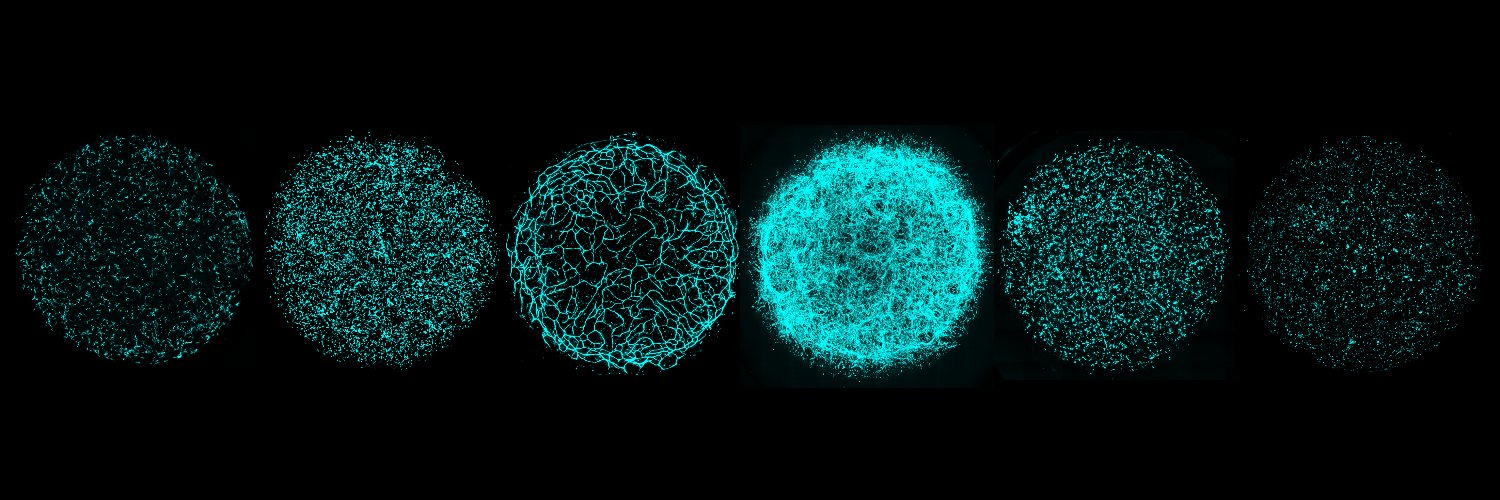

Accelerating drug discovery & delivery for neuro | Stanton Lab at MGH & Harvard Med | mini-Brain on-Chip ✨️
Boston, MA
Joined July 2009
- Tweets714
- Following452
- Followers776
- Likes14.8K


Pinned Tweet
Ever dream of a mini-brain model that is fully vascularized? Wonder if we could build a BBB + myelinated neuron + immune components all-in-one 3D brain tissue mimic? Our team took on this challenge and we are happy to share it with you now🧠biorxiv.org/content/10.1101/…

Come be our colleague in the most fantastic of environments!

The CGM @ MGB has launched a faculty search in Genomic Medicine and Neuroscience. Apply today! cgm.massgeneral.org/about/ca…
Thrilled and deeply honored to share that I have received the NIH Director’s New Innovator Award.
With this support, the Stanton Lab will launch “Therapeutic Discovery in Neurodegeneration with Bioengineered Organoids and AI-Genomics.”
hms.harvard.edu/news/harvard…

Thank you to my mentors, collaborators, and the extraordinary community at @MGBResearchNews, @harvardmed, @CGM_MGH, @MIT, @kochinstitute, @broadinstitute, & beyond who made this possible. Most of all, thank you to the scientists and engineers already building this future with me.
The Stanton Lab exists to invent technology to improve treatments. We have a lot of important science ahead.
stantonlab.info

Alice Stanton retweeted

Aptar Pharma and Massachusetts General Hospital announce research collaboration to advance predictive, data-driven models for #NoseToBrain #DrugDelivery and support future CNS pipelines. Learn more: ow.ly/baWl50ZNzAv #AptarPharma

Excited to share a new collaboration with @aptar: we’re building a predictive platform for nose-to-brain drug delivery.
The blood-brain barrier stops most CNS candidates. The nose offers a direct route, but we need better tools to optimize for its delivery of medicines. Link:


The Stanton Lab exists to invent technology to improve treatments. We have a lot of important science ahead.
#NewInnovatorAward #DP2 #NIH #HighRiskHighReward #Neurodegeneration #Organoids #AIGenomics #PrecisionMedicine
Stanton Lab | stantonlab.info
at the speed and scale that discovery now requires.
This award lets us bring those pieces together: patient-derived, bioengineered organoid models that incorporate the major brain cell types and tissue architecture, coupled to AI-genomics approaches that can map variant... 3/n
function, predict therapeutic hypotheses, and accelerate the path from mechanism to intervention.
I am grateful to the @NIH_CommonFund, @NINDSfunding, and the High-Risk, High-Reward Research program for backing early-stage investigators with unusually ambitious ideas... 4/n
Alice Stanton retweeted

1. More federal science funding should go directly to labs.
2. Science should be funded faster.
3. Scientists that convert federal funding to products (diagnostics, devices, and drugs) should be rewarded with more and faster #1 and #2.
This alone would exponentially change outcomes for our patients.
Currently, this is disproportionately delegated to philanthropic foundations.
Alice Stanton retweeted

Great stuff. We need so much more of this kind of critical introspection. This kind of work actually helps drive science onward & upward faster. Less hype, more of this kind of real science.

We are releasing a blog post to highlight some of the challenges in classifying binders from denovo design models and to propose a more rigorous evaluation protocol from what we often observe in the field (including our own past work)!
boltz.bio/experimental-proto…

Alice Stanton retweeted
Organoid researchers!! Save the date for the annual "Organoids are Us"-symposium. Held at the Beatrix Theater in the center of beautiful historic Utrecht. Venue is a 20 minute train ride from Schiphol Airport Amsterdam. Program will follow shortly.

Alice Stanton retweeted
I am really digging this kind of frank presentation of very impressive results from a startup. More of this please. Budding scientists take note. You can do impressive stuff while highlighting important caveats. It creates more trust.

Grateful to be included in the group @sciam! Thank you for the feature.

Scientific American used expert recommendations and data analysis to identify 28 exceptional early-career researchers
spklr.io/6011E3l9W

Alice Stanton retweeted

Do single-cell foundation models obey scaling laws?
A somewhat thought-provoking new Nature Methods study by the Crawford lab suggests that, for current single-cell foundation models, the answer may be “not really.” Across a broad range of architectures and downstream tasks, increasing pretraining data from hundreds of thousands to tens of millions of cells yielded surprisingly limited gains, with performance often saturating much earlier than expected.
This is interesting and provides exactly the kind of rigorous benchmarking our field needs. As Felix Fischer and I commented in the accompanying Research Briefing, such studies help move the discussion beyond model size and computational budgets toward actual scientific utility.
At the same time, I am not convinced the key conclusion is that scaling does not work in biology. Rather, it may be that current objectives are not extracting enough information from additional data.
Interestingly, in our recent scConcept work, we observe a markedly different scaling behavior, with continued gains as training data grows toward hundreds of millions of cells. The key difference may be the training objective itself: instead of reconstruction-based masked modeling, scConcept uses a contrastive objective that directly optimizes biologically meaningful cell representations.
biorxiv.org/content/10.1101/…
This raises an interesting question for the field: Have we reached the limits of data scaling, or only the limits of current objectives?
-> My guess is that the next generation of biological foundation models will depend less on simply collecting more cells and more on finding the right representation learning principles for biology.
Nature Methods paper:
nature.com/articles/s41592-0…
Research Briefing:
nature.com/articles/s41592-0…
#SingleCell #FoundationModels #AIforBiology

