

Synthetic organic chemistry group focused on the incorporation, homologation and functionalisation of organoboron compounds. Group ran account.
Bristol, England
Joined September 2018
- Tweets343
- Following191
- Followers11.2K
- Likes258





Congrats to our very own Prof. Varinder Aggarwal who has been awarded the 2026 Nagoya Gold Medal Prize. This prize was established in 1995 by Prof. Noyori and is awarded to an organic chemist who has made significant original contributions to the field in its broadest sense.
Think outside the box, but for stubborn thiazoles, think outside the ring!
Our latest @angew_chem, (in collab w/ @merckgroup) LiBAP cross-coupling, exploits an out-of-ring sulfinyl activation unlocking 1,2-migration that thiazoles resist.
onlinelibrary.wiley.com/doi/…
@BristolChem

One catalyst, two geometries.
Check out the work from the Zheng and You group showing how Ir catalysis enables stereodivergent access to chiral Z- and E-allylated isochromanones.
Original article: cell.com/chem-catalysis/full…
Our Preview: doi.org/10.1016/j.chempr.202…

Rule breaking continues!
Our latest work with the Paton Lab @bobbypaton shows how tuning electronics controls [2+2] photocycloaddition regioselectivity, enabling selective access to distinct aza-bicycles.
nature.com/articles/s41557-0…
#Photochemistry @BristolChem

Forget airbending. We’re ozone-bending. 🌬️
Our latest @J_A_C_S paper on dealkenylative borylation combined ozonolysis and Fe cat to shorten the synthesis of the a pheromone from 11 (lit.) to just 2!
Congrats team! 🎉
pubs.acs.org/jacsat/article/…
@BristolChem #Organoboron

We say goodbye to Suguru (@RGS_202803), our visiting researcher from the University of Tokyo. 🇯🇵
Wishing you all the best as you head back to Japan to finish your PhD. Thanks for being part of the Aggarwal Lab, and best of luck with the final stretch!

Prostacyclin just got an upgrade!
Excited to share our latest work with the @HersIngeborg group, now out in J. Med. Chem. (@ACSBioMed). Our chemically stable PGI₂ analogue is the most potent reported to date. Congrats team! 🎉
doi.org/10.1021/acs.jmedchem…
@BristolChem

Finally, electrophilic amine joins the migration club. 🎉
Check out our latest @NatureChemistry paper on amination-induced 1,2-boronate migration, enabling direct access to unprotected β-amino boronic esters. Congrats team!
nature.com/articles/s41557-0…
#organoboron

Radically sweet indeed! 🍬 Chuffed to see Our collaboration with the @BaranLabReads reaching @Nature. Congratulations to everyone who made this possible! 🎉
@BristolUni @BristolChem

Appearing today as an Accelerated Article Preview publication in @Nature :nature.com/articles/s41586-0…
AggarwalLab retweeted

Appearing today as an Accelerated Article Preview publication in @Nature :nature.com/articles/s41586-0…
Making C-glycosides SWEET and simple! Today in @ChemRxiv we disclose (chemrxiv.org/doi/full/10.264…), in collaboration with @GroupAggarwal, an incredibly easy way to achieve radical functionalization of sugars. In this video (youtu.be/Fqdbgmx7zEI), a two-step synthesis of the billion dollar drug Dapagliflozin is achieved using household vinegar and dextrose powder from the local supplement store.
High Level Summary:
The work addresses a longstanding challenge in carbohydrate chemistry: the efficient, scalable, and stereocontrolled synthesis of C-aryl glycosides directly from unprotected native sugars. C-Aryl glycosides form the core pharmacophore of the SGLT2 inhibitors (dapagliflozin, canagliflozin, empagliflozin, and related agents), which are frontline therapies for type 2 diabetes and represent one of the highest-grossing classes of small-molecule drugs.
Conventional synthetic routes to these molecules generally require extensive protecting-group manipulations, multi-step activation of glycosyl donors, or organometallic additions under demanding conditions. Recent advances in radical and transition-metal-catalyzed cross-couplings have improved access, yet most approaches still depend on protected precursors, specialized reagents, or protocols that are difficult to scale.
We report a practical alternative based on glycosyl sulfonyl hydrazides—stable, crystalline radical precursors that are prepared in a single step from unprotected sugars by treatment with tosylhydrazine in acetic acid, followed by simple crystallization. These hydrazides undergo redox-neutral nickel-catalyzed radical cross-coupling with aryl iodides or bromides under mild conditions (70 °C, DMSO, tetramethylguanidine as base). The reaction requires no external oxidant or reductant, no photocatalyst, and no organotin species. In glucose-derived systems the coupling typically delivers high β-selectivity (>19:1 in many cases), an outcome that appears to depend on hydrogen-bonding interactions between tetramethylguanidine and the free hydroxyl groups.
The main findings are as follows:
All five FDA-approved SGLT2 inhibitors, as well as several clinical candidates, can be prepared in a single coupling step from the corresponding glycohydrazide.
Decagram-scale synthesis of dapagliflozin was demonstrated starting from commercial dextrose; the product was isolated by aqueous workup and recrystallization (no column chromatography required at this scale).
Di- and trisaccharides (lactose, cellobiose, maltose, maltotriose) couple directly to give aryl-linked oligosaccharides.
Several natural products and medicinally relevant structures (salmochelin-SX, neopetrosin C, the tryptophan-mannose conjugate, and a ribose-derived IMPDH inhibitor) that previously required 9–20 steps or costly reagents are now accessible in 1–4 steps with good stereocontrol.
The platform extends to non-anomeric C–C bond formation at positions C2–C6 on glucose and ribose scaffolds, providing the first systematic exploration of radical diversification across these positions.
Stereoretentive radical cross-coupling, using configurationally pure hydrazides, enables programmable delivery of either α- or β-anomers, overriding inherent substrate biases and providing access to stereoisomers not previously obtainable by radical methods.
The chemistry builds on our earlier development of sulfonyl hydrazide-based redox-neutral cross-coupling and stereoretentive radical arylation, here adapted and optimized for carbohydrate substrates. The method is operationally straightforward, uses inexpensive reagents and starting materials, and eliminates protecting-group strategies.

Check out SYNFACTS’ (@thiemechemistry) Highlights in Chemical Synthesis featuring Hanwen and Roucheng’s JACS paper on Ni/PRC-enabled C(sp³)–C(sp³) deboronative and decarboxylative coupling:
thieme-connect.com/products/…
pubs.acs.org/doi/10.1021/jac…
We would also like to say goodbye to Denisa, who is returning to the Czech Republic to finish her PhD. We hope you enjoyed your research visit in our group. All the best, Denisa! 🎉

Today, we are *simultaneously* (pun intended; cf. JACS 2024, 146, 13719–13726) sad and delighted as Dr. Shen wraps up his time in our group. Sad to lose a postdoc powerhouse, but thrilled to see him kick off his independent career back in China. All the best, Hong Cheng! 🎉

Avengers! Assemble... alkyl phosphonates.
Check out our new @angew_chem paper for the direct C(sp3)–H phosphonylation of unactivated alkanes ⚗️ Using an iron photocatalyst.
Congrats Team!
onlinelibrary.wiley.com/doi/…
@BristolChem #photocatalysis
Our latest work with @duarte_group shows the unexpected exo-C2 lithiation of ABP and ABH, allowing access to ring-opening products with full stereocontrol.
Congrats Team!
#OrganicChemistry #StrainRelease @BristolChem
pubs.acs.org/doi/10.1021/jac…

🎉 Chuffed to see our JACS paper is among the most read articles this month!
See how a boron-mediated Ni/photoredox strategy for hydroalkylation of olefins enabled the access to quaternary carbons.
pubs.acs.org/doi/10.1021/jac…
Congrats Team!
#Photoredox #Organoborons @BristolChem

Mixed emotions… 😊 Proud that Dr. Liang Wei is starting his independent career at Huazhong University of Science and Technology 🇨🇳✨, but sad to say goodbye to one of the kindest and brightest postdocs in the Aggarwal Lab.
All the best, Liang! 🚀

Au revoir, auf Wiedersehen, arrivederci! 👋
Time flies✈️,our three visiting researchers are now back to their home universities to continue their research journeys.
All the best to @GrossAdrien5 (🇫🇷 → Uni Freiburg 🇩🇪), Fin (Uni Hannover 🇩🇪), and Federica (Uni Pavia 🇮🇹)!

Breaking the rule-of-five in [2+2] cycloadditions!⚡
Check out our @NatureSynthesis article where a radical stabilization strategy enabled Photo EnT route to elusive 3D-isosteres of 6 membered N-heterocycles.
nature.com/articles/s44160-0…
#Photocatalysis #bioisosteres @BristolChem

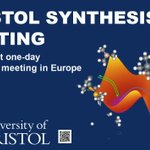
The Bristol Synthesis Meeting is back!
📅 31 March 2026
Enjoy engaging and insightful chemistry talks from our esteemed guest speakers this spring.
The deadline for registration is 20th March 2026.
@LeonoriLab @BalskusLab @dixon_group @Huckgroup @BristolChem @DonnaBlackmond
