







$IBRX Picture a man named Frank being told the cancer in his bladder has come back.
Most likely a man, because bladder cancer strikes men about four times as often as women.
Frank already did the standard treatment. It held for a while. Now it is back, and it is the high-grade, aggressive kind.
There are drugs for this moment. The cruel part of Frank's case is that none of them were approved for his exact kind of tumor. So the one real thing his doctor could offer him was surgery: take the bladder out. The whole organ. Surgeons call it a radical cystectomy. For Frank it means living the rest of his life with a bag on the outside, or a new bladder built from a piece of his own intestine.
Yesterday, October 14, 2026, that stopped being the only road.
If you have been following along, you know the project we are nearly through: a four-part series putting real numbers on what this company could become ten and twenty years out, one cancer and one country at a time.
Today we step off that for a minute.
Because yesterday was not a projection. It was one real step on that long road, actually taken. And a step that lands on men like Frank is worth stopping to look at on its own.
WHAT ACTUALLY CHANGED YESTERDAY
The US Food and Drug Administration widened the approval of a medicine called ANKTIVA, given together with BCG, to cover this exact group for the first time.
A few plain terms first, because they run through everything below.
The kind Frank has, and the kind yesterday's approval is about, is called non-muscle-invasive bladder cancer, or NMIBC for short. The tumor sits in the lining of the bladder and has not grown into the muscle wall yet. Caught at this stage, the bladder can often be saved.
BCG is the old standard. A weakened bacterium placed into the bladder that wakes the immune system up against the tumor. It has been the front-line treatment for about fifty years. When the cancer comes back anyway, the patient is called BCG-unresponsive.
Bladder tumors come in two shapes. The flat kind is called CIS, short for carcinoma in situ. The raised kind is called papillary. Those two names, CIS and papillary, are the whole story from here.
Until yesterday, ANKTIVA was approved for patients whose cancer included CIS. People with only papillary tumors, and no CIS, were left out.
That is Frank. His tumors are papillary, with no CIS, and for that exact group there was no approved drug at all. It is the reason the only thing his doctor could offer was surgery.
Now that group is in. It is the first treatment ever approved for them.
THIS IS NOT JUST A BLADDER DRUG
It is easy to file this under bladder cancer and move on. That undersells it badly.
ANKTIVA is an IL-15 superagonist. In plain terms, it rebuilds the body's own front-line cancer killers, the natural killer cells and the memory T cells. Bladder is simply where it crossed the finish line first.
The same engine is why the company is not running one trial, it is running a whole plan. Back in February, in a detailed press release, ImmunityBio put it on the record: a three-year program it calls Cancer BioShield, more than thirty trials across about ten tumor types. The same medicine, aimed at cancer after cancer, lung and pancreatic and liver among them, and at the immune collapse itself, the lymphopenia that cancer treatment causes, and at sepsis. It is already approved for lung cancer in the Gulf.
That plan is exactly what our four-part series has been sizing. This post steps off it to look at the one door that just opened. But the key that opened it is the same key built for all the others.
THE NUMBER THAT MATTERS IF IT IS YOUR BLADDER
In the trial behind this approval, about 82 percent of these patients still had their bladder three years later.
Three years on, more than four out of five had not needed the operation that removes the organ.
That is what "keep your bladder" looks like as a number, not a slogan.
THE MISTAKE THE EXCITEMENT IS ABOUT TO MAKE
Here is where the story is about to get misread. Let me correct it, because the real number does not need the exaggeration.
You will hear that papillary disease is the large majority of this cancer, so the opportunity just multiplied several times over. That is wrong.
The old approval already covered anyone whose cancer included CIS, even if they had papillary tumors next to it. So most people with both were already eligible.
The genuinely new group is the patients with papillary tumors and no CIS at all.
On grounded US numbers, the group already covered runs on the order of 2,000 new patients a year, and the newly added papillary-only group is about the same size. So adding it roughly doubles the population this medicine is approved to treat in bladder cancer.
About two times, not five. A doubling is already a large event. It does not need to be inflated to be worth your attention.
SO WE SAT DOWN AND DID THE MATH
Since the approval, the numbers have been flying. Some say it triples the market. Others say five times. Most just say huge. So here is the actual chain, built from the primary sources, one step at a time.
Start with every new US bladder cancer, about 84,500 a year.
- Roughly three in four are non-muscle-invasive, still in the lining: about 63,000
- Only the high-grade ones, and only after BCG stops working, are in play. That narrows hard, to low thousands a year
- That BCG-resistant group is what splits in two: the CIS kind, approved in 2024, and the papillary-only kind, approved yesterday
The single number that decides doubles-or-triples is that split. So we read it straight off five published trials of this exact group, and in every one the CIS share lands nearer half than a third:
- Keytruda's trial: 43 percent CIS
- ANKTIVA's own: 53 percent
- The SWOG study: 57 percent
- Cretostimogene: 67 percent
- Adstiladrin: 68 percent
Five independent reads, all clustering around half. So the papillary-only group is a comparable slice, not a bigger one. A doubling, not a multiple.
The reason it lands there is worth a sentence: papillary is the more common shape when the cancer is first found, but CIS shrugs off BCG more often, so by the treatment-resistant stage this drug is for, the two are about even.
Now the honesty, because it is the whole point of doing the math in the open. Those five trials are a strong proxy, not a population census, so treat the doubling as our best-supported read, not a settled fact. The exact split is the one input still worth arguing about. And note which way we rounded: we used the low end of every range, so the company's own filings put all of these counts two to three times higher. If the number is wrong, it is wrong on the low side.
WHAT THE NEW GROUP IS ACTUALLY WORTH
First, do not do the lazy thing. ANKTIVA lists at about 300,000 dollars for a course, so the temptation is to multiply: 2,000 patients times 300,000 is about 600 million dollars a year. Throw that out. Nobody pays the full sticker, and no drug reaches every patient, so that number is always make-believe.
The clean way needs almost no assumption, because the company already sells this exact drug for this exact disease. The first group alone, the one the old label covered, already brings in about 200 million dollars a year. And it got there fast: from approval in April 2024 to that run-rate in about two years.
The new group is about the same size, and it does not start from scratch. Same sales team, same reimbursement, same doctors who already know the drug. So there is no reason it earns much less than the first group.
Put simply: a second group about the size of the first roughly doubles the bladder business over time, toward 400 million dollars a year. A direction, not a forecast.
And here is the part worth sitting up for. That 200 million is not a finish line. It is a snapshot of something still moving: the first group alone grew from about 113 million dollars last year to a 200-million run-rate now, and it has not stopped.
So the new group does not add a second 200 million on top of a number standing still. It adds a second engine to one that is still climbing.
Here is the easy way to picture it. If both groups had been approved on the same day, the company would not be sitting at 200 million in bladder today. It would be near 400, and still rising. The approval just split that into two steps, two years apart.
SO WHEN DOES THE MONEY ACTUALLY SHOW UP?
This is the question every holder is really asking. It is approved now, in a market the company already serves, for a group the same size as the one it already sells to. So does next quarter just double?
No, and it is worth being honest about why.
- Doctors have to learn the label changed and start using it for the new group. That takes a few quarters, not a few days
- The money per patient builds over the treatment, the induction first, then maintenance across months, so even once someone starts, the revenue comes in pieces, not one lump
- Coverage and billing for the new group have to settle in with the payers
So do not expect the fourth-quarter print, or the first one of 2027, to suddenly be twice the size.
But do not expect a crawl either, and here is the key point. The first group needed about two years partly because it was building everything at once, the sales force, the reimbursement, the physician awareness, all while finding its first patients. The new group inherits every bit of that, finished. It only has to reach patients who are already in the system, some of them waiting.
So it should ramp faster than the first group did, not slower, closer to a year to its own run-rate than two, though nothing here is instant.
And there is no separate line to watch for it. The company reports one bladder number, not a split by group. So the honest tell is just the trend: bladder revenue climbing quarter after quarter as the new patients come on. Give it several prints, not one. A single quarter proves nothing; a steady climb across a few is the new door filling in.
THE REST OF THE WORLD TENDS TO FOLLOW
Here is the optimistic case, and it is not a stretch. ANKTIVA is already cleared in more than thirty countries, each of them following the lead of the original US approval. And the UAE has already matched this exact papillary step, the first country to do it. So the expansion spreading is not a wild hope. It is the base case, along a path these regulators have walked before. Not signed everywhere yet, but the precedent is doing the heavy lifting.
Now the size of it, with one honest guardrail: you cannot just multiply the US by the world and keep US prices, because approval, price, and access all differ country by country. But the patient count scales cleanly, because the disease does not care about borders.
Break it down:
- The world sees about 614,000 new bladder cancers a year, against roughly 84,500 in the US. That is about seven times as many
- Scale the papillary-only group the same way: 2,000 US patients times seven is about 14,000 across the entire world. Independent review agreed with the arithmetic
- Take the US back out, and the rest of the world, every country except America, is about 12,000 a year. Six times the US, which is exactly right: seven times for the whole world, minus the one times that is the US itself.
So think of it in engines, where one engine is a group this size running at US scale, about 200 million dollars a year. The US has two of them now, CIS and papillary, heading toward 400 million together. The rest of the world's papillary group, around 12,000 patients, is six times the 2,000 the US just approved, so six engines' worth of patients. At the lower prices paid outside America, that works out to four to five more engines of revenue.
Picture them all running at once, the way we pictured the two US engines. Two engines in the US, plus four to five across the world, would put the whole thing north of a billion dollars a year, somewhere in the 1.2 to 1.4 billion range, if they were all running together right now, as we speak. And like the US number, that is not a ceiling but a floor still climbing.
They will not all switch on at once. Prices and reach outside America run lower, and each country is its own approval. So bank less than that, and treat it as the size of the room, not a forecast. But that is the room, and the door to it has already been opened once, in the UAE.
THE BIGGER DOOR STANDING RIGHT BEHIND THIS ONE
Here is the part the headline misses. The door that opened yesterday is not the only one, and it is not even the biggest.
Everything so far is the salvage setting: patients whose cancer already came back after BCG. The first door, approved in 2024, was the CIS version of that group. Yesterday's door is the papillary-only version. Together they are the people medicine had already failed once.
There is a larger door behind them: treating this cancer first-line, with ANKTIVA added to BCG from the start, before the cancer ever becomes unresponsive. That is the whole high-grade group, before anyone fails BCG, so it is far bigger. Take the same 63,000 new cases a year and keep the high-grade ones who get BCG, roughly one in five on the conservative end, and you are at about 12,000. That is several times the size of the door that just opened, and the company's own filings put it higher still.
And that door is the company's next planned filing, expected around the end of this year.
Then scale it the way we just scaled the current one. The first-line door is already six engines in the US. Across the world, in patient terms, it balloons to dozens, the single biggest pool in this whole disease. What that turns into in dollars depends on approvals and prices that do not exist yet, so hold it as the ceiling, not a number to bank. But that is the ceiling.
So yesterday was real, and it matters. It was also a smaller, nearer step before a bigger one.
SO WHAT EXACTLY WILL HE SAY ON FRIDAY?
Here is where it gets interesting, and honest: we do not know. But over the past week, the founder, Patrick Soon-Shiong, has flagged this same fireside chat in two separate posts, about two different things.
1. Bladder. The day the approval landed, he posted that he is looking forward to discussing the status of treating non-muscle invasive bladder cancer this Friday, October 16. Read that carefully: he did not say he would discuss the approval. He said the status of treating the whole disease. So is Friday a victory lap on the door that just opened, or does he also open the next one and show fresh data from the first-line program heading toward filing?
2. Every other cancer. A week ago, when we posted the piece sizing the whole three-year plan, he quote-tweeted it and said he would give a status update on those trials at this same fireside chat. Not just bladder. The lung, the pancreatic, the liver, the rest of the Cancer BioShield board.
And the timing is not random, because two clocks are near zero right now. The third quarter closed on September 30, and in a couple of recent quarters he has pre-announced preliminary sales within two weeks of the close, which would be right about now. And the first-line trial finished enrolling its main group back in February, with a filing guided for the end of this year, so the data behind it is due to mature right about now.
So put it together. Friday is not just a bladder update. It is a status report on the whole plan, from the one door that just opened to the rest of the board behind it. Either clock could strike, or neither, and it is just a victory lap. We are not going to pretend to know which. But he did not pick a random week for this, and he did not pick the narrow words for it. That is worth watching, whichever way it breaks.
NOW COUNT IT IN PEOPLE, NOT DOLLARS
Step back from the money, because it was never really about the money.
Those roughly two thousand Americans a year are not a market. Each one is a person who was about to lose an organ and now has a real shot at keeping it instead.
So picture one. A father at the dinner table for his kid's birthday this year, not in a recovery ward. Someone who keeps their body whole, skips the bag, and keeps the cancer from spreading past the bladder. Two thousand of them, every year, in this country alone.
AND THAT IS JUST ONE COUNTRY
If this approval travels the way the earlier ones have, the same group outside the US is on the order of twelve thousand people a year.
Twelve thousand more families, every year, where someone keeps their bladder instead of losing it. It is not approved out there yet, so hold it as a maybe. But that is the real shape of the prize: a surgery avoided and a life left whole, one person at a time, until it is a stadium full of them a year.
IT IS NOT ONLY THE PATIENTS
Here is the part that rarely gets said out loud. This is not only about the people who take the drug.
It is also about the people who funded it. The shareholders who put their own money behind this company and held through the dark stretches, the quarters of going-concern warnings and a beaten-down price that punished belief. They are a reason the lights stayed on long enough for a day like this to arrive.
If the science keeps delivering, they get something too: a real chance to change their own families' futures. No price target, no promise it pays off, and plenty of ways it can still go wrong. But this is the kind of day they have been holding for.
None of this is advice, and I am not promising anyone a return. The patient counts are sourced estimates on the conservative end. The price is a number I chose and labeled. The share is a dial, and it is in your hand.
WIN, WIN, WIN
Yesterday the list of people who get to keep their bladder got longer. The medicine is ANKTIVA. The date was October 14, 2026. And men like Frank, out of options the day before, woke up with one.
So count the winners:
- The founder @DrPatrick and his team, chasing a goal most people called impossible, building the legacy he means to leave
- The patients, like Frank, who keep their bodies and their time: who make it to the grandkid's ball game, who walk their daughter down the aisle, who get the anniversaries and the ordinary Tuesdays that the surgery would have taken
- The believers who funded the whole thing, who held through the dark years when plenty called them fools, who finally see a piece of why they held, and, if the science keeps delivering, the chance to do for their own families what Frank now gets to do for his.
A true win, win, win.

RECEIPTS. Every load-bearing claim in the post above, with where to check it. No opinions here, just the paper trail.
THE APPROVAL
- FDA, October 14, 2026: the agency approved ANKTIVA plus BCG and revised the label "to include patients with high-grade papillary-only tumors." Search FDA.gov drug approvals for nogapendekin alfa inbakicept-pmln
- The April 2024 approval covered BCG-unresponsive NMIBC with CIS, with or without papillary tumors, which is why papillary-only was the gap. FDA label and ImmunityBio's April 22, 2024 approval release
- Approved by extrapolation from the CIS data: complete response 62% (95% CI 51 to 73), a single-arm trial of 77 patients. FDA, same October 14 notice
THE "KEEP YOUR BLADDER" NUMBER
- About 82 percent of the papillary-only group were cystectomy-free at 36 months (92.2 percent at 12 months). ImmunityBio data release, January 2026, QUILT-3.032 Cohort B, 80 patients
THE PATIENT MATH
- US new bladder cancers about 84,530 a year: American Cancer Society and SEER, 2026. World about 614,298 a year: GLOBOCAN 2022 (IARC). NMIBC is about 75 percent of bladder cancer: Grabe-Heyne and colleagues, Frontiers in Oncology, 2023
- The CIS versus papillary split, read off five published BCG-unresponsive trials: KEYNOTE-057 (pembrolizumab) 43 percent CIS, QUILT-3.032 (ANKTIVA) 53 percent, SWOG S1605 (atezolizumab) 57 percent, BOND-003 (cretostimogene) 67 percent, Adstiladrin (nadofaragene) 68 percent. Primary trial publications in Lancet Oncology, NEJM Evidence, and European Urology
- The company's own SEC prospectus from December 2024 implies larger counts, roughly 6,000 CIS and 38,000 high-grade US patients a year. That is why we call our figures the conservative end
THE MONEY
- Product revenue: 50.7 million dollars in the second quarter of 2026, up 92 percent year over year, and 113 million for full-year 2025. ImmunityBio SEC filings (10-Q and 10-K). From the April 2024 approval to a roughly 200-million-dollar run-rate took about two years
- List-price anchor: a wholesale cost of about 35,800 dollars per vial. ImmunityBio state price-transparency disclosures (Colorado and Connecticut), as of January 2025
THE PLAN AND THE PIPELINE
- The three-year Cancer BioShield plan, "over 30 active and planned clinical trials across 10 tumor types." ImmunityBio release, February 2026
- Lung approvals in the Gulf: Saudi Arabia in January 2026 and the UAE in July 2026, for metastatic lung cancer after checkpoint therapy. The sepsis trial is registered on ClinicalTrials.gov as NCT07578558. ANKTIVA is authorized in 34 countries, per ImmunityBio filings
FRIDAY
- Patrick Soon-Shiong, October 14, 2026, on X: "Looking forward to discussing our status of treating non-muscle invasive bladder cancer on Friday."
- Patrick Soon-Shiong, October 9, 2026, on X, quote-tweeting our whole-plan post: "Will discuss status of these trials at my fireside chat next week."
- In two of the last three quarters, the company pre-announced preliminary revenue within about two weeks of quarter-end. SEC 8-K exhibits, January and April 2026.
That is the trail. Check any of it.
$IBRX Most people never say their biggest goal out loud. It sounds too big. It feels like asking to be laughed at.
@DrPatrick said his without flinching. To rebuild the human immune system. So fewer people die of cancer and infection.
He did not set out to sell one drug for one cancer. He set out to change what the human body can do against the thing that kills it.
WHY HE KEEPS FIGHTING
Here is what some people cannot understand about him.
He has already won financially. Nothing left to prove, nothing left he needs for himself. He could have stopped long ago and no one would have questioned it.
But he still works like everything depends on it anyway.
Why?
Because when you already have everything else, one scoreboard is left that still means something: how many people are alive because you refused to quit.
That is impact. It is the one thing you cannot be handed.
You can only build it.
WHAT THE GREATS TAUGHT ME AND MANY OTHERS
I have spent most of my life learning from a handful of teachers. Bob Proctor. Zig Ziglar. Jim Rohn. Carol Dweck. Brian Tracy, and other great minds.
Some were teaching long before my time. I never cared when an idea was born, only whether it was true. The right ones never stop being true, and the people building the future keep proving it.
Different people, one shared idea: the size of the goal you chase decides the size of the life you live.
- Bob Proctor taught that the goals worth chasing are the ones that scare you and excite you at the same time
- Zig Ziglar taught that you can have everything in life you want if you help enough other people get what they want
- Jim Rohn taught that you do not chase a giant goal to reach it. You chase it for who you become on the way
- Brian Tracy taught that the real failure is not a goal too big. It is never setting a clear one
- Carol Dweck said it's OK to fail and to keep learning from your mistakes
The goal builds the person.
THE TERROR BARRIER
Bob Proctor had a name for the moment you move toward a goal big enough to matter.
The terror barrier.
It is the wall of fear you hit the instant you reach past what is safe. Fear of failing in front of everyone.
Fear of what they will say.
Most people touch that wall once and retreat to the comfort of the known. They spend the rest of their lives there.
A few walk straight through it.
And there is an old, true way of naming what that fear really is. F-E-A-R. False Evidence Appearing Real.
Patrick Soon-Shiong lives on the far side of that barrier.
THE KNOWING-DOING GAP
Between knowing what to do and actually doing it sits a gap.
Everyone knows. Almost no one does.
Patrick Soon-Shiong does.
The critics only know. It is easier to judge a thing from the safe side of the gap than to risk building one of your own. Carol Dweck called that the fixed mindset.
Creators create. That is the only answer they ever need.
THE ORDER THAT MATTERS
For Patrick Soon-Shiong, none of this was ever about the money. He already has it.
But most of us are not billionaires. We believe in the goal, and we also want to build something for the people we love. That is not a contradiction.
It is the whole design.
Here is the order that matters. The goal comes first. The reward comes second. Never the other way around.
Solve something the whole world needs, and the value takes care of itself. The people who saw it early, who put their conviction behind a goal this size before it was obvious, do not stand outside the story. They help build it, and they share in what gets built.
I am not going to promise anyone a number. Nobody can. But big goals have a way of paying the people who believed in them.
Big goals. Big returns. In that order.
So no. This was never about one man getting richer.
He does it to wake up with something so big it is worth the whole day. Worth the whole life. To put years back into people, and people back into the world they build. And to carry everyone who believed along with him.
That is why he builds. That is why I write about it. Maybe it is why you are still reading.
The only way across the barrier, every single day, is the same:
Action Cures Fear.
P.S
A speaker said something a few years ago I have not stopped thinking about.
Every morning he asks his team one question.
How many new haters did we pick up yesterday?
If only a few, he tells them they are not working hard enough. He wants thousands. Because no big goal goes unnoticed by the haters.
I think about that whenever the noise gets loud around a goal this big. It does not rattle the people doing the work.
They are too busy making this world a better place breaking through the terror barrier day in day out.

$IBRX $28 billion a year. That was one drug, in one country, doing a single job: rebuilding the immune system that cancer treatment and sepsis burn to the ground. And that was the small version. Today, the whole thing.
That drug is ANKTIVA, made by ImmunityBio, and the $28 billion was America alone, built a few weeks ago out in the open, one line of arithmetic at a time. This is post three of four, the series where we put real numbers on what this company could become, from the smallest market on earth to the wildest scenario anyone has floated. And this is the big one.
Last February the company put a three-year plan on the record and almost everyone forgot it: more than thirty trials, nine different cancers, gone after one at a time, worldwide.
$28 billion was one country and just two of its doors. Today we count the whole board: every cancer in the plan, across the entire planet, in a single pass. Watch what that does.
WHERE WE ARE IN THE SERIES
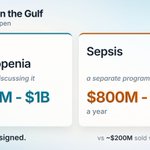
Keep the map in front of you, because the whole point of four posts is that each one is bigger than the last. Post one sized the Gulf, the smallest market, and the two immune doors - both of them the same immune collapse, called lymphopenia, one door in cancer patients whose chemo and radiation cause it, the other in sepsis - came back worth a few hundred million to a couple of billion. Post two sized America, the biggest drug market on earth, and those same two doors came back near twenty-eight billion.
This third post, the one you are reading now, is the zoom all the way out: every door in the three-year plan, counted for the whole world in a single pass. And the fourth, still to come, is the finale, and it goes all the way: forget revenue entirely - could a drug that rebuilds the immune system turn its maker into the Nvidia of biotech?
That one is for next time. For now, back to this post. We stick to the company's three-year plan and count all of it for the whole world at once: the nine cancers, the two immune doors we already sized - lymphopenia and sepsis - and whatever else the plan holds.
THE GROUND RULES
Before a single number, the same deal as last time, because it is the only reason any of this is worth reading. This is still the careful, fact-checked version. The real price a drug is paid after discounts, not the big headline number. A modest slice of patients, not all of them. The survival benefit still treated as a signal, not a settled fact.
And the ground truth under every number below: in America, only one of these nine cancer doors is approved today, bladder, and even there just one narrow form of it, so eight of the nine have no US approval at all. The Gulf has pushed further than the FDA - the UAE and Saudi Arabia have also approved lung, and the UAE a second form of bladder - but that is the whole of it, and nothing anywhere on earth is approved for the two immune doors, lymphopenia or sepsis.
On the things we can hold down, we hold them all the way down, exactly as we did in America. The two dials we release are named, and only two: the single country becomes the world, and the two doors become the whole plan. Both of those are just arithmetic we already did in miniature.
What stays a bet, out in daylight so you can turn it down yourself, is the same pair from last time, plus one this post is built on:
- A survival drug spreads fast
- It keeps its price
- And the new one: the trials behind the eight unapproved doors actually win
We are not inflating anything. We are widening the lens on the exact same careful math, so that when the number gets large, you know exactly how it got there. If it feels like it should be bigger, hold that thought. You are right, and the last post, the one coming next, is where the ceiling lives.
THE BOARD HE SHOWED YOU IN FEBRUARY
Remember where this plan came from, because it is not ours and it is not new. Back in February, in a detailed press release, ImmunityBio laid the whole thing out: more than thirty active and planned trials across what it calls ten tumor types, gone after one at a time.
We size the nine cancers the release names: bladder, lung, glioblastoma, pancreatic, liver, colorectal, triple-negative breast, non-Hodgkin lymphoma and ovarian. Sepsis the company runs as a separate program, so we count it as its own door. And running underneath all of them is the immune collapse this drug is built to reverse, which is lymphopenia.
So the board has three kinds of square on it: nine cancers hit head-on, the immune-repair layer under every one of them, and sepsis off to the side. The last post sized one of those squares in one country. This post counts the whole board, for the whole world.
THE ENGINE: HOW KEYTRUDA REALLY GOT BIG
Here is the piece the last post was missing, and it is the straight answer to a question we raised ourselves. Last time we showed one immune door climb fast to about fifteen billion dollars and then stop, and we told you plainly why it stops: one door has no engine behind it.
Keytruda, the best-selling drug in the world, did not reach thirty billion by selling harder into one cancer. It got there by stacking roughly forty approved uses across about twenty cancers, one door opening after another, each new one lifting the pile while the old ones matured. That stacking is the engine. And this post is the engine, because the nine cancers are exactly that pile of doors, each one its own market, each one opening on its own clock.
IS A WORLD NUMBER EVEN REAL?
So the tempting move, the moment you go global, is to multiply the whole thing at once and print something enormous. The nine doors hold about two million patients a year.
But no drug ever reaches every patient who could use it - a doctor has to choose it, an insurer has to pay for it, and it takes years to spread - so only a fraction of them ever actually get it. Call that fraction the share. Say the share is one in five, the kind of level a well-established drug can reach, and it is two million patients, times America's full list price of 322,000 dollars, times one in five, which comes to about 130 billion dollars a year.
A number that big is not a real market, it is make-believe. No set of health systems on earth writes a check like that for one drug, and nobody outside America pays the full American price. So we throw it out, the same way we threw out the 39 billion in the last post, and for the same two reasons: the price is wrong, and the reach is wrong. Fix both and the number that is left is one you can actually defend. Here is how we build it.
COUNT THE DOORS
Count them the way we count everything, one simple sum per door: how many patients a year that cancer puts on the table across the whole world, times a tenth of them actually reached, times a real price of about 120,000 dollars, the blended net actually paid across the wealthy world after discounts: lower than what a survival drug like Keytruda is estimated to collect in America, higher than what Europe and the Gulf pay.
One note before the list, because it governs every line of it: the patient counts are the whole world's, but that 120,000-dollar price only holds in the wealthy countries where the drug is approved, so read the tenth we reach as mostly those places, America, Europe and the Gulf. The poorer world is real numbers of patients at a far lower price, and we add it in by name further down rather than pretend one price fits the planet.
And the patient pool in each line is itself a sum: the whole world's cases of that cancer, times the slice of them in the late, advanced stage the trial is actually aimed at. So here is every door with the full math, the world's cases times that slice to get the patients, then those patients times a tenth reached times the 120,000-dollar price:
1. Lung, after the checkpoint drugs stop working: 2,480,000 cases a year worldwide x 17% in that late stage = about 420,000 patients; then x 10% reached x $120,000 = about $5.0 billion
2. Colorectal, the common kind that does not respond to immunotherapy, later line: 1,930,000 x 20% = about 385,000 patients; x 10% x $120,000 = about $4.6 billion
3. Liver, advanced: 866,000 x 40% = about 346,000 patients; x 10% x $120,000 = about $4.2 billion
4. Pancreatic, advanced: 511,000 x 50% = about 256,000 patients; x 10% x $120,000 = about $3.1 billion
5. Non-Hodgkin lymphoma, relapsed: 553,000 x 30% = about 166,000 patients; x 10% x $120,000 = about $2.0 billion
6. Glioblastoma, the deadliest brain cancer: about 150,000 cases a year worldwide, nearly all of them in that late stage = about 150,000 patients; x 10% x $120,000 = about $1.8 billion
7. Ovarian, platinum-resistant: 325,000 x 40% = about 130,000 patients; x 10% x $120,000 = about $1.6 billion.
8. Triple-negative breast, advanced or high-risk: 2,300,000 breast cases x 12% triple-negative x about 55% advanced or high-risk = about 150,000 patients; x 10% x $120,000 = about $1.8 billion
9. Bladder, the only one approved in the US today: 615,000 x 15% (the high-risk early form it treats) = about 92,000 patients; x 10% x $120,000 = about $1.1 billion
Add the nine and you are looking at roughly two million patients a year, and at a tenth of them reached, about twenty-five billion dollars a year from direct cancer treatment alone. Turn that single dial from a tenth to a fifth, the kind of share a drug reaches once it is established, and it is about fifty billion, but treat that fifty as the ceiling of this dial, not a clean doubling, because reaching a fifth of the world means either filling up the wealthy markets or pushing into the poorer ones where the price falls, and both pull the real figure back toward the twenty-five.
And say the rest clearly, because it is the whole point of this section: eight of those nine doors have no US approval. They are still in trials or on paper. This is the size of the board if the trials win, not a promise that they do.
One door is real today. The other eight are the bet.
NOW WATCH THE BOARD FILL IN
The final, full-size number is not how this arrives, any more than it was in America. It arrives as a climb, and the climb here has a shape the last post could not show, because this time the growth is doors opening, not one door deepening.
So read the clock the same careful way: each door starts counting from the day it is approved, not from today, and the approvals have not happened and may never. What follows is the shape of the stack filling in, not a dated promise.
- At the start, one door is open: bladder, the only approval that exists, ramping toward its billion as it reaches its patients
- In the first years, the lead engine opens, lung, the furthest along of the new doors, and the immune-repair layer switches on beneath it. A few doors, early in their own climbs: the first several billion a year
- Around the middle of the decade, with perhaps half the board open and the lead doors nearing a tenth of their patients, the pile is already in the low tens of billions
- Out near ten years, the whole board mature, every cancer door open and the immune repair folded in, the cancer side of the plan lands at its full size, which we will size in a moment
That is the engine running: not one curve bending toward a ceiling, but door after door opening and stacking, the exact mechanism that carried Keytruda from one cancer to thirty billion dollars.
It is also why this is slower than it is dramatic. Brand-new spending like this is the hardest kind for a health system to take on, so the money arrives in stages, a fresh slice of budget at a time, no matter how badly the patients want it.
NOW STACK THE IMMUNE LAYER, BUT DO NOT DOUBLE-COUNT
Under all nine of those cancers runs the immune door we already sized: lymphopenia, the collapse of the body's standing army that chemo and radiation cause. In America alone that door matured near fifteen billion dollars. Open it across the rest of the approved world and the pattern is simple to name, so that nobody disappears the way they did before.
- America is the single biggest slice, near fifteen billion
- Europe adds eight to ten billion. The drug already holds a conditional approval there, but for bladder cancer only, not the immune doors; the number of patients is close to America's, but the real prices paid run lower
- The rest of the wealthy world, with the Gulf where ImmunityBio already sells, adds perhaps five to eight billion more
- The entire poorer world, from Brazil to Russia to India to China to Africa, adds a lot of patients but very little money, because there the price has to collapse to a funder level, paid by an outside health fund, before anyone can be treated at all.
That is the honest shape of it. The fifty to ninety billion is the rich, approved, paying world. The rest of the planet is where most of the world's patients actually live, the two biggest countries on earth, China and India, among them. But it is not approved, it cannot pay Western prices, and counting it would mean guessing at a huge number we cannot stand behind.
So we bank none of it. If prices or funding ever rise out there, that is upside on top of the number, not inside it.
But here is the discipline that keeps the math clean, and it is the easiest number in the whole series to get wrong. A lung patient we just counted in the cancer layer is often the very same lung patient whose immune count we would repair in the immune layer. One patient is one patient.
So we do not stack those two layers on top of each other and pretend they are different people. We count each patient once. The cancer layer and the cancer side of the immune layer are two names for treating mostly the same people, paid for out of one budget, and we count that group a single time.
What the immune layer genuinely adds on top is the patients the nine doors miss: the other cancers on chemo and radiation that are not on our board at all. That slice is real, and it is new, and it is the only part of the immune layer we let add to the total.
THE ONE DOOR THAT IS GENUINELY SEPARATE
Sepsis is the exception, because septic patients are a different population from cancer patients, so this door stacks cleanly on top without any double-counting. It is also, exactly as in the last post, the widest and least certain dial we hold.
No drug has ever been proven to reverse the immune collapse of sepsis; its trial has barely started, the earliest-stage of any door on this board; and sepsis is the graveyard where one promising drug after another has died. Soon-Shiong makes the bullish case that it could move fast, and with a need this vast and immediate it might. But because nothing has ever worked here before, we size it with the most caution of all: the number of sepsis patients worldwide is far larger than cancer, yet that failure history and the long road to approval hold back what anyone can realistically reach, so we assume it opens years behind the cancer doors and climbs the slowest.
As for the number: in America alone, last time, this door came to about thirteen billion dollars, roughly 850,000 Americans a year who go septic and lose their immune defences, times a quarter of them reached, times about 60,000 dollars a course, half the cancer price. The rest of the approved world, Europe and the other wealthy countries and the Gulf, sees at least as much sepsis again, though it pays less per patient, so it adds more on top; and the poorer world, where most sepsis on earth actually happens, piles on patients but almost no money, because there the price collapses.
Add it up and hold the band wide, because this is the least certain door of all: somewhere around twenty to thirty-five billion dollars for the whole approved world once it is fully grown, and it is the first to turn down if you doubt it.
THE WHOLE BOARD
So put the board together, with the overlap netted out.
Start with the nine cancers treated directly: twenty-five billion dollars at a tenth of their patients, up to fifty at a fifth. Then the immune-repair layer, lymphopenia, which we just sized at around thirty billion across the world. But almost all of those are the very same patients, the lung and colorectal and liver cases we already counted in the direct layer, so we cannot add that thirty billion on top. We count each patient once.
What is left over, the only genuinely new money, is the immune repair in the cancers that are not among our nine, a smaller slice worth perhaps five billion. Add that to the direct layer, twenty-five to fifty plus about five, and the cancer universe lands somewhere around thirty to fifty-five billion dollars a year once it is fully grown.
Sepsis, genuinely separate, adds another twenty to thirty-five. Together, the whole plan is roughly fifty to ninety billion dollars a year, if the trials win and the approvals come, across the whole approved world.
Read that range the right way: fifty is where it realistically lands if the doors open to about a tenth of their patients, and ninety is the top, the figure you reach only if nearly every door wins and holds its price.
The floor is the expectation. The ceiling is the dream.
That is the number the last post was a corner of. It is the scale of a Keytruda and more, reached the way Keytruda actually reached it, by stacking door after door.
And it is built at a tenth of the patients, the real discounted prices, and eight of nine cancer doors still unproven. The entire poorer world is left out of the count, China and India among it, its billions sitting on top of this number, not inside it. Every dial still turned down, except the two we told you we were releasing.
That is what fifty to ninety billion looks like with the brakes still on.
WHO DOES IT TAKE THE MONEY FROM?
The first question about a number this big is always who it takes the money from, and across the whole world the answer is still the one from America: almost nobody, because it replaces almost nothing.
Chemotherapy and radiation are used exactly as they are today; ANKTIVA is the layer that repairs the immune damage they cause, not a substitute for them. There is no lymphopenia drug to replace, and even in the nine cancers it works mostly after the checkpoint drugs stop, alongside them, not in their place. So this is new spending, in a category that does not yet exist, the way immunotherapy grew the whole cancer market instead of splitting up the old one.
That one fact cuts both ways, and both matter: it is why the prize takes from no one and the ceiling is so high, and it is why the climb takes a decade instead of a jump, because brand-new spending is the hardest kind for a system to find room for.
THE SQUARE WE LEFT BLANK ON PURPOSE
There is one more square on this board, and we are deliberately not putting a number on it, because it is too early and because it would swallow everything else if we did. Every number above is about treating cancer once it exists.
The plan has an arm aimed at stopping cancer before it ever forms, in people whose genes almost guarantee it. This is the cancer-prevention vaccine you may have seen Soon-Shiong talking about: a vaccine that trains the immune system to recognise and clear the very first cancer cells, with ANKTIVA added to keep that immune army switched on. The first test is in Lynch syndrome, an inherited defect that carries a fifty to eighty percent lifetime cancer risk, in a trial run by the National Cancer Institute that is due to read out around next year.
If treating cancer is a large market, preventing it is a far larger one, because the customer is not the sick, it is everyone at risk. We flag it so you know the board has a square we left intentionally blank. We are not going to pretend to size a market that does not exist yet.
NONE OF IT IS SIGNED
Say the hard part plainly, the same way we have every time. Nothing here is approved for lymphopenia or for sepsis anywhere on earth, and eight of the nine cancers have no US approval either. Every figure above is the size of a prize that opens only if and when the trials win and the regulators agree, and when you read a share of patients, the clock on it starts at an approval that has not happened and may never.
- The patient counts are real and sourced
- The price is a number we chose and labeled
- The share is a dial, and it is in your hand
- The survival benefit is a real but unproven signal, not a fact
- The receipts, every figure and its source, are in the reply below
None of this is advice.
THE NUMBER, AND HOW WRONG IT COULD BE
So here is the whole board, for the whole world, in one line: a plan that, if its trials win and its doors open the way Keytruda's did, climbs over about a decade toward fifty to ninety billion dollars a year, at the real discounted prices, a tenth to a fifth of the patients, the poorer world uncounted, eight of nine cancer doors still unproven. That would be the scale of the biggest drug franchises on earth, reached the careful way, one door at a time.
And could the real number land far from this? Of course it could, further than in any post before it, because this one stacks the most bets. Every input is a judgment that could prove too high or too low: how many patients each case really holds, how many doors actually win, how fast the world pays for new medicine, what an insurer really hands over once the discounts come off.
We built it as carefully as we know how and showed every step, because the point was never to hand you one number to trust. It was to hand you the dials. Believe the drug is stronger than we assumed, turn them up. Think we are dreaming, turn them down. The number moves with you, and we held every one of them below its ceiling the entire way.
WHAT COMES NEXT
$50-90 billion a year.
That is the whole board, for the whole world, and we held it inside the rules the entire way: real prices, real adoption, real medicine, the same careful math we ran in one country, widened to all of them. Still playing by the rules of what a drug is allowed to earn.
Which leaves exactly one question, the one almost nobody says out loud. What happens to a company if a drug like this does not play by those rules at all?
What if it does not just earn like a big drug, but breaks out the way Nvidia broke out in AI, and becomes the foundation the whole world builds its immunotherapy on? What is a company like that worth then?
That is the finale, coming next. We kept every number inside the rules today; next time we find out what is on the other side of them.
And the number, as you can probably guess, will be a little different from this one.
Stay tuned.

Receipts. This is a curiosity sizing of a mostly unapproved plan, not a forecast and not advice. Nothing is signed. Every patient count is sourced below; every dollar figure is a labeled dial you can turn down.
THE BOARD (not ours, and not new)
- ImmunityBio's Feb 23, 2026 release ("3-Year Global Strategy: ANKTIVA as a Backbone to the Cancer BioShield Platform") states its pipeline "spans over 30 active and planned clinical trials across 10 tumor types." The company does not publicly enumerate the ten. Its oncology pipeline names the nine cancers we size below - bladder, NSCLC, glioblastoma, pancreatic, hepatocellular, colorectal, triple-negative breast, non-Hodgkin lymphoma, ovarian - and the plan runs further still (prostate and multiple myeloma appear under a separate lymphopenia program). Sepsis/CAP is a non-cancer program under that same lymphopenia strategy, not a tumor type; treating it as the tenth door is our framing, not the company's. Source: ImmunityBio FY2025 press release, Feb 23, 2026.
THE NINE CANCER DOORS (world incidence x the setting IBRX targets = pool; pool x 10% reached x $120k net = illustrative revenue) All incidence = GLOBOCAN 2022 (IARC; Bray et al., CA Cancer J Clin 2024). The treatable-setting fraction is the share of each cancer in the late-line/metastatic setting the trials aim at - an estimate, flagged.
1. Lung (NSCLC): 2,480,675/yr x ~17% (post-checkpoint 2nd-line-plus metastatic) = ~420,000. x10% x $120k = ~$5.0B.
2. Colorectal: 1,926,425/yr x ~20% (MSS metastatic, later line) = ~385,000. = ~$4.6B.
3. Liver (HCC): 866,136/yr x ~40% (advanced/unresectable) = ~346,000. = ~$4.2B.
4. Pancreatic: 510,992/yr x ~50% (metastatic) = ~256,000. = ~$3.1B.
5. Non-Hodgkin lymphoma: 553,389/yr x ~30% (relapsed/refractory) = ~166,000. = ~$2.0B.
6. Glioblastoma: ~150,000/yr (the malignant-glioma share of the 321,731 CNS-cancer total; the softest pool here, flagged). = ~$1.8B.
7. Ovarian: 324,603/yr x ~40% (platinum-resistant) = ~130,000. = ~$1.6B.
8. Triple-negative breast: ~150,000/yr (TNBC is ~12% of 2,296,840 breast cancers, about 276,000; we take ~55% as advanced or high-risk. This fraction is soft: strictly-metastatic TNBC is smaller, so read "advanced" to include high-risk early-stage combinations. Second-softest pool, flagged). = ~$1.8B.
9. Bladder: 614,298/yr x ~15% (BCG-unresponsive / high-risk NMIBC) = ~92,000. The ONLY approved door. = ~$1.1B.
TOTAL nine: ~2.1 million patients/yr; ~$25B at a tenth reached; ~$50B at a fifth. Only bladder BCG-unresponsive is approved; the other eight are Phase 1, Phase 2, or planned.
PRICE (net, not sticker, and rich-world only)
- ANKTIVA lists at ~$322,000 for a first-year bladder course (WAC $35,800/dose x ~9 doses). List is not what is paid. Source: ANKTIVA WAC / pricing trackers.
- We model an estimated net ~$120,000, and this is a BLENDED wealthy-world figure, not a single country. Keytruda's own US net is higher, roughly $190,000-$200,000 (it carries few rebates; Medicare ASP ~$199,000), while Europe and the Gulf pay materially less (ex-US ~40-55% of US). Weighted across the markets that actually pay a survival-drug price, ~$120,000 is a deliberately conservative blend, and well below ANKTIVA's own ~$322,000 US list. Sources: Merck FY2024; Medicare ASP pricing file; RAND Feb 2024; Vokinger et al., Lancet Oncol 2020.
- That $120k holds only in the approved, wealthy world. Ex-US net runs far lower (US brand prices ~4.2x the comparison-nation average, RAND Feb 2024; Keytruda ex-US ~40-55% of US). In the funder-reachable poor world the price collapses toward volume pricing (precedent: Gilead hepatitis C ~$84,000 per US course down to ~$300 per month, about $900 a course, in Egypt; PEPFAR antiretrovirals ~$12,000/yr down to ~$75/yr). So the per-door math above is the wealthy-world slice; the poor world adds reach, not much revenue.
THE IMMUNE LAYER, AND WHY WE NET IT
- Underneath the cancers runs lymphopenia: the collapse of lymphocytes (T and NK cells) that chemo and radiation cause; severe, persistent treatment-related lymphopenia carries a worse prognosis (pooled hazard ratio for death ~2.1, JNCCN 2015, PMID 26483062). ANKTIVA (N-803) is an IL-15 receptor superagonist that expands NK and CD8 T cells and raises the lymphocyte count (PMC4941302).
- A lung patient counted in the cancer layer is usually the same lung patient whose immune count would be repaired in the immune layer. One patient, one course of drug, one revenue event. So we do NOT stack the two layers; we net them, and present the cancer universe (direct treatment plus only the genuinely new immune-repair patients) as the one mostly-overlapping, budget-bounded population it is: ~$30-55B/yr at maturity across the approved world. Low end sits just above the direct-treatment $25B (the immune layer is mostly the same patients, counted once); the high end adds the immune-repair use in cancers outside the nine.
SEPSIS (the one door that is genuinely separate)
- Septic patients are a different population from cancer patients, so sepsis stacks cleanly without double-counting. Global sepsis burden ~48.9 million incident cases/yr (Rudd et al., GBD, Lancet 2020, PMC6970225); ~40-65% go lymphopenic (ccforum review 2024). Approval reality and a long record of failure cap realistic reach; we size the global door at ~$20-35B at maturity.
- Sepsis is where drugs die: the only approved sepsis drug, Xigris, was withdrawn in 2011 for lack of benefit (Lilly). There is no approved sepsis immunotherapy. This stays the softest, widest dial in the series.
THE STACKING ENGINE (why nine doors, not a bigger single one)
- Keytruda reached ~$29.5B in 2024 not by selling harder into one cancer but by stacking ~42 approved indications across ~18 cancer types, one door opening after another (Merck FY2024; Haslam/Prasad, JAMA Netw Open 2019: eligible US share rose from 1.5% in 2011 to 43.6% in 2018; a 2020 re-estimate put 2018 nearer 27%, the stacking story holds either way). The nine cancers are that same pile of doors. This is how Keytruda-scale is actually reached.
PREVENTION (flagged, not priced)
- A separate arm aims to stop cancer before it forms in very high-risk people: the cancer-prevention vaccine Soon-Shiong has spoken about publicly (X, Sep 26, 2026: his "one hour lecture to NIH and NCI about our 20 years of work on a cancer vaccine"). First test: Lynch syndrome (inherited mismatch-repair defect, ~50-80% lifetime cancer risk). The study is NCI-sponsored (NCI is sole lead sponsor; ImmunityBio is not on the registry record), Phase 2b, randomized, double-blind, placebo-controlled, n=186; intervention = Tri-Ad5 (an adenovirus-5 CEA/MUC1/brachyury vaccine) + N-803 (ANKTIVA, the IL-15 booster); prevention endpoint; primary completion 2027-07-01; ACTIVE_NOT_RECRUITING. ClinicalTrials.gov NCT05419011. Early stage; we put no number on it.
APPROVAL AND TRIAL STATUS
- Approved: ANKTIVA + BCG for BCG-unresponsive NMIBC with carcinoma in situ (US FDA Apr 22, 2024, BLA 761336), one narrow form of one cancer. The Gulf went further than the FDA: UAE and Saudi Arabia also approved lung, and the UAE a papillary bladder indication the FDA has not. EU: conditional marketing authorization via Accord, bladder indication only. China: not approved (Macau SAR only). That is the whole approved footprint. Sources: Drugs@FDA BLA 761336; ImmunityBio PRs (Apr 22 2024; Jul 29 2026 UAE); EMA EPAR (Anktiva).
- Lymphopenia and sepsis: no approval anywhere. Lymphopenia holds an FDA RMAT designation (Feb 27, 2025) - promising-evidence signal, not an approval. The randomized trial that would test the cancer survival claim is enrolling in lung (Phase 3 ResQ201A, NCT06745908) and has not read out. The sepsis trial (Phase 2, NCT07578558) is not yet recruiting.
SCALE CHECK
~$50-90B/yr would be GLP-1-category scale. For reference, the biggest single medicine on earth today is Keytruda at ~$29.5B (2024); the #10 drug is ~$10B (BioSpace 2024). This whole-plan number is a sum of nine mostly-unapproved cancer doors plus two unapproved immune doors across the whole approved world - the size of the prize if the trials win, not a claim that they will.
CAVEATS
- Mostly unapproved, unsigned plan; nothing is approved for lymphopenia or sepsis anywhere, and eight of the nine cancers are not approved either. Every number is conditional on approvals that may never come. "Reached" shares start the clock at an approval that has not happened.
- The softest inputs, all dials: the survival benefit (a non-randomized signal, not proven), the reachable share, the net price, the treatable-setting fractions (glioblastoma and triple-negative breast softest), and the ex-US price tiers. Not financial advice.
SOURCES (every figure, re-runnable)
- Cancer incidence: IARC Global Cancer Observatory, GLOBOCAN 2022 (gco.iarc.who.int/today); Bray et al., CA Cancer J Clin 2024, PMID 38572751
- Sepsis: Rudd et al., Lancet 2020, PMID 31954465 (48.9M cases, 11.0M deaths, 2017); CDC Sepsis (~1.7M US adults/yr)
- Lymphopenia prognosis: Grossman et al., JNCCN 2015, PMID 26483062 (pooled HR 2.1, 95% CI 1.54-2.78). ANKTIVA/N-803 mechanism: PMC4941302
- Keytruda: Merck FY2024 (~$29.48B); 42 approved indications / 18 cancer types (keytrudahcp.com); eligibility Haslam & Prasad, JAMA Netw Open 2019, PMC6503493
- Pricing: ANKTIVA WAC $35,800/dose (ImmunityBio prescriber disclosure, 2025); RAND RRA788-3 (Feb 2024); Vokinger et al., Lancet Oncol 2020; Gilead/Sovaldi (Reuters 2014); PEPFAR/TLD (UNAIDS/Unitaid).
- Regulatory: Drugs@FDA BLA 761336; ImmunityBio PRs Feb 23 2026 (3-Year Strategy), Feb 27 2025 (RMAT), Jul 29 2026 (UAE), Mar 20 2026 (Macau); EMA EPAR (Anktiva).
- Trials (ClinicalTrials.gov): NCT06745908 (ResQ201A lung Ph3), NCT07578558 (sepsis Ph2), NCT06956547 (lymphopenia expanded access), NCT05419011 (Lynch prevention vaccine, NCI)
- Soon-Shiong cancer-vaccine statement: DrPatrick on X, Sep 26, 2026 (status 2103920592265376208).
Late last month, on the Sean Spicer show, Patrick Soon-Shiong said a few things that set off a reaction we could not shake. A few days ago we sized the first of them in the Gulf: what this drug could be worth if it were approved to rebuild the immune system itself, in cancer and in sepsis. The number came back big enough that we could not stop there.
A PLAN HIDING IN PLAIN SIGHT
Because this is not one drug, or one region, and what he floated on that show was not even new. The lymphopenia and sepsis he described are just two pieces of something far bigger that he had put on the record months earlier, in plain sight, and that almost everyone forgot.
So take the tour back to this past February, when ImmunityBio spelled the whole thing out in a detailed press release: a three-year expansion plan for what it calls its Cancer BioShield platform.
It is not modest: more than thirty active and planned trials across ten tumor types, gone after one by one. And running under all of it is the very thing this drug is built to reverse, the collapse of the immune system itself, which is what lymphopenia and sepsis are. Run it to the end and you are not looking at a small biotech anymore. You are looking at what this company could grow into over one, three, five, ten, twenty, thirty years.
FOUR POSTS, EACH BIGGER THAN THE LAST
So we are doing something here we have not done before: a series of four posts, each one covering more ground than the last, with the full math shown at every step so you can check us. The first post, a few days ago, sized the Gulf.
This second post, today, is America, the biggest drug market on earth: what lymphopenia and sepsis alone could be worth here, the number a few of you asked for.
The third post will go global and add every cancer in the three-year plan, the whole world in a single pass. And the fourth post will ask the wild question almost no one says out loud: whether a drug that rebuilds the immune system could break the ceiling on what a single company is allowed to become, an Nvidia of biotech.
The numbers start sober in this post and end staggering by the fourth, and we will not hide a single step in between.
WHY AMERICA, AND THE BETS WE NAME
We continue with America, because it holds the biggest prize in the plan, and the slowest door to it.
And here is the honest deal for this one, so nobody feels sold to. On the things we can hold down, we hold them all the way down: net prices, not the sticker; a single country, when the drug is already sold in dozens more; a modest share of patients, not all of them.
But two dials we are not going to hide, because they are the bet: that this spreads fast, the way a survival drug spreads, and that it keeps its price the way survival drugs do. We name the bet and let you watch it in daylight. If you think either one goes the other way, we hand you the dial to turn it down yourself.
THE CLOCK HAS NOT EVEN STARTED
And hold one thing in your mind the whole way down, because we will keep saying it: none of this is approved yet. Not the lymphopenia use, not the sepsis use, nowhere on earth. Every number below is the size of a prize that opens only if and when those approvals come. So when you read Year 1, it does not mean next year. It means the first year after an approval that has not happened, and may never.
FIRST, THE SAME TWO DOORS
The idea is the one we walked in the Gulf, so we will keep it short. Your lymphocytes, chiefly your T cells and your natural killer cells, are the standing army of your immune system. Lymphopenia is that army falling below fighting strength. It happens to two large groups of very sick people: cancer patients whose chemotherapy and radiation burn down their own immune ranks, and sepsis patients whose bodies are overrun by infection.
A missing immune army is one of the strongest danger signs in medicine: these patients catch more infections, and they die sooner. ANKTIVA is built to rebuild that count. In America, both of those groups are enormous.
COUNT THE FALLEN
Let us count them the way we count everything here, one honest funnel, real numbers at every step.
America diagnoses about two million serious cancers a year, setting aside the common skin cancers that are usually just cut out. Walk the funnel:
- Of those two million, roughly two in three are treated with chemotherapy or radiation, the treatments that thin the immune ranks. That is about 1.3 million
- Of those, somewhere between half and two thirds see their lymphocyte count fall below strength. That leaves about 800,000 people a year
One honest note on that 800,000, because it matters. Today the drug's early-access program admits only the worst hit, the severely lymphopenic, and that gated group is a smaller slice of the pool, closer to 400,000 people a year.
The 800,000 is the fuller population a broad approval could reach, because a low immune count harms at every grade and this drug rebuilds it regardless of how far it fell. So read 800,000 as the market at a wide label, and 400,000 as the floor beneath it.
That is the first door. The second is sepsis, and in America it is just as wide: about 1.7 million cases a year, of whom around half go lymphopenic. Another 850,000 people.
Hold the total for a second. Well over a million and a half Americans a year, their immune armies on the floor, exactly the people this drug was built to put back on their feet.
NOW, IS A NUMBER THAT BIG EVEN REAL?
In America a course of ANKTIVA lists at about 322,000 dollars, because the United States pays more for its medicines than anywhere on earth. So the tempting move is to multiply:
- 800,000 patients a year,
- times 322,000 dollars a course = about 258 billion dollars, if every last one were treated,
- times even a fifteen percent share, roughly one in seven who actually get it = about 39 billion dollars a year.
Thirty-nine billion, from one indication, in one country. That would stand a single lymphopenia add-on beside Keytruda, the best-selling drug in the world today. So is a number that big actually real, or does it fall apart the moment you look closely?
You cannot answer that by picking a percentage that feels honest and multiplying. You answer it with three questions, and every one has a real, famous drug standing behind it: how fast does something like this get adopted, what actually happens to the price, and how does the money build over the years. Take them in order.
QUESTION #1 - HOW FAST DOES IT SPREAD?
A drug like this rolls out one of two ways, and history has run both.
The slow way is G-CSF, the drug given to chemo patients whose neutrophils, a different immune cell, collapse. It is the closest cousin a lymphopenia drug has: supportive care for a wrecked blood count, and it prevents a real and deadly complication, not just a bad lab value. It still took about fifteen years to reach most of the patients who needed it, and only got there once the cancer guidelines ordered doctors to use it above a set risk line. It became a five-to-six-billion-dollar franchise. Slowly, and only after a rule pulled it through.
The fast way is Keytruda. It reached more than half the patients in a new cancer setting in two to three years, because it does the one thing every patient and doctor is desperate for: it makes people live longer. Nobody waits for a committee to use a drug that saves lives. Survival drags a drug through the door.
THE SURVIVAL BET
So which is ANKTIVA for lymphopenia? Here is the tell, stated carefully. In its cancer trials, the patients whose immune counts recovered lived markedly longer than those whose counts stayed down. That is a striking signal, and it won an RMAT designation from the FDA in early 2025, the FDA's status for promising early evidence against a serious unmet need.
But an honest read has to add the caveat in the same breath: that signal comes from single-arm studies, not yet a randomized trial, so part of it could be that healthier patients recover their counts rather than the drug itself buying the time.
The randomized lung-cancer survival trial that would prove cause is still enrolling. So this is the bet, in the open: if the survival benefit holds up, this spreads like Keytruda, not like G-CSF, and we model it that way. If you think the data will disappoint, turn the dial toward the slow curve.
QUESTION #2 - WHAT ABOUT THE PRICE?
Two fears hide in that question. That a drug this broad must be sold cheap. And that America will force the price down anyway. Both point the same way, and it is not the way you would guess.
Start with what the drug is worth. This is not something that fixes a number on a lab chart. Its case is survival, and the drugs that carry a survival benefit sit at the very top of the market. Keytruda is estimated to collect roughly 120,000 dollars a year in net revenue per treated patient after rebates, off a list price now above 200,000.
ANKTIVA itself already lists at 322,000 for bladder cancer.
So the honest expectation is not that the price collapses to some supportive-care bargain. It is that the price stays high, because of what it does. So for the math ahead we use a net price near 120,000 dollars a year, roughly what a survival drug like Keytruda is estimated to collect once the rebates are stripped out, not the 322,000 list, because a list price is what a drug is billed at, never what a payer really pays.
What actually limits the money is not the price, it is the budget. Treating all 800,000 patients at the full 322,000 sticker would run to 258 billion dollars a year, and no health system on earth writes a check like that. So the drug gets rationed to the patients where the evidence is strongest and the need is greatest. High price, and for years a narrow slice of the people who could use it. That is the real shape of the early curve.
WHY THE PRICE MATTERS LESS THAN IT SEEMS
Here is the part worth sitting with, because it is the answer to the first fear. The health system will spend roughly a fixed amount on this problem, and that amount is the revenue. Deliver it as a high price to a narrow group, or a lower price to a broad group, and the money lands in a similar band. Price times patients is anchored to what the budget will bear, and that anchor is far harder for politics to move than the price alone.
Which is exactly why what companies actually do is hold the price. Keytruda launched near 150,000 dollars a year in 2014, nudged its list price up a little almost every year since, and never once cut it, all the way to 30 billion in sales; it grew on volume, not discounts, and still collects an estimated 120,000 net per patient today. In rich markets a price like this only falls years later, when a copycat forces it.
WON'T WASHINGTON FORCE IT DOWN?
Now the second fear, and it is real: Trump is pushing hard to drag American prices down toward what Europe pays. Medicare has already set a fresh round of negotiated prices on big cancer drugs, cuts of 40 to 60 percent on Xtandi, Ibrance and Pomalyst, effective 2027.
But here is the part almost nobody knows.
Keytruda, the biggest drug of all, was never even in that round; it was always slated for a later cycle, and a change in the law last year pushed its negotiated price back a further year, to 2029. Not an escape, a deferral, but it tells you the largest oncology drug on earth still has years of full pricing ahead of it.
So near term, prices for drugs like this hold. And if the politics eventually do reach this one, remember the offset: the price drops, but the volume keeps rising into the same unmet need, so the revenue is cushioned, not erased.
QUESTION #3 - HOW DOES THE MONEY BUILD?
Now watch it build. Not one number but a curve, because that is how a drug like this actually arrives, and it is the honest answer to when. And read the clock the way we did in the Gulf: each door starts counting from the day it is approved, not from today. Year 1 is the first year after an approval that does not yet exist, and may never come at all. The two approvals will not land together, sepsis later than cancer, so read each curve from its own start, not the same calendar year.
THE FIRST DOOR: CANCER
Every year is the same simple sum: pool, times share, times price. The pool is the one we counted, up to 800,000 patients. The price is a net 120,000 dollars, the real after-rebate figure a payer actually hands over, not the 322,000 sticker that only ever gets billed. And the share is the one thing that moves, climbing year by year as the drug reaches more of the people who need it. So it is 800,000, times that year's share, times 120,000, from the day it is approved:
- Year 1: 800,000 x 1.5% x 120,000 = about 1.4 billion dollars.
- Year 3: 800,000 x 5.5% x 120,000 = about 5.3 billion.
- Year 5: 800,000 x 10% x 120,000 = about 9.6 billion.
- Year 10: 800,000 x 15% x 120,000 = about 14.4 billion, where the share meets what the budget will carry.
Around year twelve, at its peak: about 15 billion, the last climb coming from the net price creeping up the way Keytruda's did, not from more patients.
That is a real drug growing fast for a decade, and the speed is deliberately Keytruda's, because a survival drug gets adopted fast.
But here the honesty matters, because it is the question people ask. Keytruda reached 30 billion in about ten years, and it did it by stacking around forty approved indications across some twenty cancers, not by one door climbing forever.
This is one door.
So it climbs Keytruda-fast to about 15 billion, and then, like every drug, it meets the wall: around year twelve or thirteen the patent lapses, cheaper copies arrive, the price erodes, the very cliff Keytruda itself now faces. One door rises, and one day it falls. The way you reach Keytruda's actual scale is the way Keytruda did, by opening the next doors one cancer at a time, and that is the next post.
THE SECOND DOOR: SEPSIS
Now the honest hard part, and we want to say it before a single number: sepsis is the most difficult thing in this whole post to size, because nothing like this drug has ever succeeded here. There is no ANKTIVA to point to, no adoption curve to borrow, no approved price to anchor. It is the graveyard where a generation of sepsis drugs has died. So read this entire door as the widest dial in the post, not a forecast.
Start with the one thing we do know, the pool. About 850,000 Americans a year go septic and lymphopenic, a touch bigger than the cancer pool. In the Gulf this was the larger of the two doors, because that young region sees little cancer; in older America the cancer pool catches all the way up, so here the two are twins. By raw size, sepsis could be every bit as big as the cancer door.
Here is the twist that makes it land beside the cancer door despite being the harder one to open. It is the slowest ramp in the post: it strikes in intensive care in hours, not over months of chemo; its trial is the furthest behind of all, so its approval and its clock start years after the cancer door; and payers are wary of a category that has failed them before.
Slow to take up.
But it is priced at half, about 60,000 for a short acute course instead of 120,000, and by the same budget logic that runs through this whole post, half the price lets twice as many patients fit under the same spending. Harder to adopt, but cheaper per patient and vast in number, it ends up right beside the cancer door. From the day sepsis is approved:
- Year 1: 850,000 x 1% x 60,000 = about 0.5 billion dollars.
- Year 5: 850,000 x 5% x 60,000 = about 2.5 billion.
- Year 10: 850,000 x 10% x 60,000 = about 5 billion.
- At its peak, roughly one in four reached, not because sepsis is adopted faster than cancer but because at half the price the same budget stretches over twice as many patients: 850,000 x 25% x 60,000 = about 13 billion.
Which is the same size as the cancer door, exactly as it was in the Gulf. And it is still the widest dial in the post: no drug has ever proven sepsis can be cracked at all, so if you doubt it, turn this whole door down.
Put both American doors at their peak, each a decade or more past its own approval, and the picture is this: roughly 28 billion dollars a year, from the collapse of the immune system alone, in one country. That would sit among the ten largest medicines on the planet by today's standards, and it counts not one of the other cancers still to come in the plan.
WHO DOES IT TAKE THE MONEY FROM?
The first question about a number this big is always who it takes the money from. The answer is almost nobody, because it replaces almost nothing. Chemotherapy and radiation are still used exactly as they are today; ANKTIVA is the layer that repairs the immune damage they cause, not a substitute for them.
There is no lymphopenia drug to displace, and it does not fight the checkpoint drugs like Keytruda either; it works alongside them, rebuilding the very immune army those drugs need, and in its own trials it was added on top of a checkpoint inhibitor in patients who had stopped responding. So this is new spending, in a category that does not yet exist, the way immunotherapy grew the whole cancer market instead of carving up the old one.
And that one fact, new money rather than borrowed money, cuts two ways at once, and both matter. It is why the prize takes from no one, and why the ceiling is so high. And it is the deepest reason that climb, fast as the demand for it is, still takes a decade to build rather than spiking overnight: the patients want it fast, but net-new spending is the hardest kind for a health system to absorb, so the money arrives phased, a few billion of fresh budget at a time, no matter how good the drug is.
A drug that simply swaps in for another can be paid for at once, because the money is already in the system. This one has to be found, so it builds the way we drew it, a decade of steady climbing, not a spike. The one thing that could still bite is not chemo or Keytruda but a future immune-restoration rival splitting this new category, the way Opdivo split the checkpoint market with Keytruda. We assume ANKTIVA keeps it. Turn that dial down if you expect company.
THE CEILING, NOT THE PLAN
So what about the thirty-nine billion we opened with? It was never a lie. It is the same cancer door, at the same one-in-seven share, but priced at the full 322,000 sticker instead of the 120,000 a payer actually pays: 800,000 x 15% x 322,000 is about 39 billion.
The naive number was never wrong about how many people. It was only wrong about the price. That is the ceiling of this one American door, cancer alone, in one country, every dial turned to its maximum at once, which no budget ever allows.
Do not confuse it with the whole plan; that number, every cancer and every country, is still two posts away. The real path here is the climb below it, and it is one of the biggest drugs in the country for as long as it runs.
So those are the three questions, and they point to one answer: a real, rising drug, climbing toward twenty-eight billion a year across both doors. But the math is the easy part. What is left is the reality around that number, and it cuts both ways: one reason it could climb faster than a launch from a standing start, and one reason America may be the very last place to feel it.
THE RUNWAY IS ALREADY CLEARED
Here is something almost nobody has noticed. In America, the FDA has already opened an expanded-access program for lymphopenia in solid-tumor patients, so the pathway exists before any approval does. Because it runs as expanded access the company cannot profit from it, so whatever demand shows up is real, not bought. And demand is showing up: the founder has said the requests climbed from about ten thousand when he first mentioned them to around thirteen thousand a couple of months later, and this is before a dollar of reimbursement exists.
Hold that number against the pool, because it matters twice.
Thirteen thousand requests is only about one to three percent of the patients this door could reach, so the demand is real but the room above it is enormous. When a real approval and a real price finally arrive for the cancer door, it does not start entirely cold. Part of the runway is already cleared, the kind of thing that can let a number climb faster than a launch from a standing start.
BUT AMERICA IS LAST TO ITS OWN PRIZE
Here is the sting. Everything above is real population and real math, and in America it is also the furthest away. The FDA has approved ANKTIVA for one narrow bladder-cancer indication and nothing else. For lymphopenia there is no approval and no dedicated trial of its own. The evidence lives inside the cancer trials, where ANKTIVA reverses the immune collapse and the recovery tracks with survival, and that, on top of ANKTIVA already being an approved drug, is what earned it the RMAT designation and the expanded-access program.
But the randomized trial that would prove cause is enrolling in lung cancer, and it has not read out. That is real, but it is the start of a years-long road, not the end of one. Meanwhile ImmunityBio has said it is already in talks with Gulf regulators about widening ANKTIVA's approved cancer indications, while America waits its turn.
Read that carefully, because it is not the story it looks like. Nobody is taking this drug from Americans and handing it to foreigners; Americans can already reach it through that program right now. It is a story about speed. The country holding the single biggest version of this prize has the slowest door to it, and the name on that door is the FDA, and the FDA does not hurry.
NONE OF IT IS SIGNED
Plainly: nothing is approved for lymphopenia or sepsis anywhere on earth, the United States included. Everything here is the size of a prize, not a promise that anyone collects it.
And the clock on every one of those years starts at an approval that has not happened and may never: Year 1 is the first year after that day, not a year from now.
The patient math is real and sourced. The price is a number we chose and labeled. The share of patients reached is a dial, and we have handed you the dial. The survival benefit is a real but unproven signal, not a settled fact. The receipts, every figure and its source, are in the reply below. None of this is advice.
THE NUMBER YOU ASKED FOR
So here is the American number you asked for. Not a single figure but a climb: a real, growing drug within a few years of approval, a blockbuster within a decade, peaking near 28 billion dollars a year across both doors, lymphopenia and sepsis, before the patent cliff pulls it back. From one country and two doors alone, that would rank among the ten largest medicines on earth by today's standards, and it is still only the modest opening of a far larger plan.
And could the real number land far from this?
Of course it could.
This is a sizing, not a prophecy, and every input in it is a judgment that could prove too low or too high: how many patients, how fast they are reached, what a payer actually pays, and whether the survival benefit holds up at all.
We built it as honestly as we know how and showed every step, because the point was never to hand you one number to trust. It was to hand you the dials. If you believe the drug is stronger than we assumed, turn them up; if you think we are dreaming, turn them down. The number moves with you.
WHAT COMES NEXT
So keep in mind what this is: one country, two doors, the careful corner of the whole three-year plan, with the two big bets named out loud. Two posts still to come, and each one changes the scale.
Post three, up next, goes past these two immune doors to the rest of the plan: every other cancer in it, counted this time for the whole world at once, not one country at a time.
And then post four, the finale, asks the wildest question of all, the one almost no one says out loud: whether a drug that rebuilds the immune system could break the ceiling on what a single company is allowed to become, an Nvidia of biotech.
We kept every number below its ceiling today. Starting next time, we take our hands off them.

Receipts. This is a curiosity sizing of an unapproved use, not a forecast and not advice. Nothing is signed. Every real figure is sourced below; every dollar figure is a labeled dial you can turn.
WHAT PSS SAID (Sean Spicer Show, late Aug 2026)
- He described taking ANKTIVA "to the next level, which is lymphopenia," across tumor types, and stressed repeatedly that this is regulators abroad, not the FDA, and that nothing is approved for lymphopenia. Listing what he is pursuing he said, of sepsis, "we're now trying to pursue a trial" - i.e. the earliest stage. The "reveal next year" he mentioned was the Lynch-syndrome cancer-prevention (colonoscopy) study, not sepsis.
THE THREE-YEAR PLAN (the context most of the market forgot)
- ImmunityBio's Feb 23, 2026 release ("3-Year Global Strategy: ANKTIVA as a Backbone to the Cancer BioShield Platform") states its pipeline "spans over 30 active and planned clinical trials across 10 tumor types" - bladder, NSCLC, glioblastoma, pancreatic, hepatocellular, colorectal, triple-negative breast, non-Hodgkin lymphoma, ovarian, and sepsis/CAP - with lymphopenia treated tumor-agnostically. Source: ImmunityBio FY2025 press release, Feb 23, 2026.
REGULATORY AND TRIAL STATUS
- Approved: the FDA label covers ANKTIVA + BCG for BCG-unresponsive NMIBC with carcinoma in situ (approved Apr 2024). That is the only US indication. Source: FDA ANKTIVA prescribing information.
- Lymphopenia: no approval anywhere. It holds an FDA RMAT designation (granted to ANKTIVA and a CAR-NK cell therapy, Feb 27, 2025, for reversal of lymphopenia and for relapsed pancreatic cancer) - RMAT signals promising early evidence in an unmet need, not an approval. Source: ImmunityBio/BusinessWire, Feb 27, 2025.
- A US access route already exists: FDA Expanded Access for solid-tumor adults with ALC <1,000/uL - ClinicalTrials.gov NCT06956547. Expanded access is cost-recovery only (21 CFR 312.8), so it earns about zero.
- Demand is already visible before any approval: PSS said requests rose from ~10,000 to ~13,000 over about two months. Sources: NewsNation "Killing Cancer" (~10,000, Nov 27 2025, YouTube tnVMjp9mCA0, ~0:50) and NewsNation/Cuomo (~13,000, Jan 15 2026, YouTube jY7AUFpnQJQ, ~2:06). These are requests, not treated or paid patients - about 1.6% of the ~800k pool (or ~3% of the ~400k severe floor), which is roughly our Year-1 assumption.
- The randomized trial that would test the survival claim is enrolling, but in lung cancer: Phase 3 ResQ201A (ANKTIVA + tislelizumab + docetaxel vs docetaxel, 2nd-line checkpoint-resistant NSCLC), ClinicalTrials.gov NCT06745908. It has not read out.
- Sepsis is the furthest behind: Phase 2 ANKTIVA + standard of care in sepsis with persistent lymphopenia, ClinicalTrials.gov NCT07578558, not yet recruiting.
THE SCIENCE (and the honest limit of it)
- Lymphopenia = a low lymphocyte count (chiefly T and NK cells), read as the Absolute Lymphocyte Count. Severe, persistent treatment-related lymphopenia carries a worse prognosis (pooled hazard ratio for death ~2.1). Sources: JNCCN 2015, PMID 26483062 (a pooled solid-tumor figure); severe grade 3/4 incidence in glioma ~31.6%, PMC8764122.
- ANKTIVA (N-803) is an IL-15 receptor superagonist that expands NK and CD8 T cells (sparing Tregs) and raises the ALC. Source: PMC4941302.
- The survival signal is real but NOT proven: in single-arm studies (QUILT-3.055, checkpoint-progressor NSCLC, ANKTIVA added on top of the checkpoint inhibitor), patients whose ALC recovered lived markedly longer than those whose did not. This is a non-randomized association - it may partly reflect healthier patients recovering counts (responder/immortal-time bias). Causation is unproven until the randomized trial reads out. Sources: ImmunityBio ASCO 2026 disclosures; the entire model rests on this bet.
US POOLS (real population, real fractions)
- Cancer-lymphopenia: ~2,000,000 serious (non-skin) US cancers/yr [ACS Cancer Facts & Figures / SEER] x ~2/3 treated with chemo or radiation x the lymphopenia rate. Any-grade gives ~800,000 (the wide-label market); the drug's own access program gates on severe (ALC <1,000), ~30-45% of the treated, i.e. ~400,000 - the evidence-backed floor.
- Sepsis-lymphopenia: ~1,700,000 US adult sepsis cases/yr [CDC] x ~50% who go lymphopenic [ccforum review 2024; persistent lymphopenia predicts 28-day and 1-year mortality, PMID 25051284] = ~850,000.
PRICE (list vs net, the number that does the work)
- ANKTIVA lists at ~$322,000 for a first-year bladder course (WAC $35,800/dose x ~9 doses). List is not what is paid.
- We model a net ~$120,000/yr - roughly what a survival drug like Keytruda actually collects per treated patient after rebates (Keytruda list is now >$200,000/yr; net is materially lower). A ~$120k net off a $322k list is a ~63% discount, i.e. a conservative revenue assumption. Sources: ANKTIVA WAC (buy-and-bill/pricing trackers); Keytruda WAC (Merck) and net commentary.
- US brand prices run ~4.2x the average of comparison nations. Source: RAND, Feb 2024.
ADOPTION ANALOGS (why the curve, not a spike)
- Slow: G-CSF (Neulasta/Neupogen), supportive care for neutropenia, reached ~70-80% of guideline-eligible only after an NCCN/ASCO >=20% febrile-neutropenia trigger, over ~15 years; peak franchise ~$5-6B [Amgen filings].
- Fast: Keytruda reached ~55% within a new cancer line in 2-3 years because it proved survival; eligible share of US cancer patients rose 1.5% (2011) to 43.6% (2018) [Haslam/Prasad, JAMA Netw Open 2019]. It grew to ~$29.5B in 2024 by stacking ~40 approved indications across ~20 cancers - not one door [Merck FY2024].
- Sepsis is where drugs die: the only approved sepsis drug, Xigris, was ~$7-8k and was withdrawn in 2011 for lack of benefit [Lilly]. Our $60k/course sepsis price is a flagged assumption with no precedent.
POLICY (the "Washington cuts it" fear)
- MFN: Trump's May 12, 2025 executive order pushes US prices toward European levels, delivered so far through voluntary Medicaid/TrumpRx deals rather than a mandatory cut - though Medicare Part B, the buy-and-bill channel a physician-administered drug like this bills through, is the standing MFN target, so the Medicare risk is real, not off the table. Source: whitehouse.gov.
- IRA: Medicare's second negotiation cycle set 2027 prices cutting Xtandi ~48%, Ibrance ~50%, Pomalyst ~60% [CMS, effective Jan 1, 2027]. But Keytruda was not in that round and a 2025 tax-and-budget law (orphan-drug exclusion change) pushed its negotiated price from 2028 to 2029 - a one-year deferral, not an escape. Source: KFF.
SCALE CHECK
~$28B/yr from both US doors (cancer ~$15B + sepsis ~$13B) would rank in the top few medicines on earth; by 2024 actuals Keytruda is #1 at ~$29.5B and the #10 drug is ~$10B [BioSpace 2024]. The two doors land co-equal, as sepsis was the larger door in the Gulf; the sepsis peak share (~25% at half the cancer price) is the budget-allowed reach at that lower price, not a higher-than-cancer adoption assumption - and it stays the softest input in the model.
- The "$39 billion" we open with is 800,000 x 15% x the full $322,000 sticker - the same one-in-seven share priced at list, which no budget pays. It is a ceiling, not an expectation.
CAVEATS
Unapproved, unsigned indication; nothing is approved for lymphopenia or sepsis anywhere. Every number is conditional on an approval that may never come. "Year 1" means the first year after that approval, not next year.
The softest inputs, all shown as dials: the survival benefit (a non-randomized signal), the reachable share of patients, the net price, and the severe-vs-broad pool. Not financial advice.
$IBRX On Friday, Patrick Soon-Shiong went on the Sean Spicer show and, in one quiet sentence, described the biggest opening this drug has ever had. The UAE, he said, wants to take ANKTIVA "to the next level, which is lymphopenia," for "all cancer types." Not one cancer. The failing immune system itself.
If you follow this company, you felt what happened next. The boards lit up. Stocktwits, X, Reddit, everywhere we gather, one word started bouncing around: lymphopenia, this is going to be massive. They may well be right. But here is what struck us. In all that noise, we have not seen a single person actually stop and put a number on it.
We seem to split into two camps. Those who are certain it is about to be enormous, and those who have never heard the word and quietly have no idea what it even means. Both are guessing, because nobody has done the arithmetic.
So we did, the way we did it for Germany a few days ago, and for the Gulf before that. We took the sentence apart, counted the patients, put a price on it, and left every dial in your hands. Nothing is signed. This is not a prediction and not advice, just pure curiosity about a question the whole board is arguing over. What fell out of the math surprised us. Build it with us below.
WHAT HE ACTUALLY SAID
In his words, the UAE told him: "we want you to start here, because we want to then take you to the next level, which is lymphopenia." In their eyes, he said, the drug works "for all cancer types." He was careful, over and over, to say this is the UAE, not the FDA.
But the direction was unmistakable. Bladder and lung were the start. Lymphopenia, treated with a simple injection under the skin in anyone whose immune cells have fallen too low, is where they want to go, and he says they already have the data. Separately, talking about the trials he is chasing, he named one more frontier: sepsis.
WHY THE UAE, AND WHY IT GOES FURTHER THAN THE FDA
To see why this is not idle talk, look at what the UAE has already done. Twice.
For bladder cancer, the American FDA cleared ANKTIVA for one form of the disease. The UAE went a step further and added a second group the FDA still has not cleared, and will not even rule on until January. Further than the FDA. And further than Saudi Arabia, which on bladder matched the FDA exactly.
For lung cancer, the FDA has cleared nothing at all. The Gulf approved it anyway, Saudi Arabia first and then the UAE, on the trial data alone.
That is the pattern. The UAE does not wait for the FDA, and it does not stop where the FDA stops. Nothing here is approved yet, and it may never be. But if it does move on lymphopenia the way it moved on bladder and lung, the question becomes not just whether it approves, but how far past the FDA it would go.
AMERICA ALREADY DREW THE FIRST LINE
And here is what makes it concrete. There is a program in the United States right now that already lets doctors give ANKTIVA to cancer patients whose lymphocyte counts have collapsed. It is not a full approval, it does not endorse the benefit, and it earns the company almost nothing, because these programs are provided at cost.
But it matters for a simpler reason. The American system has already accepted, in practice, that these are patients this drug is meant to reach.
So the floor here is that group, cancer patients with wrecked immune systems, and the ceiling is the "all cancer types" the UAE described. Sepsis, the seriously ill beyond cancer, is a separate program we will size on its own. We sized both.
THE SIZE OF YOUR ARMY
Think of your immune system as a standing army, and your lymphocytes, chiefly the T cells and natural killer cells, as its soldiers. Lymphopenia is simply that army falling below fighting strength.
And it is not only a cancer problem.
The ranks fall in cancer patients on chemotherapy or radiation, and they fall just as hard in sepsis, when an infection overwhelms the body. When too many soldiers are gone, the body can no longer hold the line and infection walks straight in. Those two sick groups, cancer and sepsis, are the ones we will count, and nothing else.
There is even a headcount. It is called the ALC, and it sits on almost every blood test ever run. A large study in a leading American journal found that as that headcount falls toward 1,000, all-cause risk of dying roughly doubles, and for specific causes like cancer, heart disease and infection the risk runs several times higher.
It is an association, not proof that the thin ranks themselves do the damage. But the pattern is hard to miss: the smaller the army, the worse the odds.
And that is the whole point of the drug. ANKTIVA's entire job is to call up reinforcements and rebuild the count. So the thesis fits in one line: the size of your immune army predicts your survival, and this drug rebuilds the army.
NOW LET'S BUILD THE NUMBER
So how big is the door, if it opens? Nobody can hand you one number, because it turns on the one thing nobody has defined yet: how wide the label is. So we will not hand you a number. We will build it in front of you, in four steps, and hand you every dial. Turn any one you like.
STEP ONE: COUNT THE FALLEN
Start with the cancer army, because that is the part we can actually count.
- The Gulf sees about 42,500 new cancers a year
- Of those patients, roughly 65 percent are put on chemotherapy or radiation, the treatments that thin the ranks
- Of those, somewhere between half and two thirds watch their immune army fall below strength
Multiply it through and you land at about 15,000 people a year, in the Gulf alone, whose defences this drug is built to rebuild. That is the grounded floor of the pool, and every number in it comes from published cancer data.
STEP TWO: THE PRICE NOBODY WILL PRINT
Now what a course costs, and this is the softest number in the whole post. There is no approved price for this use, because there is no approved course for it yet: PSS described an injection under the skin, and nobody has published a dose, a schedule, or a price.
So we borrow one.
In America, the approved bladder course runs about 322,000 dollars. Outside America, drugs like this sell for something like 40 to 70 percent of the US price, so we will use about 175,000 dollars as a stand-in. Too high, too low? Change it. The math does not care.
STEP THREE: HOW MANY ACTUALLY GET IT
No new drug reaches everyone at once. It reaches a sliver first, then grows as doctors and payers come on board. So turn that dial: 5 in 100, 15 in 100, 40 in 100.
STEP FOUR: NOW MULTIPLY
Put the three together, 15,000 people, about 175,000 dollars a course, and the share who actually get it:
- 15,000 x 175,000 x 5 percent = about 130 million a year.
- 15,000 x 175,000 x 15 percent = about 400 million.
- 15,000 x 175,000 x 40 percent = about a billion.
Now hold that against the company as it stands today: ImmunityBio sold about 113 million dollars of everything, in all of last year. So the middle of this, on cancer alone, in one region, is already several times the entire company. And cancer is only the first of the two sick groups this drug is built for.
A SECOND PROGRAM, AND A BIGGER ONE
Everything to here is the cancer conversation, the one the UAE described. But the same idea, rebuilding a collapsed immune army, applies to sepsis, and that is a separate program the company is already running, not part of the UAE lymphopenia talks.
Its sepsis work has an early-stage protocol already submitted to the FDA and a Phase 3 planned across Saudi Arabia, the United States and the UAE. It is earlier and less certain than the cancer work: where cancer has real survival data behind it, sepsis has only an early trial and a promising idea so far.
But the pool is far larger. In the Gulf, the number of sepsis patients whose immune army falls is not 15,000. It is on the order of 90,000 a year, and that count is a rough estimate.
It is the same drug, at the same price per dose. The difference is that sepsis is an emergency, not a years-long course, so a patient gets a short burst rather than the full cancer regimen, call it about 60,000 dollars a head.
- 90,000 x 60,000 x 5 percent = about 270 million a year.
- 90,000 x 60,000 x 15 percent = about 810 million.
- 90,000 x 60,000 x 40 percent = about 2.2 billion.
So the second door, if it opens, is bigger than the first. Keep them apart in your head, because they are apart in reality. At a realistic uptake, cancer lymphopenia, the one the UAE is discussing now, is worth roughly 400 million to a billion a year; and sepsis, still a planned trial, roughly 800 million to over two billion. Two separate doors, the same drug, one region. Neither is signed.
AND THIS IS ON TOP OF EVERYTHING ELSE
Hold on to one thing: none of this replaces what the drug already has.
It adds to it.
What ANKTIVA is already cleared to sell, in America today, in Europe for bladder, and in the Gulf for bladder and lung, is a real, approved business worth a few hundred million dollars a year as it ramps. Everything we just built, for lymphopenia and for sepsis, sits entirely on top of that. If these doors open, they do not add another engine. They dwarf the ones already running. The full tally is at the end.
WHERE THE MONEY REALLY SITS
Whichever door you are looking at, the money does not arrive as one lump, and where it sits is not what you would guess.
Take the cancer middle case, about 400 million dollars a year. More than half of it, call it 220 to 260 million, is the Gulf state buying this for its own citizens, the same governments already spending well over a billion a year flying their patients abroad for care they could soon give at home.
Another hundred million or so runs through the private and employer insurers that cover the expatriate majority, where cancer coverage is real but uneven.
The rest, a few tens of millions, is patients sponsored in from neighbouring countries and a small tail of the wealthy who travel for what they cannot get at home.
The sepsis program, if it lands, flows through the very same channels. Nothing here leans on Dubai's wellness tourism, where cancer barely registers. The full split, region by region and door by door, is in the branded table attached to this post.
WHY A GOVERNMENT WOULD WRITE THAT CHECK
You might reasonably ask why any government would spend this kind of money. PSS never quite spells it out. But put on a detective's hat and it takes about a minute, because he left both clues lying on the same show.
Clue one: asked about the economics of people living longer, he reached for a paper in Nature Aging that puts a dollar figure on healthy years of life. Add a single year to average life expectancy, it found, and in a country the size of the United States the value runs into the tens of trillions of dollars, through a healthier, more productive population.
Clue two, a few minutes earlier: he was describing the Gulf, and he made a point of their population being young, average age around thirty, and of how keeping it healthy and productive for the decades ahead is exactly what they are spending their sovereign wealth on.
Lay the two side by side, and the answer is obvious. To a young, rich country doing that math, a drug that rebuilds the immune system is not a line on a health budget. It is an investment in its workforce. In its future. In the long survival of a small nation betting everything on its own people. That is why the biggest cheque here is a state cheque.
THE VERSION WE THREW OUT
That same logic points at a much bigger version, and it is worth being honest about why we still left it out of the numbers. Imagine treating people who are not sick at all, healthy and feeling fine, just carrying a slightly low count, on the theory that rebuilding their immune system buys them healthy years.
Do that across a young, wealthy population and you can conjure single-digit billions in the Gulf, tens of billions once you add America.
This is the longevity frontier PSS keeps pointing at, and the economic case for it is real. But it is a thesis, not a market. No health system reimburses an expensive injection for people who feel well today, and the proof that it extends their lives does not yet exist.
So we keep it out of the cash math, as the prize beyond the prize, not a number anyone collects yet. Every figure above is sick patients, real reimbursement, real data.
THE WHOLE BOARD
It is easy to lose the numbers along the way, so here is the whole board laid out plainly. Only one of these is actually in the bank yet: America, where ANKTIVA is running near a 200 million dollar annual pace. Two more doors are open but barely earning, Europe, which we sized at around 120 million a year, and the Gulf's bladder and lung approvals, sized between 140 and 300 million. Approved and real, but the money has only just started to flow.
And the two doors we just built, both still unsigned, both in the Gulf alone: cancer lymphopenia, the one the UAE is discussing now, worth roughly 400 million to a billion dollars a year; and sepsis, a separate planned program, worth roughly 800 million to over 2 billion. Neither indication exists yet. Yet either one, at a realistic uptake, already beats everything the drug sells on the whole planet today.
And even this is not the whole board. Back in February, ImmunityBio laid out a formal three-year plan: more than a dozen cancers and over twenty trials, from pancreatic and colorectal to brain, breast and lymphoma, plus a bigger bladder filing already headed to the FDA. Most are earlier and less certain than what we sized here.
But we put numbers on only a corner of that plan.
Every other door is upside, and not one of them is in a single figure above. And none of it counts the developing world, the millions who could never pay for this themselves but whom a global health fund could pay to reach, which is exactly why ImmunityBio just made the former head of the World Bank its vice chairman for global access.
NONE OF IT IS SIGNED
One line matters more than every number above it: none of this is signed. The UAE has not approved anything for lymphopenia. PSS says he is in conversations and has the data. Conversations are not a purchase order. Everything here is the size of the prize, not a promise that anyone collects it. Every figure is a dial you can turn, and we picked what we could defend and showed our work. The receipts, every number and its source, are in the reply below.
So here is the whole thing in one line. There is a number on your blood test that quietly predicts how long you live. There is a drug that can move it. And there is a government that keeps approving what the FDA will not. Put those three together and the prize, across two doors in one small region, runs from a few hundred million to many times over this entire company, before America is even in the room.
None of it is signed. All of it is now on the table.
And you are no longer in the dark about how big the table is.

And remember, everything above is the Gulf alone. The US is a different order of magnitude: the biggest market on earth, at the highest price, where these same two doors, lymphopenia and sepsis, are worth multiples of the numbers above.
That is the breakdown I could do next.
Want the US numbers?
Say the word.
Receipts. This is a curiosity sizing, not a forecast and not advice. Nothing is signed. Every real figure is sourced below; every dollar figure is a labeled dial you can turn.
WHAT PSS SAID (Sean Spicer Show, Aug 2026)
- The UAE wants to take ANKTIVA "to the next level, which is lymphopenia," and in their view it works "for all cancer types," as a "simple subcutaneous injection." He stressed, repeatedly, that this is the UAE, not the FDA, and that nothing is approved for lymphopenia. Separately, listing trials he is pursuing, he named sepsis ("we're now trying to pursue a trial for sepsis") - not part of the UAE lymphopenia talks.
THE REGULATORY PATTERN
- Bladder: the FDA approved ANKTIVA for BCG-unresponsive NMIBC carcinoma in situ (with or without papillary tumors). The UAE went further and approved papillary disease alone; Saudi Arabia matched the FDA. Papillary-alone is the pending US sBLA, PDUFA Jan 6, 2027. Sources: FDA ANKTIVA prescribing information; ImmunityBio UAE approval PR (Jul 2026), Saudi PR (Jan 2026).
- Lung: the FDA has no ANKTIVA lung approval; Saudi Arabia (Jan 2026) and the UAE (Jul 2026) approved post-checkpoint metastatic NSCLC on the trial data. Sources: ImmunityBio PRs.
- A US lymphopenia access route already exists: FDA Expanded Access for adults with solid tumors and low ALC (<1,000/uL) after prior therapy - ClinicalTrials.gov NCT06956547. Expanded access is cost-recovery only (FDA, 21 CFR 312.8), so it earns about zero.
THE SCIENCE
- Lymphopenia = a low lymphocyte count (chiefly T cells and NK cells), read as the Absolute Lymphocyte Count (ALC) on a standard blood test. It has several causes - cancer treatment, sepsis, transplant - not only cancer.
- Zidar et al., JAMA Network Open 2019;2(12):e1916526 (NHANES, n=31,178): at ALC <=1,000, all-cause mortality was elevated (age/sex-adjusted hazard ratio ~1.8; fully adjusted ~1.6). Cause-specific associations were larger in the unadjusted data (cardiovascular ~4x, cancer ~3x, influenza/pneumonia ~7x). The authors call it an association, not proven causation.
- ANKTIVA (N-803) is an IL-15 receptor superagonist that expands T and NK cells and raises the ALC.
CANCER-LYMPHOPENIA SIZING (Gulf, illustrative, forecast-free)
- Pool: ~42,500 new GCC cancers a year [GLOBOCAN 2020, IARC; GCC aggregation in Al-Zalabani et al., PMC11403302] x ~65% treated with chemotherapy and/or radiation [radiotherapy ~50% optimal utilisation, Lancet Global Health 2024; chemotherapy utilisation benchmarks] x ~50-60% who become lymphopenic [radiation- and chemotherapy-induced lymphopenia literature, e.g. Front Oncol 2023 review] = about 15,000 a year.
- Price: a US course is about $322,000 (ANKTIVA WAC $35,800/dose x ~9 first-year doses; DailyMed dosing). Ex-US specialty drugs commonly sell at ~40-70% of US list [US vs Europe list ~2.3x, Lancet Oncology 2020]. Modeled Gulf course ~$175,000 - a stand-in only: no Gulf price is public, and the subcutaneous lymphopenia regimen has no approved dose, schedule or price.
- Dial: 15,000 x $175,000 x 5 / 15 / 40 percent = about $130M / $400M / $1.05B a year.
SEPSIS SIZING (a separate program, not the UAE lymphopenia door)
- Sepsis is a line item in ImmunityBio's Feb 2026 three-year plan: "Sepsis/CAP - Phase 2 protocol submitted to FDA, Phase 3 planned (Saudi + US + UAE)." It is earlier-stage than the cancer work, and its efficacy is experimental.
- Pool: GCC sepsis ~150,000-400,000 a year [derived from a global incidence of ~640 per 100,000, Rudd et al., GBD, Lancet 2020 (PMC6970225), applied to a GCC population of ~61M - a rough estimate] x ~40-65% sepsis-associated lymphopenia [PLOS One 2021; Critical Care review 2024] = about 90,000 a year.
- Price: same drug, same per-dose price, but a short acute course (~$60,000 a patient) rather than a full oncology course.
- Dial: 90,000 x $60,000 x 5 / 15 / 40 percent = about $270M / $810M / $2.16B a year.
WHY A GOVERNMENT WOULD PAY
- On the same show, PSS cited the economics of longer, healthier life: Scott, Ellison and Sinclair, "The economic value of targeting aging," Nature Aging 2021 - adding one year to US life expectancy is put at about $38 trillion of GDP, ten years at about $367 trillion. Attributed to that paper. It is not a claim that ANKTIVA delivers it.
THE OTHER ENGINES (for scale; none of it is in the sizing above)
- Already selling: US ANKTIVA net product revenue was ~$113M in FY2025 and is now running near a ~$200M annual pace (Q2-2026 ~$50.7M) [ImmunityBio SEC filings / earnings releases]. Europe (bladder, EU conditional approval) and the Gulf (bladder + lung) are approved and ramping.
- The three-year plan spans 13+ tumor types and 25+ trials (pancreatic, colorectal, GBM, breast, lymphoma and more), plus first-line "BCG-naive" bladder, a bigger pool, with a BLA planned Q4 2026 [ImmunityBio, Feb 2026].
- Developing world: ImmunityBio appointed Jim Yong Kim, former World Bank president, as vice chairman for global access - the funder-paid channel [ImmunityBio PR].
CAVEATS
- Unapproved, unsigned indication; the UAE has approved nothing for lymphopenia. Everything here is conditional on an approval that may never happen, at a scope nobody has defined.
- The ex-US price and the sepsis pool are the softest inputs, both shown as ranges; sepsis efficacy is experimental (an early trial). Not financial advice.
On Wednesday, @DrPatrick posted something that could one day rival the entire business ImmunityBio has built so far. It looks like paperwork: a finished factory run of labeled vials.
Zoom in. The writing on those vials is German. It is a boxed, shippable medicine, which means a German patient whose bladder cancer had run out of options can now actually receive it. This week, approved on paper became a real product on a real shelf.
Here is how Europe got here, and exactly what it is worth. Every patient number is real and sourced. The one number I invent, the price, I label as invented and hand you the formula to run it yourself.
HOW EUROPE GOT HERE
An engine does not arrive whole. It is built part by part, in order, and it stays silent until the last piece drops in. Piece by piece, while the market kept its eyes on the United States, ImmunityBio machined the parts of a European engine. Here they are, in the order they were made:
- February 2026: the European Commission granted ANKTIVA a conditional marketing authorization. Not one country. Thirty. All twenty-seven European Union members, plus Iceland, Liechtenstein and Norway, in a single approval.
- The same window: ImmunityBio opened an Irish subsidiary in Dublin, ImmunityBio Ireland Limited, to hold that authorization and run the European business.
- And it signed Accord Healthcare to commercialize the drug across roughly thirty countries, with an eighty-five-person sales force already in place.
- August 2026: the first German label-and-pack run is done. His words: "Global access continues. Unstoppable."
Why Germany first? Two reasons. It is the largest pharmaceutical market in Europe. And under Germany's pricing law, a manufacturer sets its own price freely for roughly the first six months before any negotiation begins. The first European market you launch is the one that turns into revenue the fastest, at a price you choose.
Approval, then a company to hold it, then a sales force to sell it, then a product to ship. Every part is now in place. Germany is where the engine turns over for the first time.
NOW CRUNCH THE NUMBERS. GERMANY FIRST.
The European approval is narrow and specific: BCG-unresponsive non-muscle-invasive bladder cancer with carcinoma in situ, with or without papillary tumors. That is the exact door, and for now ANKTIVA is the only drug Europe has approved to walk through it.
The alternative offered to these patients is surgery, removing the bladder. Let us size it the same way we sized the world in earlier posts. Real epidemiology, one honest funnel, no hand-waving.
Start with every bladder cancer in Germany: about 30,000 a year. That is grounded. The German cancer registry and the global GLOBOCAN database bracket it.
Now walk the funnel:
- About 75 percent are non-muscle-invasive. 30,000 becomes about 22,500
- About 20 percent of those are high risk. 22,500 becomes about 4,500
- About 35 percent of high-risk patients treated with BCG stop responding to it. 4,500 becomes about 1,575
- About 45 percent of those carry the carcinoma-in-situ pattern the European label covers. 1,575 becomes about 700
So the German pool ANKTIVA is approved to treat is roughly 700 patients a year. Call the honest range 400 to 1,500, because every step after the first compounds a soft fraction.
Sanity check, because a number you cannot check is worth nothing. The same funnel gives the United States about 2,000 of these patients a year. Germany at 700 against the US at 2,000 is more than population alone would predict, and that is correct: Germans get bladder cancer noticeably more often than Americans, an older population with more smoking history. The two numbers reconcile. The German figure is not an artifact.
THE ONE NUMBER I INVENT
I do not know what ImmunityBio will charge in Germany. Nobody outside the company does. So I will invent a price, tell you it is invented, and show my reasoning.
In the United States, a year of ANKTIVA runs around 300,000 dollars. European cancer drugs typically sell for well under half of American prices. So I will use 130,000 dollars a year for Germany. It is a placeholder. If you think it is wrong, change it. The formula does not care.
WHAT THAT IS WORTH
Now, no new drug reaches every eligible patient. Doctors adopt a new therapy gradually, and for some of these patients the standard alternative, removing the bladder, is chosen instead. So the honest move is not to guess one share, it is to show the revenue at several and let you pick.
700 patients, 130,000 dollars each, times the share who actually get it:
- At 10 percent of them reached, about 9 million dollars a year
- At 25 percent, about 23 million
- At 50 percent, about 46 million
And one thing about a first launch. BCG-unresponsive patients do not disappear. They live for years under surveillance, putting off having their bladder removed. So when a drug finally arrives, it does not only catch this year's new patients. It catches the pile that has been waiting. That backlog can make the first year or two considerably larger, a one-time bulge, before it settles to the steady number.
Put 46 million against ImmunityBio's entire product revenue last year, about 113 million dollars. Germany alone, at a healthy share of patients, is worth roughly 40 percent of everything the company sold worldwide in 2025. From one country. For one narrow slice of one cancer.
NOW THE WHOLE CONTINENT
Germany is not the market. Germany is the doorway. It is about a fifth of Europe's population, and one of roughly thirty countries Accord is now built to sell into.
Run the same funnel across the whole European Union and the eligible pool is not 700. It is somewhere around 3,500 to 4,000 patients a year. Take the middle, about 3,700. Reach a quarter of them, and that is roughly 900 patients actually on the drug. At the same invented 130,000 dollars each:
900 times 130,000 is roughly 120 million dollars a year.
Sit with that. Roughly 120 million dollars a year, from a single narrow bladder-cancer indication across Europe. That is on the order of what ImmunityBio sold worldwide in all of 2025. A second engine, close to the size of the whole company as it stood a year ago.
AND WE HAVE SEEN THIS NUMBER BEFORE
Here is the part that should stop you. This is not the first time we have run this exercise and landed near the size of the whole company.
In July, when the UAE approved ANKTIVA, we sized the other new market the same way. Saudi Arabia and the UAE, where the drug is cleared not only for bladder cancer but for late-line lung cancer that nothing else has touched. Different patients. Different door. A different price, because the Gulf is not Europe. And it came out in the same range: roughly 140 million dollars a year at a cautious count, and toward 300 million at the top of its range.
One honest note, so you weigh it correctly. The European number rests on a large, insured, domestic patient pool. The Gulf number is softer: a smaller local population, topped up by patients who fly in from neighboring countries for a drug they cannot get at home. It is the more speculative of the two. But even its firm, government-paid floor is a nine-figure opportunity on its own.
TWO NEW ENGINES, AT ONCE
So count them. In all of 2025, ImmunityBio sold about 113 million dollars of ANKTIVA, almost entirely in America. Now add Europe, a second engine near that size. Then the Middle East, which we sized in July at roughly 140 million dollars a year, a third. Two whole new regions, each a nine-figure opportunity, both opening at the same time.
Set them against that 2025 number and they come to roughly two of it at a cautious count, closer to three if the Gulf climbs its ladder. And the base is not standing still while the new engines start. America sold more than 50 million dollars last quarter alone, close to double a year earlier. These two regions stack on top of a first engine that is itself still accelerating. Same drug. More doors.
And it is still not the whole map. It is not first-line bladder, the larger pool the company is testing now. It is not the United States papillary decision due January 6. It is not the developing world a global fund could pay to reach, the reason ImmunityBio just hired the former head of the World Bank. It is not sepsis, or the rest of the pipeline. It is two regions, sized honestly, against one.
RUN YOUR OWN
I am forecasting nothing. None of this is signed, none of it is guaranteed, and none of it is advice. The patient math is real and sourced. The price is a number I chose and labeled. The share of patients reached is a dial, and I handed you the dial.
If you think 130,000 dollars is too high, cut it. If you think a European launch reaches more or fewer than a quarter of patients over time, move it. A first launch often starts nearer one in ten, which would halve these numbers and stretch them over more years. The engines are the same size; they just take time to reach full speed. The funnel is printed above, step by step. The receipts are in the reply below. Check any of them.
THE CATCH
The European approval is conditional. It rests on evidence the company still owes regulators, and a conditional approval can be narrowed. The price is unknown, and Europe pushes prices down, not up. Penetration in a brand-new market is never fast and never certain.
And ImmunityBio has told its own investors it needs to raise money to keep going, which means the shareholders who own this today may own a smaller share of it by the time these engines are collected. None of the numbers above are promises. They are the size of the opportunity, not a schedule for collecting it.
But the opportunity is real, and it is finally physical. For two years this was a map. Approvals, subsidiaries, partnerships, plans. On Wednesday it became a boxed vial with a German label, sitting on a line, ready to ship.
The map just became a truck. And the truck is only leaving the first city.

Receipts. Every number in the post, and where it comes from. The patient math and the history are real and sourced. The price is a labeled placeholder. Check any of it.
WHAT HAPPENED / THE EUROPEAN HISTORY
- First EU (German) labeling and packaging run complete: @DrPatrick, Aug 26 2026 ("Our first EU (German) labeling and packaging run for ANKTIVA is complete... Global access continues. Unstoppable"). Image = ANKTIVA fill/pack line + German-labeled vials.
- EU conditional marketing authorization, Feb 2026, European Commission, 27 EU members + Iceland/Liechtenstein/Norway (30 territories), authorization no. EU/1/25/2002/001. Source: EMA "new medicine to treat non-muscle invasive bladder cancer"; ImmunityBio EU launch PR.
- Accord Healthcare commercializes across ~30 countries; 85-person sales force; ImmunityBio Ireland Limited (Dublin subsidiary) = the marketing-authorization holder. Source: ImmunityBio PR ("Expands Access to ANKTIVA in EU with New Distribution Partnership and Opens Irish Subsidiary").
- EU indication (verbatim, EU SmPC): "ANKTIVA in combination with BCG is indicated for the treatment of adult patients with BCG-unresponsive non-muscle invasive bladder cancer (NMIBC) with carcinoma in situ (CIS) with or without papillary tumours."
- No on-label EU competitor for this exact door: Keytruda's EU label = muscle-invasive / metastatic urothelial only (the NMIBC/BCG-unresponsive indication is US-only); TAR-200 (Inlexzo) = US-only (Sep 2025); cretostimogene = investigational. ANKTIVA is currently the only EU-approved drug for BCG-unresponsive NMIBC CIS. Source: EMA product information (Keytruda EPAR; Anktiva EPAR).
- Germany = largest pharma market in Europe. AMNOG: manufacturer sets a free launch price for roughly the first 6 months, then the negotiated rebate (Erstattungsbetrag) applies from month 7 (window cut from 12 to ~6 months by the 2023 GKV-FinStG). Source: GKV-FinStG / AMNOG reimbursement references.
THE GERMAN PATIENT FUNNEL (all real; every step sourced)
- German bladder cancer ~30,000/yr. Grounded: GLOBOCAN 2022 (IARC) = 27,957; German registry RKI/ZfKD combined (invasive ~17,800 + non-invasive Ta/Tis ~14,000) ~31,800. Central ~30,000. (Germany reports invasive and non-invasive separately; both added to match the standard basis.)
- x 0.75 -> non-muscle-invasive (~22,500). Source: Frontiers in Oncology 2023 (PMC10272547); AUA/SUO.
- x ~0.20 -> high-risk (~4,500). Softest step; range 0.15-0.25 (SEER-based); some frameworks imply higher.
- x ~0.35 -> BCG-unresponsive (~1,575). Source: Huang, Cancer Med 2025 (PMC12434483).
- x ~0.45 -> carcinoma-in-situ-containing = the EU-approved slice (~700). The other ~55% is papillary-only, NOT EU-approved.
- Net: ~700/yr (1,575 x 0.45 = 709); honest range 400-1,500 (soft fractions compound).
- Cross-check: same funnel gives the US ~2,000/yr (on US bladder ~84,530, which matches ImmunityBio's own "~64,000 NMIBC"). Germany 700 / US 2,000 = 0.35 vs population ratio 0.25 -> the ~1.4x gap = Germany's higher per-capita bladder incidence (~33-37 vs ~25 per 100,000). The anchors reconcile.
THE PRICE (this is the invented number)
- US ANKTIVA ~35,800/dose (WAC); ~300,000 dollars for a year (induction + early maintenance). NB: the full multi-year course (up to ~37 months) runs higher (~$750k-$1M+ per The Medical Letter), so using the ~$300k/yr figure makes the German estimate conservative. Source: US prescribing/reimbursement references.
- EU cancer-drug prices run a median ~2.3x LOWER than US. Source: Vokinger et al., Lancet Oncology 2020.
- 300,000 / 2.3 ~= 130,000 dollars/yr. Illustrative placeholder ONLY. No public EU/German ANKTIVA price exists (and Germany's negotiated rebate from month 7 would pull it lower still).
THE REVENUE SKETCH (illustrative, forecast-free)
- 700 patients x 130,000 dollars x penetration: 10% ~= 9M; 25% ~= 23M; 50% ~= 46M.
- Launch-year prevalent backlog: BCG-unresponsive patients accumulate under surveillance, so a first launch can capture a one-off bulge above the annual flow before settling.
- Whole-EU pool ~3,500-4,000/yr (central ~3,700; ~5.3x Germany, which is ~19% of EU-27 population; independent GLOBOCAN EU-27 funnel cross-checks ~3,500-3,800). At 25% x 130,000 ~= ~120M/yr.
- Materiality anchors: ImmunityBio FY2025 net product revenue ~113M; Q2 2026 ~50.7M (= ~200M annualized run-rate; H1 2026 ~94.8M). Source: ImmunityBio SEC filings. So the "2x/3x" multiple is measured vs the FY2025 base, which the US is ALREADY outgrowing - the honest read is two new nine-figure regions stacking on a US business that is itself ~doubling, not "2x a static company."
THE MIDDLE EAST (recalled from our July 30 post)
- Saudi + UAE: ANKTIVA approved for BCG-unresponsive bladder (CIS +/- papillary; UAE also papillary-only) AND post-checkpoint metastatic lung (subcutaneous, with a checkpoint inhibitor). Source: ImmunityBio UAE PR (Jul 29 2026); Saudi accelerated approval (Jan 2026).
- Gulf sizing (our July crunch): domestic Saudi+UAE ~400/yr (of which ~350 is late-line lung) + ~100 sponsored inbound + ~200 global self-pay fly-in. Scenario ladder at ~$200k/course: cautious ~700 -> ~$140M; word-spreads ~1,000 -> ~$200M; really-moves ~1,500 -> ~$300M. Firm government-paid floor (~500) ~= ~$100M.
- Honesty split: Europe = large insured domestic pool (firmer). Gulf = small domestic pool + medical-tourism/fly-in (softer, awareness-limited) at a higher assumed price. Same size, not same quality. Different indication (Gulf mostly lung).
- Combined illustrative (vs FY2025 ~$113M): Europe ~$120M + Gulf ~$140M (cautious) ~= ~$260M ~= ~2.3x = "roughly two times 2025." Push Gulf to its word-spreads rung (~$200M): ~$320M ~= ~2.8x = "closer to three." All illustrative dials, not forecasts, and measured vs the trailing 2025 base (see run-rate note above).
NOT COUNTED (explicit upside beyond these numbers)
First-line BCG-naive bladder (QUILT-2.005, larger pool); US papillary sBLA (PDUFA Jan 6 2027); sepsis + rest of pipeline; and the funder-paid developing world (the global-health-procurement / "who pays" model, where a third-party funder buys in bulk, not the patient). Reference for that last lane: ImmunityBio appointed ex-World Bank President Jim Yong Kim as Vice Chairman for global access (~Aug 2026). Source: ImmunityBio press release, ir.immunitybio.com.
CAVEATS (stated in the post)
- Conditional approval (further evidence owed; can be narrowed). No public price; EU pressures prices down. Penetration unknown. Going-concern disclosure in ImmunityBio's own filings. US papillary decision (separate) due Jan 6 2027.
- Real = the patient counts, the epidemiology, the approval/partnership history. Invented + labeled = the price and the penetration dials. Nothing here is a forecast.

$IBRX How does a drug company get RICHER by selling its medicine for one percent of the price, or giving it away outright?
It sounds impossible.
It is one of the most powerful moves in modern medicine, three companies have already proved it with hard cash, and it is exactly what ImmunityBio just set up by hiring Jim Kim.
Someone asked the question everyone else was too polite to ask. Here is the answer, in receipts and in math, and a formula so you can run your own.
CHANGE WHO PAYS
Kim's job is not to make ImmunityBio sell cheap and eat the loss. It is to change WHO PAYS. A poor patient cannot buy the drug at any price. So you find a third party with deep pockets and a mission, a global fund, a foundation, a sovereign, the World Bank, and get them to sign an order to buy it in bulk for those patients.
The patient pays nothing.
The funder pays. The company gets a check it never had. The price per dose drops. Watch what happens to the check.
THE WORLD HAS DONE THIS THREE TIMES
HIV. When the world decided to treat HIV in poor countries, it did not bill patients, it built funds. The US program PEPFAR alone has spent over $110 billion since 2003 and is credited with saving 26 million lives.
The cost of a year of treatment fell from $1,200 to $58.
Now multiply $58 by tens of millions of people, every year, paid by a government. One of the largest drug-buying operations in history, built on low price times colossal, funded volume.
Vaccines. In 2007 the Gates Foundation and five governments put $1.5 billion into a fund to buy pneumonia vaccines for the poorest children.
Who collected it?
Pfizer and GSK, the on-patent makers, exactly like ImmunityBio with ANKTIVA. Doctors Without Borders campaigned for years to stop it, on the grounds that Pfizer and GSK made too MUCH money.
Read that twice.
The complaint about funded procurement is that the drug company profits handsomely. That is the opposite of a giveaway.
Hepatitis C. Gilead's pill costs $84,000 a course in America. In Egypt, Gilead sold the identical drug for about $300, less than one percent of the US price. Same drug, same year, two buyers, two prices. The $300 never touched the $84,000.
Gilead booked over $10 billion from the drug in a single year, almost all of it from that $84,000 US price.
The cheap channel did not create the fortune. It added poor-world volume on top of one the rich market already paid for.
WHY IT IS PURE UPSIDE FOR IBRX
It does not touch the rich markets. The US, the Gulf and Europe keep paying full price.
The funded channel is added underneath, poor-world volume that was otherwise zero. The company keeps the volume: ANKTIVA is on patent and ImmunityBio makes it, so it fills the funded orders itself, it is Pfizer in the pneumonia story, not a bystander.
And its whole design, off-the-shelf, AI robot-made cells at a fraction of today's cost, is built for low price and huge volume. It IS the model.
AND WHAT DOES THE PAYER GET?
Fair pushback: none of this works unless someone actually writes the check, so why would they? Because a funder is not a charity being asked a favor. Each kind gets something it already wants.
A government gets the most powerful sentence in diplomacy. "We cured your children's cancer" buys loyalty no treaty can, which is why America's PEPFAR and the Gulf states already pour billions into health across the developing world. A country that depends on you to treat its sick does not easily become your enemy. And in today's climate that is worth more than ever.
For twenty years China has bought the developing world with roads, ports, and loans; the West and the Gulf answer with health. A cure is the one bid no rival can outspend, out-loan, or sanction, and no nation forgets who showed up while its children were dying.
A foundation gets its mission. Gavi, the Global Fund, the Gates Foundation exist for precisely this. Buying medicine in bulk for people who cannot pay is not a detour for them. It is the entire job.
A development bank gets a return. Cancer kills working-age adults, and healthy populations grow economies. That is not sentiment, it is the World Bank's actual doctrine, health as an investment that pays back, and it is the doctrine Jim Kim spent seven years running.
THE MAN WHO FITS EVERY ROOM
That is the whole reason Kim is the hire. He does not represent one payer. He has BEEN each of them: the man who scaled treatment for a global health program, who ran the development bank, who now sits inside the largest pool of capital on earth. He can walk into any of those rooms and make that room's own argument back to it. That is what ImmunityBio just bought.
@DrPatrick is not hiding where this goes. On July 28, the night the UAE's broadest-yet approval hit the wires, he posted three words: "Global expansion unstoppable." Hiring Kim is how you make an unstoppable thing actually pay.
So the demand side is real. Now the size of it.
CRUNCH THE NUMBERS
The formula is one line:
patients a funder covers X price per course = revenue
Two dials. I will hold a deeply discounted $5,000 a course, a fraction of the roughly $300,000 ANKTIVA costs in the US, and keep every patient count to a small FRACTION of its pool, because a funder never covers everyone.
Then I walk straight up ImmunityBio's own pipeline, one real program at a time, and stack them. For scale, the company's entire drug revenue today runs about $200 million a year (an annualized run-rate; full-year 2025 was $113 million).
The funder story is not the one approved indication, last-line lung, which is a rich-world use the Gulf already pays for. It is the pipeline, aimed first line at the poor world's biggest cancers.
Every disease below is a real ImmunityBio trial, none of them approved for these uses yet. And one limit up front: each pool is the whole disease's yearly cases, while today's trial targets a narrower slice, so the small fractions I cover stand in for both, and the full pools only open as the first-line programs read out. Now stack them.
- CERVICAL and other HPV cancers (Phase 2 vaccine). About 660,000 cervical cases a year, nine in ten in poor countries, which makes it perhaps the single most fundable cancer on earth. Cover 200,000 at $5,000 = $1 billion.
- PANCREATIC cancer (Phase 2, granted the FDA's RMAT accelerated status). One of the deadliest there is, about 510,000 new cases a year. Cover 100,000 = $500 million.
- NON-HODGKIN LYMPHOMA (Phase 1 CAR-NK). About 550,000 new cases a year. Cover 100,000 = $500 million.
- GLIOBLASTOMA, recurrent brain cancer (Phase 2/3 registration trial). Cover 30,000 = $150 million.
- BLADDER, first line (Phase 2B, 85% enrolled), about 45,000 a year. Cover 20,000 = $100 million.
Five real programs, none approved yet, and already past $2 billion a year on a drug sold at a charity price, more than ten times the whole company. And that is before the biggest number of all.
THE CEILING - ALL CANCERS, FIRST LINE. The whole thesis in one line, and an unproven one: one immune-restoration layer, given early, across cancer. About 20 million new cancer cases a year worldwide, the majority in countries that cannot self-fund. Cover a tenth of the poor-world pool, roughly 1.5 million, at $5,000 = $7.5 billion a year.
And that is still only cancer.
ANKTIVA is also in a Phase 2 sepsis trial and holds US clearance for lymphopenia, pools bigger again by an order of magnitude.
I am leaving those two blank on purpose, and here is the reason: the sepsis trial has no results yet, and lymphopenia is too broad to size without guessing.
So I will not pretend to. Just know that if either one lands, it does not add to the stack above. It makes the whole stack look tiny.
And every dollar of all of this stacks on top of the rich-world business, where the same drug sells for the full $300,000 a course, sixty times what a funder pays. The poor world is the second engine, sitting on top of the first.
RUN YOUR OWN
Every patient count above is a fraction I made up, and the price is a number I made up. None of these are approved for the poor world today; every rung is a real ImmunityBio trial, not a promise that it lands.
I am forecasting nothing, and none of it is signed, and none of it is advice
If you think the price is higher, or lower - a global fund negotiates hard, though a cell therapy will never be as cheap as a pill - or the covered share wider, or the trials sooner, change the inputs and run it yourself.
The formula never moves: patients x price = revenue. I am only showing you the shape, and the shape is already many times the company before the biggest number, and then it climbs off the page.
And every hard number here - every disease count, every dollar, every one of those other companies - is real and sourced. The receipts are in the reply below. Check any of them.
THE CATCH
None of this is on the books. It is the opportunity Kim's hiring creates, not revenue today. An appointment is not a purchase order. But the man whose entire career is turning "someone should pay for this" into "here is the order" now works there.
So no. They did not hire a man to give the drug away. They hired the one man alive who can make the whole world pay for it. Free for the patient. A bargain for the payer. Enormous for the maker. Those three were never in conflict. That was the plan all along.

RECEIPTS. Every hard number above, with its source. The disease sizes and the other-company examples are real; the $5,000 price and the patient counts are made-up illustrations, said so in the post. Check any of it.
THE OTHER COMPANIES
- HIV / PEPFAR: over $110 billion invested since 2003; credited with saving ~26 million lives; treatment cost fell from $1,200/yr (2003) to $58/yr (2023). Sources: U.S. State Dept PEPFAR; UNAIDS; The Conversation (2025).
- Vaccines / Gavi pneumococcal Advance Market Commitment: $1.5 billion fund, pledged 2007 by the Gates Foundation + Italy, UK, Canada, Russia, Norway; Pfizer and GSK (the patent-holders) are paid from it (about $21 per child). Doctors Without Borders (MSF) campaigned for years that the two firms make too much money off it. Sources: Gavi; MSF Access.
- Hepatitis C / Gilead Sovaldi: US list price $84,000 per 12-week course ($1,000/pill); sold in Egypt for about $300 (under one percent of the US price); licensed to Indian generic makers for 91 developing countries; Gilead booked $10.3 billion from the drug in a single year (2014), almost all of it from the US price. Sources: Gilead press releases + FY2014 results; MSF; Reuters.
THE DISEASE SIZES (GLOBOCAN 2022, WHO/IARC Global Cancer Observatory)
- All cancers: about 20 million new cases a year worldwide (19,976,499).
- Cervical: about 662,000 a year, roughly 90% in low- and middle-income countries (WHO).
- Pancreatic: about 511,000 a year.
- Non-Hodgkin lymphoma: about 553,000 a year.
- Brain / central nervous system: about 322,000 a year (context for glioblastoma; no hard GBM number is claimed).
- Bladder, first-line BCG-naive pool: about 45,000 a year worldwide.
- Africa: 1,154,584 new cancer cases a year.
- Source: GLOBOCAN 2022 (Bray et al., CA: A Cancer Journal for Clinicians, 2024). IARC has since refreshed to 2024; the 2022 figures above are the ones cited.
THE PIPELINE (ImmunityBio, FY2025 Form 10-K, as of Dec 31 2025)
- Cervical / HPV (Ad-HPV): Phase 2, enrolling.
- Pancreatic (ANKTIVA + PD-L1 CAR-NK): Phase 2, holds the FDA's RMAT accelerated designation.
- Non-Hodgkin lymphoma (CD19 CAR-NK + rituximab, QUILT-106): Phase 1.
- Recurrent glioblastoma (ANKTIVA + PD-L1 CAR-NK): Phase 2/3 registration trial.
- Bladder, first-line BCG-naive (ANKTIVA + BCG): Phase 2B, 85% enrolled.
- Lung, metastatic post-checkpoint NSCLC: approved outside the US (Saudi conditional / UAE), not the funder story.
THE PRICE AND THE COMPANY
- ANKTIVA US price: about $300,000 per course (first-year list). Source: ImmunityBio pricing / market analyses.
- Current company drug revenue: about $200 million a year at the latest quarterly run-rate (Q2 2026 net product revenue $50.7M annualized); full-year 2025 was $113 million. Source: ImmunityBio SEC filings.
THE FOUNDER'S SIGNAL
Patrick Soon-Shiong (@DrPatrick), July 28, 2026 (US time), as the UAE approval hit the wires: "Global expansion unstoppable." Source: x.com/DrPatrick/status/20826….
THE PART THAT IS NOT A NUMBER YOU CAN LOOK UP
The $5,000 funded price and every patient-coverage count are illustrations, chosen and labeled as such.
Nothing here is approved for these poor-world uses, no funder has signed, and none of it is on the books.
The disease sizes and the company examples are the real part; the revenue is arithmetic you can redo with your own inputs.

Thank you for all the birthday wishes. July birthday news coming as predicted. Global expansion unstoppable.
finance.yahoo.com/healthcare…

$IBRX In 2003 a doctor walked into the World Health Organization and set a goal the room thought was insane: three million people in the poorest countries on HIV drugs within two years, at a time when a year of those drugs cost around ten thousand dollars and the places that needed them could not pay ten.
Everyone knew the medicine worked. The problem was never the medicine. The problem was the check. So he spent years building the machine that made the checks get written - the funds, the deals, the relentless price pressure - until a year of treatment fell under fifty dollars and stayed there, and more than thirty million people lived who would have died.
That doctor went on to run the World Bank for seven years. His name is Jim Yong Kim. Yesterday, he went to work for @DrPatrick
THE HOLE IN EVERY MAP WE DREW
For a year on this account we have been drawing one map from different angles, and every version had the same hole in it. We mapped where this cancer medicine actually lands, and found the two dials that decide it - regulatory speed and ability to pay - pointing everywhere except the country that invented it.
We counted the patients and found a keyhole: a lung therapy cleared for roughly 350 people in the Gulf while something like 590,000 who need it, 146,500 of them in the wealthy world, are locked out where they live.
Behind those numbers sits one specific person: a last-line lung patient in Boston, or Munich, or Manchester, whose oncologist has run out of standard moves, while the one therapy that might buy more time sits approved on the far side of the world, out of reach. Needing the drug, and unable to get to it.
EVERYTHING EXCEPT THE DEAL
And every time we have traced this global push, one half of it works and one half hangs. Go looking for the machine and it is all there:
- a drug approved in thirty-four countries
- an AI-driven robot built in Italy to mass-produce the immune cells off the shelf
- a Gulf sovereign fund that has poured billions into biotech
- a manufacturing partner in India whose entire business is making medicine cheap enough for the poorest countries on earth
- summit after summit with health ministers and heads of state.
Every part of it is real, and built, and in place.
THE EASY HALF
And here the Gulf matters, but read it precisely. Saudi Arabia and the UAE are the kind of buyer this whole model needs - rich governments that pay for their own citizens out of their own treasuries. The drug is approved there, and the launches have started.
But as of the company's last quarterly report, not one dollar of that had reached ImmunityBio's books: its revenue still came, to the last cent, from the United States.
The Gulf engine is real, and it is only warming up. As it spins up it could grow into a second engine - still small against the size of the disease, but on a full run perhaps more than double what the company sells now. That, though, is the easy half: a wealthy government paying for its own people, the same sale he will make in any rich country.
THE HALF NOBODY HAS PAID FOR
The vision he keeps describing rests on the hard half - the billions who live in countries that cannot write that check for themselves. And there, every single time, the same piece is missing: a funder who has actually signed to buy this, at scale, for the people who cannot pay.
There is a second door held shut, the biggest one of all, the United States. But that is a different fight, and a familiar one: not a missing check, but a slow regulator still holding its own patients back, the story we have told many times over.
It is also, tellingly, the one door Kim was not hired to open. His mandate begins where America ends - markets outside the United States. And across every one of them, the machine is missing exactly one thing.
Not the science.
Not the demand.
The check for the world that cannot afford it.
THE NAME WE TOLD YOU TO HOLD
Five weeks ago we went looking for who could fill that space. We took apart Soon-Shiong's plan to carry his platform into the countries that cannot pay for it, and we said it all came down to one question - not is the market big, but who writes the check.
We circled a single name. What we wrote, word for word: "The one human being alive whose entire career has been getting funders to pay for expensive medicine for the poor, and he's worked with Soon-Shiong for a decade. That is not a coincidence. That is a playbook."
Then three words: hold that name. The name was Jim Kim. Soon-Shiong has just made him Vice Chairman of ImmunityBio.
THE RESUME IS THE POINT
This is not a celebrated name rented for a letterhead. Look at what he actually is.
- He co-founded Partners In Health in 1987, building treatment programs for drug-resistant tuberculosis and AIDS in the poorest villages of Haiti and Peru
- He ran the "3 by 5" campaign at the WHO, the first global target ever set for AIDS treatment
- He was president of the World Bank from 2012 to 2019, where he built an emergency financing facility designed to move money at outbreak speed.
- And right now, on top of all of it, he is a vice chairman at Global Infrastructure Partners, the arm of BlackRock that moves capital into emerging markets
Line those up and one picture forms: he is wired into every checkbook that matters for medicine in the developing world:
- The Gates Foundation
- The Global Fund
- The World Health Organization
- Gavi, the alliance that buys vaccines for the world's poorest countries
- Sovereign wealth
- And, through BlackRock, the largest pool of investment capital on earth.
HE NAMED IT AFTER HIM
Here is the detail that should stop you. For months now, Soon-Shiong has had a phrase for the global network he wants to build, the one that ships off-the-shelf killer cells to cancer centers anywhere on earth.
He calls it the "World Bank of Natural Killer Cells."
Now read the thing he just did in real life: he named his vision after the World Bank, and then he hired the man who ran the actual World Bank. The metaphor walked in the door and asked for a desk.
THE JOB IS THE THESIS
Read the mandate they handed Kim and it is our July thesis, almost verbatim. His job, in the company's own words: relationships with governments, health ministries, multilateral institutions, and global health partners, to support access to its therapies where authorized, in markets outside the United States.
That is not the description of a board seat. That is a word-for-word description of the machine we said had to exist - global-health procurement, where a funder buys in bulk and the maker gets paid - handed a driver. The question we told you to wait for, Soon-Shiong answered by hiring the answer.
THEY BUILT HIM A ROOM
They did not just give him a title. They built a room: a new Office of the Executive Chairman, reporting straight to Soon-Shiong, meant to gather the people who will carry the global build. Kim is the first name in it. Read that as a promise that he will not be the last.
WHAT ACTUALLY CHANGED
Now the discipline, because the rule we have held all year still holds tonight. An appointment is not a purchase order - and a purchase order is the exact thing every one of these posts has been waiting for.
Kim does not write the check himself.
He is the man who gets it written.
As of tonight there is still no named global funder, no signed order to supply this at scale to the countries that cannot pay for it. Nothing in the arithmetic changed yet - and the arithmetic is not gentle: the company still runs a heavy quarterly loss and still carries, in its own filings, a formal warning about its ability to keep going, so whoever fills this role arrives with the clock running.
What changed is quieter, and if you have read this far, bigger: the one hole that sat in the middle of every map we drew now has, standing over it, the single most qualified person alive for this exact job, no questions asked - and there is no close second. A man who ran the World Bank and spent his life getting the world to pay for medicine for the poor. The apparatus finally has its operator.
And note where they put him. Not in one of Soon-Shiong's private ventures, the ones that never touch the public company. Inside ImmunityBio itself, pointed straight at the medicine it has now cleared in thirty-four countries and still cannot get to most of the people in the world who need it. This one is aimed at exactly the gap the whole map exposed.
THE MAN WHO MAKES THE WORLD PAY
For a year, every map we drew ended in the same place. The medicine is real, and it works. Where a government can pay for its own citizens, the money was never the hard part.
But for the billions who cannot pay, the check has never been written - and that, every single time, was the only thing missing. Yesterday, the man who has spent his life getting that check written walked into the building. We told you the whole game came down to who writes the check.
Soon-Shiong just hired the man who makes the world write it.

Do No Harm. No one can escape the wisdom of this ancient oath - not even those who sacrifice patients for profits
$IBRX ImmunityBio's second-quarter numbers are out, and which company you think you are looking at depends entirely on where you look. The company's own announcement leads with the good news, and it is genuinely good: record sales, up ninety-two percent, the best quarter in its history.
Scroll down into the financial tables, though, and the picture gets heavier, a two hundred and thirty million dollar loss for the quarter, a formal warning about the company's ability to keep going, and a stack of obligations most readers never see.
Both of those are true at the same time. This is the whole thing, in plain English, for people who do not read balance sheets.
The company led with its good news, so we will do the opposite and start with the number it left in the fine print, the scary one, because that is the one that trips people up. We will clear up what it actually is, then walk the rest, the genuinely good and the genuinely worrying, side by side and in the company's own words. By the end you will understand this company better than most people who own it.
And every fact in here has a receipt. Every number and every quote comes straight from the company's own filings with the Securities and Exchange Commission. The full source list, the exact document and the exact line for each claim, with the filing's own words quoted, is in the comment below. Check any of it.
THE SCARY NUMBER
Net loss for the quarter: 230 million dollars. The same quarter a year earlier, the second quarter of 2025, lost 93 million. So the loss got bigger, about two and a half times bigger, in a year when everything was supposed to be improving. On the surface, that looks like a company bleeding out faster.
Hold that thought. Most of that number, though not every dollar, is about to come apart in your hands.
WHERE 141 MILLION OF THAT LOSS IS ON PAPER, NOT CASH
Here is the single most important thing to understand about this company's accounting, and almost nobody explains it simply.
Years ago the founder, Patrick Soon-Shiong, put his own money into the company as a special kind of loan, one that turns into shares instead of being paid back in cash. Accounting rules say you have to re-measure what that loan is worth every quarter and record the change as a profit or a loss on paper.
When the company becomes more valuable, that loan-that-becomes-shares becomes more valuable too, and the rules force the company to record the increase as a loss. Read that again. The company was punished, on paper, for being worth more. The same trick happens with a stack of warrants, which are simply rights to buy shares at a fixed price, and which also gain value when the company does.
SO WHAT IS THE REAL LOSS
Add those paper marks together and they came to 141 million dollars this quarter, most of it the founder's convertible loan and the rest those warrants. Not a penny of it was spent. No money left the building. Nobody wrote a cheque. It is ink, not cash. Strip it out and the real, cash-based loss was 81 million dollars, and that number actually shrank from 90 million in the second quarter of 2025.
So the honest translation of that 230 million dollar loss: the part that grew is the part that is not cash, and the part that is real got smaller. To be precise, that paper mark is not nothing, it is the accounting shadow of shares the company will hand over later, and we will come back to that cost with both eyes open. But no cash moved this quarter.
NOW THE NUMBER THAT ACTUALLY MATTERS
In three months, ImmunityBio sold 50.7 million dollars of its cancer drug ANKTIVA. A year ago that number was 26.4 million. It nearly doubled. Up 92 percent.
This was not a fluke quarter. It is the eighth quarter in a row that sales grew over the one before. In the first quarter of this year it was 44 million. Now 50.7. Every three months, for two straight years, more.
Add the first half of this year together and it is 94.8 million dollars. The entire previous full year was 113 million. They did five-sixths of a whole year in six months.
IS THE GROWTH REAL, OR BOUGHT
And this is real demand, not a discount fire-sale. When sales jump this fast, the fair worry is that the company bought the growth by quietly slashing its price. This one did not. After every rebate and discount the system carves out, it still keeps about 83 cents of every gross dollar, barely changed from the quarter before. On a price that Medicare largely sets, that means the extra dollars came from more vials going into more patients, not from cutting the price to push product out the door. The growth is the real kind.
WHY THIS DRUG IS AN ALMOST PERFECT BUSINESS
Here is a number that will surprise you. To make and deliver that 50.7 million dollars of medicine, the company spent 298 thousand dollars. Not million. Thousand.
That means for every 100 dollars of ANKTIVA sold, it costs them well under one dollar to produce. Around 99 cents on every dollar is left over. One honest asterisk: the cost is this low partly because the early batches of the drug were made and written off before approval, so the true ongoing cost to produce each new vial will run higher than a third of a cent.
The margin is genuinely excellent and will stay excellent, just not literally ninety-nine percent forever. Once the sales cover the running costs of the company, nearly every new dollar of sales falls close to straight to the bottom line. That is the engine underneath everything else here.
WHERE DOES THE MONEY ACTUALLY COME FROM
Important, because it is easy to imagine sales pouring in from the new approvals you have been reading about. They are not. Not yet.
Essentially all of this revenue is from one country, the United States, from one use, bladder cancer, delivered by American urologists and paid through Medicare under its own billing code, J9028. Saudi Arabia only launched this spring, and the United Arab Emirates was not approved until the very end of July, after this quarter had already closed. So the Gulf is a zero in these numbers, both countries, not a trickle. This is a one-country story so far.
Sit with what that means, in both directions. The risk is real: this is one drug, one disease, one country, sold through so few hands that just four customers account for about ninety percent of it.
That is genuine concentration, and it deserves respect. The other side is just as real: the company nearly doubled its sales, in its eighth straight quarter of growth, on that narrow a base alone.
WHAT ABOUT THE GULF, AND ALL THE REST
Everything else you have heard about, the Gulf, lung cancer, first-line, the FDA decision due in January 2027, is not in a single figure on this page. But be clear-eyed about what that upside actually is.
An approval is not a sale.
A drug can be cleared by a regulator and still sell slowly, and every one of these markets starts at zero and ramps over time, not overnight. But do not mistake slow for small. When we ran the Gulf numbers on their own, that market alone, once it is genuinely selling, could in time come to rival the company's entire current revenue, and on the more bullish math, more than double it. It is not a rounding error.
It is a slow build from a standing start, still unproven, and worth exactly nothing in tonight's figures. Opportunity, not revenue, until it isn't.
IS THE COMPANY RUNNING OUT OF MONEY
The fair question, asked plainly, and here we will use the company's own words, not ours. The company holds about 357 million dollars in cash and investments. At the end of March it held 381 million. So the cushion shrank by roughly 24 million in the quarter.
The truest measure of burn is the cash that actually left the building to run the business. This quarter that was about 66 million dollars, and it is shrinking, down from 75 million in the first quarter, because the sales are catching up to the costs. Against 357 million, that is roughly five quarters of fuel with no help at all, into 2027.
THE SENTENCE THE COMPANY PRINTS ABOUT ITSELF
Now the hardest sentence in the whole filing, because the company prints it about itself: there is "substantial doubt" about its "ability to continue as a going concern without additional funding or financial support."
That is a real, legally weighted phrase, and any honest read has to say it out loud. In the very next breath the company says why it believes it will be fine anyway: its cash, its growing product sales, more share sales, and its ability to borrow from the founder's own entities should carry it past the next year.
Both halves are true, and you deserve both.
And the fuller scoreboard is heavier than one quarter: the loss for the entire first half was 863 million dollars, and across its whole life the company has lost 4.6 billion. So say it straight. This is not a company that is safe. It is a company whose business is finally working while it still depends on outside money to reach the finish line.
So how does it keep the lights on while it closes that gap? This is the part that costs shareholders something real, and we are not going to hide it.
THE REAL PRICE: THEY PRINT SHARES
To cover the gap between what it spends and what it earns, the company raised, on a net basis, about 268 million dollars in the first half of the year.
It came mainly from three places, and the details matter.
- About 147 million was selling brand-new shares straight into the market.
- About 54 million was warrant holders paying to turn old rights into new shares.
- And about 75 million was a financing deal that trades a slice of future sales for cash up front.
Notice who is absent from that list: the founder put in no new cash at all this year. He did the opposite. He converted 25 million dollars of his own loan into shares, shrinking what the company owes rather than adding to it.
WHAT IT DOES TO YOUR SLICE
Selling new shares has a cost, and it is not the drug's cost, it is yours. Picture the company as a pizza. Your slice is your ownership. Every time they cut new slices to sell for cash, your slice gets thinner. At the end of 2024 there were about 853 million slices. Today there are about 1.06 billion. That is roughly 207 million new slices, a quarter more, in nineteen months. Named plainly, that is the real bear case, and it deserves respect.
NOW WATCH THE PACE
Now here is a number almost nobody is talking about, and it may be the most encouraging one in the whole report, as long as we tell it honestly.
Watch the pace, quarter by quarter. In the second and third quarters of last year the company printed 62 million, then 69 million new shares. This past quarter it printed under 6 million.
The pace slowed sharply.
But do not oversell it: in July alone, after the quarter closed, holders of old warrants exercised another six and a half million, more in that one month than in the whole prior quarter. That was a one-time cash-in of a specific batch of warrants, which cleared that batch, not the everyday share-printing. Still, it is a fair reminder that slowing is not stopping.
Why does the pace fall?
Because the reason to print is shrinking.
A year ago the gap between what the company earned and what it spent was enormous, so it sold shares by the tens of millions to fill it. Today, with sales nearly doubled and the running costs rising far more slowly, up about fifteen percent while revenue grew ninety-two, that gap is a fraction of what it was, so the printing shrinks with it. The dilution was never meant to be permanent. It is a bridge, though the far bank is not reached yet.
WHAT IS STILL LOADED IN THE PRINTER
Now be honest about the caveats, because they are real and they are large. Last quarter was especially light partly because the company had raised heavily the quarter before and was living off that cushion, and even so it still spent more than it took in.
And the printer is nowhere near empty.
It can still sell about 349 million dollars of new shares whenever it likes. Roughly 41 million warrants are still live on top of that. And the founder's loan converts into another 88 million shares if he chooses.
The pace slowed hard this quarter, but the capacity to dilute a great deal more is fully loaded. What matters is the direction, and the direction so far is fewer new shares each quarter as sales climb, not more.
Here is the honest question underneath all of it. This dilution is the genuine bear case, and it is not temporary by decree, only by arithmetic: the printing can slow toward zero only if and when sales grow past the running costs.
That the business works is clear.
What is unproven is whether they cross that line before they have thinned the pizza too far, and before the borrowed money behind it has to be dealt with. That is the whole game.
WHAT THE BILLION DOLLAR HOLE ACTUALLY IS
One more scary line, so no one can ambush you with it. On paper the company shows a one billion dollar negative net worth, and total obligations of 1.67 billion dollars. That sounds like a company drowning in debt. It is not a stack of ordinary bank loans, but it is not harmless either, and the honest version has teeth.
Of that 1.67 billion, the larger piece is the founder's loan, held through his investment vehicle Nant Capital, now marked at 774 million. Its actual principal is about 480 million, it is designed to convert into shares rather than be repaid in cash, and the founder has been actively converting it, which shrinks it.
That much is genuinely friendly.
But it is not free: it charges real cash interest, roughly 14 million dollars every quarter, it comes due at the end of 2027, and the company itself says there is no assurance it can convert or refinance it. So even the friendly piece has a coupon and a deadline.
MEET OBERLAND, THE SENIOR CREDITOR
The second piece is the one the cheerful version leaves out. The financing deal, with a firm called Oberland under what is known as a revenue-interest agreement, is not a well-wisher betting on the future.
It is a senior, secured creditor.
It ranks ahead of shareholders, and it is owed back nearly twice what it put in. On certain triggers, including the loss of a key approval, it can force the company to buy the debt back on demand, and if the company cannot pay,
Oberland can move to foreclose on substantially all of its assets. The founder's note actually sits behind Oberland in line. So the true shape of the "hole" is this: a subordinated founder loan with a cash coupon and a hard 2027 maturity, standing behind a senior secured financier that can foreclose. Not a bank run waiting to happen, but a real set of claims that deserve to be seen.
AND THE LAWSUIT IN THE FOOTNOTES
And one more the company discloses that we will not bury, since we promised every scary number. It faces an arbitration claim brought by SRS, the representative for the former shareholders of Altor Biosciences, a company ImmunityBio absorbed years ago, seeking more than 200 million dollars, and it may separately owe up to another 164 million in cash on an earn-out if certain sales targets are hit.
Neither is settled, both are contingencies, and the company says it may have to raise money to cover them. On a business already leaning on outside funding, that is a real line, not a footnote.
THE TRAJECTORY, IN ONE PIECE OF MATH
Forget every headline number for a second and watch one thing move. In the second quarter of 2025 the company's actual operating loss, the pure cost of running the business against its income, was 71 million dollars.
This quarter, the second of 2026, with sales nearly doubled, it was about 62 million. The loss got smaller while the business got bigger.
HOW FAR TO THE FINISH LINE
That is the shape of the whole thesis. Revenue is climbing steeply. The cost of running the place is climbing too, up about fifteen percent over the year, but far more slowly than sales.
The two lines are closing.
The company's own chief executive has said he expects them to cross in 2027, on the strength of the bladder business alone, though he stressed that date is not fully pinned down, and he has quietly stopped repeating it since.
And be honest about the size of the gap that is left: running costs this quarter were more than double the revenue, so sales still have to roughly double again to reach the crossover. It is a real trajectory in the right direction. It is not a short walk.
WHERE IT STANDS TONIGHT
So here is where ImmunityBio actually stands tonight. It sold more medicine than in any quarter of its history, keeping almost every cent of it. Its real losses are shrinking even as it grows. It is paying for the last stretch of the climb by thinning its own shares and leaning on borrowed money, which is the real cost and the real risk.
Two more shadows belong in an honest picture: the pace of sales growth, while still fast, has been easing quarter to quarter, and a rival drug from Johnson and Johnson, called TAR-200, that spares patients the same failed therapy, has now been approved into the very same market.
The thesis rests on that growth holding. And the doors to the future, the markets outside America just cracking open and the run of new approvals still ahead, from January 2027's FDA decision on a second bladder use to first-line and lung, have not opened yet and are worth nothing in tonight's numbers.
THE TWO HALVES SIDE BY SIDE
So set the two halves down side by side.
- On one, a company doing five-sixths of last year's sales in half the time, at a margin most businesses only dream of, its losses shrinking as it grows.
- On the other, in the same filing, the honest weight: it still burns cash, still leans on selling shares and on a senior lender that could foreclose, still says in its own words there is doubt it can stand alone yet, and still sells to four customers in one country.
Both are true at once.
Read only the cheerful headline the company led with and you would miss the weight underneath. Read only the loss buried in the tables and you would flinch and walk past a real business. Read the whole statement, both halves in one hand, and you see it for what it is: a real business, genuinely improving, that has not yet reached safe ground.
The eight quarters of progress behind it are real. So are the doors still closed in front of it.

RECEIPTS. Every number and quote in the post above, traced to ImmunityBio's own SEC filings, with the filing's exact words. Check any of it.
THE DOCUMENTS (SEC EDGAR, company CIK 1326110)
- Q2 2026 earnings release (8-K, Exhibit 99.1), filed Aug 4 2026, accession 0001326110-26-000077. The P&L, balance sheet, and cash flow.
- Q2 2026 10-Q, filed Aug 4 2026, accession 0001326110-26-000079. The notes: liquidity, debt, litigation, revenue, dilution.
- Q1 2026 10-Q (0001326110-26-000059), FY2025 10-K (0001326110-26-000030), FY2024 10-K (0001326110-25-000033), and Q2 2025 10-Q (0001326110-25-000114) for the prior-period and share-count comparatives.
THE LOSS
- Net loss $230M; a year earlier $93M [8-K, Statement of Operations]: "Net loss (230,390) ... (92,574)" (thousands).
- $141M of it is a non-cash mark [8-K]: "Change in fair value of warrant and derivative liabilities, and related-party convertible note (140,846)."
- Real, cash-based loss $81M, down from $90M [8-K, non-GAAP reconciliation]: "Adjusted net loss attributable to ImmunityBio common stockholders (non-GAAP) (81,014) ... (89,896)."
THE REVENUE
- $50.7M, up 92%; eighth straight growth quarter [8-K headline + body]: "Record Q2 2026 Net Product Revenue of $50.7 Million, Up 92% Year-Over-Year ... marking the eighth consecutive quarter of sequential revenue growth since the commercial launch of ANKTIVA."
- First half $94.8M vs full-year 2025 of $113M [8-K + FY25 10-K]: "First-half 2026 net product revenue of $94.8 million, up 121%"; FY2025 product revenue $112,982 thousand.
- Not discounting (gross-to-net) [Q2 10-Q]: "approximately $10.7 million and $19.2 million, respectively, of gross-to-net adjustments have been recorded as a reduction of revenue." (Net revenue is ~83% of gross, ~unchanged from Q1.)
- Cost to make it, $298K [8-K]: "Cost of sales 298" (thousands).
WHERE THE SALES COME FROM
- 100% U.S. [Q2 10-Q, Note 3]: "our product revenue was generated from U.S. sales of ANKTIVA."
- Four customers = ~90% [Q2 10-Q]: "approximately 90% of our total gross revenue was from our top four customers, which accounted for 42%, 22%, 16%, and 10% of our total revenue, respectively."
CASH AND THE GOING-CONCERN WARNING
- Cash + investments $357.4M [8-K balance sheet]: cash $75,670 + marketable securities $281,701 (thousands).
- Operating cash burn $66.5M this quarter [Q2 10-Q, cash flow]: "Net cash used in operating activities (66,494)."
- The warning [Q2 10-Q]: "we believe that substantial doubt exists regarding our ability to continue as a going concern without additional funding or financial support."
- The company's own mitigation [Q2 10-Q]: "we believe our existing cash and cash equivalents, and investments in marketable securities; sales of our approved product; capital to be raised through equity offerings; and our potential ability to borrow from affiliated entities will be sufficient to fund our operations through at least the next 12 months."
- First-half loss $863M; lifetime deficit $4.6B [Q2 10-Q]: "Net loss (863,187)"; "the company had an accumulated deficit of $4.6 billion."
THE DILUTION
- $268M raised, mostly shares [Q2 10-Q, financing activities]: "$147.3 million in net proceeds from equity offerings, $74.9 million in net proceeds from payments received pursuant to the RIPA, $53.5 million of proceeds from the exercise of warrants."
- Founder added no new cash; converted $25M of his loan to stock [Q2 10-Q]: "On March 31, 2026, Nant Capital converted $25.0 million of the principal ... into 4,606,596 shares of common stock at a conversion price of $5.4270 per share."
- Share count, end-2024 to now [FY24 10-K -> Q2 10-Q cover]: 852,904,340 (Dec 31 2024) -> 915,625,053 (Jun 30 2025) -> 984,965,179 (Sep 30 2025) -> 1,053,221,645 (Jun 30 2026) -> 1,059,836,273 (Jul 31 2026 cover page).
- Still loaded: ~$349M ATM unused, ~41M warrants live [Q2 10-Q]: "$349.2 million available for future stock issuances under the ATM"; "41,462,965 warrants were exercisable."
- July's 6.5M was one warrant batch [Q2 10-Q, subsequent events]: "institutional holders exercised a total of 6,399,171 warrants ... As of August 4, 2026, no warrants remain outstanding under the February and July 2023 warrant agreements."
THE DEBT
- Founder note: $774M fair value, ~$480M principal, cash coupon, Dec-2027 maturity [8-K + Q2 10-Q]: "Related-party convertible note payable, at fair value 774,350"; "Term SOFR plus 8.0% per annum, payable on a quarterly basis"; "$480.0 million"; "December 31, 2027"; "there can be no assurance that it will be converted or that the company can refinance this promissory note." Its quarterly interest: "Interest expense on related-party convertible note 14,032."
- Oberland is a senior secured creditor that can foreclose [Q2 10-Q]: "Oberland's right to repayment is senior to the rights of the holders of our common stock"; a payment default "could result in foreclosure on all or substantially all of our assets"; it is owed up to "195.0% of the then Cumulative Purchaser Payments"; its Put Option triggers on events including "the loss of regulatory approval of our product candidates." The founder note is "subordinated to the RIPA."
- Total liabilities $1.67B; negative net worth $1.05B [8-K balance sheet]: "Total liabilities 1,674,265"; "Total ImmunityBio stockholders' deficit (1,046,629)."
THE LAWSUIT
- SRS / Altor arbitration, and a separate cash CVR [Q2 10-Q, litigation note]: "SRS's arbitration demand seeks ... approximately $164.2 million plus interest exceeding $50.0 million"; and separately, "We may be required to pay the other prior Altor stockholders up to $164.2 million for their net sales CVRs should they choose to have their CVRs paid in cash."
THE TRAJECTORY
- Operating loss narrowed while revenue grew [8-K]: "Loss from operations (61,697) ... (71,285)."
- Running costs up ~15% [Q2 10-Q]: "Total operating expenses 112,639 ... 97,574."
- The 2027 breakeven line is the CEO's own, and hedged: Richard Adcock, Piper Sandler Healthcare Conference, Dec 2025: "in 2027 ... we're a net negative company to a net positive ... we don't have it completely pinned down yet ... if I look at just bladder ... we're absolutely on the other side of the equation."
- The competitor: Johnson & Johnson's TAR-200 (a BCG-free bladder therapy) is FDA-approved. Public FDA record, not an ImmunityBio filing.
Every figure above is in a document you can open yourself. Happy to point anyone to the exact page.
$IBRX Somewhere this week, an oncologist in Boston, or Munich, or Manchester is saying the same sentence to a lung cancer patient. Call him John. We have run out of options, the doctor tells him. The chemotherapy stopped working. Then the checkpoint immunotherapy, the standard kind that takes the brakes off the immune system, stopped working too. There is nothing standard left to try.
And this same week, a government on the other side of the world approved the one thing John is not allowed to have.
On July 29, the United Arab Emirates authorized ANKTIVA - an immune therapy that, in exactly the patients that oncologist just ran out of moves for, saw the typical patient live nearly 15 months, against the 7 to 9 that standard chemotherapy delivers. ANKTIVA is now approved for lung cancer in two countries on earth. Neither of them is the United States. Neither is in Europe.
So here is what we are going to do, all of it in the open. First the map: who can get this drug, and who, despite needing it most, cannot. Then the arithmetic: what that access is actually worth, every number traceable and every assumption laid bare. Then the part almost no one prints, where the real price lands once you leave American list prices behind. And last, why every figure in here is only the floor of what this becomes. No hype, no price targets. Just the numbers, and where they point.
THE BROADEST YES SO FAR
First, what ANKTIVA is, in one line: it is not chemotherapy. It is an IL-15 signal, the body's own trigger for waking up the immune system's natural killer cells and T cells, the cells that do the actual killing of cancer.
The United Arab Emirates did not just approve it. Its regulator, the Emirates Drug Establishment, approved the broadest label any regulator has granted so far, across two cancers at once: bladder cancer in patients who failed the standard BCG therapy, and metastatic lung cancer in patients who failed both chemotherapy and immunotherapy.
And broadest is not a flourish. On the bladder side, the UAE cleared a group of patients no other regulator has cleared, the FDA included, which does not even rule on those same patients until January. Sit with that for a second: a small Gulf authority went further than the most powerful drug regulator on earth. We will come back to why that matters.
That is not a company appearing from nowhere. It is the newest step in a march that is easy to miss one press release at a time: the United States first, in 2024. Then Britain, in 2025. Then Saudi Arabia, this January. Then the European Union, this February. Now the UAE, the fifth major regulator. Five of them, on three continents, in a little over two years, and ANKTIVA is now cleared in 34 countries.
But a headline is not evidence. Before we map who is allowed to take it, the fair question is whether it is worth taking at all.
WHY IT IS WORTH WANTING
A drug is only worth fighting over if it works. Here is what the trials behind these approvals showed, the ANKTIVA numbers taken straight from the regulator's own review.
In lung cancer, in patients who had already failed both chemotherapy and immunotherapy, adding ANKTIVA back onto the same immunotherapy they had failed produced a median survival of 14.6 months. Standard chemotherapy in that setting delivers about 7 to 9. In the patients whose immune systems rebuilt during treatment, survival reached 16.2 months.
In bladder cancer, the numbers are the kind that change how a disease is treated. In the carcinoma in situ group, 71 percent of patients had their cancer completely disappear, and those responses proved durable: a median of more than two years, with the longest running past four and a half. In the papillary group, the one only the UAE has approved, 58 percent were still cancer-free at a year, and 83 percent still had their bladder at three.
That last number is the human one. When bladder cancer stops responding to standard therapy, the textbook next step is cystectomy, surgically removing the bladder. This is a drug that, for most of these patients, kept the bladder in the body. For years, the choice these patients faced was a brutal one: lose the bladder, or run out of options.
So it works. The next question is the one that turns a medical story into an injustice: who, exactly, is allowed to have it? Read the fine print, one indication at a time.
WHERE YOU CAN ACTUALLY GET IT
Bladder cancer comes in a few flavours, and the approvals split cleanly across them. Here is the real map.
- The core bladder patient, carcinoma in situ (a flat, high-grade tumour) after BCG has failed: approved almost everywhere. United States, United Kingdom, the thirty countries of the EU and EEA, Saudi Arabia, and the UAE. On this one, the developed world is covered.
- The next bladder group, papillary-only disease (the frond-shaped tumours, with no carcinoma in situ) after BCG has failed: approved in exactly one place on earth, the UAE. The United States has not ruled yet; its decision is due January 6, 2027. This is the single thing the UAE did that no one else, including the FDA, has done.
- The largest bladder group of all, first-line patients newly diagnosed, before they have ever failed BCG: approved nowhere yet. The filing is expected in the last quarter of this year.
- And lung cancer, metastatic, after chemotherapy and immunotherapy have both failed: approved in only two countries, Saudi Arabia and the UAE. Not the US. Not the UK. Not the EU.
That last line is the whole story: the disease with the most patients by far is the one almost no one is allowed to treat with it.
HOW MANY, REALLY
Nobody publishes this number cleanly, so we built it: cancer-registry totals for each country, narrowed fraction by fraction with the published medical literature, every fraction sourced and every one carrying error. Treat each count below as an estimate with real margins, not a hard figure. For lung, the addressable patient is metastatic, and has already progressed after a checkpoint immunotherapy. Run the funnel and you get, per year, roughly:
- United States: about 62,000 such patients.
- European Union: about 73,000.
- United Kingdom: about 11,500.
- Saudi Arabia and the UAE combined: about 350.
- The whole world: on the order of 590,000.
The bladder numbers, by contrast, are small everywhere, because the approved bladder slices are narrow: a few thousand a year in the United States, several thousand across the European Union, and dozens, not thousands, in the Gulf.
THE PRIZE IS LUNG, AND ALMOST NO ONE CAN GET IT
Now put the map and the math together, and the picture is stark.
For lung cancer, ANKTIVA is approved for roughly 350 patients a year, meaning the Saudi and UAE patients who reach this last-line stage, not their total lung caseload but the sliver who have exhausted everything else. Meanwhile, in the three places with the deepest pockets and the finest hospitals, the United States, the European Union, and the United Kingdom, there are about 146,500 of these patients a year. Every one of them is locked out, because the drug is not approved where they live.
Three hundred and fifty approved. A hundred and forty-six thousand locked out in the wealthy world alone, and behind them almost the whole 590,000 worldwide. The rich-world number is not the whole injustice, just its sharpest edge: even the countries that can afford anything cannot buy a drug that is not approved.
That is not access. It is a keyhole. The treatment, if the trials hold up, landed first in the one place almost no patient lives.
NOW THE MONEY: THREE DOORS OPEN
We would not turn patients into a revenue figure by guessing. So here is the opposite of a guess: a worked example, every input named and rounded, that you can push on. Treat all of it as deliberately, almost crudely approximate. The point is the shape, not the decimal.
Because ANKTIVA for lung exists in only two countries, it opens three doors, not one.
The first door is home. Saudi Arabia and the UAE have about 350 of these last-line lung patients a year, plus a few dozen on the bladder side, and their governments pay for their own citizens. Call it 400 people.
The second door is the neighbours. The other Gulf states, Kuwait, Qatar, Oman, Bahrain, already spend billions flying their citizens abroad for care they cannot get at home; Kuwait alone sends hundreds of patients a month, with cancer near the top of the list. When the one drug a patient needs now sits in Riyadh or Abu Dhabi instead of Houston or Frankfurt, some of that sponsored flow turns toward the nearer door. Imagine 100 of them a year.
The third door is private wealth, and here the limit is not really money. Plenty of families will sell a house to buy a parent another year; a few hundred thousand dollars, awful as that is, is not the wall. Three other things are.
One is the medicine itself. This approval is for the last-line patient: metastatic, already failed both chemotherapy and immunotherapy, gaining months, not a cure. Many are simply too sick to fly across the world and back for a treatment given in repeated rounds.
Two is knowing it exists at all. Most patients will never be told that an obscure drug approved in two countries is even an option. Whether that changes is a marketing question, how hard ImmunityBio and the Gulf decide to spread the word, and that we cannot see from here.
Three is the American doctor. A US oncologist cannot bill for a drug that is not approved here, and earns nothing by sending a patient abroad, while the standard American options sit in the same clinic, reimbursed. We are not saying doctors put the invoice first. We are saying the incentive runs the other way, that behaviour varies, and that it quietly narrows the door.
WHAT A YEAR COSTS, HONESTLY
Now the price, and here is where you have to be honest with yourself. ANKTIVA's US list price works out to roughly 300,000 dollars for a year of treatment, but almost no one outside America pays an American list price. European governments pay something like half, sometimes a third, of the US price for cancer drugs, because they regulate what they will pay, and those prices drift down over the years rather than up. A Gulf government negotiates too, though as a smaller and wealthier buyer it may not squeeze as hard as price-regulated Europe. And Washington itself is now trying to drag US prices down toward the rest of the world's, under the same most-favoured-nation order that already made ImmunityBio pause its UK launch while it reworked the plan. So the real ex-US price sits well below the US sticker. Call it 200,000 dollars a patient for this example, below the American price but above Europe's deepest discounts, and know it could go lower still.
TURN THE DIAL
So how many patients actually walk through those doors? Nobody knows. Which is exactly why we will not hand you one number. We will hand you the dial.
Start with the firm part: the two governments treating their own citizens, about 500 people across the domestic and sponsored doors. And remember why even that base is so small: it counts only the approved use, last-line, after everything else has failed, a fraction of the patients this drug is being tested to reach. Now add the fly-in patients on top, at that 200,000-dollar-a-year price, and watch it scale.
- Cautious, 200 of them, about 700 patients in all: roughly 140 million dollars a year.
- If word spreads, 500 of them, about 1,000 patients: roughly 200 million.
- If it really moves, 1,000 of them, about 1,500 patients: roughly 300 million.
Pick the rung you believe. Every extra hundred patients is another 20 million dollars at this price, and the inputs are all above, so if you think the real number is higher, run it yourself.
TINY TO THE WORLD, THE SIZE OF THE COMPANY
Now the two rulers, and they hold at every rung of that ladder.
Against the disease, it still vanishes. Even the top of the range, 1,500 patients, is a quarter of one percent of the 590,000 who need this drug. On the scale of the illness, a rounding error.
Against the company, it is the whole company, and at the top of the range more than double it. ImmunityBio's entire ANKTIVA revenue last year was about 113 million dollars. The cautious rung already sits on top of that; the higher rungs are multiples of it. In the one place on earth where the drug has no competitor, that is a second engine.
AND FIRST-LINE CHANGES EVERYTHING
Here is what makes every figure above a floor. All of it counts only the last-line patient, John at the start of this piece: the sickest, the least able to travel, the one gaining months. But ANKTIVA is in trials now to move earlier, to the first-line patient, who is stronger, far more numerous, and stands to gain far more. So go back in time with John.
Picture him a year earlier, before the immunotherapy failed, while his immune system is still standing, and imagine this drug is offered to him then, first-line. His oncologist tells him the truth: in a small, early first-line trial, the average patient in his position lived about three years, against under two on what came before. An average is not a promise, and John knows it. But he also knows something about this kind of medicine. Chemotherapy gives almost everyone the same short window. Immune therapy does not. It has a tail, a slice of patients who get years, who are still here long after the curve said they would be gone. John cannot know if he is in that slice. What he knows is that chemotherapy never had a slice to be in. So he sells the house, and he goes. Multiply John by every family who will make that same bet once the drug is offered first, while there is still an immune system left to wake, and you have the day the arithmetic above stops being a floor and becomes a different number entirely.
THE CATCH
Now the limits, stated plainly, because a number without its caveats is a lie of omission.
The lung survival result that started all of this comes from a single-arm study, meaning there was no built-in comparison group, so the comparison is to older trials, not a head-to-head. The larger, randomized confirmation is still enrolling.
Every patient count above is a derived estimate, built by multiplying fractions, each carrying error, and the small-country figures carry the most. The dollar figure is rougher still, anchored to a US price that will not be the price in the Gulf. What is real is the disease itself: post-checkpoint lung cancer is a multi-billion-dollar unmet need by any measure, and today the drug reaches a keyhole of it.
WHAT WE DID NOT COUNT
Everything above counts only what is approved and countable today. None of the following upside is in the numbers, and any of it could change the picture.
- Known and scheduled, not yet decided: first-line bladder, the largest bladder population of all, with a filing expected later this year. The papillary-only bladder decision at the FDA, due January 6, 2027.
- Announced ambitions, unquantified: the push into Africa and global access, and the question of who ultimately pays for it. Real as a direction, zero as a counted number today.
- In trials, no approvals yet: lung moving earlier into first-line, the rest of the basket of other solid tumours the drug is being tested in, and the non-cancer arms, restoring the immune system's depleted cells and sepsis.
- Pure surprises: an unexpected accelerated approval, new clearances in Japan, Asia, Latin America, or more of the Gulf, or the lung approval spreading beyond Saudi Arabia and the UAE. Any of these can arrive without warning.
So read every number here for exactly what it is: the floor. What is real, approved, and countable right now, with the upside named and deliberately set aside. If any of it lands, the picture only grows.
ANKTIVA carried last-line lung cancer patients to nearly 15 months, where chemotherapy carries them 7 to 9. It is now approved on three continents. And almost none of the roughly 590,000 people who need it can get it, not in Boston, not in Munich, not in Manchester, not anywhere the map stays dark. One of them is John. The map exists. His address is not on it. Yet.

Full receipts. Every number in the post above, source by source. Check any of it or tear it apart.
THE APPROVAL (primary)
ImmunityBio's own UAE press release, July 29 2026, has the label and every efficacy figure: ir.immunitybio.com/news-rele…
EFFICACY
Lung, median overall survival 14.6 months (16.2 in the subgroup whose lymphocyte counts recovered): QUILT-3.055, in the UAE release above. Trial record: clinicaltrials.gov/study/NCT…
Bladder carcinoma in situ, 71% complete response, median response over two years: QUILT-3.032, in the UAE release.
Bladder papillary, 58% disease-free at 1 year, 83% cystectomy-free at 3 years: QUILT-3.032, in the UAE release.
First-line lung, 34.7 vs 20.2 months: QUILT-2.023, from its ASCO 2026 presentation (abstract 8588); the survival figures are from that presentation. ImmunityBio's ASCO release confirming the trial and abstract: immunitybio.com/immunitybio-…
The 7-to-9-month chemo figure is a historical docetaxel benchmark, not a comparator in the single-arm study; docetaxel arms have run about 8.5 to 9.6 months in the broader second-line trials (CheckMate-057, KEYNOTE-010, OAK) and lower in older and more heavily pretreated data.
The "tail of the curve" for immune therapy is a class fact: KEYNOTE-024 showed 31.9% of lung patients alive at 5 years on pembrolizumab vs 16.3% on chemo (Reck et al., J Clin Oncol 2021).
WHERE IT IS APPROVED
US FDA papillary decision due Jan 6 2027: immunitybio.com/immunitybio-…
Saudi lung accelerated approval: immunitybio.com/saudi-fda-gr…
Saudi bladder and lung now available: immunitybio.com/immunitybio-…
First-line (BCG-naive) bladder program, filing planned this year: immunitybio.com/immunitybio-…
HOW MANY PATIENTS (base cancer incidence, GLOBOCAN 2022 unless noted)
Lung, world 2,480,675: pubmed.ncbi.nlm.nih.gov/3953… and acsjournals.onlinelibrary.wi…
Lung, US 229,410 (ACS 2026 = SEER): cancer.org/cancer/types/lung… and seer.cancer.gov/statfacts/ht…
Lung, UK about 50,200 (Cancer Research UK): cancerresearchuk.org/health-…
Lung, EU-27 319,362, Saudi 1,217, UAE 249: GLOBOCAN 2022 factsheets at gco.iarc.who.int
Bladder, world 614,298: worldbladdercancer.org/news_…
Bladder, US 84,530:
cancer.org/cancer/types/blad…
THE FUNNEL (how I narrowed incidence to the approved population)
Non-muscle-invasive share of bladder (about 75%) and tumor-type split: pmc.ncbi.nlm.nih.gov/article…
High-risk share of NMIBC: jpmph.org/journal/view.php?d…
BCG failure rate (about 30-40%): pmc.ncbi.nlm.nih.gov/article…
NSCLC share of lung (about 80-85%): cancer.org/cancer/types/lung…
Advanced/metastatic NSCLC US model: jto.org/article/S1556-0864(2…
Post-checkpoint (acquired resistance) share of progressors, 49.5%: ascopubs.org/doi/10.1200/JCO…
THE PRICE
US cancer-drug prices run a median of about 2.3x European prices (up to 3x): thelancet.com/journals/lanon… and fiercepharma.com/sales-and-m…
The US "Most-Favored-Nation" drug-pricing executive order (May 2025) is public; it is the order that delayed ImmunityBio's UK launch.
ImmunityBio full-year 2025 ANKTIVA revenue about 113 million dollars (700% growth): immunitybio.com/immunitybio-…
Every patient count is a derived estimate, not a hard figure. Every fraction carries error. The direction of the story does not.