

R_A for tech tweets retweeted

if i had 6 months to become an AI engineer from zero
i'd do this
Stage 1: the boring foundations
- learn: python, git, the terminal, http and json, basic sql, fastapi
- practice: build a cli tool that calls a public api and writes clean json to disk
- why: ai engineering is software engineering first, and every stage below assumes you can ship a working endpoint
Stage 2: llm app development
- learn: prompting, structured outputs with pydantic, tool calling, streaming, conversation state, token cost
- practice: build an invoice parser that returns a typed python object, then give a model 3 tools and let it pick
- why: this is the actual job, and most people skip straight past it to agents
Stage 3: rag, properly
- learn: embeddings, chunking, vector stores, metadata filtering, reranking
- practice: ingest 20 pdfs and ship an endpoint that returns a cited answer from the top 5 chunks
- why: most rag failures are retrieval failures, so whoever can debug retrieval gets paid
Stage 4: agents, workflows and evals
- learn: the agent loop, tool descriptions, state, retries, and when an agent is the wrong call
- practice: build one agent with no framework at all, just the api, 3 tools and a while loop
- why: a chain of 3 fixed calls beats an agent that might make 3 calls, and knowing which one you need is the senior part
Stage 5: deployment and reliability
- learn: docker, background jobs, auth, rate limits, tracing with langfuse, caching, cost control
- practice: containerize your rag app with a vector db and redis, then put a hard daily spend cap on it
- why: this is where most people stall, they can demo but they can't survive real traffic at 2am
Stage 6: pick one lane
- learn: product engineering, applied ml, or business automation
- practice: ship 2-3 projects a stranger can open and use without you explaining anything
- why: six months makes you dangerous in one direction, not average in three
you don't need to train models
you need to build systems on top of them, and that's what companies are actually paying for
i wrote the full version of this with every resource and link for each stage
so, if you're beginner and skipped this article 6 months ago, read below:



R_A for tech tweets retweeted

Found the best resource to learn Harness Engineering. 😭
walkinglabs.github.io/learn-…

R_A for tech tweets retweeted

mental trick with huge impact
no one is better than you. no one is smarter than you. no one can work harder than you. the only reason someone is better than you at something is that they have been doing it for longer. remind yourself of this often, you will turn your life around
R_A for tech tweets retweeted

GOOGLE CEO SUNDAR PICHAI: " IF YOU DON'T LEARN HOW TO ORCHSTRATE AGENTS NOW, YOU'LL SPEND 2027 CATCHING UP TO PEOPLE WHO STARTED TODAY."
30 Minutes on why the best engineers stopped writing code line by line and started orchestrating agents instead.
Most people think building an agent requires an engineering degree.
It doesn't.
It requires one guide and one afternoon.
Watch the interview. Then read the article below.
One guide. One afternoon. That's all it takes.


R_A for tech tweets retweeted

Learn Coding by playing games
1. Kubernetes
k8sgames.com
2. DevOps
devops.games
3. Linux
overthewire.org
4. Git
ohmygit.org
5. Python
codecombat.com
6. CSS & HTML
codepip.com
7. Cybersecurity
picoctf.org
8. Mobile Coding (like Duolingo)
sololearn.com
9. For Complete Beginners
scratch.mit.edu
10. 25+ Programming Languages
codingame.com


R_A for tech tweets retweeted

INSTEAD OF WATCHING NETFLIX TONIGHT.
Spend 3 hours with this.
Claude Code FULL COURSE that teaches you how to BUILD apps, teams, and anything.
The people who watch this tonight will wake up tomorrow with a new skill.
Watch it and Bookmark it now.





R_A for tech tweets retweeted

Don't waste 2 years learning to become an AI agentic engineer in 2026.
Andrew Ng, the godfather of AI, gave the complete playbook to become one from scratch.
1 hour course. Free:
• 00:00 - AI agent basics
• 12:12 - AI Agentic workflows & design patterns
• 53:27 - Practical tips for building AI agents
• 1:20:30 - self-improving AI agent loops
• 1:30:19 - multi-agent AI systems
I watched it last night.
Halfway through, I realized I could get into Anthropic in weeks, not years.
Bookmark now. Watch it. Then build your own AI agent.


R_A for tech tweets retweeted

Google Brain founder, Andrew Ng:
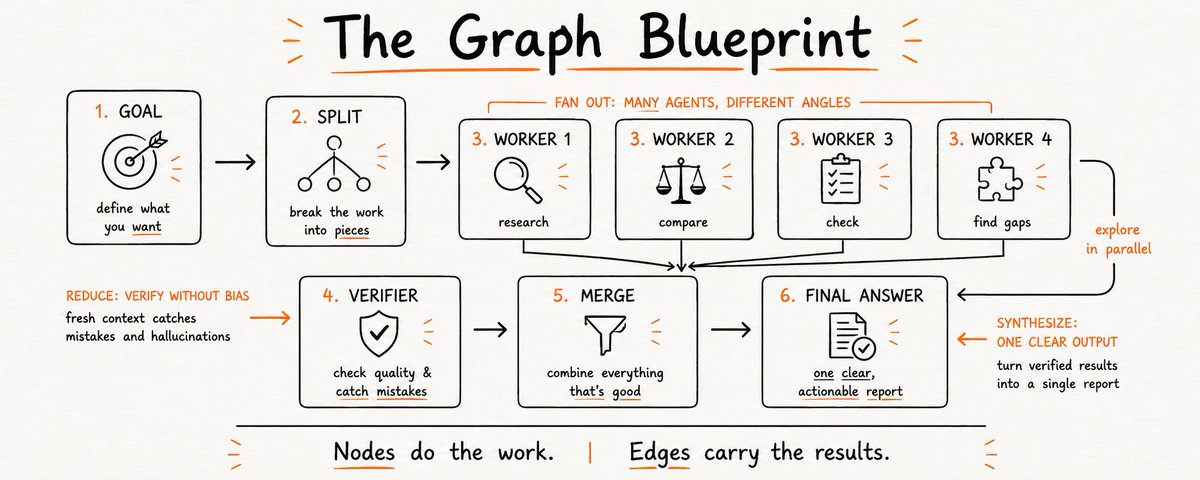
"Prompting will be dead in 6 months, graphs are what's replacing it."
In 2 hours at Stanford he shows how to build agents that work and improve entirely on their own.
The first 10 minutes cover what most $500 courses never do.
Watch the lecture first, then read the guide below on how to build a system that improves itself.

R_A for tech tweets retweeted

Here's the YouTube link of the lecture:
youtube.com/watch?v=Unzc731i…

R_A for tech tweets retweeted

You don’t think highly enough of yourself because:
- You don't know about the Galatea Effect studies
- You haven't read Rosenthal's 1968 study in Cali
- Or Van Dinther's research in self efficacy
- You haven't even read the book Self-Efficacy
- You might not even know wtf Self-Efficacy means
- You have no clue who Bandura is
- You've never read Pajares on the misunderstanding of self efficacy constructs to really understand it
- You don't know what RAS stands for
- You've never seen Ozer's 1990 analysis on empowerment mechanisms
- You don't know what Cervone discovered about self-reactive influences in 1986
- You don't know what Maddux proposed in 1995 about imaginal experiences
- You have no clue what the Golem Effect actually measures
You haven't gone down the right rabbit holes yet...
This is just the tip of the iceberg.
R_A for tech tweets retweeted

Top 7 skills required for Java devs to get a job these days.
Which one are you struggling with ?
1. Core Java (8–22) : Streams, records, virtual threads, collections, OOP
2. Spring Boot: REST APIs, validation, profiles, AOP, actuator, config management, devtools, custom starters, error handling.
3. Microservices: Feign/WebClient, API versioning, service discovery, config server, circuit breakers, retries, distributed tracing, API Gateway,SAGA, CQRS.
4. Spring Security : JWT, OAuth2, role-based auth
5. Hibernate/JPA : Mappings, lazy/eager, JPQL, performance tuning
6. DSA : Arrays, trees, graphs, DP, hashing
7. Concurrency : Thread pools, locks, CompletableFuture, Loom
R_A for tech tweets retweeted

the skills that actually get you hired (not 500 leetcodes):
• auth flows (oauth, jwt, sessions)
• db schema design & migrations
• caching (redis, cdn)
• background jobs & queues
• file uploads & storage
• realtime (websockets, pub/sub)
• forms & validation
• state management
• testing (unit + e2e)
• deploys & monitoring
leetcode won’t save you. this stack will.
R_A for tech tweets retweeted

After giving 10+ Backend interviews, I found only 20 topics you should really master -
Backend Fundamentals:
1. How the Server Works (Request–Response Cycle)
2. REST API Design Principles
3. HTTP Methods & Status Codes
4. Middleware & Request Flow
5. Authentication vs Authorization
Node.js & Backend Runtime:
6. Event Loop & Non-Blocking I/O
7. Async/Await & Promises
8. Error Handling & Global Error Middleware
9. Environment Variables & Config Management
10. Logging & Debugging
Databases:
11. SQL vs NoSQL (When to Use What)
12. Database Schema Design
13. Indexing & Query Optimization
14. Transactions & ACID Properties
15. Relationships (1–1, 1–Many, Many–Many)
Security & Scalability:
16. JWT, Sessions & Cookies
17. Password Hashing & Security Best Practices
18. Rate Limiting & Caching (Redis)
19. Scalability Concepts (Load Balancing, Horizontal Scaling)
20. API Versioning & Deployment Basics
If you master these, most backend interviews become predictable 🚀