

One time lecturer, one time writer on European politics, now retired, walking the dog and doing a little harmless blogging
Huddersfield UK
Joined July 2011
- Tweets5K
- Following1.8K
- Followers1.7K
- Likes6.1K





This week, Sepia Saturday is celebrating Halloween with ghosts as its theme. In many ways, this is a suitable theme for lovers of old photographs, because so many early photos were linked in one way or another to ghostly phenomena. My photograph shows my Uncle Frank’s parents, Frank and Clara Fieldhouse, at the seaside. Whether the ghostly couple following them are the result of spirits, double exposure, or AI is up to you to decide.

You need an old camera, slow film, and a decent downpour to get a good night shot. Modern digital cameras are hopeless: they sharpen the focus, bring up the shadows, and tone down the glare, leaving you with something about as dramatic as a soggy digestive biscuit. Luckily, when I took this photograph of Commercial Street in Halifax back in the 1960s, my camera was old, my film was slow, and it had rained for days.

I took this photograph in Sheffield more than forty years ago. After all this time, I’m not certain where it was taken - possibly around Kelham Island. The exact location does not matter; it is the starkness of the scene that grips the imagination, accentuated by the photograph’s black-and-white composition. The shapes possess a beauty of their own - a kind of industrial cubism - that is both attractive and meaningful.

This map may not mean much to most people, but it shows Northowram, the village where I grew up. It is dated 1920, although it may be based on data from a decade earlier. What is surprising is not the amount of development in the past 70 years, but how much occurred in the 30 years between the map’s publication and the 1950s, when I was growing up in the village.

For as long as I can remember, I have been in love with images. They offer the ultimate freedom of expression and interpretation, allowing you to explore a moment, place, emotion, or expression in detail. They let you freeze time and make the transient permanent. Images are magical.

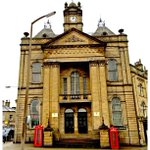
Here’s a fun diversion for a miserable Monday morning: take a photograph of a famous Calderdale building, ask a friendly AI bot to turn it into an architectural drawing, and then ask people to guess which building it’s supposed to be. I’ll post the original photograph - and the location - at the end of the day, in case you want to guess.


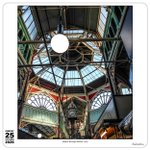
The Dutch painter Piet Mondrian was one of the founders of the art movement known as Neoplasticism. His palette was limited to the three primary colours - red, blue, and yellow - along with black, white, and grey. The result was art composed of lines and shapes. As far as I know, Mondrian never visited Halifax, but it is hard not to feel that he might have found inspiration there after looking up at the ceiling of Borough Market.

I like to think that, when Bill Brandt walked up Old Lane in Halifax in 1937, he took his famous Snicket in Halifax photo. He then climbed to the top of the steps leading to the railway bridge and took his equally famous Halifax photo. After walking down the other side, he turned and cursed because he had run out of film. Conversely, I had one frame left - so here is the shot Brandt missed. (He would have had to wait a few years for Burdock Way to be built.)

Where can you find Halifax in New York? The answer is on the fifth floor of the Museum of Modern Art on West 53rd Street. There, you will find a copy of Bill Brandt’s 1937 photograph, Halifax - a clear indication that it is regarded as one of the finest twentieth-century photographs. My interpretation, taken forty years ago and the fifth image from my chosen strip of negatives, is but a pale imitation of the original.

Old Lane in Halifax was the setting for two of the finest photographs of the twentieth century. The fourth frame on my forty-year-old strip of negatives is my rather mediocre recreation of Bill Brandt’s magnificent 1937 photograph, Snicket in Halifax. The original is easy to find online, and it is worth noting that little had changed during the half-century leading up to my photograph of the same snicket.

Bridge over bridge, concrete over iron, set against a hillside as old as time. Over my nearly eight decades, I’ve travelled widely, but Halifax was, is, and will remain my greatest source of inspiration. This is the third photograph from that strip of negatives taken forty years ago.

The second image in my strip of six negatives, taken 40 years ago, shows a bus on a bridge. The bridge is, of course, Burdock Way in Halifax. If you look closely, you may see that the bus is advertising even more local editions of the local newspaper. Forty years later, the photograph would have been taken on a mobile phone — which would also have been the platform for local news. The bus, however, would still be there!

Lest we forget the days when images were chemical stains on translucent cellulose acetate, and photographic imagination was limited by the number of frames left on a roll of film. This week, I am limiting myself to a single strip of six negatives, all exposed around Halifax some forty years ago. The first image is, as far as I can remember, of Oats Royd Mill in Luddenden, taken before it was badly damaged by fire in 1989.

My postcard this week takes us back to a time when political cartoons were considered suitable content for picture postcards. It also takes us back to 1903–04, when the idea of free trade was being challenged by politicians advocating protectionism and the use of tariffs as an instrument of foreign policy - most notably Joseph Chamberlain, who urged the rest of Balfour’s Cabinet to join him. You would probably find similar cartoons on social media today - plus ça change!

For the past 848 weeks, Sepia Saturday has offered themes that allow lovers of old photographs from around the world to share their favourite images. This month’s themes are working their way through the elements, and this week’s theme is “fire”.My submission is this rather sweet photograph from, I think, the 1920s, which I have entitled “Friendly Fire”.

Those who know the town of Brighouse can have fun with this picture - which I must have taken sixty or so years ago - trying to work out where I took it from and what the various buildings, fading into the post-industrial mist of time, are. Many have now gone, and most of those that remain have entirely different uses from those they had back in the 1960s.

It seems so long ago - almost another age. The colours and styles may have changed, but then, as now, we stood on the edge and looked out.

When I look back at the pictures I took of Halifax in the 1960s and ’70s - the town I have always considered home - several things stand out. The town had a greyness then that went beyond an over-reliance on monochrome photography. There were still plenty of mill chimneys breaking up the skyline. Most striking of all, Beacon Hill was bare, devoid of any meaningful vegetation.

Sitting in a restaurant, whiling away the time while the others enjoyed their starters, I began playing with the reflections of the bottles behind the bar. Within a handful of seconds, my photograph had bounced from Thongsbridge to an AI mega-kitchen on the far side of the world, where it was cooked to perfection and served back to me. Good taste.
