

Political polling analysis and data visualisation. Created by @patrickjfl.
London, England
Joined October 2018
- Tweets1.6K
- Following140
- Followers3.5K
- Likes320



326 Politics retweeted

Conservative leadership election endorsement leaderboard, coloured by who MPs backed in July.
Rishi Sunak: 38
Boris Johnson: 37
Penny Mordaunt: 15
90 / 357 MPs (25%) have endorsed a candidate so far.

Hey everyone, I haven’t posted on here in a while, but for the time being some of my forecasting work is over at @patrickjfl, so be sure to give me a follow if you haven’t already!


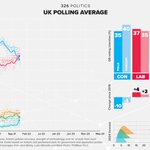
NEW: Labour now hold their largest poll lead over the Conservatives since the 2019 election.
Poll averages (vs. 11 Nov)
LAB: 37% (+2)
CON: 35% (-2)
LDM: 9% (-)
GRN: 7% (-2)
RFM: 5% (+2)
2024 forecast (vs. 2019)
CON: 40% (-4)
LAB: 35% (+2)
LDM: 8% (-4)
GRN: 6% (+3)
RFM: 4% (+2)


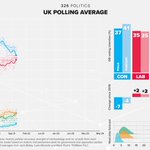
NEW: UK polling averages, now including forecasted next election vote shares.
Current polls (vs. 2019)
CON: 37% (-7)
LAB: 35% (+2)
GRN: 9% (+6)
LDM: 9% (-3)
RFM: 4% (+2)
Forecast
CON: 41% (-4)
LAB: 35% (+2)
GRN: 8% (+5)
LDM: 8% (-4)
RFM: 3% (+1)

As you can see, despite the polling average since 2019 ranging from a 21-point CON lead to a narrow LAB lead, the range of forecasted vote shares for the next election has remained narrow (CON 40–43%, LAB 34–37%).
💥 2021 German federal election final forecast 💥
Vote shares (change since 2017)
SPD: 25.3% (+4.8)
CDU: 22.4% (-10.6)
GRN: 15.7% (+6.8)
FDP: 11.6% (+0.8)
AFD: 10.6% (-2.0)
LNK: 6.4% (-2.9)
Next Chancellor
Olaf Scholz: 67%
Armin Laschet: 32%
Annalena Baerbock: 1%

With Keir Starmer set to try and change Labour's leadership election rules and revert to a system where party members, unions and MPs all get 1/3 of the vote, I've done some rough calculations to estimate results of the last three leadership elections under this system. (THREAD)
2020 Labour leadership election
Keir Starmer: 55% (-1)
Rebecca Long-Bailey: 25% (-3)
Lisa Nandy: 20% (+4)
Keir Starmer elected leader.
Our latest forecast for next Sunday's federal election in Germany makes the SPD the likely largest party, with an SPD/Green/FDP coalition the most likely government.
Vote shares (+/- vs 2017)
SPD: 26% (+5)
CDU: 21% (-12)
GRN: 16% (+7)
FDP: 12% (+1)
AFD: 11% (-2)
LNK: 6% (-3)

Latest forecast for next month's German federal election
Vote shares (change with 2017)
CDU: 23% (-10)
SPD: 21% (-)
GRN: 18% (+9)
FDP: 13% (+2)
AFD: 11% (-2)
LNK: 7% (-2)

