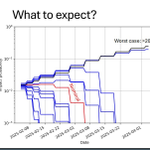
No impact in 2032! #2024YR4
This quoted post is unavailable.
2024 YR4 - Science data about NEO asteroid retweeted
Tomorrow the @NASA JWST will observe asteroid 2024YR4 in an attempt to refine its orbit (and again on Feb 26). Reminder there is a 4.1% chance this asteroid will hit the Moon on Dec.22, 2032. We should have an updated impact probability estimate soon.
2024 YR4 - Science data about NEO asteroid retweeted
JWST has completed it’s first observation of 2024 YR4 for this year. A second observation is planned for next week, 2026-Feb-26. I imagine it might be several weeks before the results are announced. There’s quite a bit of processing to do to get the astrometric measurements.
2024 YR4 - Science data about NEO asteroid retweeted
The observability plot from the IAWN page gives a sense of the degree of difficulty. iawn.net/obscamp/2024YR4/gal…
2024 YR4 - Science data about NEO asteroid retweeted
Yes. Two mega-Chelyabinsks passed closer than the Moon this week. Good news: Earth is a small target. Even with gravitational lensing, our planet is only about 80% the size of a dartboard’s bullseye compared to the board itself. In fact, 2013 was the last time I had a bullseye.
This Post is from a suspended account. Learn more
2024 YR4 - Science data about NEO asteroid retweeted
Will asteroid 2024 YR4 hit the Moon?
2024 YR4 made headlines this year when its probability of impacting Earth in 2032 briefly rose as high as 3%.
While an Earth impact has now been ruled out, the story continues.
The final glimpse of the asteroid as it faded from view left it with a 4% chance of hitting the Moon on 22 December 2032.
Find out more in this FAQ: esa.int/Space_Safety/Planeta…
After last scheduled obs from May of #2024YR4 by NASA/ESA JWST, the nominal pass is slight away from impacting moon, and the % goes to a 4-5% range which is low but not negibible. 2024 YR4 will not impact the earth following this new data observed
JWST observation of asteroid 2024 YR4 on 11 May was reported to the Minor Planet Center on 3 June. JPL has updated to solution #78. Nominal distance to the Moon 2032-12-22 is 10,700 km (3-sig uncert +/- 74,000 km). Horizons (via Telnet) gives impact risk ~4%. My SOLEX calc.
👀 ☄️ -> 🌍
Our #AsteroidInstitute team launched a demo of ADAM::Impact Probability, a new tool to simulate and visualize potential impact risks from near-Earth #asteroids over the next 75 years. Hear from one of our engineers on how it works and how you can use it. bit.ly/43ibeXC
2024 YR4 - Science data about NEO asteroid retweeted
The discovery and characterization of Earth-crossing asteroid 2024 YR4: arxiv.org/abs/2503.05694 -> Astronomers Trace Earth-Crossing Asteroid to Surprising Origin: keckobservatory.org/2024-yr4… (namely that it's from an asteroid family in the central Main Belt between Mars and Jupiter).
2024 YR4 - Science data about NEO asteroid retweeted
JWST 🔭 infrared measurements nail size of close-call asteroid 2024 YR4 as test for future potentially hazardous objects
Thanks to @NASAWebb, we have more information about asteroid 2024 YR4. It's about the size of a 10-story building.
Based on data from Webb and ground-based telescopes, the asteroid also has a nearly 4% chance of impacting the Moon in 2032.
go.nasa.gov/42eQI8o
60m is the new estimate of size of 2024 YR4 based on JWST observations. The new ellipse of uncertainty is quite centered in the moon. #2024YR4 will be in the news again for a while…
Thanks to @NASAWebb, we have more information about asteroid 2024 YR4. It's about the size of a 10-story building.
Based on data from Webb and ground-based telescopes, the asteroid also has a nearly 4% chance of impacting the Moon in 2032.
go.nasa.gov/42eQI8o
2024 YR4 - Science data about NEO asteroid retweeted
The @ESA_Webb space telescope has spotted asteroid 2024 YR4!
Webb’s observations indicate that the asteroid measures roughly 60 m across, making it the smallest object targeted by Webb to date.
esa.int/ESA_Multimedia/Image…
Credit: NASA, ESA, CSA, STScI, A Rivkin (JHU APL)

ALT A collage of three images showing the black expanse of space. Two-thirds of the collage is taken up by the black background sprinkled with small, blurry galaxies in orange, blue, and white. There are two images in a column at the right side of the collage. On the right side of the main image, not far from the top, a very faint dot is outlined with a white square. At the right, there are two zoomed in views of this area. The top box is labeled NIRCam and shows a fuzzy dot at the center of the inset. The bottom box is labeled MIRI and shows a fuzzy pinkish dot.
Hit to the moon of 2024 YR4 is a real possibility with new observations published very recently and made on 22th and 23th March by the VLT (Very Large Telescope) nominal solution for the orbit is a hit for #2024YR4
#Asteroid 2024_YR4 may collide with the Moon 🌙.
Its nominal trajectory, based on updated observations, shows a lunar impact on Dec 22, 2032.
But the odds of collision remain low.
New obs. of VLT at near M 27 ! Which is quite dim, gave a nominal orbit of 2024 YR4 with impact on the moon on 2032. The actual calc is 3% because moon is smaller but the actual calculation is a hit. We will have to wait probably to 2028 to be sure or not about #2024YR4 & 🌙
Sources about impact is JPL: ssd.jpl.nasa.gov/tools/sbdb_… and estimation about probability was given by Daniel Bamberger here, based in a simple Gaussian model groups.io/g/mpml/topic/new_2…
2024 YR4 - Science data about NEO asteroid retweeted
All clear: NASA analysis drops asteroid 2024 YR4's impact probability to 0.004%, meaning it is expected to safely pass by Earth in 2032. NASA’s #PlanetaryDefense team will continue to monitor all known asteroids that may come our way.
Learn more: go.nasa.gov/3I0ZA7K
Risk is virtually 0 now #2024YR4
NASA JPL has updated their Impact Probability of 2024 YR4: No risk for 2032-12-22 [2024-02-21] cneos.jpl.nasa.gov/sentry/de…
Tiempo para preocuparse de alguna otra cosa. 2024 YR4 no impactará la tierra.
Has oído hablar del asteroide 2024 YR4 y nosotros hemos escuchado tus preguntas ¿Cuáles son las probabilidades de que impacte la Tierra? ¿Por qué estas cambian? ¿Deberías preocuparte? (Spoiler: No)
Conoce más de la mano de un experto de @NASAJPL.
+ info: go.nasa.gov/4k2qzSm