

DIFC,ADGM & AIFC Courts’ registered Counsel/GC/Litigation & Arbitration/Mediation/Dispute Settlement& Resolution/ Civil Fraud/Commercial Disputes/LegTech savvy.
Abu Dhabi, United Arab Emirate
Joined January 2017
- Tweets4.3K
- Following1.5K
- Followers194
- Likes62.2K





Zubair Sapi retweeted

This is f*cking gold..
Chinese researchers just dropped a paper called "The End of Harness Engineering" and it reads like an obituary for LangChain.
The claim: the file that organizes the model should be written by the loop that runs it, not by the person who built it.
A hand-built harness is a guess with a commit message. A self-revising harness is a file that grades itself every round.
The mechanics are almost boring. Execution report in, 8 edits out, score them on held-out questions, keep the winner, repeat. Frozen solver the whole time.
Across 41 rounds the held-out score went from 0.31 to 0.64 and the harness never saw an editor.
The human writes exactly one thing: the scoring set. Never shown to the proposer, never optimized against, used to grade every candidate.
So you stop arranging calls and tools. You start deciding what counts as correct and reading the score.
Harness engineering turns disposable. The scoring set turns into the job.
That is exactly the loop I run and documented below: one harness.py, 300 Kimi K3 workers, 37 rewrites in 41 rounds, zero edits by hand.
The whole paper in one line: grade the file, don't write it ↓


Zubair Sapi retweeted

Introducing RSI-Anything: Unlocking Recursive Self-Improvement with World Models 🚀
Can AI learn to improve itself by predicting the consequences of its actions?
Built on JEPA-Anything, RSI-Anything uses world models to guide action selection and learning. Feedback improves the policy or workflow and, when needed, the world model. Validated updates carry forward to shape the next round of experience.
Across code, GUI interaction, laboratory planning, and reaction optimization:
• Code-repair success: 26.3% → 31.2%, with the coder fixed
• GUI agent task: 39.4% fewer actions, with higher completion
• Lab-planning scores: 21.80% → 46.01% over five policy versions
• Mean best observed reaction yield: 96.15% vs. 82.16% for Bayesian optimization, under the same 40-experiment budget
📄 Paper: arxiv.org/abs/2610.13912
💻 Code: github.com/Gen-Verse/RSI-Any…
Watch the video below 👇
#RSI #WorldModels #RSI #AIAgents #AIforScience #JEPA
Physical touch and hardware agents, who work as an a real touch assistant, it’s really big breakthrough..

Introducing Interface, the primary hardware for the agent era.
Interface lets you control all your agents from your hand.
$99 for early adopters. Ships in January.
Zubair Sapi retweeted

This is insane 🔥
The FDA cleared the first human age-reversal trial
A Harvard professor proved you can reverse aging by 75% in 6 weeks in mice cured blindness, reversed Alzheimer's, MS, ALS, kidney and liver disease then confirmed it works in monkeys
Now humans are next. Life Biosciences raised $80M to make it happen
His words "The eye is just the beginning. We believe we can treat every tissue. A whole body reset"
Readers added context they thought people might want to know
The post overstates: FDA cleared Phase 1 trial of ER-100 for glaucoma/NAION eye conditions using reprogramming, not general age reversal. Mouse study (Lu et al Nature 2020) & primate data restored vision in optic models; Alzheimer's etc. unproven here. $80M raised.
lifebiosciences.com/life-bioscienc…
nature.com/articles/s4158…
wired.com/story/longevit…
lifebiosciences.com/life-bioscienc…
Zubair Sapi retweeted

Introducing Core, The Personal Al Computer
The most powerful technology humanity has built should belong to you
Order today: ghost.ai
Zubair Sapi retweeted

OpenAI engineer just showed how they use Dots inside OpenAI.
In 7 minutes she shows an agent doing the job of a whole team.
This is how work already looks there, and it's coming for every company next.
Higgsfield is already bringing it to creative work, more below.
🤝 Paid partnership

Will see how impressive is it?

Announcing dots. Dots work 24/7 for you, learn from your feedback, have their own computer, browser and can be connected to over 4k apps in our ecosystem.
They’re powered by Astra our best model yet. Included in your Pro plan, without drawing down on any of your usage. You can even call a dot while it’s working.
We’re getting you started with your primary dot today and soon you’ll be able to create entire teams of them.

Zubair Sapi retweeted

We achieved a breakthrough at BTL.
AI models are very linear. They think in one direction at a time, and when they're wrong they scramble and start again. For something meant to replace humans, that's way too human.
We changed that. We made LLM reasoning and execution work more like a quantum computer: many paths at once, the ones that meet merge into one, the dead ends cancel out, and everything left moves forward together.
On the same hard problems, a 1.7B model thinking the normal way solved 3 out of 30. Interference Search(our new architecture)solved 23.
We watched the normal model find the right answer at token 1,313, check it 9 more times, wander off and run out of budget without ever answering. Ours got there in 3 steps.
Parallel thinking and execution. Subagents were a terrible way to tackle this.
More technical details soon.
Zubair Sapi retweeted

Today we announced the preview of Microsoft Autopilot is rolling out to our first customers - "Autopilot is a persistent, proactive and personal agent that keeps working even when you’re not"
It's been a while since I updated you all on what we are building. First Scout is now Autopilot, and my team leads building this personal agent.
We are building Autopilot on @openclaw, working with @steipete and the OpenClaw Foundation to make it a fantastic enterprise grade runtime.
blogs.microsoft.com/blog/202…
Re-introducing Sebastian, my Autopilot - and he is as excited as I am!

Zubair Sapi retweeted

اندرو هوبرمن تازه یه دفترچه راهنمای ۵۴۰ صفحهای برای بدنت منتشر کرده.
این کتاب به ۷ بخش تقسیم شده: خواب، ورزش، کنترل استرس، تغذیه، نور، تمرکز و یادگیری، و رشد فردی.
پر از اطلاعات مفیده، اما اگه وقت نداری همهاش رو بخونی... اینا مهمترین نکات کتاب «پروتکلها» هستن:

Zubair Sapi retweeted

Thoughtful piece by Jeffrey Katzenberg

The World is Changing: AI For Creativity
By Jeffrey Katzenberg
A few months ago, I sat in my office in Silicon Valley and watched as a tech founder showed me something extraordinary. On the screen was a fully realized, beautifully lit, well-composed animated scene. It was stunning and it made me feel exactly what I felt in 1986 watching Luxo Jr. That was the first time I watched a computer-animated 3D character take a breath and seem, against all reason, to have life. It left me in awe.
Later that day, I received a text from an artist I've known for thirty years, 350 miles to the south, in the city where I spent most of my career. After seeing a similar video, she texted: "Is this the end of us?" My answer was, "Certainly not.”
I have spent the better part of the last decade in Silicon Valley, but the heart of my career has been in Hollywood. Being deeply connected to both worlds means I have deep loyalties to each and a responsibility to speak honestly to both.
In 2023, I said that these new AI tools would cut the time and cost of producing world-class animation by as much as ninety percent within three years. Some colleagues were alarmed, many were furious.
There is growing fear and resistance surrounding AI within the creative community. I deeply understand it, because I've spent countless hours walking through animation studios watching gifted artists bent over their desks, rebuilding a single second of film for the tenth time because the ninth version wasn't quite right. I've sat in screening rooms where four years of people's labor played out in minutes, and I knew the name of every person that had spent countless hours bringing those images to life. The creative process is a calling, there's really no other way to describe it. From the outside some see resistance. From the inside, it is love.
People do not fight this hard for things they don't care about. The pushback coming out of Hollywood represents the collective effort of people who are deeply passionate about their craft.
Is History Repeating Itself?
The history here is more complicated than either side may realize. In 1906, the most famous composer in America, John Philip Sousa, published an essay titled “The Menace of Mechanical Music." He warned that the phonograph would become "a substitute for human skill, intelligence and soul."
Sousa's fight was not really about the machine, it was about money. The machines were playing his compositions, and the men who built them weren't paying him a cent. His campaign helped create the Copyright Act of 1909. He did not stop the technology. He changed the terms under which it could use his work.
A hundred years ago, sound came to the movies. We remember it now as a miracle, and it was. What we forget is who paid for it. Before sound, tens of thousands of musicians made their living in the orchestra pits of movie houses, scoring every film live, every night, in towns all over the world. When the soundtrack arrived, the work of one composer and one orchestra was recorded for a film that went into thousands of theaters. The union fought back with everything it had, taking out newspaper ads across the country warning against the menace of "canned music," one of them showing a mechanical man tearing the strings out of a harp while an angel wept.
They were not fools, and they were not Luddites. They were right. Those pit jobs did not come back. And yet (this is the part we have to be brave enough to admit), sound gave us the movie musical, the modern score, sfx, sound design, audio engineering, and an art form vastly larger than the one it disrupted. And it helped keep Hollywood in the forefront of world entertainment for the rest of the century and into the next. The loss was real. And yet the art form expanded.
This is a story that has been told over and over again. To resist technology is to risk irrelevance. Just look at Kodak or Blockbuster. To embrace technology is to open doors of new possibility. Just consider Apple and Netflix.
What I Learned From Walt Disney
In the mid-1980s, I was tapped to lead Disney's animation division at a moment when the studio was at an inflection point. Animation wasn't just another business unit. It was the soul of the company, a medium revered because of Walt's genius and his passion. But the production system was cumbersome and unforgiving. A single movie was 125,000 individual hand-drawn and painted cels, photographed one frame at a time. Every revision carried a cost measured in months. These degrees of difficulty shaped the kinds of stories we could tell.
We found our way forward in an unexpected place: Walt himself. The Disney archives held astonishing recordings of Walt explaining his creative process. His own writings. His notes and storyboards. Work product captured at every stage of his process. This was truly a gift. Listening, reading, sitting with the work itself, we heard him talk about character, about emotion, about how an audience feels when a character truly comes alive. He talked about making bold choices and refining a scene until it genuinely moved people. We didn't hear a word about pencils or paintbrushes. In fact, Walt was famous for being a technologist, forever hunting for state-of-the-art tools, often inventing them himself to achieve the images he saw in his head. But he never defined animation by the tools. He defined it by whether the audience believed the character. His principles were timeless. The tools were not.
That realization changed everything. We co-developed the Computer Animation Production System (CAPS) with a young Northern California company called Pixar, replacing hand-painted cels with CGI. In The Little Mermaid, the final scene shimmered with a dimensionality and light that the old process simply couldn't achieve. In Beauty and the Beast, the ballroom sequence moved with a cinematic sweep that placed the audience inside the emotion of the moment. In Aladdin, the Cave of Wonders felt vast and alive, and the Magic Carpet became an intricate, compelling character all its own. In The Lion King, the stampede carried a scale and intensity that raised the emotional stakes beyond anything we'd done before. Technology didn't diminish the craft, it expanded the canvas. It gave artists more room to create.
A decade later, the canvas expanded again. When Disney released Pixar's Toy Story, it wasn't simply a technical milestone. It was proof that a fully computer-animated film could carry real emotional weight, that it could make audiences laugh, cry, and believe. At DreamWorks, we made the difficult decision to sunset hand-drawn animation and become a fully computer-animated studio. It was the right thing to do, but it was not without pain. It cost talented people their place in an industry where they had worked their whole lives. Some made the leap to the new tools and did the finest work of their careers. Some never did.
Tools are never the point. The instruments change with every generation. What endures is taste and imagination. The magical ability to make an audience feel. One of the greatest storytellers of our generation, George Lucas, succinctly captured the eternal essence of this issue: “It’s not the how, it’s the why.”
A Distinction With a Difference
I asked one of the leading AI models a question that has been challenging me for months. What is the difference between reasoning and creating? Its answer changed how I think about almost everything happening in this industry. It said . . .
Reasoning and creating are two distinct cognitive modes, though they also work together. Reasoning is fundamentally evaluative and analytical. It operates on what already exists: facts, premises, evidence. It moves toward a conclusion that was in a sense already implied by the input. Reasoning is constrained by logic and truth. Its goal is to arrive somewhere correct, not to invent somewhere new.
Creating is fundamentally generative. It produces something that didn't exist before. And crucially, there's no single right answer waiting to be found. A blank page has infinite valid responses. Creation involves choices that can't be fully justified by logic alone. Taste, intuition and vision fill the gap where deduction runs out.
Reasoning is what Silicon Valley has been perfecting. Creating is what Hollywood has been practicing for more than a century. AI today operates almost entirely on the reasoning side of the line. It can deduce, evaluate, optimize, and pattern-match brilliantly. And while it can create, there is a real distinction to being creative. What it doesn’t yet have is those things that make us human: empathy, devotion, serendipity, the kind of creativity that comes from a person trying to say something only they could say. When the bot generates a piece of art, it is not trying to communicate anything. It is statistics, not soul; it is emulating things that have been done. By contrast, human creativity isn’t about repeating patterns of zeros and ones; it is about doing something new.
One day, AI may close this gap. Three years ago, the leaders building AI would have called what they are achieving today, improbable, if not impossible. Impossible is no longer improbable.
Today, the line between reasoning and creating is real. Even the leading technologists acknowledge we are not there yet. There is no scientific path to crossing this divide that anyone in the field can articulate today. Understanding that gap is where we will find common ground.
A Path Forward
In 2016, I closed one chapter in Hollywood with the sale of DreamWorks and opened another in Northern California, co-founding WndrCo. We’ve backed more than 50 founders building the next generation of technology and watched how breakthroughs in Silicon Valley emerge, first as experiments, then as platforms, and finally as infrastructure that reshapes entire industries. It's worth remembering that the last great revolution in animation also came from the north. Pixar was a Northern California company, forged not in the conventions of the Hollywood studio system, but in the technological breakthroughs of Silicon Valley. I've spent years on both sides of this bridge. For sure, I don’t have all the answers (take Quibi, for one!). But, from my past and present vantage points of my long career, here is what I see . . .
Brilliant people in Northern California building this technology have made something extraordinary. They have earned the right for the rest of us to be, if not believers, at least optimistic that what comes next will be remarkable. But they have not made an artist. The tools are powerful, but they are not what makes a story matter. That knowledge lives 350 miles to the south, inside people whose life's work has informed the very models you are building. The right path forward includes them by design, with credit, with consent, and with compensation. Build this with the storytellers. Not on top of them. Taste is not something that can be synthesized, it is uniquely human.
At the same time, Hollywood needs to accept that AI is not going away. The energy they are spending trying to make it disappear is energy they are not spending deciding the terms on which it will exist. And the terms are everything. The north needs something from it that they cannot build and cannot buy: creativity. The kind that takes a blank page and conjures a single right answer where there was none and has held audiences for a century. Without it, the most powerful reasoning engine ever invented will still be missing the only thing that makes a story worth telling.
The artists who learn to wield these new instruments will do things the engineers never dreamed of. They always have. Edison invented the motion picture but made terrible movies. It took Chaplin, Lloyd, Keaton and so many others to make movies emotional. Now, the canvas is about to expand yet again. We should decide now that we intend to paint on it.
There are so many valuable lessons in history. This has happened many times before, and it was never settled by the technology. It was settled by the terms. Sousa did not stop the phonograph; he helped write the law that made sure composers got paid. And two years ago, when the writers and the actors walked out, they were fighting for the very things Sousa was fighting for in 1906. Consent, compensation, the basic recognition that human creative work has a price that must be paid. The terms of that fight are still being negotiated, but the principle is older than any of us.
The tools-versus-no-tools argument is a trap. First, we must all agree that there should be terms. Then we can have the crucial debate about what fairness requires.
What I Learned From Steve Jobs
Years ago, Steve Jobs said, "It's in Apple's DNA that technology alone is not enough. It's technology married with the liberal arts, married with the humanities, that yields us the result that makes our hearts sing." He was describing a device. But he could just as easily have been describing this tale of two cities.
What I See Coming Soon
As the barriers and the costs come down, more films will get made, not fewer. Studios will get to take more risks. There will be more seats at the table, and very soon entirely new forms of storytelling. In the 1980s, animation was dismissed as a niche corner of the business. Today it is one of the most beloved and profitable forms of storytelling in the world. In live action, filmmakers like Steven Spielberg, James Cameron and Peter Jackson embraced new visual tools not as shortcuts, but as instruments, and expanded cinema in the process. Every time storytelling has met a genuine technological shift, from synchronized sound to color to computer animation, it has redefined the boundaries of the medium and grown larger in the process.
Assuredly, I don’t have all the answers, but I am confident that the creative opportunities will expand yet again. How we come through this is a choice. The north has the new tools. The south has the creative soul. The best future will draw on the best of both worlds.
Zubair Sapi retweeted

🎉 Introducing 𝙾𝚙𝚎𝚗𝙼𝚞𝚜𝚎
An open source, self-hostable personal assistant that works with any agent harness.
Includes:
- Computer use: browser, terminal & files
- Connectors for your personal apps
- Ideas, goals & progress tracking
- Built for Mobile and Web
Repo → github.com/CopilotKit/OpenMu…
Powered by @CopilotKit and AG-UI.
Clone this template and customize it however you want.

Introducing Muse, your personal AI agent from Meta that gets things done across every part of life.
Download the Muse app and get started: Muse.ai
Zubair Sapi retweeted

🚨: Mexican scientist Eva Ramon has successfully eliminated Human Papilloma Virus (HPV) in 29 patients!


Readers added context they thought people might want to know
The sensational claim recycles 2019 results from a small pilot study on experimental photodynamic therapy; HPV cleared in 100% of cases without lesions among the 29 women but only 64.3% with lesions (57.2% for lesions alone).
ipn.mx/proyectovph/co…
pubmed.ncbi.nlm.nih.gov/36773299/
snopes.com/fact-check/eva…
saude.abril.com.br/medicina/cient…
Zubair Sapi retweeted

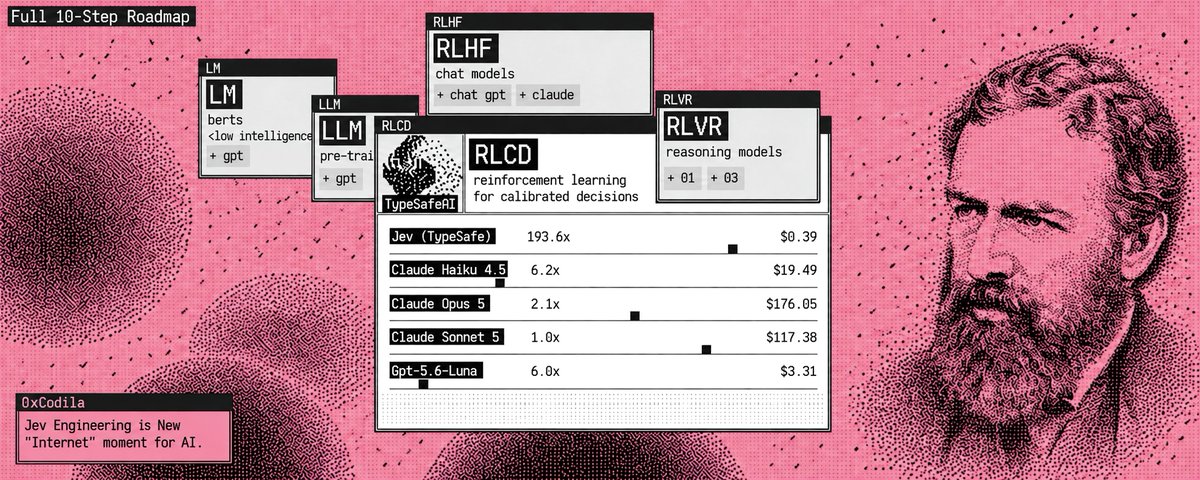
Jev is "Internet" moment for AI: up to 193x faster and 444x cheaper in tests with Claude Fable 5.1 and GPT-6 Astra
Whar is Jev, how to use and unlock its real 100х advantage in my 10-page research:
step 1 → meet Jev: LLM writes, agents act, Jev chooses the next move - split intelligence from execution
step 2 → turn every agent fork into three primitives: Choice selects one route, Score measures a defined scale, Noul returns the probability of yes
step 3 → build before getting access: use TypeSafe’s official adapter with OpenAI, Anthropic or xAI, then swap in Jev without rebuilding the graph
step 4 → setup first Jev: one state, three parallel decisions, risk-based thresholds and a real queue your agents can execute
step 5 → batch decisions instead of serializing them: 13 questions in one call ran 10x faster and 12.2x cheaper than 13 sequential calls
step 6 → place Jev at every bounded fork: choose the agent, model, tool, browser action or human escalation, then read fresh state
step 7 → benchmark the entire loop: Browser Use hit Google Flights in 7.1s, Every ran 777 checks in under 0.7s, Mobile Jev completed 9 actions in 21s
step 8 → rank wide, read narrow: Jev cut wrong Hermes skill loads from 16.8% to 7.3% and pushed legal Top-10 retrieval from 38% to 62%
step 9 → steal a system, not a prompt: Chief of Staff, model router, inbox firewall, research feed, browser controller and safety gate all use State → Questions → Action → Verify
step 10 → keep Jev out of math, writing and irreversible execution: code computes, LLMs create, Jev decides, fresh state proves the result
the result: one slow, expensive agent becomes an always-on decision machine that routes, scores and escalates in milliseconds
Copy the complete 10-page Jev blueprint - then read full 10-step roadmap below ↓


Zubair Sapi retweeted

We just killed Exa, Tavily and Brave.
Your agent can now search & fetch any webpage for 100% FREE.
Them: $7 per 1,000 searches.
Us: $0. No subscriptions, no quotas.
Humans search Google for free. Agents shouldn't have to pay either.
Made possible by @Tiny_Fish and @MonidHQ.

Zubair Sapi retweeted

JEV is INSANE 🤯
We gave it 1.7 million mentions
In 53 seconds, it scored 1,759,932 buying signals across Reddit, X, Bluesky, Hacker News and Facebook, and drafted 6,752 replies in the voice of your last 20 posts.
All for just $0.65.
JEV can also rank intent and product fit, flag when a competitor gets named, weigh the poster's reach, and tell you which threads to reply to now and which to just watch.
Coming soon to RedReplier + MCP.
Comment "JEV" for early access.
Zubair Sapi retweeted

Your Hermes can get 100x faster if you connect it to the Jev skill. 🚀🪽
👉Login to Typesafe console get the api key. Set in the .env file.
Then in terminal
👉npx skills add typesafe-ai/skills --skill typesafe-ai
Then ask your Hermes Agent to us the typesafe skill to analyze your codebase to make it faster. 🚀🪽

Per million just $0.042 - A model this much affordable to the normal users.🤏
Jev is TypeSafe’s first public System One Model, optimized for automation. Send Jev structured questions and get typed decisions with probabilities and confidence that your software can act on.
This can be the most cheap model for Hermes Agent if true. 🚀🪽
System One Models are a new class of AI model built for decisions inside software.
