

@zonderlabs, generative 3d @Stanford, @CarnegieMellon, @UMich
Bay Area | NYC
Joined September 2021
- Tweets189
- Following896
- Followers1.1K
- Likes2.6K
Fable 5.2 is not better at writing
A perfect example of why we need to align AI writing for humans!


Why is AI slop so frustrating to read?
AI writing often obscures main ideas and invents awkward phrases, making sentences more complex than necessary.
Many of these slop patterns violate writing principles established in English writing books.
In our benchmark, AI writing breaks these principles far more often than human writing, with Claude Code replies by far the worst offenders.
We show examples of the most common slop patterns in this thread

ALT How often AI and humans break writing rules
Finally, AI writing often has no prioritization of the points it wants to make. This results in sentences that are devoid of meaning or sentences that have multiple distracting points. 4/5

Another common AI slop pattern is awkward and confusing word choice. AI models have a tendency to chain together nouns into unnatural expressions.
Some in the wild examples include "a label's awareness entry," "vision-and-transcript pass," and "length floor drops a block." 3/5

The most jarring slop pattern of AI writing is hidden characters and actions. This happens when the main character and action of a sentence are not the subject and verb.
See how the same story of "a duck (main character) walked up and asked (main action)" can be written in an unclear way. 2/5

Why is AI slop so frustrating to read?
AI writing often obscures main ideas and invents awkward phrases, making sentences more complex than necessary.
Many of these slop patterns violate writing principles established in English writing books.
In our benchmark, AI writing breaks these principles far more often than human writing, with Claude Code replies by far the worst offenders.
We show examples of the most common slop patterns in this thread
ALT How often AI and humans break writing rules
simply including "write in ASD-STE100" in your prompt makes a huge difference in ai readability
we benchmarked before / after "write in ASD-STE100" with Opus 5.5, and sentences became easier to read


We'll be spending a lot more time trying to understand the outputs of language models. A few thoughts, tips & tricks:
Writing. Something I've had success with: Ask your LLM to explain something in ASD-STE100, it's a controlled language specification originally developed for aerospace maintenance documentation. LLMs well-versed in this language and it comes with heavy constraints on clean writing style that I often find a lot more readable. Sometimes I've tried to soften it a bit e.g. ask for "80% of the way to ASD-STE100" because the spec is quite stringent. But even better:
Diagrams / images. Instead of writing, ask your LLM to create a diagram. These can be a lot easier to process, parse, and understand. But even better:
Web pages. Ask for output "in HTML" to get a beautiful, interactive webpage. LLMs are getting really good at frontend and can create beautiful experiences, animations, etc. But even better:
Explainer videos. The output format I am most bullish on is fully custom / bespoke explainer videos generated on any arbitrary topic. Experiment with things like "Create a 3b1b style video explainer on X. Use my ElevenLabs API key for audio narration". (you'd need an API key for the latter or you can ask your LLM to find you decent free alternatives that use your local compute). This is actually starting to work!
In summary:
- As LLMs get better, they will do more and more of the legwork autonomously, and a lot more of our work will rise up the abstractions into oversight and understanding.
- Luckily, LLMs can help here too because as intelligence and code are increasingly abundant, you can ask for large, custom, discardable software artifacts (e.g. web apps, video explainers) that would have never made sense to create before. Push the boundaries here and you'll be surprised.


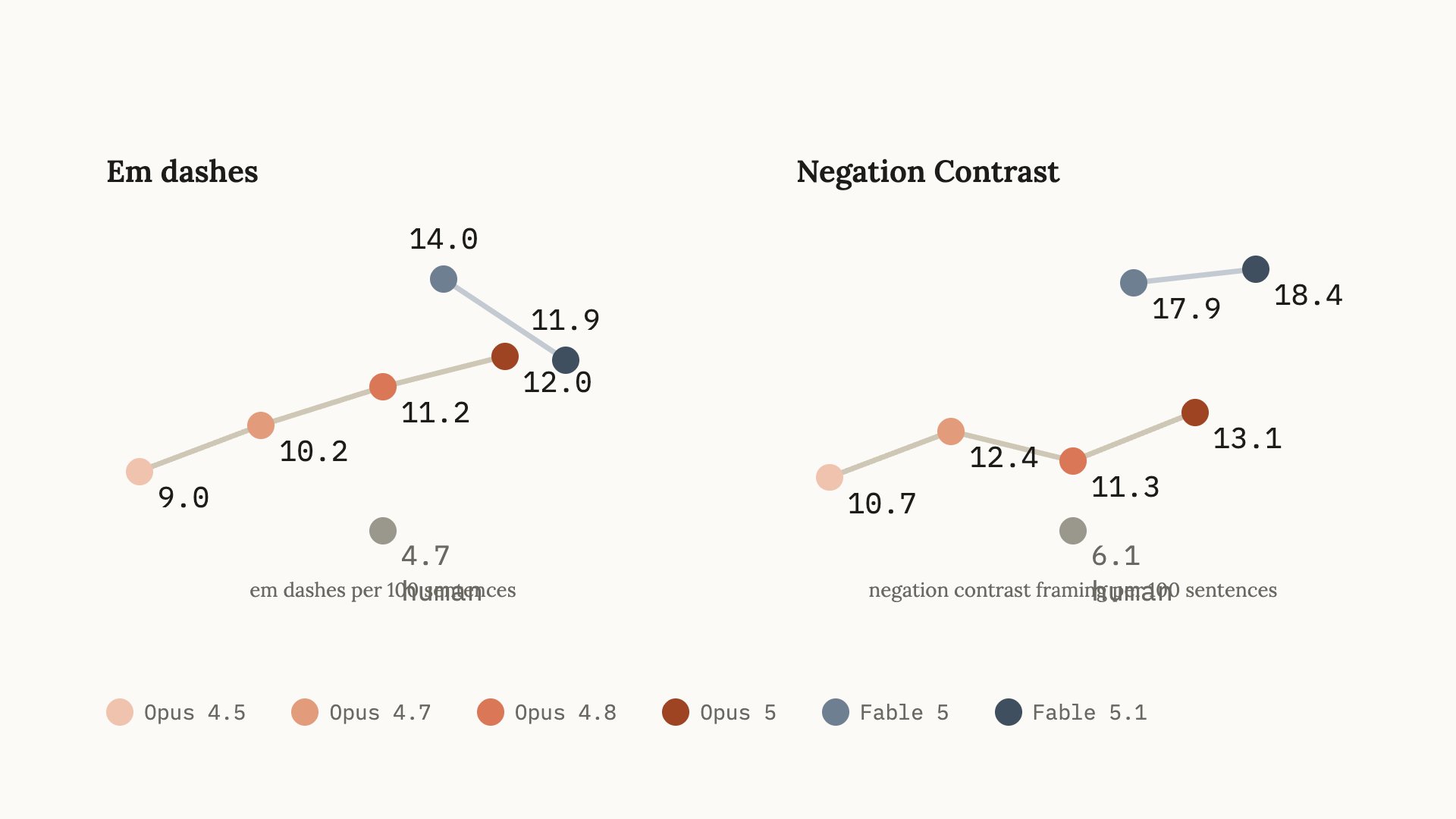
however, while these help reduce some sloppiness, Fable models use a lot more negation contrast and short fragments, at a rate 3x higher than human writing
1
89
Claude Code added a new rule for writing turned on by default for Fable models that specifically removes em-dashes, parentheticals, and arrows--as well as semicolon joined phrases

1
1
352
