

Your go-to place to understand what's happening in the Indian stock market and why. No drama, no nonsense — just insights.
Joined June 2024
- Tweets19.5K
- Following142
- Followers90.7K
- Likes744





In March 2020, Yes Bank wiped off ₹8,415 crore in AT1 bonds to shore up its capital cushion. On October 15, 2026, the Supreme Court declared the write-off legally invalid.
The issue wasn't whether AT1 bonds can absorb losses; they are designed to do so. The issue was how it was done. The draft rescue scheme provided for writing down the AT1 debt, but that clause was dropped in the final approved scheme. The bank administrator wrote them off anyway a day later—acting without statutory authority or backing.
While the total capital of Yes Bank remains stable, restoring bondholder rights transfers capital back to AT1s, shrinking its core CET1 cushion by 250 bps and potentially forcing fresh equity dilution to meet accumulated coupon obligations.
We break down the 2020 AT1 saga, why the timing and authority mattered, and what this landmark ruling means for shareholders and foreign investors.

ALT Source: https://thedailybrief.zerodha.com/p/yes-banks-big-comeback?utm_source=publication-search
We cover this and one more interesting story in today's edition of The Daily Brief.
Read on Substack: thedailybrief.zerodha.com/i/…
Watch on YouTube: youtu.be/yoeA1POKjSk?si=jxKV…
Or listen on Spotify, Apple Podcasts, or wherever you get your podcasts; just search for "The Daily Brief by Zerodha."
Between April and September 2026, regulators carried out roughly 7 lakh inspections—nearly double the rate from the previous year. In Maharashtra alone, over 3,000 raids hit major establishments like Domino's and JW Marriott within a matter of months.
This aggressive push follows FSSAI's shift to perpetual licenses and "risk-based" inspections. By removing the constant need for license renewals, the regulator effectively stripped state officers of the power to demand bribes, freeing them up to actually enforce safety rules out in the field.
But this massive crackdown has exposed serious flaws in the system. The aggressive pacing led to procedural overreach, with 75% of the 3,100 raids in Maharashtra requiring no corrective action, prompting courts to step in and overturn arbitrary license suspensions.
"A risk-based system is supposed to focus resources on habitual offenders, but in this case, the net was spread far too wide."
Beyond the raids, a 340% surge in collected food samples is overwhelming the state's limited NABL-accredited labs, forcing authorities to drastically alter their testing priorities. Meanwhile, FSSAI's attempt to mandate clear, red hexagonal front-of-pack warning labels for products high in sugar or fat remains stuck in a battle between consumer groups, the industry, and the Supreme Court.
We look at the recent FSSAI overhaul, the precedent set by the Maggi testing case, and why finding a safety violation is only half the battle.

We cover this and one more interesting story in today's edition of The Daily Brief.
Read on Substack: thedailybrief.zerodha.com/p/…
Watch on YouTube: youtu.be/yoeA1POKjSk?si=jxKV…
Or listen on Spotify, Apple Podcasts, or wherever you get your podcasts; just search for "The Daily Brief by Zerodha."
Markets by Zerodha retweeted

Given a choice, would you pick a tehsildar job that pays 50K a month, or a pvt. sector job at 3 lakh?
Kunal Mangal asked this of some state exam aspirants in Pune. All of them went tehsildar.
Our latest episode is with Kunal on the cost of India's govt job exams. Links below!
During a July announcement, the government approved the ₹84,084-crore Samudra Manthan offshore oil and gas program running through FY31 to address India's persistent drop in domestic crude production.
Domestic output has dropped 27% since FY12, forcing India to import ~89% of its crude requirements in FY26. Compounding this challenge, existing fields suffer an annual natural decline of 6–7%.
At the same time, offshore exploratory drilling remains extraordinarily capital-intensive. A single deepwater exploratory well requires massive upfront investments of $125M–$150M.
Samudra Manthan directly de-risks these financial hurdles for explorers through targeted allocations. It sets aside ₹28,534 crore for 2D/3D seismic mapping, ₹43,200 crore to subsidise up to 50% of drilling costs for 60 deepwater wells (capped at ₹675 crore per well), and ₹10,000 crore for shared subsea infrastructure.
These incentives align with the 2025 Oilfields Amendment, which introduced single petroleum leases, stabilisation clauses against policy shifts, and cleared over 99% of offshore "no-go" zones for Open Acreage Licensing Policy (OALP) bidding. We break down how the scheme de-risks deepwater exploration, what the legal overhauls mean for private investors, and why commercial production from new blocks is unlikely before the 2030s.

We cover this and one more interesting story in today's edition of The Daily Brief.
Read on Substack: thedailybrief.zerodha.com/p/…
Watch on YouTube: youtube.com/watch?v=uTn8fnBI…
Or listen on Spotify, Apple Podcasts, or wherever you get your podcasts; just search for "The Daily Brief by Zerodha."
During a September hearing, the Supreme Court scrutinised extreme price gaps on non-scheduled cancer medicines, where a drug supplied to retailers for ₹2,700 carried a printed MRP of nearly ₹27,000. The bench described such markups as "broad daylight dacoity" and questioned why consumer prices couldn't be capped.
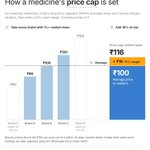
India's drug pricing framework separates medicines into two categories. Essential scheduled drugs face strict ceiling prices calculated by taking the average price to retailers plus a capped 16% retail margin. Meanwhile, non-scheduled formulations make up ~80% of the market and fall outside ceiling price rules, allowing manufacturers to set high initial MRPs.
Without margin caps, manufacturers set inflated MRPs while supplying pharmacies at deep discounts, incentivising hospitals to stock higher-margin brands over cheaper alternatives. Ahead of the Supreme Court's October 12 hearing, the Centre decided to extend a 30% Trade Margin Rationalisation (TMR) cap across all non-scheduled anti-cancer medicines to lower consumer prices without risking supply shortages.
We break down how drug pricing rules function in India, why non-scheduled markups exist, and how trade margin caps aim to balance affordability with supply availability.

We cover this and one more interesting story in today's edition of The Daily Brief.
Read on Substack: thedailybrief.zerodha.com/i/…
Watch on YouTube: youtube.com/watch?v=x1s8tzt3…
Or listen on Spotify, Apple Podcasts, or wherever you get your podcasts; just search for "The Daily Brief by Zerodha."
Markets by Zerodha retweeted
How do developing nations build a functional national innovation system?
Prof. Rakesh Basant, founding member of @IIMAVentures & ex-Chair Professor at @IIMAhmedabad, breaks down evolutionary economics, pharma's capability trap, and broken academic links.
Key insights 🧵

According to the National Statistics Office's first-ever travel survey covering over 20 lakh people, the average Indian worker with a fixed job reaches their workplace in just 25 minutes. In fact, 83.4% of workers complete their trip in under half an hour.
Despite billions poured into modern urban transit, mass rail carries just 2.1% of commuters nationwide and 5% in cities, with most of that concentrated in Maharashtra, West Bengal, and Delhi. Instead, workforce mobility runs primarily on two-wheelers at 42.6%, walking at 28.3%, and personal cars at just 3%.
"For millions of wage earners, a 25-minute commute isn't necessarily a sign of smooth traffic—it reflects 'spatial entrapment,' where high transit costs force low-income workers to settle for lower-paying jobs closer to home."
The survey also reveals a massive gender gap, as only 42% of working women commute over 1 km compared to 62% of men. Meanwhile, long-distance travel isn't about vacations: 70% of overnight trips are driven by family and social ties, while tourism accounts for a mere 7.4%.
We break down what the 25-minute headline figure really masks, why metro adoption remains slow, and how India actually moves.

We cover this and one more interesting story in today's edition of The Daily Brief.
Read on Substack: thedailybrief.zerodha.com/p/…
Watch on YouTube: youtu.be/x1s8tzt3jqk?si=evdN…
Or listen on Spotify, Apple Podcasts, or wherever you get your podcasts; just search for "The Daily Brief by Zerodha."
More spending power, changing food habits, convenience or cheaper ration grain, what’s driving rural India’s spending shift towards drinks, snacks and purchased meals? What do you think?

Aviation turbine fuel (ATF) prices jumped 13% in a single month to ₹137 a litre in Delhi, forcing carriers like IndiGo to hike passenger fuel surcharges. Fuel now accounts for a massive chunk of an airline's expenses, turning previously profitable quarters into heavy losses.
The underlying problem is how jet fuel is priced in India. Even though India refines its own fuel, airlines don't pay local production costs. Instead, prices are tied to global import benchmarks, converted to dollars, and then hit with compounding central excise and state VAT.
"The government offered a ₹10,000-crore price safety net at ₹115 a litre—but when market prices temporarily dropped below that baseline, not a single airline signed up."
Now that fuel prices have spiked again, airlines want the system changed entirely—demanding fixed tax rates and pricing based on actual refining costs rather than volatile foreign benchmarks.
We look at how jet fuel is actually calculated, why the government's protection scheme lapsed, and what airlines are asking for next.

We cover this and one more interesting story in today's edition of The Daily Brief.
Read on Substack: thedailybrief.zerodha.com/i/…
Watch on YouTube: youtu.be/25Tqp2wT6ag?si=KPOT…
Or listen on Spotify, Apple Podcasts, or wherever you get your podcasts; just search for "The Daily Brief by Zerodha."

India’s major players—including JSW, Reliance, and Tata—have announced plans for massive battery cell factories supported by government incentives. But almost all of them have hit a major roadblock: getting access to Chinese technology.
While Indian companies can easily assemble battery packs, making the individual cells inside requires years of hands-on factory experience and fine-tuning. China controls roughly 80% of global battery cell production and nearly 99% of LFP batteries—and it is tightening control.
"We're very keen to make cells in India, but the LFP technology currently is not available for us... LFP is not available anywhere in the world outside of China, and right now they are guarding it like a weapon."
Beijing has added advanced battery know-how to its restricted export list and limited Chinese engineers from traveling to India to help set up machinery and train local workers.
With licensing deals stalled, Indian firms are changing tactics: JSW is pouring money into university R&D, Tata is trying to develop tech in-house, and Reliance has bought up overseas battery patents.
We look at why cell manufacturing is so hard to copy, how Chinese export restrictions work, and how Indian conglomerates are attempting to break the monopoly.

We cover this and one more interesting story in today's edition of The Daily Brief.
Read on Substack: thedailybrief.zerodha.com/p/…
Watch on YouTube: youtu.be/25Tqp2wT6ag?si=KPOT…
Or listen on Spotify, Apple Podcasts, or wherever you get your podcasts; just search for "The Daily Brief by Zerodha."
With CAFE 3 norms set to kick in from April 2027, carmakers were locked in a bitter dispute. Maruti Suzuki fought hard for a special emission discount for small petrol cars, while rivals like Tata Motors and Mahindra fiercely opposed it.
The government has now finalized the rules—and arrived at a clever compromise:
It dropped the explicit small-car concession. Instead, it reshaped the core weight-based formula. Lighter car fleets get significantly higher permitted emission limits, while heavier SUV fleets face tougher targets.
"Under the September proposal, a 909 kg fleet's limit was 76 g/km—the final formula raises it to 82.8 g/km. Meanwhile, a 2,500 kg fleet's limit falls from 151.4 g/km down to 142.4 g/km."
To push cleaner tech, the rules also give green cars extra bonus points toward a company's total score—counting every electric car sold as three vehicles and every hybrid as 1.6 vehicles.
We look at the formula tweaks, the super-credit system for EVs and hybrids, and what this means for Maruti, Mahindra, and Toyota.

We cover this and one more interesting story in today's edition of The Daily Brief.
Read on Substack: thedailybrief.zerodha.com/i/…
Watch on YouTube: youtu.be/se-sdo1R_00?si=GZYp…
Or listen on Spotify, Apple Podcasts, or wherever you get your podcasts; just search for "The Daily Brief by Zerodha."
