

Onchain breakdowns on Ethereum DeFi. Weekly in The DeFi Digest
Newsletter 👉
Joined August 2021
- Tweets10.7K
- Following940
- Followers3.6K
- Likes39K






Pinned Tweet
Every week in my DeFi newsletter, discover:
➡️ trends 📈
➡️ Protocols deep dive 🧐
➡️ Yield Farming Strategies 👩🌾
➡️ Weekly DeFi news 🗞️
You can subscribe: thedefidigest.io/

Lighter spent $4.12M buying back LIT over the 30 days to Nov 3. That's 68% more than in the previous 30 days.
Revenue grew 19% to $5.15M over the same window. Its Robinhood Chain perps deployment brought in $2.09M, roughly 41% of the total.
I'm bullish on the direction for ethereum:0x232ce3bd40fcd6f80f3d55a522d03f25df784ee2. Revenue is growing across both perps deployments, giving the treasury more room to keep buying.
The buyback jump was lumpy, though. $1.4M happened on Oct 28–29, roughly a third of the 30-day total in two days. I wouldn't annualize that burst.
I'd be more bullish if November's revenue keeps growing and those purchases continue outside a couple of big days.

7
15
221
Yannis retweeted
Crypto feels draining lately. Weeks going nowhere, then another leg down.
With so much uncertainty, I get why people hesitate to put fresh money in. Even I’ve been looking elsewhere, including Pokémon cards. There’s always something competing for a degen’s attention and capital.
I still believe the market will turn. Periods like this can offer some of the best opportunities, even when buying feels uncomfortable. That’s why I’m still holding.

Just claimed my free @pudgypenguins booster box.
Love seeing holders rewarded with something they can actually rip open and enjoy. More of this, please.


To celebrate the launch of The Huddle, every big Pudgy NFT and all 245 Set 4 licensees can claim one free booster box of our upcoming @vibes_tcg set, Table for Two.
Claims are on a per-asset basis—one box per eligible NFT and will be open for 7 days.
Claim yours below 🐧

2
23
265
Ethena Pay is offering up to 12% APY with Earn+, through a strategy targeting roughly 11x leverage.
The vault supplies USDe to Aave V4 on Avalanche, borrows USDT, buys more USDe and repeats. Upshift provides the vault infrastructure; Steakhouse manages the strategy.
Putting that inside a payments app is a sensible way to reach people who don’t want to manage loops themselves.
USDe has around $4.5B circulating today. Earn+ starts with a $4.5M vault cap, so it’s early. I’m interested in whether the app can bring in users who stick around when yields fall.
The advertised rate is variable. You’re still exposed to USDe risk and the cost of borrowing USDT. Withdrawals are normally processed within 24 hours, but can take longer.
I’d want the leverage and exit terms to be as easy to find in the app as the 12% headline.

ALT USDe circulating supply, DefiLlama, October 29. Supply context; this chart does not show Earn+ returns or deposits.
5
10
262
Ethereum L1 fees fell for a fourth straight week, while transaction activity held up.
For Oct 19–25, users paid $2.12M in fees, down 13.7%. Transactions were almost flat (+0.2%), and average daily active addresses rose 3.2%.
The average transaction fee came down from about $0.20 to $0.17.
Over on Arbitrum, DeFi TVL rose 4.2% to $1.47B between Oct 19 and 26. USD stablecoin balances grew 2.3% to $3.87 B. Both measures fell on Ethereum and Base.
I haven’t pinned down what’s behind Arbitrum’s increase yet. I’m watching whether those stables stay and where they get used.

7
14
296


Yannis retweeted
Ethereum already has $13.4B in active RWAs onchain. As more of those assets become usable collateral, DeFi’s lending market has room to get a lot bigger.
Ondo, Securitize, Centrifuge and Superstate already have substantial assets on Ethereum. Getting those assets into lending markets is where this starts to get interesting.
Ondo’s SPYon, QQQon and TSLAon can already back stablecoin loans on Euler. SPYon and QQQon are also live on Morpho. You keep the exposure and borrow against it.
That gives lending markets more types of collateral and lets holders borrow against portfolios they already want to own. It also creates demand for the liquidity, oracles and risk management needed to make those markets work.
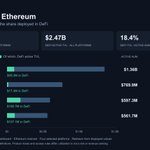
@DefiLlama currently tracks about 18% of that active RWA AUM as deployed in DeFi. Utilization is ~7% for Ondo’s Ethereum assets versus ~31% for Centrifuge. Their products and access rules differ, so the percentages need to be read in that context.
I’m bullish on tokenization becoming a bigger part of Ethereum’s economy. The assets are already onchain, and more of them can become usable across lending, trading and vaults as integrations expand.
For ethereum:0xfaba6f8e4a5e8ab82f62fe7c39859fa577269be3 and the other RWA tokens, I’d still check where the fees end up. AUM growth can be real while token holders capture very little of it.

Yannis retweeted

$13.4B in active RWAs already on Ethereum 👀
- Ondo, Securitize, Centrifuge and Superstate all live there
- The unlock is turning them into usable collateral
Tokenization gets capital efficient when you can borrow against it. That's the number I watch.

Ethereum already has $13.4B in active RWAs onchain. As more of those assets become usable collateral, DeFi’s lending market has room to get a lot bigger.
Ondo, Securitize, Centrifuge and Superstate already have substantial assets on Ethereum. Getting those assets into lending markets is where this starts to get interesting.
Ondo’s SPYon, QQQon and TSLAon can already back stablecoin loans on Euler. SPYon and QQQon are also live on Morpho. You keep the exposure and borrow against it.
That gives lending markets more types of collateral and lets holders borrow against portfolios they already want to own. It also creates demand for the liquidity, oracles and risk management needed to make those markets work.
@DefiLlama currently tracks about 18% of that active RWA AUM as deployed in DeFi. Utilization is ~7% for Ondo’s Ethereum assets versus ~31% for Centrifuge. Their products and access rules differ, so the percentages need to be read in that context.
I’m bullish on tokenization becoming a bigger part of Ethereum’s economy. The assets are already onchain, and more of them can become usable across lending, trading and vaults as integrations expand.
For ethereum:0xfaba6f8e4a5e8ab82f62fe7c39859fa577269be3 and the other RWA tokens, I’d still check where the fees end up. AUM growth can be real while token holders capture very little of it.
Yannis retweeted
Aerodrome + Velodrome are now Aero.
And yes, even existing base:0x940181a94a35a4569e4529a3cdfb74e38fd98631 holders need to migrate.
The merged protocol launches across seven chains, with a new AERO token and sAERO replacing veAERO/veVELO.
Weekly voting becomes continuous allocation. sAERO holders direct rewards to pools and earn a share of their exchange revenue as it comes in.
There’s a 47-hour cooldown between allocation changes at launch.
If you hold tokens or positions in your own wallet:
> AERO: manually upgrade 1:1 to the new token.
> VELO: converts at roughly 0.044 AERO per token. Upgrade from OP Mainnet; receive the new AERO on Base.
> veAERO/veVELO: retrieve your NFT from any Relay or vault, claim rewards and rebases, reset votes, then upgrade to sAERO. Your remaining lock carries over, rounded up to the next full week.
> LPs: migrate to eligible Aero pools to keep earning emissions. Old ALM positions won’t move automatically.
Use the upgrade portals on aerodrome.finance or velodrome.finance. CEX holders should follow their exchange’s migration notice.
No fixed upgrade deadline, but old emissions have stopped and conversion is irreversible.
Using Autopilot? Its first allocation is scheduled for 16:00 UTC today. Allocating manually beforehand triggers the cooldown.
Seven chains gives Aero more room to grow. I’ll be watching whether fee revenue keeps up with the incentives needed to attract liquidity.
Official migration guide in the first reply.

Personal reflection:
Chasing every narrative can leave you with very little capital for the opportunities you actually believe in.
I’m thinking in years, so I’m watching the DeFi teams that keep shipping through the bear and whether people use what they build.
Taking profits matters too. We saw plenty of memecoin gains disappear last cycle while people waited for one more pump.
Which DeFi team has earned your attention during this bear, and what have they shipped?
1
8
317
Earn from onchain stock trading without managing a stock LP.
That’s one reason I’ve locked my base:0x940181a94a35a4569e4529a3cdfb74e38fd98631 for the long term.
SpaceX, Nvidia and Apple tokens already trade on Aerodrome. I’m directing my voting power toward stock pools because I want a share of that activity as more equity trading moves onchain.
The appeal is collecting fees and voting incentives while keeping my main position in AERO. I don’t have to manage stock inventory or concentrated-liquidity ranges.
I’m still exposed to AERO’s price and the lock. My conviction is that more markets trading on Aerodrome can create more fee income for the pools I support. Voting itself doesn’t give me ownership of the underlying stocks.
With Aero’s upgrade scheduled for October 22, reward mechanics are changing. Some migration fees have special treatment, so today’s figures shouldn’t be projected forward unchanged.
At the October 21 snapshot, the SpaceX, Apple and Nvidia USDC pools had about $46,000 in rewards for the October 15–22 voting epoch, almost entirely from trading fees. Those rewards are shared across their voters.
For scale, Blockworks recorded $1.70 million in income across all Aerodrome voters for October 2–8: $1.49 million in fees and $213,000 in incentives.

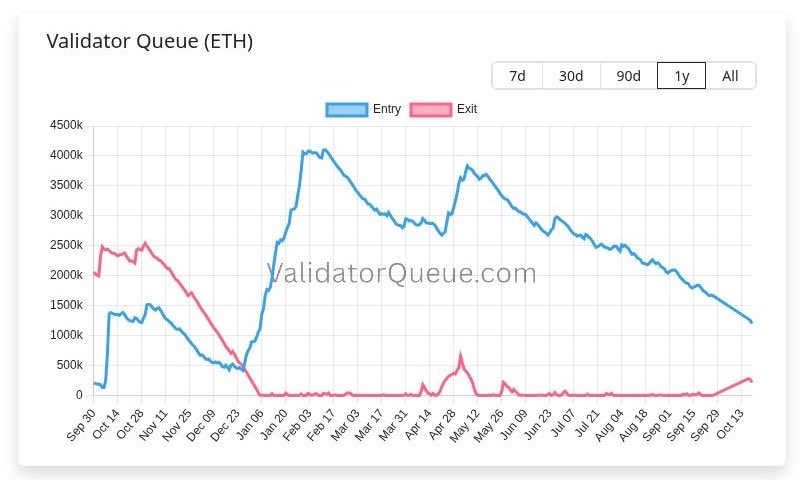
Institutions are staking millions of ETH. So why has Ethereum’s entry queue shrunk 72% since February?
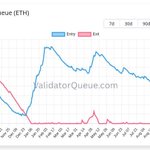
Back in February, around 4.1M ethereum:native was waiting to enter, with a 71-day delay. In May, it was still 3.8M ETH and 67 days. On October 20, we’re down to 1.16M ETH and a 20-day wait.
The backlog is clearing as ETH gets activated faster than new ETH joins the queue. Institutions can keep buying while that happens.
Bitmine reported 5.07M ETH staked on October 18, roughly 84% of its holdings. It continued buying ETH between October 4 and 18, but reported exactly the same staked balance on both dates.
BlackRock’s staking ETF, ETHB, had $1.06B in assets on October 19.
Buying ETH and putting it into staking don’t necessarily happen at the same pace.
Some of the exits also come from security issues. On September 9, 2025, Kiln began exiting all its Ethereum validators as a precaution after a potential compromise of its infrastructure.
Then on September 30, 2026, Lido disclosed precautionary exits by MetaMask Staking after an infrastructure compromise. Lido expected that ETH to return to staking, estimating up to 45 days for the full exit, withdrawal and re-entry process.
So some of the same ETH can pass through both queues without a new spot trade. And ETH joining the entry queue may have been sitting in someone’s wallet already.
I wouldn’t use either curve alone to call institutional buying or a sell-off. The entry queue tells us how much ETH is waiting, while the reasons behind the exits can be very different.
I’m curious whether new deposits start outpacing activations again, and whether ETF inflows pick up alongside them.
4
15
424
Yannis retweeted
Lighter is doing almost 30% of Hyperliquid’s perp volume, with roughly 10% of its open interest.
I still give Hyperliquid the edge today. But Lighter has enough activity and distribution to take seriously.
DefiLlama’s numbers on 17 October:
• 30d perp volume: $214.6B for Hyperliquid vs $63.9B for Lighter
• One-sided open interest: $7.6B vs $748M
• 30d protocol fees: $88.2M vs $5.94M
Hyperliquid’s lead goes from 3.4x on volume to around 15x on reported fees.
Those fee totals cover more than perp trading. Hyperliquid includes spot activity and USDC reserve yield; Lighter includes liquidation fees. They aren’t a clean comparison of trading fee rates.
Lighter’s Standard account charges zero maker/taker fees on ordinary orders, with 300ms taker latency. That’s a credible offer for fee-sensitive traders, although spreads, fills and funding still determine the total cost.
It also has Robinhood Wallet distribution. The Robinhood Chain deployment contributes about a quarter of Lighter’s 30d perp volume. I’d watch how much of that activity stays when rewards change.
Hyperliquid is getting easier for institutions to access through Copper and Ripple Prime. Ripple names Virtu among its RWA swap clients, but those clients face Ripple Prime. The announcement doesn’t tell us how much hedging reaches Hyperliquid.
Lighter has options teased and an EVM at devnet stage. Both could bring more activity, but I’m waiting to see usage once they ship. LIT also has team and investor unlocks starting 29 December, at roughly 3.19M tokens per week.
For now, Hyperliquid has the stronger business. I’d become more constructive on Lighter if its distribution brings sustained growth in open interest and fee-paying activity. Busy volume alone wouldn’t convince me on ethereum:0x232ce3bd40fcd6f80f3d55a522d03f25df784ee2.