
CS PhD at UC Berkeley @Berkeley_AI | BS at Tsinghua University @Tsinghua_IIIS
Joined December 2025
- Tweets21
- Following31
- Followers103
- Likes26



Pinned Tweet
Static benchmarks are dying — they tend to get saturated quickly.
Evaluation and training data should co-evolve with frontier models.
We released BenchEvolver — a framework that automatically evolves saturated problems into harder, verified tasks for evaluating frontier models, which can also serve as useful self-improvement signals for RL.
New work from UC Berkeley @berkeley_ai @BerkeleyRDI @BerkeleySky
Project Page: benchevolver.github.io
Paper: arxiv.org/abs/2606.01286

Yangzhen Wu retweeted

Robotics has spent years scaling demonstration data and model size. What happens when we scale EXPLORATION for robot agents?
We're incredibly excited to share RAX, an agentic robotics system that learns by scaling online exploration.
A coding agent connects directly to the robot’s perception and control APIs, learns from feedback, and builds programs that perceive, plan, and act. The model stays frozen. As exploration scales, the agent improves its programs and builds up reusable skills.
The results:
• ZERO teleoperation or action demonstrations on real robots—from insertion with 0.1 mm clearance and air-fryer manipulation to deformable objects and long-horizon mobile whole-body control.
• +37 percentage points on average over leading learned policies across five simulation benchmarks: RoboDojo, BEHAVIOR-1K, HumanoidArena, DexJoCo’s bimanual tasks, and LIBERO-Pro.
• One framework spanning single-arm, bimanual, dexterous, humanoid, and mobile robots, with new embodiments connected through APIs.
The craziest part: on each real-world embodiment, going from scratch to mastering the tasks took roughly two hours. No teleop. No model finetuning.
We’re open-sourcing the full framework AND every experiment session. We can’t wait to see what people build with it!
Project + sessions: robot-agent-exploration.com/
Paper: assets.robot-agent-explorati…
GitHub: N
Project fully led by @RunhanH and @xczhangxx who are absolutely awesome.
How it works, experiments, and robot videos below 🧵
(1/N)
Excited to see RSI evaluated in realistic, long-horizon research settings—not just through short, isolated tasks.

As AI systems enter a recursive self-improvement loop, the central question is whether it can systematically move beyond human-designed methods to genuinely extend the scientific and intelligence frontier.
What’s missing is a neutral, open standard for evaluating these capabilities in real, production-scale intelligence development.
Today, we’re releasing OpenRSI-Index v0.1: evaluating whether AI can recursively improve itself and push the boundaries of intelligence and science, on production-scale clusters with 1k GPUs.
We turn fully open-source projects into autoresearch environments, with agent trajectories lasting 60+ hours. Building v0.1 took 100K+ H100-hours.
We’re building an ecosystem with and for the research community: let RSI benefit everyone, and let everyone shape RSI together.
We invite task contributors and compute partners to build this open benchmark with us - all contributors will be included as paper authors.
Shape RSI with us:
🌐 Website: index.openrsi.foundation/ind…
🛠️ GitHub: github.com/OpenRSI-Foundatio…
🤝 Contribute: github.com/OpenRSI-Foundatio…

Yangzhen Wu retweeted

Introducing CUA-Lite 🧵 — an open platform for computer-use agents.
Training and benchmarking CUAs (Computer-Use Agents) requires four core pieces:
1️⃣ Agents — the models and the scaffolding that drives them
2️⃣ Environments — runtime/sandboxes for agents to interact with, tasks & verifiers/graders
3️⃣ Traces — records of agent trajectories
4️⃣ Frameworks — to evaluate, SFT & RL-train agents
Today, all four are fragmented.
Every agent ships with its own implementation, often in a separate repo — there is no unified way to run them all. Every environment exposes its own interface and action space, often requiring an expensive VM sandbox for each verifiable task. Traces come in incompatible formats. And without common standards across the stack, every project ends up rebuilding its own tooling/framework for eval, SFT, and RL.
CUA-Lite unifies the stack:
→ One standardized interface & action space for agents and environments
→ One standardized format for agent traces
→ One framework for evaluation, SFT & RL
→ Across desktop, browser & mobile
And open resources plug straight in, creating the largest open collection of CUA agents, environments and traces, all in a unified format:
🤖 10+ CUAs, including GPT, Claude, Gemini, Qwen, Muse-Glimmer, UI-TARS
🌐 15+ benchmarks, including OSWorld, WebArena & AndroidWorld
⚡ Optional VM-free sandboxes with 30K+ verifiable tasks for training
📚 10+ trace datasets, freely available on Hugging Face, including public datasets converted into the standardized format and fresh rollouts from frontier open-weight CUAs
Led by @BerkeleyRDI , our goal is for CUA-Lite to become a community-driven, open-source ecosystem for computer-use agents.
Join the community and contribute today: bring an environment (runtime/sandbox + tasks + verifier), traces, or an agent, and plug it into CUA-Lite!
Yangzhen Wu retweeted

Can an AI agent surface why an ML paper might be hard to reproduce — just by reading it, without running any code?
We build ReproRepo, a framework for auditing reproducibility with agents.
Across 1,149 recent papers, the best agent surfaced a semantically related, human-reported reproducibility blocker for ~90% of them. 🧵👇

Yangzhen Wu retweeted

Self-improvement depends on whether a model can judge its own work. We usually train models to generate better - why not train them to verify just as well?
We show how to train models to pinpoint their errors, and the same model nearly doubles its accuracy on hard math and jumps 14x on scientific reasoning. 🧵1/5

Yangzhen Wu retweeted
Static benchmarks inevitably saturate as models improve.
Our recent work explores how to evolve existing tasks into harder, validated variants that co-evolve with frontier models — and also serve as RL training data for self-improvement.
A step toward benchmarks that evolve as quickly as the models they measure.


Static benchmarks are dying — they tend to get saturated quickly.
Evaluation and training data should co-evolve with frontier models.
We released BenchEvolver — a framework that automatically evolves saturated problems into harder, verified tasks for evaluating frontier models, which can also serve as useful self-improvement signals for RL.
New work from UC Berkeley @berkeley_ai @BerkeleyRDI @BerkeleySky
Project Page: benchevolver.github.io
Paper: arxiv.org/abs/2606.01286
Easy problems are dead data for RL when model solves it perfectly.
BenchEvolver turns saturated coding problems into harder verified tasks for self-improvement.
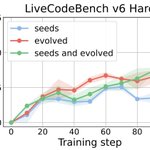
Result: RL on evolved data gives 34.8%–115.6% larger gains than RL on the original seeds across 3 coding benchmark

Static benchmarks are dying — they tend to get saturated quickly.
Evaluation and training data should co-evolve with frontier models.
We released BenchEvolver — a framework that automatically evolves saturated problems into harder, verified tasks for evaluating frontier models, which can also serve as useful self-improvement signals for RL.
New work from UC Berkeley @berkeley_ai @BerkeleyRDI @BerkeleySky
Project Page: benchevolver.github.io
Paper: arxiv.org/abs/2606.01286
Yangzhen Wu retweeted

It’s a fascinating job; the bench is always on the hunt for the “Holy Grail”. What is often overlooked is that the Holy Grail has become fixed in our minds, whereas the real world needs a Holy Grail Evolve
Static benchmarks are dying — they tend to get saturated quickly.
Evaluation and training data should co-evolve with frontier models.
We released BenchEvolver — a framework that automatically evolves saturated problems into harder, verified tasks for evaluating frontier models, which can also serve as useful self-improvement signals for RL.
New work from UC Berkeley @berkeley_ai @BerkeleyRDI @BerkeleySky
Project Page: benchevolver.github.io
Paper: arxiv.org/abs/2606.01286
Yangzhen Wu retweeted

We are really excited to share our recent work, BenchEvolver, a framework for transforming saturated benchmark tasks into challenging ones for frontier models.
We hope our work encourages the community to rethink benchmarks not as fixed datasets, but as adaptive evaluation systems. For many verifiable domains, automated and reproducible pipelines can continuously generate, validate, and calibrate new tasks as frontier models improve.
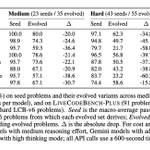
Our results are promising: some beginner coding tasks, such as LeetCode Easy problems, can be evolved into extremely challenging problems comparable to the hardest tasks in top competitive programming contests, with estimated Codeforces ratings around 3000. Beyond evaluation, these synthesized tasks also enable self-improvement of frontier models.
Paper: arxiv.org/abs/2606.01286
Project Page: benchevolver.github.io/

Static benchmarks are dying — they tend to get saturated quickly.
Evaluation and training data should co-evolve with frontier models.
We released BenchEvolver — a framework that automatically evolves saturated problems into harder, verified tasks for evaluating frontier models, which can also serve as useful self-improvement signals for RL.
New work from UC Berkeley @berkeley_ai @BerkeleyRDI @BerkeleySky
Project Page: benchevolver.github.io
Paper: arxiv.org/abs/2606.01286
6/7 Most importantly, evolved tasks are not just harder benchmarks. They become valuable training signals for self-improvement.
For example, using gpt-oss-20b as both evolver and target, RL on evolved tasks improves held-out coding performance beyond training on the original seeds alone. 34.8% more gains on LiveCodeBench Pro and 70.7% more gains on LiveCodeBench v6.
Which means BenchEvolver closes the self-improvement loop:
models generate hard tasks → learn from them → get stronger.


7/7 Any fixed benchmark will eventually saturate.
BenchEvolver points toward living benchmarks: reproducible pipelines that periodically generate, validate, and calibrate new tasks against current frontier models.
Thanks to my collaborators from UC Berkeley and Tsinghua University! @aaron_jli @wenjie_ma @mertcemri @shulynnliu Yu Bin @istoica05 @dawnsongtweets
Paper: arxiv.org/abs/2606.01286
Webpage: benchevolver.github.io/
Dataset: huggingface.co/BenchEvolver
Code: github.com/thu-wyz/BenchEvol…
Yangzhen Wu retweeted

Our Inference Scaling Laws paper received an Outstanding Paper Award at NeurIPS Math-AI!
Congrats to Yangzhen (@WYZ0402), Zhiqing (@EdwardSun0909), Shanda (@Shanda_Li_2000) and Yiming!


2. Inference Scaling Laws: An Empirical Analysis of Compute-Optimal Inference for Problem-Solving with Language Models
arxiv.org/abs/2408.00724
Oral presentation at Math-AI!
Saturday, West Meeting Room 118-120
xitter.cf/wellecks/status/182125…
Yangzhen Wu retweeted
How do we optimally use compute at inference time?
New paper led by @WYZ0402: "An Empirical Analysis of Compute-Optimal Inference with LMs"
arxiv.org/abs/2408.00724
We study scaling laws of inference, finding that smaller models with sophisticated inference are compute-optimal.

