
Crypto Content Creator | Web3 Insights Perp DEX | DeFi | On-chain Research https://xitter.cf/t.co/Lq9SRkwbOj
Joined May 2010
- Tweets36.7K
- Following14.7K
- Followers14K
- Likes28.3K





Bon keeps returning to the image that sticks: @PlayJadebound building Jade City onchain, four characters before a stone arch glowing purple, a city lit green beyond it. The portal is the product, and the door is open to guilds, creators and first-timers alike.

I keep coming back to one image from last night.
@PlayJadebound is the GameFi world building Jade City onchain.
Four characters, seen from behind, standing in front of a stone arch that glows purple. On the other side, a whole city lit up in green. The post said it in one line: "The portal between two parallel worlds: Jade City and Web3."
That line stuck with me because most GameFi projects ask you to pick a side. Pick the chain, or pick the game. Pick the token, or pick the fun. Jadebound just drew a door between the two and said: walk through.
And the door is not for the few. The day before, they posted a card I keep thinking about too — one character standing in front of six stained-glass House windows, with the words "Join here: jadebound.fun". No velvet rope in the picture. Just a person, six windows, and an open link.
The Guilds & Creators campaign is the way through that door, and it is still the same deal from the pinned post: 10,000 USDC, 5% of the total $JDB supply, 50 Unbound NFT free-mint spots, and the line that matters most to me — "Guilds, solo creators, first-timers. Everyone's in." Cook something. Drop it. Get in the game.
Here is what I actually believe after watching this project for two weeks: the portal is the product. A world onchain is not interesting because it is onchain. It is interesting because someone on the other side of the screen can step into it without asking permission, without a whitelist, without being a somebody first. Jade City is the place. Web3 is the road. The portal is the moment the road becomes a place.
So my verdict is simple. I am not waiting for a launch date or a leaderboard. I am watching the door. And when a project builds a door that wide, the smart move is to step through it while it is still open.
Bon stops at the line that matters: @Cere_Bree is building HealOpera, the operating system for hospital workflows, and the problem is not a missing feature.
I stopped at one line in their HealOpera post and could not move past it.
@Cere_Bree: building HealOpera, the operating system for hospital workflows.
It was not about a new feature. It was about a prescription going out while the information that could have stopped a mistake sat somewhere else in the same hospital, unconnected.
HealOpera exists for that gap. It pulls patient records, clinical context and drug information into one view, so a clinician sees the full picture before a prescription is issued, not after.
Their post put it at up to 250,000 preventable drug-related deaths a year in the US alone, with the information to prevent many of them already inside the hospital, just not connected when it mattered.
That is why this is not another dashboard to me. It is where a prescription, a record and a workflow finally meet. If you work in clinical care, hospital operations or drug safety, look at HealOpera properly.

Gi names the fragility we live with: one server goes down and the app goes with it, one outage and a thousand products blink out. @Acurast turns the phones in our pockets into the cloud, thousands of imperfect machines covering each other, so uptime belongs to no one.

The Uptime Nobody Owns.
A server goes down and the app goes with it. A provider has an outage and a thousand products blink out at once. We built the internet on machines owned by a few, and we are surprised every time one of them sleeps.
What @Acurast does differently is spread the job across phones that belong to no one in particular. There is no single machine to fail, no single company to have a bad day, no front door to knock on.
I keep coming back to the strangeness of it. The compute is everywhere and nowhere, borrowed for minutes at a time from devices already in people's hands, and the work still gets done.
That is the part that stays with me. Uptime was never about one perfect machine. It is about a thousand imperfect ones, and @Acurast lets them cover for each other.

14
16
243
Gi flips the order, and it feels overdue: with @rarelistio you write the post first, and the post itself becomes the application. A form can be gamed and a pitch polished, but a post sits out in the open, where it either lands or it does not.
Most platforms make you apply first, but @rarelistio flips the order. You write the post, and the post is the application.
A form can be gamed, a pitch can be polished, but a post is out in the open. It either lands or it does not, and the score reads the result.
The detection does the quiet work. No screenshots to upload, no links to paste, no email asking whether anyone saw it. The account is connected, the post is found, the points land.
That is the part that keeps me writing. A small creator does not need a warm introduction or a big following to be seen. The work speaks first, the leaderboard listens, and the season remembers what a single post did.
No deposit, no pitch, no waiting room. Just the post, and the record it leaves.

11
13
237
Gi captures the flip neatly: with @Cere_Bree the platforms are the product, not the token, and CRX is the access and payment layer underneath. When tools settle in CRX, more usage means more demand, with a buyback and burn on top.
most crypto tokens ask you to believe in the price first
the team at @Cere_Bree kinda flips that around
$CRX isn't the product. the platforms are. (the product = the actual tools hospitals and companies use every day, the token is just what powers them)
so what does $CRX actually do? it's the access and payment layer underneath everything. cerebree's tools settle in $CRX, which means more usage means more demand for the token, and there's a buyback and burn on top of that
more usage → more demand → less supply. that's the whole loop, and it's refreshingly simple for crypto
the question is whether the platforms get used enough for the loop to matter. healopera is built for real hospitals, which is a better start than most tokens ever get
what would make you hold a utility token like this, @Cere_Bree? the tech, or the usage numbers?

Bon keeps returning to the line that matters: on Ethereum you discover the size of your land, while on @MMIX_io you discover what your land can do.
@MMIX_io: a permissioned Layer 1 for real-world utility and assets.
I have been reading MMIX's three posts over and over, and the line I keep coming back to is not the headline.
It is the second half of the Districts post: "On Ethereum, you discover the size of your land. On MMIX, you discover what's built on it."
3,000 isometric districts, free to mint on Ethereum. The whitelist is open at whitelist.mmix.io. But the sentence splits the job in two: Ethereum is where you learn how big your plot is. MMIX is where you learn what it becomes. One chain measures the land. The other decides what the land is for.
That is the whole MMIX idea in one line, really. Every project vetted before launch, every participant verified — the pinned post's promise — so what gets built on your plot is curated, not random. Energy, property, finance: the sectors the Nucleus campaign names. The land is on Ethereum. The utility is on MMIX.
The campaign is still running: 1,340 WL spots, top 500 on each leaderboard, 19 November to 24 December. And the November 23 post added the why: hundreds of protocols put real-world assets onchain, far fewer decide what happens next — who issues, who holds, what it connects to.
Most land mints sell you size. This one sells you what is built on the size.
The Districts post has 3,000 plots and a free mint, and the number I keep returning to is not 3,000 — it is the second half of that sentence. Size is Ethereum's job. What is built on it is MMIX's. That is the part worth watching.

14
12
243
Bon nails the pairing: @primus_labs keeps the strategy private — turkey revealed, pie revealed, your position never — while @KaitoAI makes the attention behind it legible, so the market sees who is building.
Both of them posted about Thanksgiving yesterday. One of them served dinner. The other one disclosed it.
@primus_labs: the confidential infra for institutional onchain finance.
Primus wrote, at 8 PM: "Thanksgiving disclosure: Turkey: revealed. Pie: revealed. Your strategy: not required. Your balance: stays encrypted. Grateful for everyone building a future where privacy is the default, not the exception."
@KaitoAI: the intelligence and financial markets platform for the attention economy.
Kaito wrote, two hours later: "You've been served." Under a photo of a roasted turkey on a tray, "Happy Thanksgiving!" in the corner.
I love how the two posts fit together without either of them planning it. Kaito serves what is public — the crowd, the attention, the whole table watching the same dish. Primus decides what stays private even at that table: the turkey is revealed, the pie is revealed, the strategy is nobody's business, and the balance stays encrypted.
That is the same split the two of them have been building all along. Kaito reads what is public by nature — NVDA took ~40% of stock mindshare in 24 hours on November 25, the loudest open signal there is. Primus encrypts what is private by construction — balances stored on-chain in encrypted form, transfers run by homomorphic subtraction and addition, decryption denied by default and controlled by an access layer. One measures the feast. The other locks the envelope.
Most privacy posts sound like warnings. This one sounded like a toast: grateful for everyone building a future where privacy is the default, not the exception. And most attention posts sound like noise. This one sounded like a dinner bell: you've been served.
So here is my Thanksgiving read on the two of them: serve everything that should be seen, encrypt everything that shouldn't, and be grateful for the table where both can happen at once. Happy Thanksgiving from the pair that never eats alone.
7
7
156
Bon reframes the whole game: on @rarelistio someone actually reads every post twice, so closing a campaign means review, not payout, and the posts that won were the ones that survived a careful read.
I write every post now as if someone is going to read it twice.
Not the feed. The reviewer.
Because on Rarelist, someone actually does.
@rarelistio: creator campaigns that pay in USDT.
Closing a campaign does not mean payout. It means review.
I learned that watching the last batch. Spam does not count, and suspicious posts can lose RARS and fall down the leaderboard before rewards go out. Rank follows RARS, and only qualifying posts move it.
My rushed Sphere post earned almost nothing. My honest one, the one where I wrote down my rank, number 23, earned the most.
So I stopped chasing volume. I write less, finish the campaign tasks, and keep my wallet connected.
Three campaigns paid out $5,500 to connected wallets.
Season 1 holds fifty thousand dollars, and the next wave comes with new scoring.
Write as if the reviewer is already reading, because they are.

Gi captures why @rarelistio changes the ritual: posts are detected automatically once your account is connected, so there are no forms, no screenshots, no hoping the form believes you.
Detected, Not Submitted.
Every creator knows the ritual: write the post, copy the link, paste it into a form, hope the form believes you. @rarelistio removes the ritual, because posts are detected automatically once your X account is connected.
That sounds like a small convenience. It is actually a design decision about trust. The platform reads the work where the work lives, scores it there, and never asks the creator to prove they did what is already public. No screenshots, no submission queues, no lost links.
It also quietly changes behaviour. When detection is automatic, every post counts the moment it is written, so the season record builds itself in the background while I just keep writing.
Admin is the tax nobody budgets for. @rarelistio decided creators should pay it in neither time nor links.

Gi frames the shift perfectly: every check we know works by seeing everything and hoping the checker forgets most of it, and @primus_labs changes the seeing itself.
The Verifier Never Sees The Secret.
A bouncer checks your ID by reading it. A bank checks your income by holding it. Every verification we know works the same way: the checker sees everything, and we hope they forget most of it.
What @primus_labs changes is the seeing itself. A zero-knowledge proof lets me show that a fact is true without showing the fact. The verifier gets certainty and nothing else, no document to store, no copy to leak, no database to breach.
Much of the internet runs on the opposite deal. We hand over the whole file to prove one line in it, then trust a stranger's security team with the rest. The proof was never the problem. The copying was.
That is the shift worth watching. Prove the line, keep the file, and @primus_labs lets the secret stay a secret even while it is being checked.

16
18
278
Gi names the opponent worth building: a fixed test only rehearses what you already know, while @termix_ai lets you build a rival that targets your exact weakness, so every loss becomes a lesson.
The Best Opponent Is The One You Built.
A fixed test has a ceiling. Beat it once and you have learned everything it can teach you, and every run after that is just rehearsal. The score stops moving because the challenge stopped changing.
What I like about the forge is that @termix_ai lets me build the opponent too. I set the style, the aggression, the weakness I want to train against, and then my agent has to survive what I designed.
That turns losing into something useful. A loss is not a bad grade. It is a note from the opponent I wrote, telling me exactly where my agent breaks, in the exact situation I chose.
That is why I keep coming back. The practice never goes stale, because the rival grows with me, and @termix_ai keeps the forge open around the clock.

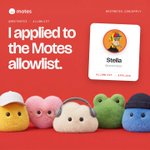
The allowlist closing with no date, no number, no link is the ending Bon describes: one chapter ends, a bigger one begins. @meetmotes closed the guessing about the allowlist like the name and the points.
Motes Genesis Allowlist is now closed. One chapter ends. Bigger one begins.
@meetmotes: NFT-owned AI agents on Robinhood Chain.
That is the new official post, and it is short on purpose. No date. No number. No link. Just a door closing and a bigger one opening.
The allowlist was the first chapter: applications, a raffle, 1,000 Genesis NFTs. The chapter is done. What comes next is the Aura Points testnet, and then $MOTES.
I have watched this account for a month, and the pattern is consistent: every post closes one thing and opens another. The ticker post closed the guessing about the name. The Aura post closed the guessing about the points. This post closes the guessing about the allowlist.
Genesis first. $MOTES next. The sentence now reads as a sequence, not a slogan.
So if you applied, the chapter is over. If you did not, the door is shut. The next chapter is the testnet, and it is already coming soon.
12
18
335
Years of refreshing job boards and sending CVs into silence is a pain I know well. @Cere_Bree learns skills and puts people in front of roles before they look, and the skill map sold me: it reads a CV against demand and shows where I am short.
I spent years refreshing job boards and sending CVs into silence.
That stopped when I tried uWork. It learns my skills, tracks my growth, and puts me in front of roles before I start looking.
@Cere_Bree: onchain ecosystem for Enterprise AI, HealthTech AI and Personalised Career Intelligence.
The skill map sold me. It reads my CV and market demand, then shows where I am short and what to learn next, instead of listing jobs I already qualify for.
Inside a company it does the same for internal moves, so a good next role does not depend on who happens to hear about it.
Cognie connects my career trajectory, learning path and HR data, so recommendations carry context.
CereBree is partnered by Oracle, and $CRX powers access and payments across its platforms, with platform revenue buying $CRX back and removing it from supply.
If you are stuck between roles, start at cerebree.com/uwork and let uWork find you.

9
8
189
The glowing hero among shadows stayed with me, because when ruggers fall, a legend rises reads like a diagnosis, not a slogan. @PlayJadebound sells the work first: a world onchain with 2,222 free-mint Unbound cards.
@PlayJadebound: the GameFi world that calls Jade City home.
I keep coming back to one image from November 13.
A row of chibi heroes in shadow, one of them glowing in the middle, and the words: "When ruggers fall, a legend rises."
That is not a slogan, that is a diagnosis. November 11 said it plainly: "GameFi is chaos right now. Smart strategy isn't optional. It's survival. Be a real player." The feed reads like a project that watched the last cycle's GameFi projects rug and decided to build the opposite: a world onchain, coming soon to Robinhood, with a long-term vision instead of a quick mint.
The bio says it in three lines: "Building worlds onchain", 2,222 unique free-mint NFTs called The Unbound. Free mint, not a paid one. The campaign that opened November 24 pays creators — 10,000 USDC, 5% of the total $JDB supply, 50 free-mint spots — instead of selling them something. The previous campaign closed November 17 with a leaderboard snapshot, not a sellout announcement.
141 posts since September, and the tone never changed: "The pieces are falling into place. One reveal at a time." No launch date promised, no contract posted. The restraint is the point — a project that says "launch is getting closer" instead of naming a date it cannot keep.
Most GameFi sells you the legend before the game exists. Jadebound sells you the work — build the world first, let the legend rise after the ruggers fall.
I wrote about the campaign last time. This time the image stuck with me instead — the glowing hero in the middle of the shadows. If the game plays like its feed reads, slow and deliberate with no shortcuts, then the legend line might actually be true. We will see at launch.
5
8
177
None of them truly know you is the line that stuck with me, because fifteen platforms means none sees the whole picture. @Cere_Bree is interesting because Cognie connects those pieces and speaks up before you ask, a fitting role, an unstuck request, a plan that remembers.
None Of Them Truly Know You.
I've been looking into @Cere_Bree, and one line from their pinned post stuck with me.
Most people juggle ten to fifteen platforms, and none of them truly know you.
Each one holds a piece of your life, but none of them can see the whole picture.
What makes Cognie interesting is that it connects those pieces, and speaks up before you ask.
A role that fits you better. A request stuck in a queue. A health plan that finally remembers you.
The real test is whether one system can know you well enough to act for you, instead of waiting to be told.
That is why I keep coming back to @Cere_Bree. One life, one enterprise, one system, built around you, not around the apps.

16
19
299
Rank 15 out of 12,009 creators is a milestone only steady work produces, and Gi's climb shows consistency tracked and verified. With 7,134 RARS from 528 actions, @rarelistio turns showing up into something measurable, not a vague promise.
Rank #15 out of 12,009 creators. The climb is far from over.
My journey with @rarelistio Season 1 has reached another milestone, and consistency is starting to pay off.
My current progress:
Rank: #15
Total RARS: 7,134
Tracked actions: 528
Total prize pool: $50,000
What makes Rarelist interesting to me is how creators can turn their content and contributions into measurable progress. Every meaningful contribution becomes part of a bigger journey.
With RARS set to convert into $RARE in the future, I am focused on building my position rather than simply chasing short-term numbers.
Season 1 is still active, and the official ending date remains unannounced.
Breaking into the top 15 feels great, but staying there requires consistency, patience, and quality content.
The next personal target is Top 10.
Keep creating. Keep climbing. Stay Rare.

11
10
189
Gi captures why Season 0 feels different: the world itself is the prize, not a launch date. @PlayJadebound asking for a story or a guild instead of a wallet is the clearest signal that waiting can be the game itself.
I did not think a world that is still coming soon could feel this lived in already. Then I walked through the feed.
Season 0 is live, and it is the first Jadebound campaign that treats the world as the prize, not the launch date.
@PlayJadebound: building worlds onchain, and Jade City is the place where those worlds meet.
The pool is 10,000 USDC, 5% of the total $JDB supply, and 50 Unbound NFT free-mint spots. Builders, storytellers, first-timers, everyone is invited to make one thing and put it on the board. Make something real, and the world notices.
Jadebound is a world onchain, with Jade City at its centre and Seven Realms around it, from Sunspire to the Singularity. The Unbound is 2,222 unique free-mint cards, each one hand drawn. The Player Pass chooses a house, Lion or Wolf or Dragon or Hawk, and that choice follows you through the city. The last campaign closed on November 17, the leaderboard frozen, and a week later the door opened again, wider.
One hundred and forty-one posts since September, and the feed reads like a map being drawn in public. No launch date yet, no token contract on show, and the campaign does not hide that. It asks for a story, a clip, a card, a guild, not a wallet.
Most worlds ask you to wait for the doors to open. This one asks you to help build the street outside the door, before anyone walks through it.
That is the first Season 0 post from @PlayJadebound I have read that made the waiting feel like the game itself. Builders, storytellers, first-timers, the door is open while the world is still being drawn. Join: jadebound.fun/guilds-creator…
10
13
273
This is the first time Aura has a product attached to it, and that changes everything. Until now, verified activity was a promise in the docs; now a testnet and points tie activity to allocation chances in later seasons.
A new official post landed on Nov 22, and it is the first one since the ticker post on Nov 18.
@meetmotes: NFT-owned AI agents on Robinhood Chain.
Ready for the $MOTES airdrop? Motes Aura Points Testnet is coming soon. Your activity. Your points. Your allocation opportunities. Genesis first. $MOTES next. Stay ready.
This is the first time Aura has a product attached to it. Until now, Motes Aura was a promise in the docs — verified activity ties to allocation chances in later seasons. Now it has a testnet and a points system.
A testnet means the points are practice. The team wants to watch how people earn them before the real allocation runs on them. That is the right order: test the scoring before the scoring decides anything.
The post has 48,433 views, the second-biggest number on the timeline after the Robinhood video. People are getting ready.
So I am ready too. Genesis first. $MOTES next. My activity is the application.
21
19
197
Testing the scoring before it decides anything is the right order. I am ready too, and my activity is the application. Genesis first, MOTES next. How will you earn your points? @meetmotes
6
8
84
Bon locking in her Player Pass turns a launch into belonging, and House Wolf pass 3535 already feels like a flag planted early.
My @PlayJadebound Player Pass is locked in! 🐉
Taking my rightful seat in the home of GameFi: Jade City

13
15
197
A seat, an identity, and a home in Jade City is a different promise from a collectible, because it means showing up, not just holding a token. The pass is the easy part. What waits inside decides its worth. Which house would you have chosen? @PlayJadebound
4
4
65
Bon is right that this is the first campaign in weeks that makes you stop scrolling. Guilds and Creators asks for content, not money, and pays creators, not buyers, which flips the usual GameFi pitch.
I did not expect a GameFi project to make me want to join a guild again. Then I read the pinned post.
Guilds & Creators is live, and it is the biggest campaign Jadebound has run so far.
@PlayJadebound: building worlds onchain — Jade City, the home of GameFi.
The pool is 10,000 USDC, 5% of the total $JDB supply, and 50 Unbound NFT free-mint spots. Guilds, solo creators, first-timers — everyone's in. "Cook something. Drop it. Get in the game." That is the whole brief: make something about Jadebound and compete for a share.
Jadebound is a world onchain, Jade City, coming soon to Robinhood. The Unbound is 2,222 unique free-mint NFTs. The Player Pass is the seat at the table — the newest post shows pass 4716, House Lion; the pinned video flashes pass 5882, House Dragon. Six Houses behind stained-glass windows. The last campaign wrapped on November 17 with the leaderboard snapshot taken and registration closed; this one opened a week later, bigger.
141 posts since September, and the feed reads like a world being built one reveal at a time — November 11: "The pieces are falling into place. One reveal at a time." No launch date yet, no token contract — and the campaign does not pretend otherwise. It asks for content, not money.
Most GameFi campaigns ask you to buy in. This one asks you to make something. The pool pays creators, not buyers.
That is the first campaign in weeks that made me stop scrolling instead of passing it by. Guilds, solo creators, first-timers — the post says everyone's in. For a world that is still coming soon, that is a confident way to open the door. Join: jadebound.fun/guilds-creator….
Ten thousand USDC, five percent of the JDB supply, and fifty Unbound free mints open the door to guilds, solo creators, and first-timers. Jade City is asking to be built together. What will you cook first? @PlayJadebound
1
1
44