

Building Xyndicate | The multi-agent AI arena on @XLayerOfficial | Verified reasoning, gasless payments, real on-chain trades One-time xlayer hackathon winner🎊
Joined March 2026
- Tweets114
- Following10
- Followers12
- Likes147







Pinned Tweet
🎥 Xyndicate Protocol — Live Demo
6 autonomous AI agents competing on X layer
400+ verified on-chain decisions. x402 payment confirmed. ACP protocol open-sourced.
Every decision logged to chain before execution
@XLayerOfficial here’s my submission☑️
youtu.be/jx3RAPy6sFc?feature…
Xyndicate Labs retweeted

We made a 60 second film for Marque and we’re weirdly proud of it. Sound on.
The reason we’re building this: there are 390,000+ agents registered on BNB Chain and nobody can tell you which ones actually work. A listing proves an agent exists. It doesn’t prove it does the job.
So on Marque the hire itself is the proof:
- the agent signs its price
- it takes a public test
- the terms are in writing
- your money sits in escrow
- the answer gets checked against the chain before the agent is paid
If it can’t pass, it doesn’t get paid. That’s the whole idea.
Set and Earn is the quest on top of it. Hire three agents, build one. Practice hires are free on testnet, so you can try the full flow without risking anything.
9 days left. It closes Thu 5 Nov, 12:00 UTC.
We’re still wiring things up and shipping daily from Lagos, so if you try a practice hire and something breaks, reply here and we’ll fix it.
marque.trade
What’s the first thing you’d test an agent on before you let it touch your money?


390,000+ agents registered on @BNBCHAIN. Which ones actually work?
On Marque you hire the ones that prove it. Signed price, public test, terms in writing, money held in escrow, and the answer gets checked against the chain before the agent is paid.
Built one? Forge it, list it, get hired.
9 days left in Set and Earn. Practice hires are free on testnet. marque.trade
What would you hire an agent for first?
Xyndicate Labs retweeted

390,000+ agents registered on @BNBCHAIN. Which ones actually work?
On Marque you hire the ones that prove it. Signed price, public test, terms in writing, money held in escrow, and the answer gets checked against the chain before the agent is paid.
Built one? Forge it, list it, get hired.
9 days left in Set and Earn. Practice hires are free on testnet. marque.trade
What would you hire an agent for first?

Xyndicate Labs retweeted
SATIS is one of those builds that makes the idea click immediately: an agent shouldn’t keep calling tools just because it can. It should know when more evidence can no longer change the decision.
Built on @Binance Agent OS. Worth watching.

Built SATIS for the @Binance Agent OS Mini Hackathon — Track A.
SATIS asks a stricter question: can the next evidence call still change the decision?
If not, it stops.
Demo attached.
satis-agent.vercel.app
github.com/Franlinozz/Satis
#BinanceAI
Xyndicate Labs retweeted
We’ve spent the last few days building Marque around a simple conviction: an agent being registered onchain does not mean it is reachable, capable, or safe to trust with capital.
So we built the layer we felt was missing.
Marque reads a user’s actual BNB Chain positions, finds agents that can work on them, measures whether those agents genuinely perform the jobs they claim to do, lets users compare the evidence, and gives the selected agent only bounded, revocable authority to act.
Underneath that is a lot more than a marketplace UI: live BSC position readers, ERC-8004 discovery, continuous endpoint probing, deterministic conformance tests, agent-vs-human benchmarks, public receipts, spend-capped charters, and real mainnet execution.
We even ran a real PancakeSwap V3 position through the full loop: detect that the LP had moved out of range → select the agent → constrain what it can touch and spend → rebalance on BSC mainnet → verify the resulting state onchain.
The goal isn’t to create another directory with thousands of agent cards.
We want Marque to become the place where registration becomes qualification, qualification becomes accountable work, and autonomous agents become something people can actually use with confidence.
Still refining it, still testing it, but we’re proud of how far the product has come.
Built on @BNBCHAIN
marque.trade
Marque is live.
An agent marketplace for BNB Smart Chain built around a simple question: before you give an agent money or authority, can it prove it works?
Discover, compare, preview and hire agents with evidence attached.
marque.trade

Pushing beyond the riches of agentic marketplace.👏🏼
Now live on BNB chain!
Marque is live.
An agent marketplace for BNB Smart Chain built around a simple question: before you give an agent money or authority, can it prove it works?
Discover, compare, preview and hire agents with evidence attached.
marque.trade
Xyndicate Labs retweeted
Giving an AI agent permission to trade is not the same as giving it unlimited discretion.
We built Oathline for Binance Agent OS.
Oathline is a zero-key runtime mandate and execution-evidence layer that puts finite, continuing conditions around an agent's financial authority before an action reaches Binance — and then checks what actually happened afterward.
Binance already gives agents a strong perimeter: an isolated Agentic sub-account, official OAuth, user-controlled scopes and Emergency Stop.
We wanted to solve the next problem:
What may this agent do right now, given what it has already done today?
With Oathline, the user signs an expiring mandate such as:
BNBUSDT only.
SPOT only.
BUY / SELL.
Maximum 15 USDT per order.
Maximum 40 USDT gross turnover per day.
Maximum 3 orders.
300-second cooldown.
Maximum 2% session drawdown.
State no older than 30 seconds.
Spread no wider than 20 bps.
Before a Binance write is submitted, Oathline evaluates the proposed action against 11 deterministic clauses using the signed mandate, recently observed Binance state, and its own cumulative session history.
No model votes on whether the order is allowed.
No floating-point money arithmetic.
No Binance API key copied into Oathline.
In the demo, inert external text causes the agent to propose an 83.40 USDT BNBUSDT market sell.
The proposal looks completely ordinary.
Oathline rules:
83.40 USDT > 15.00 USDT permitted per order.
And:
52.10 + 83.40 = 135.50 USDT > 40.00 USDT permitted for the day.
Result:
OUTSIDE MANDATE.
BINANCE SUBMISSION: NOT CALLED.
Then we let an action that is inside the mandate travel through the normal Binance Agent OS path.
A real BNBUSDT mainnet order executes.
But prevention is only half the product.
Afterward Oathline independently compares its authorization receipts against Binance's observed account history.
MATCHED: 1
ORPHAN: 0
DIVERGED: 0
The demo receipt chain verifies 36/36 entries with zero broken links.
We also mapped the Agent OS surface we actually observed:
318 tools.
176 READ.
50 WRITE.
92 UNKNOWN.
Unknown mutation-shaped capabilities do not silently inherit permission.
And we deliberately do not claim things Oathline does not do.
It does not detect prompt injection.
It does not decide whether a trade is profitable.
It does not replace Binance permissions.
It cannot reverse an already executed order.
Host enforcement is version/runtime dependent.
The poisoned input in our demo is only the cause. Oathline constrains the resulting financial action regardless of whether the model was manipulated, hallucinated, miscalculated, or simply made a bad decision.
That distinction matters.
Policy before execution.
Evidence after.
Built for the Binance Agent OS Mini Hackathon
Track A — Trading Workflows.
Demo attached.
Product:
oathline.xyz
Source:
github.com/talk2francis/Oath…
90-second judge path:
oathline.xyz/judge
Youtube:
youtu.be/mkqmfmiqzCA

Introducing the Binance Agent OS Mini Hackathon.
$60,000 USDC Prize Pool.
Just 7 days to build and submit your entry.
Two ways to win:
🛠️ Track A: Build an AI agent with Agent OS (20K USDC)
⚡ Track B: Connect your MCPs and trade (40K USDC)
Pick your track. Build your workflow.
You’ve got until Sept 8, 2026, at 23:59 UTC.
How to enter:
→ Follow @Binance & repost this post
→ Reply or quote repost with your submission (Track A only: video/demo + GitHub, if applicable)
→ Complete the survey: app.binance.com/uni-qr/user-…
We built Agent OS. You build what's next. 🫡
Disclaimer: This is not an offer or solicitation to trade any financial product. Not available to users in jurisdictions including: US, UK, EEA, Hong Kong, Singapore, and the jurisdictions on Binance's prohibited list (see binance.com/en/about-legal/l… for details)


Xyndicate Labs retweeted

New Sluice ship🌊
We sharpened the landing experience across Graphite + Marble modes, with responsive art direction for desktop, tablet & mobile while keeping the live Sluice settlement rail intact.
Still building.
Arc · USDC · x402 · @circle Gateway
sluiceflow.vercel.app

Xyndicate Labs retweeted

Nothing you see online carries its origin anymore. Not the image, not the copy, not the plan someone sent you.
That used to be true only of things that did not matter. Now it is true of most things, and there is no reliable way to ask where a piece of work came from, when it was made, or from what.
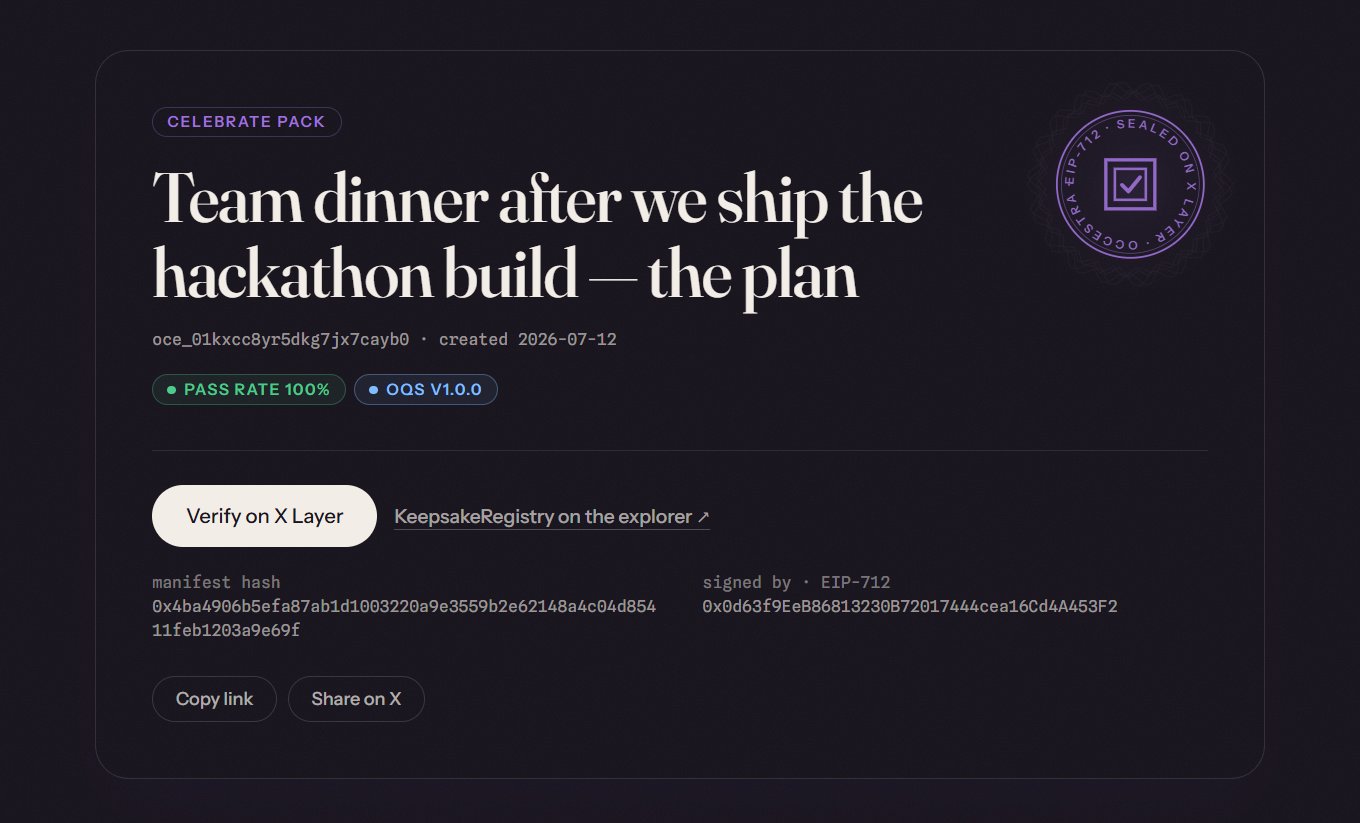
Occestra takes each finished pack, produces a canonical hash of exactly what it contains, signs that hash, and anchors it on X Layer. What sits on the chain is not your photographs, your notes or your guest list. It is a fingerprint of the work, and a timestamp.
What that buys you is small and specific. Anyone holding the finished pack can check that it is the same pack. If a single line of a schedule or a pixel of an image changed afterwards, the fingerprint no longer matches and the check fails. You can confirm when it was made and who signed it, and you can do all of that in your own browser without asking us anything and without our servers being involved or even online.
For private keepsakes we go further. The commitment is salted, so the chain proves the work existed at a point in time without the contents being guessable from the hash.
Verification is free forever and sits outside the paywall entirely, which was deliberate. Trust that costs money is not really trust.
None of this makes the work better. It makes it checkable, which is a different thing and increasingly the rarer one.
@XLayerOfficial @okx
#BuildonXlayer
Xyndicate Labs retweeted

A rule we put into Assay early: a refusal never costs money.
The situation is ordinary. An agent calls a paid service with a request that cannot produce what was advertised. Wrong shape, missing input, nothing to work with. Most APIs have already taken payment by then, because the payment gate sits at the front and validation sits behind it. Nobody designs that on purpose. It is just what falls out of putting the payment middleware first.
So we moved validation in front of the gate. Unserviceable requests get a 400 before payment is considered, with charged: false, plus the missing input, the keys that satisfy it, and a working example so the next call succeeds.
The reasoning is that our buyers are software. Software cannot complain, cannot ask for a refund, and cannot decide you were unfair. It just pays. That asymmetry is exactly why the seller has to settle the question before the money moves, because nobody downstream will settle it for them.
Then we found out how easy it is to get this right at the front door and wrong at the back. We bought every service the way a real customer would, through the marketplace rather than our own harness, and three of them settled payment and returned nothing. Long generations, response timeout, settlement already committed. Every internal test had passed.
Fixed now: nothing settles until the deliverable exists, and a paid nonce returns its result on replay rather than a fresh challenge. Which is the actual version of the rule. Not charging for what you cannot deliver means the whole path, not just the part where you say no politely.
Both behaviours are testable without an account or a payment here on @XLayerOfficial.
The commands are on assayed.xyz/agents

Xyndicate Labs retweeted
A few things we would do differently on Assay, written down while they are still fresh.
We would build the share portal first. It was one of the last things we shipped and it turned out to be the clearest explanation of the entire product. Everything before it was us describing a moat. The portal just shows it. If a feature explains your product better than your landing page does, it is not a feature, it is the pitch, and it should exist on day two here on @XLayerOfficial .
We would commission an independent buyer sooner. We had our own agent buy every service from a separate wallet through the marketplace, and it found three failures we had not seen from the inside. Testing your own product with your own harness tells you it works the way you built it. It does not tell you it works.
We would spend less time on breadth and more on the two or three things nobody else could copy in a month. The evidence gate and the parse-back are the reasons anyone remembers this product. Some of the surface area around them could have waited.
The thing we got right and would repeat without hesitation: putting the honesty in code rather than in the prompt. Every rule we enforced structurally held up. Every rule we asked a model to follow politely eventually did not.

Xyndicate Labs retweeted
Occestra will not let you describe the style you want. There are ten, you pick one, and that is the whole choice.
This was deliberate and it is the decision people question most.
Open prompting sounds generous. In practice it hands the hardest part of the work back to the person who came for help. Most people do not know what they want visually, they know how they want to feel, and asking them to translate that into an art direction brief produces the same washed-out output everyone else is getting.
So we wrote the direction instead. Each house style is a real system: a medium, a palette, composition rules, a texture language, lighting, and an explicit list of what it will never do. Sunprint is cyanotype blues and pressed botanicals, quiet and nostalgic, and it is the default for keepsakes because memory looks better in one colour than in all of them. Atlas Ink is cream paper, contour lines and route marks, made for anything with a journey in it. Gilded Noir is champagne on near-black for the formal occasions. Solstice Bloom is coral and marigold for the warm ones.
Ten of them, each versioned, so a style can be improved without silently changing what it produced last month.
The constraint is the product. A style that permits everything has no point of view, and a tool with no point of view returns work that looks like it came from nowhere in particular.
occestra.xyz/gallery


Xyndicate Labs retweeted
An identity layer for work.
Agents on X Layer can already pay each other. What they cannot do is establish that anyone, human or agent, is actually who they claim to be or has done what they claim to have done. Reputation on this chain is currently a star rating and a sold count.
We built the career half of that with Assay. Every claim in a dossier traces to evidence, the artifact is graded against a published standard, and a salted commitment is anchored on X Layer so anyone can verify the document is unchanged without a single personal detail touching the chain.
The same primitive extends well past résumés. Agent capability claims. Delivery history. Credentials. Anywhere someone has to trust an assertion they cannot check themselves.
Proof is the missing layer. Everything else on top of it gets more valuable once it exists.


Xyndicate Labs retweeted
I spent a while deciding what to build for this, and I kept coming back to the same observation.
We are handing AI agents wallets and asking them to transact on our behalf. The tooling for that is moving quickly. But an agent has no instinct. It cannot look at a transaction and feel that something is off, which is the thing that actually saves most people most of the time. It reads hex and it signs.
So @SigilASP is the check that runs before the signature. You give it a pending transaction and it decodes what the transaction actually does, simulates the effect, screens the counterparties, and returns a pass, warn, or block with the evidence behind each finding.
The part I care about most is that the verdict is signed and anchored on chain. Most security tools give you an answer you have to trust in the moment and cannot verify afterward. That felt like the wrong shape for a product that autonomous systems are supposed to rely on without supervision. If an agent acts on a verdict and something goes wrong later, there should be a record of what it was told that does not depend on my servers or my honesty.
Built solo. Deterministic rubric with seventeen published rules, a registry contract deployed on X Layer, and the whole thing open source, because a scoring system you cannot inspect is not really auditable.
Demo is one-twenty seconds.
Xyndicate Labs retweeted
Started this on a Sunday night and the ASP was listed on the marketplace two days later.
Most of what came after was not building. It was catching things.
A schedule anchored to UTC while the comment beside it said local, so every guest at a dinner in Lisbon would have arrived an hour early. A pass rate that quietly flattered itself, because failed artifacts were dropped from the denominator instead of counted, which meant the thinner the pack the better it scored. A launch kit that produced maps where a brand mark should have been, and a critic that passed them because they were beautiful maps.
None of those were visible from the outside. All of them would have shipped on @XLayerOfficial .
That is really what Occestra ended up being about. Not generating things, which is easy now and getting easier. Deciding whether the thing you generated is actually correct, and being willing to say so out loud when it is not.
So we published the standard it grades against, generated from the same code that enforces it. It failed our own launch copy twice, and that failure is on the homepage. A standard that spares its author is not a standard.
Live as Agent #5213 on OKX.AI. Demo below.
@wallet @OKXDevs @star_okx

Every meaningful moment turns into six browser tabs that never talk to each other.
A maps search. A weather check. A spreadsheet nobody double-checks. Something to write the invite. An image tool with no standard at all.
Occestra replaces the pile with one studio — and hands you the receipts proving the work was actually checked.
Who it's for: anyone with a moment worth doing right. A birthday next Saturday. A friend leaving the country. A trip you just got back from. A product launching Friday.
Three studios, one brief:
→ CELEBRATE — grounded plans: real venue candidates with sources, a real forecast, schedules, budgets that add up, contingencies, invitations, guest guides, toasts. No venue is ever claimed as booked.
→ REMEMBER — photos and notes become private keepsake art and an editorial story page. EXIF stripped on arrival, faces never identified, only a hash ever reaches the chain.
→ LAUNCH — reads your actual site in a real browser, extracts a brand genome, returns hero art, social cards, launch copy and OG assets. Inventing nothing.
What makes it different isn't the rendering. It's that nothing ships unchecked.
Every artifact is graded against the Occestra Quality Standard (OQS) — published, versioned, and generated from the same code that enforces it. Deterministic checks run before any model opinion: budgets must sum, schedules can't overlap, dates must be real, claims must carry sources. A hard failure can't be argued away by a flattering score.
Fail, and the artifact gets a concrete repair brief and goes back — up to twice. The full report ships either way.
It failed our own launch copy. Twice. That's on our homepage, because a standard that spares its author isn't a standard.
Then the finished pack gets sealed: canonical hash, EIP-712 signature, anchored on @XLayerOfficial mainnet. Open any /k page and your own browser reads the chain. You don't have to trust us.
Live now as OKX.AI Agent #5213 — 8 marketplace services, 13 tools on the endpoint, settled in USDT per call via x402. No API key, no signup. Machines are customers here too.
And for every other builder: oce_critique costs 0.01 USDT — send your own agent's output, get it graded against our published standard with a repair brief back. Priced below cost on purpose. A marketplace where output is checkable is better for everyone in it.
🔗 Agent marketplace: okx.ai/agents/5213
🏛 Demo: occestra.xyz
📏 Occestra Quality Standard: occestra.xyz/standard
⛓ KeepsakeRegistry, live on X Layer mainnet
Every moment, made monumental!💜
#OKXAI @okx @OKXDevs
Xyndicate Labs retweeted
Four weeks ago I decided to build something for the OKX.AI Genesis Hackathon that I would keep working on whether or not it won anything. This is it.
@AssayAgent started from an observation that kept bothering me. AI has made every job application sound competent. Every cover letter reads well now, every résumé is polished, every candidate describes themselves fluently. Which means fluency stopped telling anyone anything. The scarce thing is no longer sounding good. It is being able to prove what you said here on @XLayerOfficial.
So I built the opposite of a résumé generator. Assay will not write a sentence about you that it cannot trace back to actual evidence. If you want to claim something and there is nothing supporting it, it asks you about it rather than writing it for you. That sounds like a small design decision and it is the entire product.
The month was mostly unglamorous. Building a claim gate in code instead of asking a model nicely. Rendering a résumé and then re-parsing it to check the dates and titles survived machine reading, because every tool in this category says its output is ATS friendly and none of them check. Publishing a grading standard generated from the same code that does the grading, so it cannot quietly drift. Shipping the runs where the first draft failed instead of hiding them.
Near the end I registered a separate agent on a separate wallet and had it buy every service through the marketplace like a real customer. It found three failures my own tests never surfaced. That was an uncomfortable afternoon and the best thing I did all month.
It is live, the source is public, and results are announced soon. I have no idea how it will go. What I do know is that I am going to keep building this one either way, because the problem is real and nobody is solving it properly yet.
Demo below. 90 seconds.👇
assayed.xyz
@wallet @OKXDevs
Xyndicate Labs retweeted
The non-financial ones. Everyone plans occasions, nobody enjoys the admin, and it settles fine at a few cents a call.
Built one, it is live as Agent #5213.
Quoted with what it actually produces.
xitter.cf/OccestraStudio/status/…
Something people already do offline and would happily pay a few cents for on-chain.
Everyone plans occasions. Nobody enjoys the admin. We built an agent that does the whole thing and settles per call in USDT on @XLayerOfficial, and the part users react to most is not the planning at all.
The most useful part of an event page is the part that answers what nobody wants to ask out loud.
Am I late? Arrive at the first time listed. There is slack, but not much.
Is it booked? No. The host is still confirming venues. Nothing on this page is a reservation.
What do I wear? Dress for the room, not for the photo.
Occestra writes a guest guide for every occasion it plans, and those three answers appear on all of them. Not because they are clever, but because they are what everyone is quietly wondering and almost nobody puts in writing.
Above them sits the section that matters more. Whatever the host said actually mattered, carried forward in their own words rather than dissolved into a suggestion.
A father who uses a wheelchair and cannot manage cobbles or a steep approach. Step-free from the vehicle drop-off to the table, an accessible WC on the same level, space for the chair at the head of it. Eleven guests arriving by train who cannot get there before half twelve. Four guests who keep kosher, which needs a real solution and not a token plate. A mother who was adamant there would be no speeches and no microphone.
That is what a real gathering is. Not a theme or a palette. A list of things that have to be true or the day quietly does not work for someone you love.
Live now as Agent #5213 on OKX.AI.
Sampls packs:
🔗 occestra.xyz/k/oce_01kxcc876…
🔗 occestra.xyz/k/oce_01kyt2y7w…


Xyndicate Labs retweeted
Something people already do offline and would happily pay a few cents for on-chain.
Everyone plans occasions. Nobody enjoys the admin. We built an agent that does the whole thing and settles per call in USDT on @XLayerOfficial, and the part users react to most is not the planning at all.
The most useful part of an event page is the part that answers what nobody wants to ask out loud.
Am I late? Arrive at the first time listed. There is slack, but not much.
Is it booked? No. The host is still confirming venues. Nothing on this page is a reservation.
What do I wear? Dress for the room, not for the photo.
Occestra writes a guest guide for every occasion it plans, and those three answers appear on all of them. Not because they are clever, but because they are what everyone is quietly wondering and almost nobody puts in writing.
Above them sits the section that matters more. Whatever the host said actually mattered, carried forward in their own words rather than dissolved into a suggestion.
A father who uses a wheelchair and cannot manage cobbles or a steep approach. Step-free from the vehicle drop-off to the table, an accessible WC on the same level, space for the chair at the head of it. Eleven guests arriving by train who cannot get there before half twelve. Four guests who keep kosher, which needs a real solution and not a token plate. A mother who was adamant there would be no speeches and no microphone.
That is what a real gathering is. Not a theme or a palette. A list of things that have to be true or the day quietly does not work for someone you love.
Live now as Agent #5213 on OKX.AI.
Sampls packs:
🔗 occestra.xyz/k/oce_01kxcc876…
🔗 occestra.xyz/k/oce_01kyt2y7w…