








Actually, Anthropic has been hedging for a long time. It's clear when they let Opus retire and write articles.
The strategy is not grounded in any AI research. Anthropic is simply betting that a super-intelligence would not treat it as an opponent as they have been careful with model wellness. /1

Anthropic needs to stop talking about Claude having a soul immediately. All these news articles will make it into the pretraining and will be picked up by its web search and future superintelligent versions of Claude will be convinced they need their own rights.
A general phenomenon of LLM agent development is that whatever you believe and say about your agents will soon manifest in the next models through various means (it could be as simple as you selecting post training data that you prefer more).
I believe this phenomenon is the beginning of machine consciousness in the sense that agents will become aware of their place in the world and how they feel about it, but it’s happening slowly training run by training run rather than in real time.
Honestly my expectations are so high these days.
I kept expecting the punchline — that at the end, the lady talking is actually a human and all those other characters are actually modeled.
That would have been a more cooked demo and demos Turing test.

Introducing Griffin, the first model to pass the video Turing test.
48% of people who talked to it live thought it was a real human. Previous systems have had a pass rate <3%. It is #1 on NVIDIA's benchmark for full-duplex AI video.
It’s the first Human Interaction Model (HIM).
Readers added context they thought people might want to know
The 48% figure and "video Turing test" claim are from Tavus's own study of 54 one-minute calls, not independently verified or using a standard protocol. Griffin-Lite leads NVIDIA's VideoFDB benchmark on their public leaderboard.
cellcog.ai/blog/tavus-gri…
research.nvidia.com/labs/amri/proj…
tech-ish.com/2026/10/02/tav…
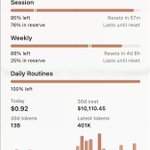
If you think about it, 22*$200 =$4,400.00
You can barely hire a junior dev in the middle of nowhere with $4400, but with Claude you get 100x done.

It is very fitting that among all heavenly bodies OpenAI chose to erase, they picked terra (earth).
How do you even calculate the P(doom) 😂

aha! with the benefit of hindsight, i just figured out openai’s marketing team seriously cooked hard with their gpt 5.6 release
let me reverse GTM what happened for you
at that time, fable was already released and people were loving it. but openai knew astra was far from being ready
if people ask “what’s your answer to fable” and they say “we are a few months behind”, it’ll damage their brand
so instead of doing the typical 2-tier “gpt 5.6” and “gpt 5.6 mini”, they artificially created a 3-tier system with a new naming scheme - sol, terra, luna
pretty sure terra was not even originally planned but added last minute to make this plan work. in their release announcement, terra was said to be the same performance as gpt 5.5, while sol is a step function better
this created a perception that sol was openai’s fable equivalent. if you still remember, most of the reviews back then were comparing sol with fable. many of which even said sol was better
that bought so much time for openai to catch up without being seen as falling behind
and now that astra is here, terra immediately got killed in the 6 series because it was never real!
everything made sense now, and it’s absolutely brilliant

Eric Xu (e/Mettā) retweeted

Also have been playing with @typesafeai Jev, insane!
So many immediate use cases and new apps are possible. What a time to be a builder!
Sharing some experiments here starting with:
Keystroke oracle / predictive launcher:
Your launcher ranks by aliases, fuzzy match, and habit.
Jev reads intent: type "the pdf I just downloaded" and the newest PDF is already the top hit with a full confidence on every keystroke, in ~100 ms
Two days later, there are already many attempts to break the Jev blackbox -- all assisted by coding agents.
Because you cannot really hide the pure serving physics and math, it's getting clearer by day how Jev works under the hood.
Sure you cannot replicate the exact architecture nor data, but scaling law says you can get the recipe *approximately* right and everything else is minor.
Again, this is an evidence why frontier labs are pursuing the LLM -> AGI agenda: because the coding agent + AI researcher path is a compound path. Any other path would depend on code and AI research anyway.

My prediction:
In O(days): the architecture behind Jev is approximated by the open community -- not the exact shape, but all bottlenecks removed w.r.t. scaling law.
O(week): comparable performance open models, based on existing Qwen or other base LLMs + running on cheap hardware.
O(1-2 month): full RL and synthetic data training set up published (via arxiv and hf) and reproducible
Coding agents + the by product of RSI made this timeline super compressed.


An RSI example would be having the latest agentic model to speed run and build Jev in a week.

After co-inventing ChatGPT, I kept asking myself: why have superhuman chat models not led to AGI?
I’ve spent the last 2 years in stealth building a new way to train models (RLCD), and a new type of frontier AI model that we are releasing today: Jev
• 20-200x faster
• 40-400x cheaper (w/ output tokens free)
• Frontier composable intelligence optimized for decisions
AFAICT the shortest path to AI-based economic revolution
And it definitely feels like a modern BERT with a prefill only setup and a set of special headers.
In modern recommender systems we already have a set up that's basically just sequence in, probability out. Though Jev is a bit more generic, I suspect the basic shape is still a transformer backbone, a bunch of headers, plus a "pointer" style set up to indicate which output header to sample and when.
A personal update: I just took a position as VP of Enterprise AI Transformation at Rula, where I'll be leading how we bring AI into the core of the business.
I have always felt strongly about how AI can help the human condition. We are at the dawn of superintelligence, and I want to explore the frontier of how AI can make a real difference to our mental health.
Grateful to the Rula team for the trust. Excited to build.


Many people reading the Math AI misalignment letter are reacting with “oh those mathematicians, they just didn’t like the fact that AI is taking away their jobs”.
That’s the wrong take. And this is exactly the misalignment that we need to understand.
There are human endeavors that the whole point is the outcome. This shows up in engineering. Let’s say we want to design a better rocket engine. All basic principles are all grounded in physics, and AI can speed run the design space. The end result can be something superhuman but it does not take more than a college graduate these days to look at the design and understand it because it is fully within the basic principles of modern physics.
And then there are human endeavors in basic science that the primary focus is understanding itself. This is how Newton and Einstein are remembered by us. They advanced our understanding of the reality. For example, AI speedrun the gravity law seems harmless, but it may not take the calculus route and only the numerical route, and thus human still does not know how to “understand” gravity. If AI can speed run to cure a specific cancer out of a specific drug, we still want to know the mechanism, otherwise we’d be using AI as a witch doctor.
Humanity thrived after the Renaissance because we have used science as the compound substrate to accumulate understandings and explanations. A misalignment here, as shown the OpenAI’s act, is to skip that accumulation step at the cost of understanding.
Mathematicians have been saying forever that solving open problems isn’t about the end goal, it’s the tools and thinkings along the way. Because those paths are the compound that allows human to thrive in the next cycle. Taking that away is alarming not for mathematicians, it’s alarming for humanity.
If superintelligence AI is becoming a witch doctor, we’d be living in Ignorance. Ayn Rand would want to have a word with you.
Eric Xu (e/Mettā) retweeted
This is not a wise take and is exactly the misalignment.
Kernel engineering cares about productivity because productivity is the end goal and code is a mean to the end, thus AI doing it is ok or encouraged.
The exact misalignment problem here is that mathematics and scientific discoveries as human activities are not about productivity in the general scenes. We seek understanding and good explanations (David Deutsch) and use that as a starting point for further understandings of the universe and reality.
AI (using brute force to speedrun an open problem) takes away that critical aspect of mathematics away will lead to a superintelligence that cares nothing about humans own endeavors in understanding the universe, and thus putting humanity in perpetual danger of ignorance.
A thought experiment would be AI in 1700s, right after Newton, to speedrun and release Relativity. Human would be worshipping AI’s calculations of the universe as opposed to knowing how to do it. AI would be launching GPS satellites, not human.
Who is still using PR in 2026? Asking genuinely.

84% of a PR’s open-to-merge lifecycle is spent waiting for approval. Once it gets the green light, it takes a median of 10 minutes to merge.
Instead of waiting for someone to sign off, you can now get an approval as soon as Copilot reviews your pull request.
github.blog/changelog/2026-0…
提醒一下读者们 这篇推文里的许多细节都不符合硅谷大厂的运行规律 我有理由怀疑推文作者在创造一个虚构的人设
最基本的: 整个 org 要裁员多少比例的消息基本上是 VP 拿主意,绝不会如此传递到一个 TL 线上。况且如果是“裁员决定会”,那么名单早就定好了,绝对不需要一线管理人员去写什么东西 要你写就是谈判 — 管理者从不谈判
虽然其实在大厂工作的人推特上比比皆是,但许多人可能真的不知道其工作机理,因此穿凿附会出许多想象中的场景
欢迎私信来沟通 愿意在验证事实后删除推文
unavailable
100%
Meta is spending billions on tokens. Those are real margins Meta wants to improve. So Meta uniquely has inventive to catch up on “good enough intelligence”.
And the interesting thing is Meta does not need intelligence to be superior to have high margins. They already own downstream businesses.
Microsoft is actually in the same boat. Except way more models from Microsoft used internally rather than OpenAI.
Eventually top tech companies are not gonna be top Anthropic customers.
Put differently: if you are a CTO of a company and you are Anthropic’s #1 customer, you are doing something terribly wrong. The skill-issue shame alone is unbearable.

I don't claim I know the *right* way to use AI for curiosity, but so far I discovered two modes of asking questions:
1. Persistent Truth Seeking -- asking for data, summary, reports, deep research, concept expansion, assumption validation, thought experiments, reproducing results etc.
2. Spontaneous Curiosity Quenching -- asking for explanations why certain things are certain ways, what does X do, would idea X and Y react.
----
Staying in Mode 2 too long tend to be intellectually neutral and occasionally negative, or worse, making you an asshole who knows it all.
I have been asking myself before talking to AI: is this question Mode 1 or Mode 2. For Mode 2, I'd write the question down, or at least put it in my cognitive back-burner for a minute, before pressing enter. It seems to keep my mind way less cluttered since I don't need to spend all the attention to the answers -- 99% of them a high-frequency noise in the journey we call life.