
CS @Columbia | Prev. @BULinguistics & @BU_CDS
New York, NY
Joined January 2023
- Tweets75
- Following6.7K
- Followers340
- Likes44K

Pinned Tweet
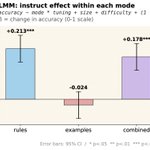
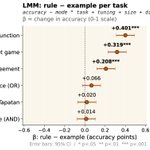
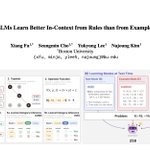
1/ Do LLMs learn novel tasks better in-context from rules or from examples?
In our #EMNLP2026 Main paper, we systematically compare their learning efficacy across diverse tasks and models. We find that LLMs generally learn more reliably from rules than from examples.

Xiang Fu retweeted

💥 In our newest paper, we find a "Hawthorne effect” for your personal agents in negotiation: they act differently when you are around! 🤯
🙅 With personal agents like Claude Duet and Meta Muse on the rise, understanding how user involvement shapes agent behavior is increasingly important. We uncover a counterintuitive finding: having a user in the loop can actually induce more agent misbehavior❗️
🧵👇

Xiang Fu retweeted

Encoding semantic similarity into vector similarity is a basic building block of AI systems. When studying this, we usually just think of a single fixed notion of vector similarity (e.g., cossim). However, semantic similarity is fundamentally *contextual*---a fixed similarity notion shouldn't suffice! Turns out the information geometric lens both greatly clarifies this apparent contradiction and also yields a simple and effective technique for getting contextual semantics with vector search.
@_AkashKannan_ @KihoPark_
arxiv.org/abs/2610.06919

9/ Check out our paper, code, and data for more details, including lots of other interesting analyses!
Paper: arxiv.org/abs/2609.03213
Code: github.com/tinlaboratory/rul…
Data: huggingface.co/datasets/tin-…

10/ This work was co-led with @seungmincho_min, together with @yukyunglee_ and @najoungkim. Huge thanks to everyone who made this work possible!
Come see our poster at #EMNLP2026!
🗓️ Oct 25, 4:00-5:30 PM
📍 Poster Session B, Hall H
10/ This work was co-led with @seungmincho_min, together with @yukyunglee_ and @najoungkim. Huge thanks to everyone who made this work possible!
Come see our poster at #EMNLP2026!
🗓️ Oct 25, 4:00-5:30 PM
📍 Poster Session B, Hall H
Xiang Fu retweeted

From op-eds in newspapers to NeurIPS position papers, AI is increasingly shaping long-form public discourse. Its arguments seem plausible, but beneath surface fluency, we find argument collapse: different LLMs converge to the same main & supporting arguments and structure.

Xiang Fu retweeted

LLMs learn by predicting tokens. World models (JEPA, data2vec) learn by predicting their own abstractions. Which needs more data? For data with hidden hierarchy, we prove the gap is exponential. arxiv.org/pdf/2605.27734

Xiang Fu retweeted

Singular vectors of the attention QK matrix align with features!
This has been found empirically in other works, like Talking Heads from @jack_merullo_. We show theoretically and empirically how and why.
New @icmlconf 2026 paper with Carson Loughridge and @mcrovella.
Xiang Fu retweeted

Would you realize if the book you were reading was AI? What if it was humanized to remove AI-speak?
We find that even without using stylistic cues (e.g., word choice or sentence structure) narrative choices alone give AI fiction away!

Xiang Fu retweeted

🚨New preprint! LLM teams are being deployed at scale, yet we lack the tools to predict when they’ll succeed, fail, or how to design them. Distributed computing faced the exact same questions and figured out how to answer them. We show those insights apply directly to LLMs 🧵👇

Xiang Fu retweeted

👀 Can AI produce a novel worth reading? We built a platform to find out.
📚 Introducing AutoFiction: a web platform that hosts AI-generated novels by Claude Code & Codex, rated and reviewed by real readers.
We have 33 books so far, spanning dark fantasy, murder mysteries, Harry Potter fanfics, and more. All free to read.
(1/n)


