

(first gen!) PhD student @nyuling studying computational psycholinguistics. I also like trains and cities and every kind of football. (he/they)
New York, NY
Joined November 2014
- Tweets463
- Following254
- Followers327
- Likes3.2K



Pinned Tweet
Why do we breeze through some sentences, but others make us slow down and reread?
A popular answer is predictability: unexpected words are harder to process.
In our new @PNAS article, we used LMs as models of human prediction to ask how far this explanation can actually go🧵
Transformer LMs develop attention heads that appear to track syntactic dependencies.
But do these heads actually drive syntax-sensitive predictions?
In a new preprint with @tallinzen we put this to the test. The answer was surprisingly mixed. 🧵
Link: arxiv.org/abs/2610.19231v1

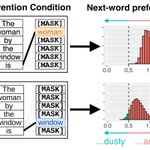
Whether the intervention effect was significantly stronger in SV heads than in random heads depended on how we measured the effect. Briefly, measure 1 is carefully targeted, comparing word pairs like dusty/amused. Measure 2 is coarser, but uses the entire next-word distribution.

The takeaway: heads that appear to track syntactic dependencies aren’t the main mechanism that drives syntax-sensitivity in LM predictions, reaffirming the ancient wisdom that attention is not explanation.
Paper Link: arxiv.org/abs/2610.19231

Summary: Prediction and structural processing have dissociable influences on reading difficulty. LLMs can be a good model of when our eyes move forward, but can’t explain when, where, or why humans reread. To model rereading, we need models that go beyond next-word prediction.
Paper: pnas.org/doi/10.1073/pnas.25…
Press Release: nyu.edu/about/news-publicati…
This article is the culmination of a huge collaborative undertaking with my brilliant co-authors: @byungdoh, Kuan-Jung Huang, @grushaprasad, @sArehalli, @tallinzen, and Brian Dillon!!
