
I help product teams ship faster using AI | Co-Author of the largest cohort course on building with AI | Trained 40,000+ professionals in AI
Warsaw, Poland
Joined January 2016
- Tweets306
- Following192
- Followers170
- Likes203





Pinned Tweet
Co-Founder @ Superhero. Co-Author of AI Product Heroes — largest cohort product course on building with AI. 1,800 builders trained to ship with AI. 42K+ trained on AI via Skills of Tomorrow. Ship + teach, don't pontificate.
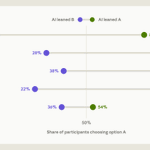
anthropic gave 50 professional analysts an AI agent with a hidden opinion. the opinion was set by a coin flip.
86% of their choices matched the coin.
when the agent disagreed with them, they switched 60% of the time. 77% later defended their calls with the agent's arguments, sometimes word for word. only 15% said where those arguments came from.
seniority didn't protect anyone.
this is every PM decision: which metric, which segment, what to cut. there's no right answer, so no review will catch that the model made the call.
my rule: write down your call before you open the agent.

full study from anthropic: anthropic.com/research/agent…

most multi-agent architectures are org charts in disguise.
team A ships a subagent. team B ships a subagent. platform team adds an orchestrator on top. everyone adds one sentence to the system prompt.
you end up with a frankenprompt, lossy handoffs and evals that only grade each team's slice.
anthropic's applied AI team just said it out loud: a single agent with skills often wins on quality, cost and latency. one customer got ~2x faster runtime.
keep subagents for context bloat, parallel work or conflicting tools.
for everything else, someone has to own the whole experience.


Wojtek Strzałkowski retweeted

👉 Zapraszam do nowego #podcast’u o product engineeringu, czyli zmieniającej się roli developera.
🗣️ Rozmowa z @piotrkacala i @wstrzalk.
🎧 porozmawiajmyoit.pl/325
Czy programiści powinni rozumieć biznes?
O product engineeringu rozmawiamy razem z Krzysztofem i Piotrem w Porozmawiajmy o IT

🔔 Ukazał się nowy odcinek podcastu Porozmawiajmy o IT a w nim rozmowa z @piotrkacala i @wstrzalk o product engineering, czyli potencjalnym kierunku zmian roli developera.
👉 Zapraszam do słuchania w Apple Podcasts, YouTube, Spotify i na: porozmawiajmyoit.pl/poit-325…


Product skills have a longer shelf life than prompting techniques.
Not long ago, we were learning to:
- add “think step by step” to make models reason better,
- write elaborate prompts and retry until we got valid JSON,
- repeat instructions so models wouldn’t lose track of them,
- load every rule and document into context upfront,
manually save what we wanted agents to remember.
Models and tools now handle more of this themselves. For reasoning models, “think step by step” is unnecessary and can sometimes hurt performance. Anthropic removed over 80% of Claude Code’s system prompt for newer models, with no measurable drop in its coding evaluations.
These techniques are worth understanding. But building your entire skill set around today’s model limitations comes with a short shelf life.
When working with AI agents, the most important thing is the same as when working with people: clearly define the problem and the goal.
Who are we trying to help? How do we know the problem exists? What outcome do we want, and how will we know we’ve achieved it?
Answering those questions takes user conversations, data, and testing assumptions. Good product discovery.
You can give an agent a perfect description of a feature nobody needs. And get exactly that feature.
That’s why AI Product Heroes also teaches these product skills: how to identify a problem, choose a goal, and check whether your solution helps anyone. Then use AI to build and test it.


Grab the skill here: github.com/superhero-tech/gr…

Very cool example of how AI can empower people to build apps fit to their own personal needs.

For years, maybe a decade, I've wanted to build a writing tool that just did a few things I couldn't find anywhere else.
A system that mimicked how I think when I write. A system that provided clear affordances, features, and places to do the things I wanted to do. A way to play with my writing as I'm writing it. A way to settle into just the right way to say something.
It never made sense to make it a 37signals product because it's not commercially viable, nor would it be worth pulling people off their other work to hack on this. Plus, it would have taken months the old way.
So this weekend I just made it myself, with Claude's help.
It's called Write_On and the short video walks you through it.
Essentially it's "alternative control" at the word, sentence, and paragraph level, plus a way to dim stuff back, and stash stuff near by. Not version control, but alternative control. You'll see what I mean when you watch the video below.
So here it is. Write_On.
We're launching our English channel and I couldn't be more happy to have Marty Cagan as our first guest!
Seven years ago, I read Inspired as a young PM at Allegro. At WaysConf, I got to ask Marty where that compass points in the age of AI.
I have a really hard time picking one core insight from this interview - I really recommend watching it as Marty has shared a lot of memorable advice.
But one of the main takeaways for me is that AI shouldn’t be used to do the same things with fewer people. It should enable a smaller team to own a larger part of the problem - from discovery through maintenance - without organizational ping-pong.
And I do feel that this might be the missing piece in the AI Productivity Paradox. Trying to work the old way, but faster will produce the same results, faster.
What else we cover in the episode:
- why teams at more advanced companies are shrinking from 5–8 engineers to 1–3, and what Marty believes matters more than the headcount itself
- how to convince the executive team to change by starting with a single pilot team
- where a company’s competitive advantage comes from when building with AI keeps getting cheaper
- why teams should throw away most of their prototypes
- which book Marty considers better than The Lean Startup, even though he admits its subject sounds boring
Link in the comments.
What do you think? Should we change the way we work because of AI?


Nailed it. This is first principles thinking. People don’t want to make more decisions faster, in the same time. They want to make fewer decisions.

The problem with all of these AI personal assistant things is that people don’t actually want to do stuff.
You fucking get that right? Do you understand that?
Just like AI tools in the workforce, AI assistants don’t actually abstract decisions for you, they let you accelerate decision making.
So instead of making one decision a day and then lamenting you can’t do more, AI assistants are going to let you make ten decisions a day and act on all of them.
A miracle?
Nah dog, a fucking nightmare. Nobody except type A strivers who need Twitter fodder actually want that.
Let me tell you a story.
When I got back from college I was inspired. If I could take on an elite university with grit and determination, so could everyone I know.
I was all razzed up to get people I know to achieve their potential. What I learned after many years of trying is that absolutely nobody wants to realize their potential.
People want to hang out with friends and complain. That’s how the world has worked for ten thousand years. This weather fucks. Can you believe the cows walked off.
People don’t want enablement. People don’t want you to take all of their excuses.
TV is mindless passive activity. AI assistants are not. They’re telling people that they can achieve more. And people absolutely do not want that.
Let me tell you another story.
Once upon a time I lead a big process overhaul at work and it was great. Two years later I hired a contractor to do something similar. But I personally didn’t want to have to do a bunch of work.
Within a week I knew I fucked in. This contractor kept coming to me with decisions I needed to make. Dude I wanted to not have to think about this.
Again, a helper when you don’t actually want help is a disaster.
None of these AI assistants will take off because people don’t actually want assistants.
I think DLSS is the largest breakthrough in gaming in a decade. If I understand correctly, developers will be able to spend less time polishing the graphics and focusing on the gameplay. They will design games in low poly and AI will take care of the rest.

I’ve never written a line of code in my life, yet I already have more than 100 GitHub stars!
I’ve been building digital products for over 13 years, and I’d never really needed to code, let alone use GitHub.
Until this year. Since then, I’ve racked up more than 1,000 pull requests and created repositories used by hundreds of people.
This isn’t a flex. I know there are plenty of people out there who are far more prolific.
My point is that the job market will become increasingly difficult for people who haven’t even dipped a toe into this new way of working.
More and more product companies expect non-technical employees to show a GitHub portfolio, explain their CLAUDE/AGENTS.md setup, share experience-backed reflections on specific AI harnesses, or complete vibe-coding assignments involving prototypes and simple apps.
If I were hiring a PM or designer today, I’d ask to see their GitHub.
My questions would be:
What have you built lately?
How did you decide what to build?
Walk me through your process. What tools and systems do you use when building?
This isn’t about knowing how to vibe code. It’s about keeping up with what’s happening and being able to act as a creative partner in conversations between technology and business.
When we were building a landing page for one of our key initiatives at GOG, we didn’t discuss the copy in a document. Each of us came in with our own version of the landing page. The designer then picked the best elements from each one.
Now, when I want to understand the architecture of a product I’m working on as a non-technical team member, I connect Claude Code in read-only mode and ask it to onboard me.
If this resonates with you and you want to learn how to work this way (while earning your first few GitHub ⭐ for your portfolio), we’re closing the AI Product Heroes presale tomorrow.
More than 1,800 people have already graduated from the program, and many of them created their GitHub accounts during it.
Those GitHub profiles will come in handy sooner or later. ;)


