

Product Design ✦ Craft ✦ Design Engineering ✦ Bugs
Joined August 2021
- Tweets2.2K
- Following940
- Followers3.5K
- Likes2.7K




tbh, I’m super impressed by @WisprFlow marketing.
There are 100s of open-source alternatives, and they’ve still built a company valued at $2B.
Building software keeps getting easier. Getting people to notice, try, and choose your product is still hard.
Proves marketing and distribution is the real most now.

Introducing Yap, a free and open-source voice dictation and video messages for Mac
Yap turns what you say into clean text, records your screen, and takes notes on every call, all on your Mac.
So you can just say it, the way you meant it.
yap.primitive8.cc

tutorial:
xitter.cf/writenicecode/status/1…

I realized this after my quit my full time job around 4 years ago.
I had good coding and design skill at the time, but when I started posting on X I realized how important and hard it is to talk about your work.
It's a whole different ball game.
Creating a product/business that solves a specific problem is one thing, but convincing other people that why your solution is better, is entirely different game.
It's hard to put your intuition and thoughts into words that other people understand.


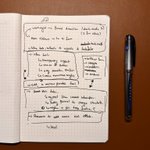
I've been taking 10-15 min in the morning to plan out how I'll be spawning agents in parrallel for the entire day.
I write down most of the tasks, and draw rough rectangles and arrows around the ones that can run at the same time, then use those groups to decide what to hand off.
I used to do this in Figma previous, but it's super satisfying to scribble out each box as a agent finishes. Also it's a great way to get back on track, if you've drifted away while your agent is doing the work.
Today's plan is mostly creating some design tools, to speed up the creation of a few effects for the team.
P.S. I can read my handwriting.


How do people find the courage to give random AI productivity agents entire access to their computer
online marketing is cool and all,
but for some reason I love such creative offline campaigns.
holding something physical just makes you feel something.
folks at @WisprFlow are masters at this.
might not convert as much, but ya do it on a big scale and at the right places, a lot of people remember your brand and ya get good ROI in a longer timeframe.

We handed out 500 newspapers at one of India's biggest design conferences, one that's been running since 2006.
The paper was us going through the recent launches and writing down where each one went wrong with its positioning
The last few pages are how we structure ours.
I wrote one line in my notes while I was there:
Art is not aesthetic
It's strategy
Human like is not human enough
We're searching for a connection not an answer


This is so cool

We built vgpu.sh to ship shaders on vercel.com. Now it's open source.
▪︎ Minimal agent-first WebGPU library
▪︎ Run in the browser or headless Node.js
▪︎ Render in CPU sandboxes and CI tests
▪︎ Create reusable .wgsl modules

Hands down my favorite system for managing colors.
100, 200, 300 for backgrounds
400, 500, 600 for borders
700, 800 for contrast backgrounds
900, 1000 for text
super easy to understand what to use when instead of just guessing.
write this to your agents.md and you always get a consistent theme throughout the project.

A few random thoughts around design and AI nobody should care about.
- Using AI to fix creative blocks is great. When stuck on something, I ask Codex to go wide and prototype 5 screens with completely different layouts directly in code to play around with how the real user will experience them. 7/10 times it creates a good base to build and refine on top of.
- AI is still bad at complex frontend tasks. It's hard to get all the details right. It's annoying to write so many follow-up prompts to get those tiny details right. Sometimes it's just quicker to dive in the code and fix these small things yourself.
- With building becoming so easy, the only moat companies have is design and distribution. After a wave of slop, designers are gonna be valued more than ever. Taste and user experience will set products apart. Speed is no longer the bottleneck. The new edge is shipping tastefully with a focus on user experience.
- There's a massive gap right now for exporting assets. When working in Figma, I mostly just crop, move images, and add effects and textures on top of them as layers until everything looks great. No model can accurately export this, and I always have to manually export things then reference in the prompt use these assets. I've tried naming layers, but it still fails to understand the image in context with the viewport and exports something gibberish. Not sure if it's possible to solve this.
- Creating design systems in Figma gives very high quality and clean code output. Creating proper components for everything, using auto layouts, named layers, organized designs, and a custom agents.md guiding the agent on existing components with codex terra on high gave surprisingly good results very quickly without many follow-up prompts.
- More designers should get their hands dirty in code. A lot of designers on design twitter especially have no idea what tokens and components are, or how their designs are gonna be properly adapted into a product.
- I miss the days when I was in complete flow while coding. Now it's just managing and delegating to agents. Flow is still achieved with designing, but I kinda miss the coding days.
- Retainers are the best model when working on product design projects. Product design requires a ton of iterations to get right. For fixed-scope projects, the freelancer/agency feels cheated if you iterate too much. If the number of iterations are fixed, and the client does not like a result they're not satisfied. Retainers work best if there's mutual trust and give best results overall.
- AI in Figma sucks. It's only good for removing simple bgs and rewriting text. Hope it improves down the road.
Thanks for reading!