

The Journal of Writing Assessment provides a peer-reviewed forum for the publication of manuscripts that address a variety of topics in writing assessment.
- Tweets234
- Following435
- Followers386
- Likes52



ALT The image announces issue 18(2) of JWA.


ALT Statement from JWA with the text: The decision by the National Council of Teachers of English (NCTE) to de-charter the Conference on College Composition and Communication (CCCC) marks a significant moment for our writing studies community. For decades, the CCCC has been home to vital discussions about writing assessment, just as it has fostered so many facets of Writing Studies scholarship and teaching. The Journal of Writing Assessment (JWA) joins colleagues across the field in expressing solidarity with CCCC’s leadership, with the editors and editorial staff of the journals and book series under NCTE, and with the membership of our field’s preeminent professional organization. We also affirm our strong belief in the importance of preserving the scholarly communities and professional networks that have long supported research and teaching in writing studies.

ALT Statement from JWA with the text: As a scholarly journal, JWA remains committed to the principles of academic and intellectual freedom and to the open exchange of ideas that makes scholarship possible. We believe that the advancement of knowledge depends on professional communities that encourage open and independent inquiry, methodologically sound investigations, and research centered in and inclusive of the communities most in need.

ALT Statement from JWA with the text: We know the future of NCTE’s journals, especially College Composition and Communication (CCC) and Teaching English in the Two-Year College (TETYC), as well as our field’s book series Studies in Writing and Rhetoric (SWR), are currently unknown or in flux. We stand with the editors and editorial staff of those publications and want to extend an offer of support in whatever way we can. We look forward to working with colleagues across writing assessment as we build a sustainable future for our profession grounded in academic freedom, intellectual openness and curiosity, and a shared commitment to advancing knowledge.

ALT Statement from JWA with the text: Stacy Wittstock, Co-Editor Mathew Gomes, Co-Editor Lizbett Tinoco, Co-Editor Chris Blankenship, Associate Editor Tara Wood, Copy Editor Madeline Sutton, Associate Editor Alexis Teagarden, Assistant Editor JWA Reading List Olivia McMurray, Copy Editor JWA Reading List Stephen McElroy, Associate Editor

ALT an image of text that says 'The JWARL Fall 2025 Issue is live! Featuring... Reconstructing Response to Student Writing: A National Study from Across the Curriculum by Dan Melzer, reviewed by Isaac Castillo (San Diego State University) Cripping Labor-Based Grading for More Equity in Literacy Courses by Asao Inoue, reviewed by Kat M. Gray (University of Arkansas) Educational Assessment's special issue: "Fairness in educational assessment and the next edition of the Standards," reviewed by Jen Daly (University of New Hampshire)'

ALT The image announces the publication of JWA volume 18 issue 1.

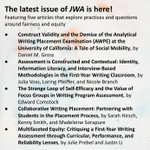
ALT A graphic of text that says 'Issue 18(1) of JWA is here! Editor's Editor's Introduction: Placement and Its Discontents or The Long Winding Road toward Change, by Carl Whithaus Using Completion Rubrics to Grade Engagement in Online Spaces, by Sallie Koenig, Catrina Mitchum, and Shelley Rodrigo The Trouble With "Ungrading": Toward Disciplinary Specificity in Alternative Writing Assessment, Maggie Fernandes, Emily Brier, and Megan Mclntyre'

ALT A graphic of text that says 'Issue 18(1) of JWA is here! Special Section Student Self Placement (SSP) Collaboratively Building Our SSP Scholarship (Because Placement is Still Everyone's Business), Kate L. Pantelides and Erin Whittig; Wrap-around support via a directed self placement model: A treatment for SLAC writing programs, Genie Giaimo and Kristina Reardon; Everything Old Is New Again: Reconsidering DSP Amid the Changing Academic Landscape at Grand Valley State University, Amy Ferdinandt Stolley, Dauvan Mulally, and Craig Hulst; and Afterword: Finding the Right Note in Writing Placement, Jessica Nastal and Kris Messer'

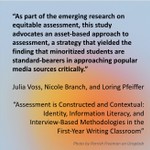
ALT The image includes a quote from Julia Voss, Nicole Branch, and Loring Pfeiffer’s “Assessment is Constructed and Contextual: Identity, Information Literacy, and Interview-Based Methodologies in the First-Year Writing Classroom.” The quote reads: “As part of the emerging research on equitable assessment, this study advocates an asset-based approach to assessment, a strategy that yielded the finding that minoritized students are standard-bearers in approaching popular media sources critically.”

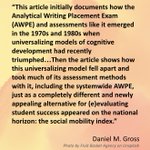
ALT The image includes a quote from Daniel M. Gross’s, “Construct Validity and the Demise of the Analytical Writing Placement Examination (AWPE) at the University of California: A Tale of Social Mobility.” The quote reads: “This article initially documents how the Analytical Writing Placement Exam (AWPE) and assessments like it emerged in the 1970s and 1980s when universalizing models of cognitive development had recently triumphed…Then the article shows how this universalizing model fell apart and took much of its assessment methods with it, including the systemwide AWPE, just as a completely different and newly appealing alternative for (e)evaluating student success appeared on the national horizon: the social mobility index.”

ALT Image includes a list of articles in issue 17.2 of the Journal of Writing Assessment.

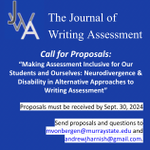
ALT The image is a call for proposals for a special issue of the Journal of Writing Assessment. The topic of the issue is: “Making Assessment Inclusive for Our Students and Ourselves: Neurodivergence & Disability in Alternative Approaches to Writing Assessment.” The image includes the September 30 2024 due date for proposals, and special issue editor emails.

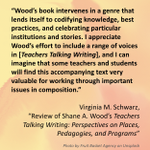
ALT The image includes a quote from Virginia M. Schwarz’s, “Review of Shane A. Wood’s Teachers Talking Writing: Perspectives on Places, Pedagogies, and Programs.” The quote reads: “Wood’s book intervenes in a genre that lends itself to codifying knowledge, best practices, and celebrating particular institutions and stories. I appreciate Wood’s effort to include a range of voices in [Teachers Talking Writing], and I can imagine that some teachers and students will find this accompanying text very valuable for working through important issues in composition.”

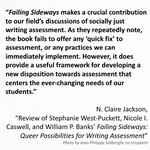
ALT The image includes a quote from N. Claire Jackson’s “Review of Stephanie West-Puckett, Nicole I. Caswell, and William P. Banks’ Failing Sideways: Queer Possibilities for Writing Assessment.” The quote reads: “Failing Sideways makes a crucial contribution to our field’s discussions of socially just writing assessment. As they repeatedly note, the book fails to offer any ‘quick fix’ to assessment, or any practices we can immediately implement. However, it does provide a useful framework for developing a new disposition towards assessment that centers the ever-changing needs of our students.”

ALT The image includes an abstract background and text that reads: The JWARL Summer 2024 Issue is live! Featuring… Failing Sideways: Queer Possibilities for Writing Assessment by Stephanie West-Puckett, Nicole I. Caswell, and William P. Banks — reviewed by N. Claire Jackson (SUNY Geneseo) Teachers Talking Writing: Perspectives on Places, Pedagogies, and Programs by Shane A. Wood—reviewed by Virginia M. Schwarz (San Francisco State University)


ALT The image includes a quote from the article “(Re)Placing Personalis: A Study of Placement Reform and Self-Construction in Mission-Driven Contexts” which reads: “To be sure, our DSP proposals packaged ready solutions for campus decision-makers facing urgent external mandates of their own. However, DSP also appealed powerfully because its core values mapped readily to core values espoused by our respective institutional missions.” Written by Meghan Sweeney and Crystal Colombini


ALT The image includes a quote from the Special Editors’ introduction article “Directed Self-Placement for Multilingual, Multicultural International Students” which reads: “When placement systems attend to the complexity of multilingual, multicultural student populations, they have the potential to honor the linguistic, educational, cultural, social, and emotional factors—some predictable and others surprising—that guide self-placement decisions.” Written by Kristine Johnson and Sara Vander Bie

ALT The image includes a quote from the Special Editors’ introduction article “Placement is Everyone’s Business: A Love Letter to Our SSP Coalition” which reads: “We suggest SSP as an umbrella term, one that accounts for the various (and sometimes disparate) methods of placing students into courses that include student choice as part of the mechanism.” Written by Kate Pantelides and Erin Whittig

ALT The image includes a quote from the Special Editors’ introduction article “Informing Self-Placement: A Polyvocal Narrative Case Study” which reads: “Our central question was how to develop locally situated SSP that valued students’ writing self-knowledge and capacities for reflection, communicated a more accurate and nuanced message about college writing, and closed equity gaps in WR1 enrollments and WR2 completions. In this article, we present our experiences as an imperfect but generative polyvocal case study of that how.” Written by Christie Toth, Jennifer Andrus, Nkenna Onwuzuruoha, Nicole Clawson, Pietera Frasier, Aubrey Fochs, Samuel Rivera Aguilar

ALT The image includes a quote from the Special Editors’ introduction article “After Implementation: Assessing Student Self-Placement in College Writing Programs” which reads: ““For the purposes of working toward equity, inclusion, and access, we must also assess how [placement] changes affect stakeholders: students from various backgrounds, instructors in the program, and university staff, among others.” Written by Lisa Arnold, Lei Jiang, and Holly Hassel

ALT The image includes a quote from the article “Self-Characterization in the Self-Placement Assessment Ecology: Complicating the Stories We Tell about DSP’s Effects and Effectiveness” which reads: “We examine a corpus of short-answer survey responses, totaling more than half a million words, in which students write about their strengths as writers and what writing tasks they find most challenging… this short-answer dataset helps to shed light onto the ways that students who self-place into a variety of writing courses differentially construct their identities as writers in relation to what SSP tells them about the writing program.” Written by Theresa Tinkle, Jason Godfrey, J.W. Hammond, and Andrew Moos

ALT The image includes a quote from the Special Editors’ introduction article “Supporting Student Linguistic Identity and Autonomy in Directed Self Placement Through Linguistic Domains Using Qualtrics” which reads: “Institutions serving multilingual students must recognize their needs and goals and provide opportunities for them to make decisions regarding FYC. Self placement methods have the potential to offer these students some critical autonomy; however, self-placement methods should be sensitive to the student population served by the institution and carefully crafted.” Written by Laura Decker and Brianne Taormina-Barrientos