

Main: @afankhanvc | Research @Starcap_xyz | VC Analyst & Software Engineer | SpaceTech · DefenceTech · Blockchain
Shackleton Crater
Joined April 2024
- Tweets2.6K
- Following844
- Followers396
- Likes4.3K






Afan retweeted

Update on the HLS provider timelines from NASA
Short Overview:
Still targeting early 2028 for Artemis 4 and late 2028 for Artemis 5.
Starship cargo lander expected in 2032 and Mk2 cargo lander in 2033.
NASA provided an image of the CONOPS for Artemis 3 which is currently targeting NET Q3 2027.
Starship uncrewed landing demo still targeting NET Q4 2027. Blue Origin uncrewed Mk2 landing demo NET Q1 2028.
Starship Milestones:
First cape flight in Q4 2026 (currently NET Dec 10th). Completed HLS "Cabin 1" in Q4 2026 (ground testing cabin). This will have operations testing in Q1 2027 and airlock demonstrations in Q2.
Prop demo in Q1 2027, first launch from LC-37 also in 2027 - I personally believe 37a will be ready in Q2 or Q3.
Tank presurizations upgraded in Q2/Q3.
The first uncrewed landing demo tanker launch in Q3 with the landing demo in Q4.
Blue Origin Milestones:
New Glenn return to flight Q4 2026. First Blue Moon Mk1 landing in Q1 2027. Second Mk1 landing in Q4 2027 with the viper rover. Third Mk1 landing in Q1 2028 with an LTV (Lunar Terrain Vehicle) for Artemis 4.
Artemis 3 crew vehicle hardware complete in Q1 2027 with launch in Q2/Q3 2027.
LC36B (9x4 Pad) complete in Q3 2027 with the first NG 9x4 launch in Q4.
Source: ntrs.nasa.gov/api/citations/…


Afan retweeted

The ridiculous arguments by Ambani’s army of Internet shills make no sense
On the one hand, they say Starlink couldn’t possibly compete with the amazing low prices offered by Ambani’s de facto monopoly in India and then, in the same breath, they essentially claim that Starlink would be too strong of a competitor! This is absurd hypocrisy and hyperbole.
The reality is that competition would greatly benefit the average citizen in India by giving them more choices, as it always does. Ambani’s profits will be lower, but he is not going out of business. And, obviously, if Starlink is too expensive in India, no one will buy it, so SpaceX will need to make pricing affordable.

Something feels off with this chorus of “India’s internet is great and super cheap” … the data shows that Indian market is absolutely dominated by mobile. When they say it’s cheap and well connected factually this only applies to mobile usage.
This makes sense because a tower connects thousands of subs instantly after construction and running fiber is a building by building or resident by resident job. This is also why “fixed wireless” has started growing fast. Follow the incentives. It’s the cheapest and shortest route to revenue.
Due to this, India is amongst the highest mobile bandwidth usage populations on the planet. 30-40GB/month. (20-50% above US/UK usage) However, home Fiber lines in India pull closer to 300GB/month. 10x gap
For context, that gap in the US and UK is 20-30x. It’s pretty ubiquitous that if you have access to a lot of more bandwidth you will use it.
Bandwidth abundance does not favor mobile devices.
I’d argue that it’s not very hard to believe that these paltry sub 5% fixed customer penetration numbers would be much higher if a cost effective alternative existed.
Is that alternative existed it wouldn’t be crazy to expect to see the fixed customer numbers jump from 6% to maybe 10%, 15% or 20%. 100M-200M customers.
And if the rest of the world is any precedent that would lead to a dramatic increase in overall bandwidth used.
However, that would mean that mobile bandwidth usage would likely drop or stagnate with in home mobile usage.

Afan retweeted

Kapta Space raised $24M in a Series A led by @WashingHarbour LP and co-led by @BisonVP, bringing total funding to $30 million. Here is what sets them apart.
Kapta builds radar payloads that track moving targets from orbit. The US military has wanted this for decades but conventional spaceborne radar has been too costly to deploy at constellation scale.
Kapta uses a modular metamaterial antenna that does it at a fraction of the cost.
Milton Perque and Adam Bily founded the company in 2023. Both were engineering leaders at @EchodyneCorp, which built metamaterial radar for ground and counter-drone use.
Before this round, Kapta had a $1.8 million @DARPA SBIR and a $5 million seed.
Kapta won classified moving target tracking contracts this year and raised the Series A to deliver on them.
If you are building for defence, the contract is the fundraising deck.
🔁 Repost and share this with founders and friends in your network building in space and defence tech.

💪

Blue Origin's LC-36A rebuilding: Another section added to the tower.
nsf.live/spacecoast
Afan retweeted

Nothing is allowed to slow @SpaceX down. It is swallowing every obstacle between itself and the sky, laying its own pipeline to fuel more launches.
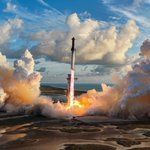
This week, SpaceX filed for approval to build its own 32.4-mile natural gas pipeline to fuel Starship launches from Cape Canaveral.
Because Starship burns liquid methane in volumes local utilities said they can't deliver, so SpaceX is building and running its own transmission line instead of waiting on tanker trucks.
A rocket company that makes most of its money selling internet from orbit is now moving into gas transmission, because the ground can't supply what the sky demands.
Still think the sky is the limit?


Afan retweeted
The next cancer breakthrough won't be discovered on Earth. It'll be grown in orbit.
@Merck grew its $25B drug Keytruda in space and turned an hours-long IV into a one-minute shot. Gravity was the problem all along.
@VardaSpace is building the factory for it with six missions flown, five capsules recovered, and $250M now raised at $1.6B, taking their total to $598M.
Now funded, here's what Varda does next:
- Two capsules on one @SpaceX Falcon 9 this week.
- The first drug with @UTHRMed in 2027.
- The first medicine made in space and taken on Earth.
This is the dawn of a new pharma market, built in orbit.


Today, we’re announcing Varda’s $250M Series D raise, bringing the total amount of capital raised to $598 million with a $1.6B valuation.
This funding will help us build more vehicles, grow pharmaceutical partnerships, and advance toward the first medicine manufactured in space for patients on Earth.

Afan retweeted
The $1.8T space economy is no longer too early.
$100M+ deals went from 1 in 10 to 1 in 3 in a year.
Q2's top 6 rounds all crossed $275M, every one led by generalists, sovereigns, or defence capital.
If funds with billions in AUM are already leading, what are you waiting for?

ALT Share of space deals over $100M, Q2 2025 to Q2 2026. Source: Seraphim Space Index.
Afan retweeted
Every drug crystallised in orbit could come home as an injection, handing a cancer patient back two hours, every three weeks, for years.
@Lux_Capital, @foundersfund, @khoslaventures and @generalcatalyst have all backed @VardaSpace with $251M to make drugs in orbit and bring them home.
Why? Because antibody drugs are a $300B market still delivered mostly by infusion, and orbit is how that converts.
The space economy isn't only about satellites taking beautiful pictures of Earth anymore. It's solving real problems for humanity.
They're already in. Are you?

ALT Credit: Aurich Lawson / Getty
Afan retweeted
The head of NASA has the @POTUS, @congressdotgov, a national space policy and a clear mandate.
Even fully backed, he admitted NASA cannot do this alone.
Then @NASAAdmin asked for entrepreneurs, scientists, engineers, allies, and anyone left who still believes great nations can do great things.
Dozens of landers, dozens of rovers, surface resource extraction and a moon base on a near monthly launch cadence, all inside four years.
$25B pointed at problems no company is currently willing to touch.
The same budget taught fighter jets to steer by pointing their engines, then spent years buying 3% off 40 year old ones.
That shows capital only compounds against hard problems and rots against incumbents, and this new direction speaks for itself.
"Our children will either inherit the confidence of a nation still capable of the extraordinary or the memory of one that used to be."
A generation gets one of those two, so which side are you building on?
Afan retweeted
The @USSpaceForce called @RocketLab and gave them 24 hours.
They were in orbit in 16 hours and 42 minutes.
The order was not for a rocket or a satellite. It was for a photograph of somebody else's satellite.
The launch beat the previous record by more than 10 hours, and the spacecraft was commissioned and operating in 37 hours 36 minutes against a 72 hour requirement.
One private company designed it, built it, launched it, and parked it next to a target in orbit.
Nothing up there is unobserved now, and you are either the call or the photograph.
Name one company in your country that could answer that call in 24 hours.
Afan retweeted
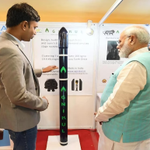
India's Department of Science & Technology @IndiaDST has backed @AgnikulCosmos with $21 million to build a fully reusable rocket.
The deal is structured not as equity or a grant but as optionally convertible debentures, meaning the state only makes money if AgniKul does.
AgniKul has already flown a suborbital demonstrator from India's first private launchpad, and this funding takes the next step: a fully reusable Agnibaan, from lab validation to flight-ready.
Most launch startups raise venture capital and promise reusability later. AgniKul got its own government to fund the R&D directly, before the first orbital flight, through a convertible instrument that keeps the cap table clean.
If you are building deep tech in a country that wants strategic autonomy, the government is not only a customer but a capital partner.
Find the gap your government cannot afford to leave open, and make the case before the market does.
🔁 Repost and share this with founders building launch and defence hardware.

ALT AgniKul Cosmos showcasing its Agnibaan rocket model to Prime Minister Modi. Courtesy of PIB, Government of India.
Yet again, Americans will pay for NASA's missteps as it loses the only ride to orbit and hands the keys back to Russia and China.
Before American rockets, @NASA had to pay Russia $80–90M a seat to reach orbit, making it expensive and geopolitically reckless.
So NASA ran an open competition. @Boeing got $4.2B for Starliner, @SpaceX got $2.6B for Crew Dragon. Two providers, no monopoly.
But SpaceX moved faster and cheaper, delivering 17 crewed flights and 64 astronauts.
Meanwhile, Boeing kept failing, once stranding two astronauts on the ISS for nine months until SpaceX rescued them.
Now, SpaceX is retiring Crew Dragon after 2030 and Starship won't replace it. No crew flights for NASA, @Axiom_Space, @voyagertech_, or @vast.
Boeing has burned $2B on top of NASA's investment and still can't certify Starliner.
The ISS deorbits around 2030, and if no one steps up, the United States loses crewed access to space entirely.

ALT An astronaut peers out of a spacecraft window, highlighting the challenges of a prolonged space mission.
Afan retweeted
The administrator of NASA stood on a stage, admitted America might lose the Moon to China, and made a room full of billionaires watch it happen.
@NASAAdmin is not being dramatic, because here is what the rest of the world is building while America gets ready.
China lands astronauts by 2030, its Shackleton lander was already built and on the pad in August, and the nuclear base with Russia follows.
Shackleton is 21 km wide, its rim holds near permanent sunlight right beside permanently shadowed ice, and China is aiming for a sub-100 metre landing box on that exact ridge.
America has spent 57 years and $100B+ getting ready to go back.
Lose, and every country on Earth picks again, whose technology to buy, whose standards to adopt, whose word to trust.
He does not think it is lost. He thinks it is a choice nobody has finished making.
So which one do our children inherit, a nation still capable of the extraordinary, or the memory of one that used to be?
The space economy keeps breaking records.
As @zebulgar says, have fun staying poor.


The $1.8T space economy is no longer too early.
$100M+ deals went from 1 in 10 to 1 in 3 in a year.
Q2's top 6 rounds all crossed $275M, every one led by generalists, sovereigns, or defence capital.
If funds with billions in AUM are already leading, what are you waiting for?
ALT Share of space deals over $100M, Q2 2025 to Q2 2026. Source: Seraphim Space Index.
The head of NASA has the @POTUS, @congressdotgov, a national space policy and a clear mandate.
Even fully backed, he admitted NASA cannot do this alone.
Then @NASAAdmin asked for entrepreneurs, scientists, engineers, allies, and anyone left who still believes great nations can do great things.
Dozens of landers, dozens of rovers, surface resource extraction and a moon base on a near monthly launch cadence, all inside four years.
$25B pointed at problems no company is currently willing to touch.
The same budget taught fighter jets to steer by pointing their engines, then spent years buying 3% off 40 year old ones.
That shows capital only compounds against hard problems and rots against incumbents, and this new direction speaks for itself.
"Our children will either inherit the confidence of a nation still capable of the extraordinary or the memory of one that used to be."
A generation gets one of those two, so which side are you building on?
Afan retweeted
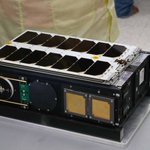
TakeMe2Space, an Indian startup, is about to put an AI data center in orbit, launching MOI-1A, a sub-50-kilogram satellite that runs AI in space, on a SpaceX rideshare on October 1.
Starcloud and SpaceX are building data-center-class satellites, huge power, huge cost, aimed at training large AI models in orbit.
TakeMe2Space did the opposite, a small, cheap satellite that runs one narrow job, processing imagery in orbit so only the answer comes down, not the raw file.
While the giants chase a market that does not exist yet, orbital AI training, years and billions away, TakeMe2Space found one that exists today.
They already have 23 customers signed, who want their data crunched in orbit to save on download costs. It ships now, while the giants are still building.
Its first satellite was lost in a launch failure this January, but it rebuilt the payload, booked the next SpaceX slot, and is flying again nine months later.
You do not beat a better-funded rival by matching their scale. You beat them by shipping something useful now, to customers who exist, while they build for customers who do not. Small and real beats big and someday.
🔁 Repost and share this with founders in your network building in space and deep tech.

ALT TakeMe2Space is preparing to launch a six-unit cubesat on a SpaceX Falcon 9 rideshare. Credit: TakeMe2Space.
Afan retweeted

Starcloud is going to the moon! 🌚🚀
I'm excited to share that @Starcloud_ has signed an agreement with @FireflySpace to fly onboard Firefly's Elytra spacecraft in lunar orbit, validating capabilities for a future orbital lunar data center.
Integrated on Elytra, Starcloud’s SC-1L processor, including the @NVIDIA H100, will ingest data from Firefly’s onboard Solux vision system, perform high-power AI computing on orbit, and rapidly transmit the processed data back to Earth. The demonstration builds directly on our recent AI computing demonstration in low Earth orbit, extending those proven capabilities into lunar orbit, a strategic priority for both @NASA and the @USSpaceForce.
