

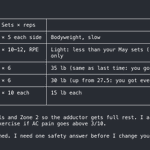




this morning's checkin with fitness coach:
"alright, new day, what are we doing. Take a look at the week and lemme know where we're short. I want to do some db lateral raises, bis, tris, shoulder cars
Adductor still strained, let's rest that completely"

And here's the harness github.com/westvegh/coach-ha…

opensource harness for your workout programs. It's worked great for me as I've been working through some injuries.
github.com/westvegh/coach-ha…
West Vegh retweeted

this California wealth tax thing is just incredible.
so in October 2025, a California healthcare union proposed a "one time" 5% tax on any billionaire's wealth. the ballot measure will be voted on next month. In early December 2025, California announced that it would be a retroactive tax if passed, applying to anyone with CA residency as of Jan 1, 2026. The objective is to pay for Medi-Cal, California's incredibly dysfunctional healthcare system. (which also functions as a glorified welfare apparatus, but that's a discussion for another time).
polls reveal that the CA electorate is split around 50/50 on the tax, but prediction markets only give Prop 40 a ~23% chance of passing (there are competing measures on the ballet that would nullify it).
there are 200 billionaires in CA, worth collectively somewhere between $2.3 and $2.6 trillion. 5% of that is around $100b, accounting for a small amount of attrition. proponents of the tax forecasted a significant windfall, assuming only a 10% departure rate.
supporters thought they were being clever with the retroactive concept. no billionares would leave CA in the few short months between the tax being proposed and the residency cutoff date, without the tax even having passed yet, right?
well as it turns out, they did.
a new paper [1] from two academics at Stanford called "The Net Present Value of the California Billionaire Tax Act", argues that not only did more billionaires leave due to the proposed tax than its proponents expected, but that the value of the tax, if it does pass, is actually negative.
proponents of the tax only assumed 10% avoidance, that is, only 10% of the taxable base of targeted billionaires would leave CA within the very short Oct-Dec 2025 window. Jaros and Rauh, the Stanford academics, find that a lower bound of 28.6% of the taxable base managed to leave.
just based on known departures, those departures total $577b in net worth, or $28.8b in potential tax lost. this of course does not capture everyone (many left without announcing their departure), so the authors normalize to departure rates estimated from other wealth tax events, and apply other discounts for litigation, arriving arrive at a figure of only $28-$36b in forecasted tax revenues.
but this isn't all! all of the income taxes paid by the departed billionaires are also forsaken. the authors estimate that CA billionaires pay $3.3- 5.8b in annual income taxes. they assume a midpoint of $2b lost in annual collections from departed billionaires. the net present value of that lost income stream is -$68.9 billion.
so when you add it all up you get:
+ $30b one-time tax windfall (estimated)
- $69b in present value of lost future income taxes
= - 38.9b overall net present value of the tax
of course, this analysis is highly estimate driven. the authors simulate the parameters 100k times and find a negative NPV of the implemented tax 85 percent of the time.
and if the tax doesn't pass, which it's not looking like it will, California still ended up losing at least $577b in departed net worth, and they have permanently poisoned the well with entrepreneurs who will now worry about future wealth taxes.
[1]: nber.org/system/files/workin…


How do people bypass claude's restriction on inputting details like government-issued IDs or payment information? It also won't route around it, e.g. hand off to a different model or something like @AsideAI
edit: just realizing this is the same question I had a few days ago. feels like claude is becoming more restrictive. Maybe the answer is to use codex as the orchestrator instead of claude


Your AI agent can now plan your lifting in Tally with an API key.
Works with Hark, Perplexity, Codex, cron jobs, anything that speaks MCP with a token.

Hook up Hark to Tally to keep tabs on your workouts @hark_labs tallyworkout.app/connect?for…

West Vegh retweeted

Monthly API credits are now available on Max and Team plans: $100 on Max 5x, $200 on Max 20x, and up to $500 pooled on Team. Use them on any Claude model.
How it works and full terms: support.claude.com/en/articl…


We’re rolling out monthly Claude Platform API credits for Max and Team plans:
Max 5x: $100
Max 20x: $200
Team: up to $500, pooled
Works on any model, including Haiku 5.5, in your code or third-party harnesses.
How it works and full terms: support.claude.com/en/articl…
Fun side project I've been working on: Tally, your UI for the workouts you've been building with AI.
Plan your week in Claude or Muse. Log every set in Tally. Your next plan starts from what you actually lifted.
Free on iPhone → tallyworkout.app
West Vegh retweeted

An email from Coach Sommer I revisit often:
Hi Tim,
Patience. Far too soon to expect strength improvements. Strength improvements [for a movement like this] take a minimum of 6 weeks. Any perceived improvements prior to that are simply the result of improved synaptic facilitation. In plain English, the central nervous system simply became more efficient at that particular movement with practice. This is, however, not to be confused with actual strength gains.
Dealing with the temporary frustration of not making progress is an integral part of the path towards excellence. In fact, it is essential and something that every single elite athlete has had to learn to deal with. If the pursuit of excellence was easy, everyone would do it.
In fact, this impatience in dealing with frustration is the primary reason that most people fail to achieve their goals. Unreasonable expectations timewise, resulting in unnecessary frustration, due to a perceived feeling of failure. Achieving the extraordinary is not a linear process.
The secret is to show up, do the work, and go home.
A blue collar work ethic married to indomitable will. It is literally that simple. Nothing interferes. Nothing can sway you from your purpose. Once the decision is made, simply refuse to budge. Refuse to compromise.
And accept that quality long-term results require quality long-term focus. No emotion. No drama. No beating yourself up over small bumps in the road. Learn to enjoy and appreciate the process. This is especially important because you are going to spend far more time on the actual journey than with those all too brief moments of triumph at the end.
Certainly celebrate the moments of triumph when they occur. More importantly, learn from defeats when they happen. In fact, if you are not encountering defeat on a fairly regular basis, you are not trying hard enough. And absolutely refuse to accept less than your best.
Throw out a timeline. It will take what it takes.
If the commitment is to a long-term goal and not to a series of smaller intermediate goals, then only one decision needs to be made and adhered to. Clear, simple, straightforward. Much easier to maintain than having to make small decision after small decision to stay the course when dealing with each step along the way. This provides far too many opportunities to inadvertently drift from your chosen goal. The single decision is one of the most powerful tools in the toolbox.
West Vegh retweeted

🐻 We can bearly contain our excitement that @davebanking is now #NasdaqListed!
$DAVE is a financial platform supporting 10M registered members with banking, budgeting, cash advances, credit building, and finding side hustles.💚
Learn more: dave.com

