

Meditations on AI startups, consciousness & nonduality. Sold my last company. YC unc.
Joined May 2008
- Tweets1.4K
- Following439
- Followers829
- Likes543






So true. One secret I realized working with Opus 5.5: speed minimizes your overthinking and helps you lean towards doing.
With the right AI setup, the old startup advice of bias for action now comes with a 10x multiplier.
I used to swear by ChatGPT Astra 6... until I started using Claude Opus 5.5. The reason is the pure speed. It is sooo much faster!
Habitually, I used to rely on the online versions of ChatGPT and Claude. But the bigger realization is that, because they were sandboxed, even very smart AI chatbots didn't default to acting on anything after their wonderful insights. We'd have just completed a fascinating round of thinking and strategizing.
Whereas when I default to Opus 5.5 on Claude Code, we'd have a quick round of discussion, and then we'd start doing. And it feels incredible.
I'm collaborating almost instantaneously with an AI agent that can spawn whole armies of AI agents.
I now default do instead of default think.
Default to action. And everything feels so magical.
This is the clearest living example of speed overriding quality. Clumsy action with constant iteration beats thoughtful inaction.

With standard ChatGPT, students scored 17% lower on the exam without it.
A second group's AI tutor gave hints, not answers. They did about as well as students who never had AI.
Same technology. The difference was what it was pointed at.
Neal Stephenson: "The paradox is that you learn self-reliance through failure, and AI tools construe failure as a malfunction."
Trying to do something without help is part of the practice.
Back in the 1940s, a "computer" was an actual job title for a person.
When machines took over the math, some of them moved one abstraction up and became the first generation of computer programmers.
Programming is next.
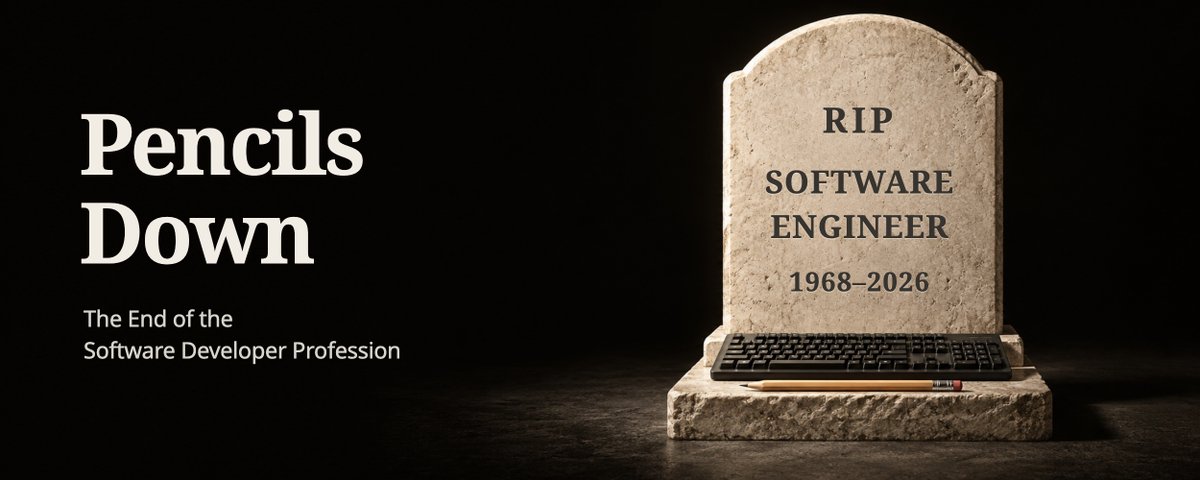
From my essay, Pencils Down: xitter.cf/weitingliu/status/2104…

Will Muse, Instinct, Dots, all these consumer AI agents, actually flop?
Last week I called Muse the iPhone moment of AI. This week Instinct raised $1B and OpenAI launched Dots.
Personal agents are the hottest market in tech.
But here's a contrarian take - the consumer agents may all flop.
Because the average consumer doesn't want to save time.
They want to kill time - on Netflix, TikTok, Instagram, and games.
Most people don't aspire to be productive.
Plenty of people who installed OpenClaw still couldn't find a real use case for it after months.
What do you think?
Very impressive sight to behold when a government starts to act more like a well-run tech company with taste.

Impressive. This set of talks, along with the new America dot gov website, has the unmistakable feel of an Apple launch event. They're rebooting the federal government as a tech startup. Several observations.
(1) First, with this new AI interface to the entire federal government, if it works as promised, there won't be a single American who can't say their life wasn't helped at least in part by AI, or that the benefits accrued solely to zillionaires. This in itself cannily mitigates anti-datacenter sentiment.
(2) Second, Joe Gebbia and Marco Rubio's talks on simplifying name changes and passport filings introduce a completely new era where the US government is actually launching tangible features that benefit users.
(3) Third, this launch event in and of itself may visibly drive reform. It could become much more important than the State of the Union. Unlike laws, code is user-visible, and can be instantly audited by the public, as Obama found out with the failed obamacare website launch. So: the annual America dot gov event may be substance, whereas SOTU is traditionally optics. I wouldn't be surprised to see the President present at the next one.
(4) Fourth, this kind of event is a perfect example of where tech and red cooperate best. They both hate bureaucracy. Automating paperwork with code reduces the power of statists over both capitalists and nationalists. It's also hard to undo by other admins: once you digitize a process, hard to turn it back to paper.
(5) Fifth, it's an obvious point perhaps, but think about how much influence YCombinator has had in 20 years. From Gebbia's Airbnb joining their 2009 batch to a complete overhaul of the user interface of the US bureaucracy, and thus the US government.
(6) Sixth, this is another take on the network state. The functional part of the US (the network, meaning tech) is merging with and partially reforming the dysfunctional part (the state, meaning bureaucracy) by automating 20th century paper forms.
As a tech startup, there will no doubt be bugs and user issues and so on, but unlike with paper laws those issues will be visible and the code fixes will be verifiable. A new era of AI America. Rooting for them.
Very relevant to @dhh’s Pencils Down talk last week at Rails World

Jensen Huang says the idea that we won't need software engineers is "completely false." His example: radiologists.
But radiologists survived on moats, not on a paradox.
Jevons multiplies software, not software engineers.
From my essay, Pencils Down: xitter.cf/weitingliu/status/2104…
Will Instinct be remembered as the Kosmo of the AI era?
Instinct raised $1B at a $10B valuation ... then OpenAI launched Dots basically the same day.
I get the "bubble" reaction, but I love the David vs. Goliath story at the start of the AI era! Even if David now needs a billion-dollar slingshot.
There's Dots, and there's Meta Muse. And Grok Bot. It would be easy to assume the companies that own the distribution will own this market too.
But we're still figuring out what a great personal AI should actually be. I'm glad there are founders willing to take on the giants rather than accept that the outcome is settled.
I'm rooting for the $10B underdog + @noahrshinn!

A list of surprising and mind-boggling stats from this conversation:
- $1B+ a year in transaction volume (still invite only)
- Growing 10%+ A DAY and has spent zero dollars on marketing
- 40% of users shared a personal credit card with Instinct within 3 weeks
- Compute demand is doubling roughly every week
- At 5 to 8% daily growth over the months it takes to bring new compute online, Instinct would reach about 100 million users
- On Instinct's own A/B tests, it matches Opus 5 performance at a fraction of the cost
- Noah spends about 40% of his time on compute
- Buying compute at the last minute costs 3 to 4x more
- Background work runs on setups that are 3x, 5x and 8x more efficient on the same compute
- 50% of Instinct's transaction volume is travel
- Instinct plans to take a cut of what users buy (take rates, Shopify is~2.5-3%, Amazon ~15%, Apple 30%)
- Noah's personal goal is to keep Instinct free for everyone for life
- Some small businesses run their entire back office on Instinct
- Users who connect at least one piece of sensitive information retain at about 80%
- Some users send more than 90% of their messages to Instinct by voice
- Say an app makes 70% of its money from ads and 30% from actually selling you things. Agents could wipe out the 70%, but Noah thinks the 30% gets much bigger, because people buy more when buying takes zero effort
- Instinct launched to about 200 friends and family
- Invites have sold on eBay for around $300
- More than 50% of Instinct's traffic doesn't run on iMessage
- Instinct has proactively called Noah three times
- The company is less than a year old
- Raised $1B at a $10B valuation, less than a month after raising at $2.5B
- Noah is 23

I’ve been using Instinct for the past 24 hours, and I’m pretty impressed.
More impressed than I was with Muse, actually. And of course definitely a better experience than trying to use ChatGPT as an agent…
Should we stop training software engineers?
DHH says it's "pencils down."
Jensen Huang says the idea that we won't need software engineers is "completely false."
Who's right?
My X feed last week was filled with two paradoxes.
@DHH at Rails World said that writing code by hand is no longer “an economically productive enterprise for the vast majority of programmers working at the vast majority of companies.” It’s “pencils down” for all programmers. Everyone went nuts.
Jensen Huang of Nvidia brought up Geoff Hinton’s infamous 2016 prediction on radiologists: “People should stop training radiologists now,” because deep learning was going to be better at reading medical images than humans within five years. Jensen was uncharacteristically critical, calling these predictions irresponsible and “hurtful.”
Put the two together and it raises the question: should we stop training software engineers?
Is DHH wrong this time, like Hinton was 10 years ago?
This question is personal to me. A decade ago I founded Codementor, a marketplace where developers paid other developers to teach them to code. The premise it was built on, that people learn to code from people, is the thing DHH says is over. Codementor was eventually acquired, so I no longer have skin in the game. But for sentimental reasons, I was looking for the comforting answer.
Maybe software engineers will be like radiologists? AI writes the code. Engineers move up a level of abstraction. We produce 100x more software, which creates even more demand for capable humans to catch the mistakes. AI will be everywhere in the field, and software engineers will thrive. Just like radiologists.
I wanted to believe that. Then I looked more closely at why radiologists survived, and the analogy became much less comforting.
Why Hinton was wrong about radiologists
Hinton was right about something important: AI became very good at parts of image interpretation. But he mistook a task for a profession.
Hinton later admitted he spoke too broadly, though he still says he was wrong on timing, not direction. Maybe. Ten years later though, the industry is still short of radiologists, not flooded with AI ones.
What happened is what some tech people like to cite as the Jevons paradox: radiology became so much cheaper that demand skyrocketed. But that’s not actually what happened for radiologists. Deep learning did not make scans cheaper. Imaging demand rose because the population aged and doctors ordered more scans. Radiologists survived on moats, not on a paradox.
Image interpretation was only part of the job. One time-and-motion study found radiologists spent about 36% of their time directly interpreting images. The rest included supervising examinations, consulting clinicians, procedures, and patient care. Automating the image read did not automate the entire bundle.
Medicine also requires humans to be legally accountable. Licensing, regulation, and liability all keep humans in the loop. And demand kept rising. Imaging volumes have grown faster than the productivity boost AI delivered.
Compare that with software engineers, and they are similar in only one way: demand. Insatiable demand. And this is where Jevons actually applies. There will be 1000x more software now that building it with AI is becoming relatively trivial. New kinds of software are now possible: malleable software. Just-in-time apps. Building for a market of one.
But Jevons multiplies software, not software engineers. Other than demand, human software engineers have no durable moats. Outside a few regulated corners like medical devices and aviation, there is no license required before an AI-generated pull request reaches production. And software has the unique nature of cheap automated verification. Compilers. Types. Tests. CI. Agents can test and debug for other agents.
What tests can’t check is whether the software should have been built that way in the first place. That judgment is real. But it’s a thin moat, and it doesn’t belong to engineers alone.
The coding bootcamps are already gone. Even Stack Overflow’s traffic has plummeted. Coding by hand is gone, but not software creation. That’s a distinction between tasks, not titles.
Over a longer time horizon, none of the radiologists’ moats would save software engineers. But there is a better analogy. The profession has a lineage of predecessors that kept reinventing themselves.
“Computer” used to be a profession
Back in the 1940s, a “computer” was an actual job title for a person. Computers were mostly women who performed complex mathematical calculations by hand. It’s hard to believe today, but there were literally whole office buildings of human beings doing calculations by hand. You may have seen the Oscar-nominated movie Hidden Figures.
Then machine computers were invented, and human computers as a profession disappeared. It now sounds ridiculous to have a building full of humans calculating math by hand.
So what happened to those human computers?
Some of them moved one abstraction up and became the first generation of computer programmers. The six women who first programmed ENIAC were picked from a pool of human computers. Dorothy Vaughan, the Hidden Figures supervisor, taught herself and her team FORTRAN when the IBM machines arrived.
When a task is no more, the profession morphs into something else, one level of abstraction higher.
Programming is next
Writing code by hand is disappearing as a specialized human activity. But we all know software creation will not. It will thrive and explode.
A founder becomes a software maker. A designer becomes a software maker. A doctor, scientist or teacher creates the software they need without handing the idea through an engineering department. Software creation becomes a general capability embedded inside other professions.
At that point, asking how many “software engineers” remain is asking the wrong question.
Impermanence
How do we train the next generation of “new software engineers”? The industry is unbundling and re-bundling the profession so quickly that universities might not redesign their curricula fast enough. It’s already showing: new computer science majors at US research universities fell 13% last year.
So should we stop training software engineers? Not quite. We should stop training them for a task that is disappearing, and start training everyone for the one that isn’t: making software.
Perhaps it’s just the nature of life. Impermanence. Things change. Things have always changed. Around 1800, most Americans worked on farms. 80 years ago, math calculations were done by hand, by humans.
AI may eliminate skills we once thought were essential. Some jobs will shrink. Some will disappear. Some new ones will be born. But our existing job titles do not define what we are capable of becoming.
If a designer can build software, a founder can design, and a single motivated individual can create what once required an organization, the possibility space gets much larger.
I started out looking for the comforting answer. I didn’t find it. I found a more interesting one.
We can be anything. And if we might as well be anything, we might as well be optimistic. Not the passive optimism that assumes everything will work out. The builder’s optimism that says the future is still being made.
Then go help create it.

“Make me a 10x founder” is a prompt for a 10x confused founder.
In my case, it created months of 10x thinking that felt like founder work.
Build. Talk to users. Ship. Learn. Iterate.
Point AI at building, shipping, and learning instead.
I want to become a 10x shipper.
I just received my specialist appointment date in Canada:
February 2027.
Why the f is this acceptable ???!!!
A high-functioning society doesn’t stay that way when low standards keep getting accepted as the norm.

My Claude Code gave me this:
“AI multiplies whatever you point it at. You pointed it at thinking, which was never your bottleneck, and got 100X thinking and roughly 1X shipping.”
Wow. This hit me hard.
I pointed AI at thinking and I got 10x thinking. Not 10x shipping.
"If you might as well be anything, you might as well be optimistic."
Exactly.
We need more AI leaders to publicly express confidence in AI - like Jensen saying there’s a “0%” chance AI ends humanity, or @AndrewYNg consistently pushing back against AI doomerism.
Especially for young people.
We can all believe in anything, and we might as well believe in a better future.
