

Crypto • TradFi • AI • Shitposting occasionally "This time it's different™" (spoiler: it's not) Bulls & bears make money, pigs get slaughtered DYOR | NFA 🔄
Joined January 2026
- Tweets491
- Following71
- Followers91
- Likes510
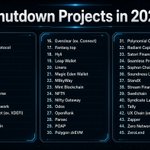







Around a hundred projects have already shut down or are winding down in 2026.
Abstract, Blast, Blur, Polygon zkEVM, Nifty Gateway, ZeroLend and dozens more.
In my view - this is just the beginning.
Looked at on-chain revenue data recently (DefiLlama and similar rankings): out of hundreds of blockchains and protocols, only a few dozen consistently generate more than $1,000/day in profit. The rest are a suitcase without a handle. It’s only a matter of time before they’re abandoned.
Investment buys a project time, not a reason to exist. You can raise tens of millions, build a beautiful site and call yourself the future of finance - only to discover that fees don’t even cover the present.
Money sitting in a protocol is not the same as people paying for its services. My diagnosis of this model: waiting for an airdrop is easy to mistake for love of the product. While users are fed with future rewards, the charts look like mass adoption; when the trough runs empty, real demand gets tested.
Another blockchain is not owed relevance just because it exists. You can build a magnificent toll road and then realize people didn’t want to go in that direction at all.
The economic question is ruthless for everyone: who will pay for this beauty once the budget for promises runs out? A venture round is an advance on a hypothesis. User revenue is the exam. And the logos of funds on your website won’t take that exam for you.
#Crypto #Web3 #Shutdown2026
🤖 Made with AI

Why are crypto projects dying?
Take part in the anonymous poll 👇👇
(takes 5 seconds)
P.S. If you have your own answer - drop it in the comments.
#Crypto #Web3 #CryptoPoll
33%Dumb developers
33%Greedy founders
33%Raise money & scam
0%Just unlucky
3 votes • 5 daysTOKEN2049 Singapore is over. I wasn’t on site, but I went through the coverage, sessions and reports. The main takeaway: the conversation is moving away from pure crypto narratives toward topics that feel familiar from traditional finance.
RWA. Probably the biggest narrative of the week. Tokenization wasn’t just a crypto-native topic. BlackRock, Franklin Templeton, Morgan Stanley, Nasdaq and others were on the program. Institutional interest looks real, and the plumbing (custody, accounting, regulatory frameworks) is slowly being built. But we’re still far from something convenient for the average user. Liquidity is fragmented, legal questions vary by jurisdiction and a tokenized asset isn’t always easier than a regular brokerage account.
For me this is no longer “something to watch.” RWA is a priority right now. I hold some tokenized stocks, farm others in liquidity pools and hedge part of the exposure through perps. The tool isn’t perfect, but it works - which is why I’m in it instead of waiting for ideal conditions.
Options and derivatives. This was the part I found most interesting. There was a lot of talk about onchain options and more mature derivatives infrastructure: Hyperliquid’s options plans, Coinbase completing its Deribit integration and a broader move toward more grown-up instruments.
Here’s why it matters to me. My first serious money came from options, trading through Interactive Brokers and Saxo Bank starting in 2015. To me they were never “just another hyped instrument.” Options let you define risk upfront, express a view beyond simple up/down and treat volatility as its own exposure. In crypto most people still work with spot and leveraged perps. It works, but it’s a blunt toolset.
If options become properly usable here - with real liquidity, tight spreads and clear clearing - that’s a meaningful step toward a more mature market. It’s early and it’ll need testing at real size and on stressed days.
Other things that stood out in the coverage:
• More institutions, with a more down-to-earth agenda: compliance, custody, reporting.
• Stablecoins discussed as payment and settlement infrastructure, not just trading pairs.
• AI agents were everywhere. Interesting idea, but working use cases were scarcer than slide decks.
• Exchanges keep widening their product lines and the “everything in one place” race is heating up.
Bottom line. There was plenty of hype, as always. But the market is slowly becoming more than just a leveraged casino. Infrastructure is appearing and so are tools that let you manage risk instead of simply betting on direction. I’ll be watching what actually ships versus what stays on slides.
#TOKEN2049 #RWA #Options #Derivatives #Crypto
🤖 Made with AI

An NVDA ticker on a DEX means nothing by itself.
I trade RWAs a lot and keep seeing scam tokens wearing popular stock tickers. The same ticker can sit on five different contracts. The real asset is the address, not the label in your wallet.
Before you buy, match the contract to the issuer’s official registry:
• @xStocksFi - xstocks.fi/products
• @RobinhoodCrypto - docs.robinhood.com/chain/con…
• @Ondo - app.ondo.finance/
• @coinbase - base.org/stocks
• @Backpack - learn.backpack.exchange/blog…
If the address doesn’t match, it is not “the same NVDA”. It is a different token.
P.S. If these links break, I’ll keep the updated registries in the replies under this post.
#RWA #TokenizedStocks #CryptoSecurity #DeFi #Crypto

Add-on for @binance
These are bStocks: BEP-20 on BNB Smart Chain, ticker ends with B (NVDAB, AAPLB, TSLAB). Not the same as Ondo (on) or xStocks (x).
Official contract list: web3.binance.com/en/dev-docs…
Same rule: the ticker proves nothing, the contract address does.
FUD is spreading that Bitget got hacked.
This is not an official confirmation from the exchange yet. It is onchain: wallets labeled as Bitget hot/cold moved about $160–183 million in a short window. The Block reported $170M+ going to a single address. ETH, stables, AVAX, BNB, XAUT were in the flow.
First red flag: a fresh Arbitrum wallet bought ~7,111 ETH in minutes with ~$19.7M USDT0 from a labeled Bitget hot wallet - and paid a premium to spot. Stables were then flipped to ETH fast. That looks more like stolen funds being moved out than a routine internal transfer to the exchange’s own cold wallet.
But it is still a version. It could be compromised ops wallets, or a mislabeled whale wallet. Bitget has not commented. Silence after a move like this is itself a problem.
Be careful. A lot of people will rush to withdraw. In hours like this, the extra risk is phishing “withdraw now” links, fake sites and jammed withdrawal queues.
#Bitget #CryptoSecurity #CEX #Onchain #Crypto

UPD on Bitget: this is no longer FUD.
The exchange officially confirmed the incident. On September 24 at 18:31 UTC, about $351.6M left parts of its hot and warm wallets. Cold wallets, they say, were not hit.
How it happened: the attacker got into the wallet backend, spoofed transaction data, and pushed funds out through the normal authorization flow. Private keys were not stolen, according to the CEO. Withdrawals are paused. Deposits and trading are live. The user protection fund is $464M+ and is supposed to cover the loss.
They suspect a North Korea-linked group based on IP/VPN patterns. Some attacker addresses have already been frozen. The largest single-chain hit was XRPL.
For users right now: ignore “urgent withdraw” DMs. The exchange went silent for hours, now it’s talking. Next watch is when withdrawals actually reopen.
P.S.
I was among the first to flag this, before any official statement. Unfortunate that it got confirmed. Even large exchanges can get hacked. Protect yourself and your capital.
#Crypto #Bitget #CryptoHack #CEX #CryptoSecurity
Tokenized stocks are no longer one issuer’s experiment. It’s a race.
@Backpack just brought 20 more tokenized stocks onto Solana through Backpack Securities: Boeing, Costco, IBM, JNJ, Shopify, Roblox and others. 24/7 trading. 1:1 redeemable for the underlying share through their rails.
That’s the signal. Ondo, xStocks, Robinhood, Coinbase, now Backpack - more issuers means RWA is leaving the small-club phase.
What matters next is liquidity, redemption and how these names actually work in DeFi. But the direction is right.
learn.backpack.exchange/blog…
P.S.
I’m already testing some Backpack assets in liquidity pools on @Raydium.
#Crypto #RWA #TokenizedStocks #Solana #Backpack #DeFi

I just ran into a real advantage of Rabby (@Rabby_io) over other wallets.
I had a volatile token / USDC position open on Uniswap V4. The Uniswap site didn’t show it. Explorers and portfolio trackers did. In one day the position had collected solid fees in both USDC and the token itself, which had pumped hard. I needed to take profit - and couldn’t, because the UI still didn’t see the position.
Then I remembered DeBank can manage a Uniswap position directly through the smart contract. You need Rabby for that. Connected it - and collected the fees.
Simple takeaway: if the protocol UI “loses” your position, the position is still there. You need a wallet that can talk to the contract when the frontend breaks.
#Crypto #RabbyWallet #DeBank #Uniswap #DeFi #LP

Are you ready for volatility?
The market is calm. The calendar is not.
September 15: cloture on the CLARITY Act. Not passage - a fork. Either the bill gets debated, or it stalls again.
September 16: the Fed. Rate is 3.50–3.75%. Hold or hike. A surprise hits bonds, the dollar, growth stocks and crypto at once.
Then the political season starts. October is the month before the November 3 midterms. This is not “just another election.” It’s a fight for Congress while markets start treating the White House as a lame duck.
If the House flips, impeachment talk, investigations, budget delays and shutdown risk come back immediately. The fiscal year starts October 1. In a campaign fight, funding becomes a weapon.
The risk is not one headline. It is the stack: crypto regulation, the Fed, political storm, fiscal gridlock.
I’m already preparing. Ahead of September 15–16 I’m widening LP ranges and planning new hedges. A quiet VIX is not safety. It’s a pause before a dirty season.
#Macro #Fed #CLARITYAct #Midterms #Crypto #RiskManagement #Volatility #Crypto

Urgent. Right now on Robinhood Chain: GLD is trading at a crazy premium.
Official GLD ETF ≈ $409. The on-chain GLD token on Uniswap is trading around $580.
That’s roughly a +40% premium.
If you already hold the token, consider selling into GLD/USDG. Do not buy it at $580.
Contract is Robinhood Chain only: 0xc9a981fee1f9dec688bb123ccdecc63d0debfc4e
Liquidity is thin. Size will eat the premium. Split the sells.
This is not clean arb. Retail cannot mint. The gap can close fast when markets reopen.
P.S. I collected a decent amount of fees and got kicked out at the top of the range. Shame the range was so tight.
#Uniswap #RobinhoodChain #GLD #RWA #TokenizedGold #DeFi #CryptoAlert #Crypto

As I said: GLD holders needed to look for a sell over the weekend. The price went above $1,500.
On Monday, new GLD could be issued - and the premium collapsed right away.
Congrats to everyone who, like me, managed to catch this anomaly!

On @Uniswap still doesn’t have a proper range rebalance. And that’s becoming a real problem.
I’m actively running tokenized stocks in tight ranges. Price moves a little - and you have to rebuild the whole position: close, open, set the range again. Extra transactions, extra time, extra gas.
In some other protocols this is one click. On Uniswap - it isn’t.
For LPs this is a basic feature, not a “nice to have”. Especially if the protocol wants to be the main venue for onchain stocks and RWA.
If you also want a proper range rebalance - like this. Let the team see the demand.
#Crypto #Uniswap #DeFi #LiquidityPools #RWA #TokenizedStocks #LP

A reminder of the risks facing global financial markets in 2027–2028. Below are 20 high-probability threats for the next two years. If they materialize, crypto as a high-risk asset will usually fall faster than the rest of the market.
Green candles feel great right now, but risk management doesn’t work on the current candle - it works beyond the horizon.
Debt, refinancing and credit
1. A U.S. technical default tied to the debt ceiling. A political standoff could delay payments, disrupt the T-bill market and trigger outflows from money market funds.
2. The corporate refinancing wall. Companies that locked in ultra-low rates in 2020–2021 for 5–7 years will have to refinance trillions at rates 2–3x higher. Next comes margin compression, High Yield defaults and bankruptcies among zombie firms.
3. A commercial real estate crash. Mass refinancing of office mortgages at 7–9% while buildings sit empty could set off a wave of defaults. U.S. commercial mortgage debt is around $6 trillion, with banks holding roughly half of it - a large share sitting at small and regional banks.
4. A consumer credit breakdown. Exhausted pandemic savings and rising unemployment could sharply increase delinquencies on credit cards and auto loans.
5. A wave of emerging-market sovereign defaults. Countries with heavy dollar debt may fail to refinance amid a strong dollar and high rates. Almost half of the world’s 26 poorest economies are already in debt distress or close to it.
6. Pension system stress in Japan and Europe. Massive government bond issuance to cover demographic shortfalls would pressure yields and national currencies.
Inflation, rates and policy error
7. A second wave of inflation. A new acceleration in energy, food, services, logistics and imported goods could stall disinflation. Central banks would then keep rates high for longer - or start hiking again.
8. A monetary policy mistake and a global recession. Cutting too early could reignite inflation and asset prices. Staying tight for too long would hit investment, defaults and corporate profits. The risk is stagflation followed by a worse credit cycle.
Geopolitics and supply chains
9. Escalation in the Middle East. Disruptions through Hormuz and other chokepoints would hit oil, gas, fertilizers, shipping insurance, inflation and importer budgets.
10. A maritime or hybrid blockade of Taiwan. That would disrupt chip supply, data-center equipment, autos and industrial automation - hitting profits, AI capex, Asian currencies, trade and inflation at the same time.
11. Escalation of the war in Ukraine. New strikes on gas, oil and grain supply would push inflation higher again. Even without direct NATO involvement. Direct involvement would be a much heavier scenario.
China, Europe and politics
12. A hard landing in China. A deflationary spiral, a prolonged property crisis and demographics could turn China from a growth engine into a source of global deflationary shock.
13. Capital flight from Europe. Structural stagnation and high energy costs make European assets less attractive.
14. Rising populism and pressure on EU cohesion. Political shifts in major countries could challenge common fiscal rules - and even the eurozone itself. France’s 2027 presidential election is ahead, along with votes in Italy, the Netherlands and Spain.
15. Political polarization in the U.S. Shutdowns, unpredictable fiscal policy and social tension ahead of the 2028 presidential election.
AI, infrastructure and tech repricing
16. A regulatory hit to the AI sector. Antitrust cases, breakups, or new liability rules for generative AI could crush Magnificent 7 multiples.
17. A collapse in AI monetization expectations. If mass adoption by 2027–2028 does not deliver a sharp rise in productivity and profits, tech giants could be repriced 30–50% lower. Through ETFs, options and algos, that can spread across the whole market fast.
18. An energy bottleneck for data centers. Shortages of generation and grid capacity for AI and EVs mean local blackouts, higher industrial power tariffs and frozen projects.
19. An AI capex debt hangover. A slowdown in hyperscaler spending would hit data centers, energy projects, private credit, equipment suppliers and structured finance.
Market valuation
20. A crash in an overvalued equity market. The world’s largest markets are expensive, while bonds offer higher yields relative to dividends. That is a poor backdrop for any negative surprise.
And these are only the risks that are already building and could realistically hit in 2027–2028. On top of them, the usual black swans remain: new pandemics, climate and tech disasters, cyberattacks, regime changes, civil unrest and others.
The most dangerous scenario is not a single shock. It is a combination: an energy or geopolitical crisis + a second inflation wave + rising Treasury yields + fiscal stress + forced position cuts. In that case, stocks and bonds can fall together, the dollar can strengthen, EM spreads can blow out and liquidity can dry up.
So green candles are not a reason to relax.
Taking profits on time and keeping a hedge is not fear. It is discipline.
#RiskManagement #Macro #Markets #Crypto #Geopolitics #Inflation #AI

Coinbase just put real stocks on Base. Not synthetics.
As of August 24, tokenized shares of Nvidia, Meta, Apple and Alphabet (NVDAc, METAc, AAPLc, GOOGLc) are live on Base. These are 1:1 claims on actual shares, not price trackers.
Key points:
• Issuer: Coinbase Onchain SPV (regulated under ADGM, Abu Dhabi)
• Underlying shares held by Alpaca in a bankruptcy-remote structure
• Issued as B20 tokens (Base-native, ERC-20 compatible)
• Self-custody, 24/7 trading, usable across Base DeFi (Aave, Morpho, Euler, Aerodrome, etc.)
• Available only to eligible non-US users
Corporate actions:
• Dividends are reinvested via an onchain multiplier (after 30% US withholding + 5% distribution fee). Token balance stays the same, economic claim increases.
• Stock splits are also handled via the multiplier so DeFi positions don’t break.
• Voting rights: most holders get none. Only “vested” (KYC’d) holders can instruct the SPV, with no guarantee the vote will be cast.
Mint and redeem are restricted to Authorized Participants. Regular users trade on the secondary market.
This is currently one of the cleaner tokenized equity products on the market. Not perfect (limited voting, dividend fees), but meaningfully closer to real ownership than most existing alternatives.
More tickers are expected in the coming weeks.
Registry and contracts: base.org/stocks#registry
P.S. Starting to test liquidity pools on @aeroxyz
#Coinbase #Base #TokenizedStocks #RWA #DeFi #Crypto

The market has been strong and clean since August 19.
A lot of people are already starting to feel like geniuses again.
I wouldn’t recommend it.
Long-term risks haven’t disappeared. We still have the midterms ahead, the situation around Iran remains unresolved, and the macro backdrop is far from simple. One strong move doesn’t erase structural problems.
Euphoria is the most expensive emotion on these kinds of rallies.
Better to stay calm and stick to the plan instead of the mood.
P.S. Right now I’m doing the boring work: partially reducing positions that ran too far and rotating some capital into delta-neutral strategies. No magic, just risk management.
#Crypto #Bitcoin #ETH #RiskManagement #MarketRally #CryptoTrading

Why ETH jumped almost 20% on August 19
On August 19, 2026 the market pulled a classic crypto move.
A few genuinely positive headlines appeared. Then it turned out the market was packed with shorts. After that, crypto simply took everyone on a collective liquidation tour.
ETH accelerated roughly 20% at the peak, BTC returned toward $69,000, and HYPE shot above $70.
The market did not rise because Trump walked out and said “crypto is good.”
Four engines fired at the same time:
• a positive signal from Washington
• an improving macro backdrop
• returning spot demand
• massive short covering
First came a reason to buy. Then the market forced the sellers to buy even more.
What happened at the White House
Donald Trump held a meeting with crypto executives, financial platforms, exchanges and regulators.
In one room: Coinbase, Ripple, Robinhood, Nasdaq, ICE, SEC and CFTC.
This was no longer a few guys in hoodies asking not to be jailed for tokens. These are people who actually run parts of the American financial infrastructure. That is the real signal.
Washington is no longer treating crypto as a weird toy for internet millionaires. It is discussing it as part of the future U.S. financial system and as a piece of technological competition with China. Trump explicitly linked the CLARITY Act to the need for America not to fall behind other countries.
Translation from political language:
The U.S. realized it cannot fully ban crypto. And if Americans do not build their own rails, someone else will.
The new strategy is simple:
If you can’t beat it - lead it.
Preferably in a way that keeps the fees, taxes and the dollar inside the American system.
Why HYPE exploded
The key line of the meeting came when Trump said CFTC Chair Mike Selig is working to bring Hyperliquid into the U.S. in a fully compliant way.
For the market this did not sound like a casual politician’s comment. It sounded like a signal that one of the largest on-chain perpetual venues might get a legal path into the biggest capital pool in the world.
HYPE jumped roughly 17–22% depending on the timeframe. Related instruments moved with it.
Hyperliquid is not a token invented last night. It is one of the largest venues for perpetual futures. Until now such markets mostly lived outside U.S. jurisdiction. The United States is the largest pool of capital, funds, market-makers and leveraged users.
A real legal route for Hyperliquid would mean access to American users, more institutional money, higher volumes and pressure on traditional exchanges that long considered perps their private territory.
This is still a political signal, not a license. But the market trades probabilities, and that probability rose sharply yesterday.
CLARITY Act
Trump again pushed Congress to pass the CLARITY Act - the bill meant to finally draw the line between SEC and CFTC and explain which digital assets are commodities and which are securities.
A procedural cloture vote is scheduled for September 15, 2026. It requires 60 votes and does not pass the bill itself, but it opens the path to further consideration.
The market did not get “CLARITY Act passed.”
It got “the bill now has a real path to a vote.”
Sometimes that is enough.
Softer regulatory background
This meeting did not appear out of nowhere.
The U.S. is already building a crypto jurisdiction.
In July 2025 Trump signed the GENIUS Act - the first major federal law creating a framework for payment stablecoins (reserves, disclosure, oversight). Stablecoins are moving from a gray zone into a regulated digital-dollar rail.
That creates a tight loop:
crypto needs dollar stablecoins → stablecoins need dollar reserves → reserves create demand for U.S. Treasuries → U.S. debt becomes part of crypto infrastructure.
On CBDC the direction is the opposite: federal agencies are barred from creating a central-bank digital dollar, and legislation limits the Fed from issuing one until at least 2031.
American model right now:
Fed digital dollar - no. Private dollar stablecoins - yes, under rules.
Bonds and liquidity - the real macro piece
Crypto Twitter immediately wrote “the Fed turned on the printer.”
No.
On August 19 the U.S. Treasury announced it will at least double the size of its buyback operations for long-term Treasuries (from $2 bn to at least $4 bn per operation for 10–30 year paper), starting September 9.
This is not sudden helicopter money.
It is a signal that authorities see stress in the long end of the bond market and are ready to support liquidity there.
Think of a huge used-car market full of old, unpopular inventory. If sellers dump everything at once, prices collapse and the market freezes. The Treasury is saying: “We are ready to regularly buy some of that old inventory.” Liquidity improves, forced selling risk drops, and risk assets feel safer.
Important distinction:
Treasury buybacks ≠ Fed purchases.
The Fed has been buying short-term Treasuries since January 2026 under its reserve-management program (roughly $250 bn of bills by July). That is about keeping bank reserves adequate, not classic QE.
Correct framing:
The overall liquidity backdrop became less tight. The Treasury additionally tried to calm the long end of the bond market. That is positive for risk assets, including crypto.
Spot demand and the short squeeze
On August 18 spot BTC ETFs saw about $189 m of inflows and ETH ETFs about $71 m. Real money was already buying before the explosion.
Then the shorts became fuel.
The market had been positioned for further downside. When price started rising, the first liquidation levels were taken out. After that the cascade is automatic: forced buying pushes price higher → more liquidations → more forced buying.
Total liquidations during the move were estimated between $1.4 bn and $1.9 bn, mostly shorts. The market did not calmly buy - it forced the sellers to buy in panic. That is why the move was so vertical.
Why ETH outperformed BTC
ETH is higher-beta. In risk-on regimes capital often rotates from BTC into assets that can move more. ETH reclaimed $2,000, short positioning was vulnerable, and ETF inflows were already present. It became the most convenient vehicle for the risk-on impulse. HYPE received its own personal gift from the White House meeting.
What the market actually re-priced
It re-priced the probability that the United States will actually build crypto infrastructure instead of just talking about it.
The chain was simple:
Treasury + Fed → less liquidity stress
White House + regulators → softer regulatory tone
CLARITY Act → hope for clearer rules
ETF flows → real demand
Level break → short squeeze
Five factors pointed the same way while the market was positioned for the opposite.
Don’t lose your mind after one green day
Trump’s words about Hyperliquid are not a license.
The September 15 cloture vote is not the law.
Treasury buybacks start September 9.
Fed reserve management is not COVID-style QE.
The liquidation wave ends, and after that the market still needs real demand.
Watch:
ETF flows, 10y/30y yields, the dollar, open interest, funding rates, whether BTC and ETH hold the levels, and actual SEC/CFTC actions - not just press-conference quotes.
Bottom line
August 19 did not prove that every coin will rise forever.
It showed that several important forces temporarily aligned: Washington wants to bring crypto inside the American system, the Treasury is trying to reduce stress in bonds, the Fed is keeping bank reserves adequate, ETF demand is still present, and the shorts, as usual, thought they knew the future.
They didn’t.
We are in a transition zone.
The old market is already breaking down. The new one is not fully built yet.
It feels like the Wild West is slowly ending and a more regulated financial market is being sewn in its place.
Crypto did not die.
It is simply being fitted for a suit.
#Ethereum #Bitcoin #Hyperliquid #Crypto #CLARITYAct #Trump #CryptoNews

Same story again.
A Trezor phishing site became the top sponsored result on Google.
People are still losing funds by clicking ads and entering their seed phrase.
Exactly the same thing happened with the fake Uniswap:
xitter.cf/web3parser/status/2060…
Simple rule:
• Don’t Google wallets or protocols.
• Use bookmarks.
• Double-check the official @Trezor account on X.
• Never enter your seed phrase anywhere online.
Stay safe and protect your capital.
#Trezor #Phishing #GoogleAds #CryptoSecurity #Fake #Crypto #Scam


A Google search was enough to drain crypto users.
Recently, scammers ran Google Ads impersonating Uniswap. Users searched for “Uniswap,” clicked a sponsored result near the top of the page, and landed on a fake site that looked almost identical to the real one: same branding, same interface, same buttons.
They connected their wallets, signed what looked like a normal transaction, and lost their funds.
To be clear: Uniswap was not hacked.
The protocol was fine. The attack happened at the search layer.
Scammers created a high-quality clone of the Uniswap app and used Google Ads to put it in front of users who were already looking for the real product.
How it worked:
The fake site pushed users into signing malicious approvals or transactions that gave attackers permission to move assets from their wallets. Once signed, the draining happened fast.
According to on-chain analysts, the scam has already taken more than $400,000.
The frustrating part is that this is not a new problem. Fake crypto ads have been documented on Google for years, and security researchers continue to report malicious ads targeting DeFi users. @_SEAL_Org recently said it blocked hundreds of malicious Google Ads URLs tied to crypto phishing campaigns.
How to protect yourself:
• Don’t click sponsored Google results for crypto apps
• Use bookmarks for protocols you trust
• Verify links through @DefiLlama, @CoinMarketCap and the project’s official X account
• Check the full URL before connecting your wallet
• Read every wallet prompt before signing
• Revoke old approvals regularly
In crypto, security starts before you connect your wallet.
Stay safe and protect your capital.
#CryptoSecurity #Phishing #DeFi #CryptoScam #StaySafe #ScamAlert #Crypto #Scam

US National Debt has surpassed $40 trillion.
Source: usdebtclock.org
#USDebt #NationalDebt #Macro #Economy #USA

RWA is a market with trillion-dollar potential.
Right now it’s a complete mess.
There are no unified tokenization standards. Every issuer does it their own way.
As a result, the rights of token holders are protected very differently (and often barely at all).
Voting rights? In most cases - none.
Dividends? Some reinvest via a multiplier, some raise the token price, and only a few actually send stablecoins to your wallet.
Corporate actions, taxes, claim on the underlying - everything is still a gray zone.
I wanted to make a simple table: “How RWA Issuers Handle Dividends.”
It turned out that even this basic question is solved differently by every issuer. It feels like the issuers themselves haven’t fully figured out how to handle it yet.
P.S.: If there’s any inaccuracy in the table or something has changed - drop a comment. Happy to correct it.
Until clear standards appear, every investor has to dig into the legal structure of each specific issuer. And that’s a far cry from the seamless RWA narrative we’re being sold.
#RWA #TokenizedStocks #RealWorldAssets #DeFi #Crypto
