

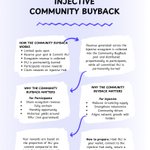


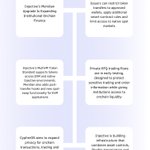

The next @Injective Community BuyBack is happening tomorrow, Wednesday, and this time, there’s something extra to look forward to.
Hey Ninjas, the BuyBack basket is already worth over $247K, and with Injective Stockdrop joining the experience, I think this round makes things more interesting.
✔️ The Community BuyBack lets participants commit $INJ and receive a proportional share of revenue generated across the Injective ecosystem. Once the round ends, participants receive their share of the revenue, while all committed $INJ is permanently burned, reducing the supply.
Now as Injective grows and generates more revenue, this mechanism will become even more meaningful over time.
And now, there’s an extra incentive, Injective Stockdrop.
✔️ Every address that participates in the BuyBack gets a chance to receive a tokenized stock on Robinhood Chain, with possible rewards linked to companies like $NVDA, $AAPL, $TSLA, $COIN, $MSTR, $AMC and more.
✔️ The allocation is randomized, so receiving a particular stock isn’t guaranteed. Each participating address can receive one Stock Token regardless of how much $INJ it commits, and this reward is separate from the usual BuyBack revenue.
I really like how this combines ecosystem revenue sharing, permanent $INJ burns and tokenized stocks in one experience.
It gives the community another reason to participate while bringing more attention to Injective’s growing role in onchain finance.
✔️ A quick reminder- secure an available slot, check the displayed commitment limits, and only commit what you’re comfortable locking in because submissions are final.
✔️ When claims open after the event, return to Injective Hub and connect the same wallet you used for the BuyBack. Stockdrop claims are subject to eligibility and jurisdictional restrictions, and token delivery happens after review.
The next round returns tomorrow, Wednesday, October 21. Check Injective Hub for the official details, understand the commitment before participating, and who knows? You might earn ecosystem revenue and land a Stockdrop too. xitter.cf/injective/status/21121…


The $INJ Community BuyBack returns this Wednesday!
October's event is now worth $247,000+
Oh, and Injective Stockdrop 👀
If you’ve not taken the time to read through @Injective’s new whitepaper yet, I’d advise you to set some time aside and go through it, because it gives you a clearer picture of what Injective is building and where the ecosystem is heading in the long run.
This is Injective’s first complete whitepaper rewrite since December 2018.
✔️ Back then, the focus was on a front-running-resistant exchange protocol on Ethereum. Today, Injective has evolved into a Layer 1 built for institutional finance, real-world asset tokenization, and making financial assets usable across markets, applications, and AI agents.
What I actually appreciate is how the new paper explains the infrastructure behind everything.
✔️ Injective’s native RWA infrastructure supports permission controls for minting, sending, receiving, and burning assets, alongside receive hooks and sealable namespaces. iAssets also provide oracle-priced, stablecoin-margined exposure to external assets without wrapping or pre-funding them.
✔️ Then there’s the fully onchain orderbook, which uses sealed batch auctions to clear orders at one price every block, helping prevent front-running and transaction-ordering MEV.
The network also delivers deterministic finality in approximately 600ms through BFT consensus.
✔️ Injective brings EVM and WASM together through a shared state, while its MultiVM Token Standard allows assets to maintain a single balance across both environments. Its perpetual markets include funding calculations, margin requirements, reduce-only liquidations, and insurance funds to help manage trading risks.
✔️ The AI side is another interesting part. Through MCP servers, policy-bounded signing, and x402 payments in USDC, AI agents can interact with tokenized assets and financial markets under defined permissions.
✔️ And for $INJ holders, onchain protocol revenue flows into the monthly Community BuyBack, alongside Injective’s deflationary mechanisms, connecting ecosystem activity to the token’s economic design.
What makes this whitepaper even better is that it formalizes the mathematical reasoning behind these systems, including consensus thresholds, auction clearing, oracle accounting, margin checks, permissions, and dynamic issuance. xitter.cf/injective/status/21118…

This month, we released the new Injective Whitepaper, our first full rewrite since the original paper in December 2018.
Back then we described a front-running-resistant exchange protocol on Ethereum. Injective is now a layer-1 built for institutional finance and tokenization, and the new paper covers how the entire chain works to issue real-world assets and make them usable across markets, apps and AI agents.
What's inside:
→ Native RWA tokenization with role-based permissions over mint, send, receive and burn, plus receive hooks and sealable namespaces
→ iAssets, stablecoin-margined derivatives priced by oracles that track external assets without wrapping or pre-funding
→ A fully onchain orderbook that runs a sealed batch auction every block at one clearing price, so front-running and ordering MEV don't work
→ BFT consensus with a >2/3 commit threshold and deterministic finality in ~600ms
→ EVM and WASM sharing one state, with the MultiVM Token Standard keeping a single balance per asset that Solidity reads through precompiles
→ Perps with time-weighted funding, initial and maintenance margin checks, reduce-only liquidations and insurance funds
→ AI agents trading tokenized assets through MCP servers, policy-bounded signing and x402 payments in USDC
→ Onchain protocol revenue going to the Community BuyBack for $INJ every month with deflationary mechanisms built in
We also formalized the mathematical reasoning behind each of these parameters, including the consensus threshold, batch clearing rule, oracle accounting, margin checks, permission model and dynamic issuance.
Full paper below 👇


Happy Sunday CT
If you’re seeing more conversations around RWAs on @Injective, keep reading.
✔️ Nearly half of all markets on Injective are tied to tokenized assets, with 135 RWAs spanning equities, forex, commodities, indices, and pre-IPO assets.
But the crucial aspect is not just the number of assets, it’s what Injective is building around them.
Tokenizing an asset is one thing, but making it useful from day one is where things get interesting.
✔️ Injective connects tokenization, trading, lending, and settlement on one protocol, allowing assets to move beyond simply sitting in a wallet. They can be traded on native orderbooks, used as margin, lent for potential yield, or used to hedge exposure through derivatives where supported.
✔️ Issuers can also customize their markets, control participant access, and configure KYC, compliance, and jurisdictional requirements at the protocol level. They can even launch private, permissioned pilots before expanding to broader markets.
✔️ And let’s talk about liquidity.
Tokenized assets need more than an onchain existence, they need markets where people can actually trade them. Injective is building unified liquidity and customizable market infrastructure to help assets become part of an active financial ecosystem.
✔️ I think this is what makes the long-term vision exciting. As more businesses and institutions bring real-world assets onchain, they’ll need infrastructure for issuance, compliance, trading, and settlement, all working together.
And with over $11 billion in assets issued on Injective, there’s already meaningful activity behind this direction.
✔️ I also think the real test is how much adoption, liquidity, and practical usage these markets attract over time. But Injective is not just bringing assets onchain, it’s building the financial infrastructure that could make those assets productive.
And I’m excited to see how far this goes.
Happy Sunday again 🥷 $INJ

This is to let you all know that @Injective is becoming one of the most exciting and fast-growing L1 ecosystems to watch, and the ecosystem is only getting bigger.
What I find interesting about Injective is that it’s not just trying to be another blockchain where people launch tokens and trade crypto.
The vision is building the infrastructure for the new internet economy, with finance at the center of it all.
✔️ Think about everything that happens in traditional finance, from tokenizing real-world assets and moving money through stablecoins to trading derivatives, bringing institutional capital onchain, and even allowing AI agents to participate in financial markets. Injective is building the foundation to bring all these activities together on one next-generation blockchain.
✔️ And that’s what makes this interesting to me. Instead of treating every financial use case as something separate, Injective is creating an interconnected financial ecosystem where tokenization, stablecoins, payments, perpetuals, options, and institutional applications can operate on purpose-built infrastructure.
We’re also seeing the vision expand beyond traditional trading.
✔️ AI and agentic finance are becoming important parts of the conversation, with the potential for autonomous agents to execute transactions, interact with financial markets, and make programmable payments. Privacy and quantum resistance are also areas in development, showing that the roadmap extends beyond what is already available today.
✔️ For institutions, this kind of infrastructure could make it easier to bring financial assets and activities onchain while supporting compliance and the requirements of larger market participants. For developers, it creates opportunities to build financial applications that can benefit from shared infrastructure and connected markets.
✔️ And for everyday users, it opens the door to a future where accessing different financial products onchain can become more seamless.
And through all of this, $INJ remains at the center of the Injective ecosystem, powering its role in this broader financial network. xitter.cf/injective/status/21112…

Injective is built for
-> RWAs
-> Perps
-> Stablecoins
-> Options
-> Institutions
-> Agentic Payments
-> Privacy: In development ⏳
-> Quantum Resistance: In development ⏳
The new internet economy on one next-gen blockchain for finance. Powered by $INJ
GM CT
The latest @Injective proposal, IIP-709, has just one day left in its voting window, and it’s worth paying attention to because it focuses on something we all use - gas fees.
✔️ Injective already has some of the lowest gas fees onchain, but this proposal is about making them more predictable. It aims to enable fixed gas fees for core exchange transactions on mainnet, including placing and cancelling orders, deposits, and withdrawals. The feature has been live on testnet since July 2026, and if approved, it will be enabled on mainnet.
So, what does this mean for us?
✔️ Instead of simulating every transaction to estimate gas, users and developers can rely on published gas values for supported exchange messages. This could reduce latency, prevent out-of-gas failures, and make transactions smoother.
✔️ And looking at the impact, as Injective grows its ecosystem around trading, DeFi, tokenized assets, and institutional finance, predictable transaction costs matter. Traders need smoother execution, developers need easier integrations, and institutions need reliable infrastructure.
✔️ IIP-709 won’t automatically make every transaction cheaper, and it doesn’t change other exchange parameters. It specifically enables fixed gas for supported exchange messages, but that’s still a meaningful improvement for an ecosystem built around frequent onchain activity.
What I love is that $INJ stakers get a say in this decision.
Governance is how we help shape the network we’re building on, so if you’ve staked INJ, you’re eligible to vote.
The voting window closes October 17. Let’s not just watch Injective grow, let’s participate in shaping its future. xitter.cf/injective/status/21100…

Injective already has some of the lowest gas fees onchain. Our latest governance proposal (IIP-709) makes them predictable.
Fixed gas fees with lower latency. Fair & scalable onchain transactions for every user, trader and institution.
All $INJ stakers are eligible to vote 👇
Good morning CT
This post is about how to get $INJ and explore the @Injective ecosystem on @solana using @Raydium , pay attention to this if you’re looking for more ways to access and put your $INJ to use.
Injective recently shared a guide showing how to swap $USDC for $INJ using Phantom on Raydium, and even provide liquidity to the INJ/USDC pool to earn a share of trading fees.
Here’s what makes this interesting 👇
✔️ $INJ began trading on Solana on September 17, 2026, through Sunrise using Wormhole’s token gateway. This gives people already exploring Solana another way to access INJ.
✔️ To get started, you need Phantom, USDC on Solana and some SOL for network fees. Connect Phantom to Raydium, search for INJ and verify the mint address.
Review the quoted amount, minimum received and price impact before confirming. Remember, Solana-based INJ and native INJ on Injective are on different networks.
✔️ You can also provide liquidity to the INJ/USDC concentrated liquidity pool. Simply choose your price range, deposit your tokens and confirm the transaction. A narrower range can earn more fees per dollar while the price stays within it, but if the price moves outside your range, your position stops earning fees until it returns or you adjust the range.
✔️ Raydium gives you an NFT representing your position, so don’t burn or casually transfer it! You’ll need the wallet holding it to manage or withdraw your liquidity.
You can track your position, harvest pending fees and withdraw some or all of your funds through Portfolio.
✔️ Note, there are risks. Price movements can cause impermanent loss, new trading pairs may have higher slippage, and fees and APR change with market activity. Always review the numbers before committing your funds.
I think this is an interesting step for Injective.
Giving $INJ access through Raydium creates another entry point for Solana users, opens up more opportunities for cross-ecosystem participation and allows INJ holders to explore trading and liquidity provision beyond Injective’s native environment. xitter.cf/injective/status/21100…

Are you guys really seeing how incredible this is for @Injective? Because there’s so much to this announcement.
Gulf Labs, the blockchain and digital asset venture of Thailand’s $27B GULF Group, is now live as an institutional validator on Injective. And this is the kind of development that makes you think about where Injective could be heading in the long run.
✔️ GULF Group operates across energy, telecom, banking, digital assets, cloud and data centers, with 24GW+ in installed energy capacity and over 46M mobile subscribers.
So this is not just about validating transactions. It creates opportunities to connect Injective with established businesses, institutions and users across Thailand.
✔️ Gulf Labs is already securing the network, validating transactions and participating in governance. Over time, both sides plan to explore tokenization, stablecoins, enterprise finance, education and AI infrastructure.
✔️ And there’s more. Binance TH is the official partner for Gulf Labs, helping introduce Injective to users nationwide through education, roadshows, universities and exchange campaigns. Through Gulf Edge, builders could also access local data centers, cloud services and AI compute.
✔️ Now, look at the big picture. POSCO International and LG CNS are exploring real trade receivables tokenization in a live pilot.
Four Pillars and Korea University have launched institutional validators. M-INJ is live in Thailand under Thai SEC supervision, Pineapple Financial has moved over $1B in mortgage records onto Injective, and Injective is now an SEC-registered transfer agent.
Different institutions, different industries, but the same direction, bringing real-world finance onchain.
✔️ GULF is bringing an entirely new level of institutional connections and potential distribution to the ecosystem. Imagine what could happen if these relationships translate into real asset issuance, stablecoin usage and financial activity onchain.
And more major enterprise adoption announcements across Asia and globally are coming in the months ahead. $INJ xitter.cf/injective/status/21100…

Injective's enterprise adoption is accelerating ike never before.
Gulf Labs, part of Thailand's $27 billion GULF Group, is now live as an institutional validator on Injective. Over time, Gulf Labs and Injective will work together across tokenization, stablecoins, enterprise distribution, education and AI infrastructure in Thailand.
This is the latest in a run of enterprise wins for Injective across Asia and the US.
→ Korea's largest trading company POSCO International and LG CNS are tokenizing real trade receivables on Injective in a live pilot
→ Four Pillars and Korea University launched institutional validators on Injective
→ M-INJ, Asia's first regulated INJ fund, is live in Thailand under Thai SEC supervision
→ Pineapple Financial has moved over $1 billion in mortgage records onto Injective
→ Injective is now an SEC registered transfer agent
GULF brings that momentum to a new scale.
GULF Group is one of Thailand's biggest conglomerates, with operations across energy, telecom, banking, digital assets, cloud and data centers.
→ $27 billion market cap
→ 24GW+ of installed energy capacity
→ 46 million+ mobile subscribers
→ Data center business serving hyperscalers and Thai enterprises
Gulf Labs is the group's blockchain and digital asset venture. Its validator is already securing Injective, validating transactions and voting in governance. That is the starting point.
Tokenization and stablecoins
Gulf Labs will connect Injective with institutions across GULF Group and the wider Thai market to explore tokenized assets, stablecoins and new onchain finance programs. Injective brings protocol level permissions, compliant asset controls and instant settlement. Gulf Labs brings local access and institutional relationships.
Distribution and education
Binance TH is the official partner for GULF Labs. bringing Injective to users nationwide through Binance TH Academy, roadshows, university networks and campaigns on the exchange.
Data centers and AI compute
Through Gulf Edge, builders on Injective get a local route to data center capacity, cloud services and AI compute in Thailand.
In the coming months, injective will reveal a number of major enetrprise adoption wins across Asia and globally. Brick by brick, we will bring the entire insittutional world onchain with $INJ

This @CoinMarketCap report on @Injective’s onchain finance stack reminds me that the real point is not just what a blockchain can do today, but how everything it’s building can work together in the long run.
And seriously that’s what makes Injective really interesting to me.
✔️ Injective is not just another chain for launching tokens and trading. The vision is a finance-native Layer 1 where onchain markets, tokenization, stablecoins, institutional finance, and AI agents share the same infrastructure.
✔️ Its decentralized order book supports shared markets, while frequent batch auctions help reduce transaction-ordering advantages. Add fast execution, low fees, and integrated risk controls, and you can see the bigger picture.
✔️ MultiVM brings native EVM and WASM together on one chain, giving developers more flexibility without splitting assets and liquidity across separate settlement environments.
And Native USDC adds another important piece, supporting trading, payments, collateral, and settlement.
But the RWA side is where things get more interesting in my opinion
✔️ Injective’s infrastructure goes beyond perpetual markets that track traditional asset prices. Injective Mint supports token issuance and permissions, while the August 2026 effective SEC registration of affiliated Injective Institutional Services adds regulated securities recordkeeping.
✔️ Access to $INJ is also expanding through US-regulated futures, while three proposed US INJ ETFs remain pending. These developments could create more familiar routes for traditional investors, although ETF approval isn’t guaranteed.
Plus there’s AI too, so with MCP servers, Agent Skills, the AI Agent SDK, x402 payments, and onchain agent identities, Injective is building tools that could let AI agents interact with markets, access services, and make permitted transactions.
I believe if all these pieces come together successfully, the long-term potential will go beyond DeFi ecosystem. xitter.cf/injective/status/21091…

Onchain markets, tokenization and AI agents, all in one unified financial system.
Injective brings infrastructure, MultiVM execution, native $USDC & RWAs together on a finance-native Layer 1.
Read the full report by @CoinMarketCap👇
coinmarketcap.com/academy/ar…

In case you missed this, @DefiantNews recently published an article about @Injective’s Meridian upgrade and how it’s expanding support for tokenized real-world assets (RWAs).
Seriously this is worth paying attention to because bringing real-world assets onchain is about more than creating tokens. Institutions also need ways to control who can hold them, how they’re transferred, and how trading can meet compliance requirements. And Injective is making progress in this area.
✔️ Meridian went live on September 24, introducing new post-transfer contract hooks that allow smart contracts to execute additional logic after tokens move. Combined with existing permission controls, issuers can restrict transfers to approved wallets and limit participation in native spot markets to approved addresses.
✔️ This builds on Injective’s MultiVM Token Standard, which allows tokens to operate across both EVM and native Injective environments, giving developers more flexibility when building tokenized asset applications.
✔️ But that’s not all. Meridian has also introduced early testing for private request-for-quote (RFQ) trading, designed to help institutions access onchain liquidity while protecting sensitive trading and order information. This matters because large institutions may not want their trading strategies exposed publicly.
The testing lays the groundwork for CypherOS, Injective’s planned native privacy platform.
✔️ On October 1, Injective shared a preview focused on confidential transactions, trading and tokenization. The broader privacy features are planned for a later chain upgrade, so there’s still more to anticipate.
✔️ Another interesting detail is that the IIP-701 governance proposal passed with 99.55% support among non-abstaining voting power before Meridian became effective at block 184,394,000.
Now I think if tokenized stocks, funds and other real-world assets are going to attract more traditional financial institutions, the infrastructure needs to offer more than fast transactions and low fees.
It also needs compliance controls, flexible asset management and ways to protect sensitive financial activity.
Injective is building toward that kind of environment, where assets can be issued, managed and traded with more of the controls institutions may need. $INJ xitter.cf/injective/status/21087…

We’ve all been talking about the Canary Staked INJ ETF that’s coming soon, but have you checked out @Injective’s new whitepaper? Because there’s a lot happening here that deserves attention too.
✔️ This is Injective’s first full whitepaper rewrite since December 2018. Back then, it focused on a front-running-resistant exchange protocol on Ethereum. Today, Injective has evolved into a Layer-1 built for institutional-grade finance, real-world asset tokenization, and AI-powered financial applications.
- Now the interesting part is that Injective is not only talking about bringing finance onchain. It’s building the infrastructure to handle the entire process, from issuing tokenized assets to trading and settlement.
✔️ Projects can issue RWAs with programmable permissions, while iAssets provide oracle-priced, stablecoin-margined derivatives that track external assets without wrapping them or requiring pre-funding.
✔️ Trading happens through a fully onchain orderbook with frequent batch auctions designed to make front-running and ordering manipulation harder. Add approximately 600ms blocks and deterministic finality, and you can see the kind of financial infrastructure Injective is building.
✔️ There’s also native EVM and WASM support in one shared state, connecting applications to common assets and liquidity. Its perpetual markets include margin checks, liquidation safeguards, and insurance funds, while AI agents can interact with financial applications through MCP servers, policy-bounded signing, and x402 machine payments in USDC.
✔️ And $INJ holders should pay attention too.
INJ powers transaction fees, staking, and governance, while onchain protocol revenue flows into the recurring Community BuyBack, connecting ecosystem activity to the token’s value-accrual design.
I think the ETF conversation is exciting, but while we anticipate institutional exposure, Injective is also building the infrastructure for tokenized assets, onchain markets, stablecoins, and AI-driven finance.
We’re watching Injective move beyond its original exchange protocol into a network built for the full lifecycle of tokenized finance. xitter.cf/injective/status/21078…

Today we are releasing the new Injective Whitepaper.
It is the first full rewrite since our original paper in December 2018, which described a front-running-resistant exchange protocol on Ethereum.
Eight years later, Injective has evolved greatly into becoming a layer-1 blockchain for institutional-grade finance and tokenization. Every layer of the protocol exists to issue real-world assets and give them real utility across markets, applications, and AI agents.
Inside the paper
→ Asset issuance. Native RWA tokenization with role-based permissions over mint, send, receive, and burn, plus programmable receive hooks and sealable namespaces
→ RWA exposure. iAssets, stablecoin-margined, oracle-priced derivatives that track external assets with no wrapping or pre-funding
→ Trading. Tokenized assets trade on a fully onchain CLOB where each block runs a sealed frequent batch auction at a uniform clearing price, resisting front-running and ordering MEV
→ Settlement. BFT consensus with a greater-than-two-thirds commit threshold delivers deterministic finality with ~600ms blocks
→ Composability. Native EVM and WASM in one canonical state, with the MultiVM Token Standard keeping a single bank-module balance per asset, exposed to Solidity through precompiles
→ Derivatives. Perpetuals with time-weighted premium funding, initial and maintenance margin checks, reduce-only liquidations, and insurance funds
→ Agentic finance. AI agents operate on tokenized assets through MCP servers, policy-bounded signing, and x402 machine payments in USDC
→ Value accrual. Onchain protocol revenue flows to the recurring Community BuyBack for $INJ
The paper formalizes each mechanism, from the consensus threshold and block lifecycle to the batch clearing rule, oracle accounting, derivative risk checks, permission model, and dynamic issuance controller.
From issuance to settlement, one chain built for the full lifecycle of tokenized finance.
Read it below.

Good news for everyone who participated in the last $INJ Community BuyBack. @Injective just confirmed that all Stockdrop rewards have been sent out, so check your wallets for a surprise.
If you missed this round, don’t worry, because Stockdrop is continuing this month.
✔️ In case you’re new here, the Community BuyBack lets you commit $INJ, earn a pro rata share of revenue generated across the Injective ecosystem, and permanently burn the INJ you committed. Now, Injective has added another reward, giving participants a chance to receive a tokenized stock on Robinhood Chain.
✔️ We’re talking stocks linked to companies like $NVDA, $AAPL, $TSLA, $META, $COIN, $MSTR, $AMC, $SNAP, $HIMS, $RKLB, $CRCL, $INTC, $MU and more. Each eligible address can receive one randomized Stock Token, regardless of how much INJ was committed, but remember, receiving one isn’t guaranteed.
✔️ What I find interesting is how this connects everything together.
Participants can earn ecosystem revenue, contribute to permanent INJ burns, and potentially receive an additional stock reward. As Injective grows and generates more ecosystem revenue, the BuyBack mechanism could become even more meaningful, while Stockdrop introduces another way to connect the community with tokenized financial assets.
And this goes with Injective’s vision of building financial infrastructure where crypto, tokenized assets and other markets can operate onchain.
✔️When claims open, remember to connect the same wallet you used for the BuyBack on Injective Hub to reveal your allocation and request your Stock Token. Claims remain open for one week, and distributions happen in batches, so delivery isn’t instant. Signing the claim request doesn’t move funds from your wallet or cost a submission fee.
✔️ One important thing to know is that Stock Tokens provide economic exposure to underlying securities, not direct ownership rights in those companies, and jurisdictional restrictions apply.
So if you missed this last round, keep an eye on Injective Hub for this month’s Community BuyBack. More rewards for the community, more $INJ burned forever, and another step toward bringing financial assets onchain. xitter.cf/injective/status/21083…

Canary Capital has recently announced that its Staked INJ ETF is coming soon, and this is actually a big development for @Injective.
Remember Canary recently filed Amendment No. 3 to its S-1 with the SEC for a spot Staked INJ ETF that would give investors exposure to $INJ through a traditional brokerage account without needing to buy, custody or stake the token themselves.
✔️ And the Trust is expected to hold actual spot INJ, with BitGo as custodian, use the CoinDesk Injective Benchmark Rate 60m NY Rate for pricing, and trade on Cboe BZX.
So here is the interesting part, Canary expects at least 90% of the Trust’s INJ to be staked under normal circumstances.
✔️ So the ETF would not only hold INJ. Its holdings could participate in Injective’s proof-of-stake network and generate staking rewards, with those rewards subject to staking fees and generally being restaked or used for the Trust’s requirements.
✔️ The Trust also has to manage liquidity carefully because unstaking INJ involves a 21-day unbonding period. It will therefore keep enough liquidity available for things like redemptions and expenses.
✔️ The ETF is designed to be passive too. No leverage, no derivatives and no active trading strategy. The main goal is to provide exposure to INJ, with staking as an additional source of returns.
And this is where I think the important aspect is
✔️ An ETF can give traditional investors, wealth managers and institutions another way to access INJ through familiar brokerage infrastructure without directly dealing with crypto wallets and staking.
That creates another bridge between traditional finance and Injective.
✔️ And it also aligns with what Injective has been building around institutional finance, tokenization, perpetuals, stablecoins and agentic finance.
The big part is accessibility. If this launches, traditional investors can potentially gain exposure to $INJ through a familiar financial product while that vehicle participates in Injective staking.
And with Canary saying it is coming soon, I think the next big thing to watch is the actual launch. xitter.cf/CanaryFunds/status/210…


🐤 The Canary Staked INJ ETF (Ticker: $INJC) is coming soon.
View our SEC filing: sec.gov/Archives/edgar/data/…



If you know you haven’t been around lately or you’ve missed the latest happenings across @Injective, grab a seat because there’s a lot to catch up on.
The latest is the Injective Trench Treasury, and I think this one is worth paying attention to.
✔️ The Injective Foundation launched it to support projects building with $INJ while rewarding the ninjas and communities helping the ecosystem grow.
Projects will be assessed around things like having $INJ at the core, organic holders, real liquidity and community activity, fair launches, innovative technology and value accrual. And the first rewards are already going to Sprout and RunUp, two projects that brought new users and builders into the $INJ trenches.
But this is happening alongside a bigger wave across Injective.
✔️ The first Stockdrop went live, the Community BuyBack has burned 7.2M+ $INJ, CypherOS has previewed privacy infrastructure for confidential finance, Robinhood now supports native $INJ trading and transfers, and Canary is advancing its Staked INJ ETF filing.
✔️ Injective is also working with LG CNS, expanding across Solana through Phantom and other apps, adding new USDC routes, and bringing more builders into the ecosystem through projects like Sprout and RunUp.
✔️ On the institutional side, more than $1B in RWAs are now tokenized on Injective, while 21Shares and Canary continue advancing $INJ ETF filings. Injective also has an SEC-registered transfer agent and a live MiCA whitepaper.
And the new Injective whitepaper ties everything together.
- What started as an exchange protocol in 2018 has evolved into a layer-1 built for institutional-grade finance and tokenization, covering asset issuance, RWAs, trading, derivatives, settlement, composability and agentic finance.
✔️ Injective has already processed 3B+ transactions, including 42M+ in the last 30 days.
So while Injective is building infrastructure for institutions, tokenization and AI agents, it is also investing directly in the builders and communities creating what comes next.
Injective is building the infrastructure, supporting the builders and bringing more real-world finance onchain. xitter.cf/injective/status/21068…

The first Injective Stockdrop went live. The Community BuyBack closed with more than 7.2 million $INJ burned to date with loyal ninjas now being able to claim tokenized stocks. CypherOS also made its first public appearance as the privacy platform for confidential transactions, trades and tokenization on Injective.
Here are some of the top developments from the past week on Injective ⤵️
🟪 The Community BuyBack is complete with more than 7.2 million INJ burned to date, and Stockdrop participants can now claim tokenized stock rewards.
🟪 The first CypherOS preview is live, showing a privacy platform built for confidential transactions, trades and tokenization.
🟪 Canary Capital filed Amendment No. 3 to its SEC registration statement for a Staked INJ ETF, with plans to hold spot INJ and stake at least 90% of its US institutional holdings.
🟪 Robinhood now supports INJ trading and transfers, giving users a direct route into Injective with native INJ and no bridge.
🟪 Injective and LG CNS are working together to bring more activity onchain through a 24/7 programmable economy.
🟪 Injective hosted the largest institutional event during Korea Blockchain week alongside members from @coinbase, the Federal Reserve, LG, BitGo and more
📊 Key Stats
🟪 Injective has processed more than 3 billion transactions, including more than 42 million in the past 30 days.
🌐 Ecosystem News
🟪 @sproutsomefun is live as one place to bridge, discover and trade new launches across Injective.
🟪 @runupdotfun is officially live, letting users launch tokens powered by long or short perp markets.
🟪 INJ is now live across the Solana ecosystem, including @phantom and several trading, launch and data apps.
🟪 The @fomo thesis competition concluded, with INJ sent to every winner.
More releases are on the horizon.
Are you still holding your $INJ on @binance ?
If yes, this might be the sign to finally move some of it onchain.
✔️ @Injective have shared a complete guide for moving native $INJ from Binance into the Injective ecosystem, and this is actually more important than it might look.
✔️ Binance has supported native INJ since the early days of Injective, but when your INJ is sitting on an exchange, you’re mainly just holding it. Once you move it into your own Injective wallet, you can actually use it across the ecosystem.
✔️ Now this is the process. Open Keplr, select Injective, copy your native address starting with “inj”, then go to Binance, select INJ withdrawal and choose the Injective network. Always check the live withdrawal fee and minimum, and make sure the address and network are correct. Sending a small test amount first is also a good idea.
✔️ Once your INJ arrives in Keplr, you can connect to Injective Hub, stake, participate in governance and interact with Injective dApps.
✔️ And if you have USDC on Binance, there’s a route for that too. If Binance supports Injective for USDC withdrawals, you can send it directly.
If not, Injective’s guide shows how to use Circle CCTP through the Injective Bridge to move USDC from Ethereum to Injective.
✔️ Injective is not just building a chain where $INJ exists. It’s building an onchain financial ecosystem around trading, staking, governance, stablecoins, tokenized assets, DeFi and increasingly more applications.
So moving your INJ onchain means you’re not just holding the asset. You can actually participate in the ecosystem being built around it.
Just remember to check Binance’s live network, fee and minimum before every transfer, and never send an inj address through the wrong network.

Want to move your assets from Ethereum to @Injective? Then keep reading, because it has gotten simpler.
✔️ Injective recently published a guide showing how to bridge ETH from Ethereum to Injective using MetaMask, and the part I find most interesting is that you don’t need to create another wallet.
✔️ You can use the same MetaMask account you already have on Ethereum. Once connected to Injective, that account gets an Injective address beginning with “inj”, allowing the same wallet to interact with both networks.
✔️ The process too is straightforward. Open the official Injective Bridge, connect MetaMask, select Ethereum and ETH as your source, then choose Injective and WETH as the destination.
- Your ETH becomes WETH once it reaches Injective, which is the wrapped version of ETH used across supported Injective applications.
✔️ Before bridging, make sure you have enough ETH left to cover Ethereum gas fees, check that you’re using the official bridge domain, and never enter your MetaMask recovery phrase anywhere.
✔️ After you approve the transaction, the bridge locks the Ethereum asset, Injective processes the deposit, and the corresponding WETH is issued on Injective. You can track the transfer through the bridge and verify your WETH in the Injective Hub Wallet using that same MetaMask account.
And this is actually bigger than only moving ETH.
✔️ It lowers the friction for Ethereum users who want to explore what Injective is building around onchain finance without having to set up an entirely separate wallet.
So if you’ve been thinking about entering the $INJ universe but weren’t sure how to get your Ethereum assets there, this guide gives you a simple place to start.
Please remember to carefully verify the network, asset, amount, destination and fees before signing. Bridge details and processing times can change.

Ifedayo retweeted

$INJ [Short Term Update]
The previous orange outlook is now the main outlook.
I'm expecting ~ $7.15 to complete the correction then have a race back up.
Of all the #Altcoins I can rationalize the nested 1-2's here better than any other coin.
Good Luck Degen.


$INJ [Long Term Update]
Injective performed better than expected. I was looking for a complex correction but we're going immediately into wave 3.
What this means. We're going to have 2 more drawn out wave 4's above us given the sharp declines we've seen here. Meaning as we get higher it'll get choppier.
My baseline assumption here is that these are all nested and it follows logically into the next larger degree waves.
Though a more bullish interpretation exists I'm keeping it simple.
Good Luck.

Ifedayo retweeted

I think we could see more rotations here, because $ETH going up usually means risk on mode for Alts
and people who missed the recent runs will be looking for the next trade / beta plays
so i think we could see $HYPE, $NEAR and $LIT chilling for a bit, so I’m watching coins with fresh catalysts that fit the narratives already catching a bid like
- $AAVE for a DeFi rotation, with V4 crossing $1B in deposits and $310M in active loans, so there’s actual borrowing behind the story
- $ZRO with Zero and ATLAS coming, bringing planned staking incentives and trading-fee buybacks beyond the bridge-token label
- $INJ if the privacy and confidential DEFI bid broadens, with its upcoming CypherOS platform adding confidential transactions to the thesis
- $ZAMA for the same narrative, but with encrypted balances and transfers already available to apps on Ethereum
- And $CRV if stablecoins and DeFi catch more attention, since swaps and crvUSD borrowing already generate protocol fees
More coins to keep watch on $KITE $CHIP for Ai agents and computing