

CEO @ LabGPT / Rep of Taiwan ROC @ Liberland
Earth
Joined July 2013
- Tweets809
- Following278
- Followers177
- Likes722


Alice retweeted

Anthropic employee tells students at university that their career won't exist when they graduate.
Imagine the levels of psychopathy it takes to give a speech to students trying to make their future better, then telling them don't bother, don't plan for the future, your degree is worthless and you wont have jobs.
1/ Plot twist: Publishing more papers might actually help you make more breakthroughs. 🔬
This study involving 21,271 economists found that scientists' hot streaks weren't just citation bonanzas.
They also produced more disruptive research.
Full paper here 👇
doi.org/10.1057/s41599-025-0…

2/ So should scientists publish MORE or LESS? 🤔
Li et al. (2025): Lower productivity was linked to stronger peak disruption. (doi.org/10.1038/s41598-025-9…)
Chen et al. (2025): Higher publication volume was linked to greater chances of disruptive work.
Both can be true. Quantity and originality aren't the same metric.

1/ Academia: Publish or perish! 📚
Science: Actually, could I get some time to think? 🧠
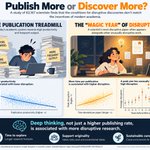
A recent paper studied 62,167 scientists and found that greater time per paper and lower publication rates were associated with more disruptive research.
More papers ≠ more breakthroughs.
Full paper here 👇
doi.org/10.1038/s41598-024-7…

2/ Plot twist: scientific breakthroughs have a “magic year.” Why?
A scientist's most disruptive paper often appears alongside other unusually disruptive work. And researchers who spent more time per publication tended to achieve higher disruption.
> Deep thinking beats the paper treadmill.

3/ Academia rewards productivity. But productivity isn't the same as progress.
What if we funded scientific breakthroughs instead of rewarding publication counts?
#DeSci could reward originality, fund longer research horizons, and give scientists room to explore risky ideas.
How would YOU redesign science funding? 👇
#OpenScience #ScienceonScience
1/ Academia has a midlife crisis. And the data shows it. 🔬📉
A study of 100,000+ scientists found that consecutive high-impact papers cluster early and late in research careers.
In the middle? A productivity hot-streak drought.
Full paper here 👇
doi.org/10.1038/s41598-024-7…
2/ What's the secret behind scientific hot streaks? 🔥
👩🔬 Early career: Small teams, close collaborators.
🏛️ Late career: Big projects, established networks.
😵 Mid-career: More responsibilities, fewer close ties, and not enough resources to build large teams.
The awkward middle child of academia.
3/ #DeSci loves funding young talent and bold new ideas. But what about scientists stuck in the middle?
Fund mid-career researchers. Support long-term collaborations. Make research infrastructure accessible.
Don't just fund the next generation of scientists. Stop losing the current one.
If you are one of these middle-career scientists, please leave a comment below about your experience 👇
#ScienceonScience #OpenScience
Academia's incentive and power structures often discourage high-risk, high-reward research. The problem isn't a lack of talent, but a system that struggles to translate scientific expertise into real-world impact. I see #DeSci as an opportunity to rethink these structures, encourage creativity and entrepreneurship, and break down institutional and disciplinary silos to enable transformative breakthroughs.

I recently spent some time with former colleagues from academia. All of them brilliant, peak human capital. Almost all of them fundamentally unable to plug into the economy, inoculated against productivity by a youth spent experimenting in laboratories instead of building wealth for society. Dealing with real people in the real world.
90% of them have left academia in the last 10-15 years, and 90% of those are functionally unemployed. Grad school does a lousy job of training scientists to be professors (since most of them don't get the good postdoc or tenure track position) and an even worse job of preparing people for real life.
We complain that our societal infrastructure is collapsing, our state capacity is low, our incumbent industries are faltering. Where are the next generation of leaders that can push us forward?
A huge fraction of them were conveyor-belted into academia by schooling systems that have no mechanism to channel ambition and 99+%ile competence, and our universities are mostly hedge funds with glorified psych wards/academic departments on the side, running an insane pyramid scheme that exists only to prove, over and over again, the Shirky Principle: Institutions will try to preserve the problem to which they are the solution.
We literally poured trillions of dollars into state-funded research and effectively neutered our elite civilian technical leadership development programs.
I recently asked a few academic friends if they were finding AI useful in accelerating their programs of research. You know, to solve the Big Problem their entire field exists to solve?
Some were. But most were complaining about how it created pedagogical issues, explaining how their department decided to ban the use of AI, or how it took 18 months to approve an enterprise account, or how they tried Gemini 2 on a puzzle a year ago and it wasn't very helpful, or repeating nonsense about datacenters and water consumption, or supposed IP theft by model companies, as though that has any bearing on their ability to, eg, accelerate a cure for cancer.
Elon sometimes calls AI a supersonic tsunami - a huge wave you don't see coming. I see it coming. But even the people who you'd think have been waiting for this their entire careers are steadfastly looking in the other direction.
1/ Science loves a rebel. But not every revolution survives its own revolution. 🔬💥
A recent study found that disruptive papers aren't necessarily influential.
The real game-changers don't just challenge old ideas. They become the foundation for new ones.
Full paper here 👇
doi.org/10.1038/s43588-025-0…

2/ Plot twist: disruption has an expiration date. ⏳
Researchers introduced "persistent disruption": overturn older work AND remain foundational to future research.
Their new metric identified Nobel-winning papers better than a conventional benchmark.

3/ DeSci shouldn't just fund scientists to kick over the chessboard. ♟️
Fund the experiments that test their ideas. Enable independent replication. Make research reusable.
Breaking old paradigms is exciting.
Building knowledge that survives the next revolution? That's progress.
#DeSci #OpenScience
1/ Academia loves a predictable career story. 📈
Publish more. Peak early. Slowly decline.
One tiny problem: only ~20% of individual researchers follow that pattern.
Zhang et al. (2026) suggest the “typical” scientific career might be a statistical illusion.
Full paper here 👇
doi.org/10.1038/s44260-026-0…
2/ Your scientific career might look more like a random walk than a staircase. 🎲
Researchers modeled 2,085 computer science faculty careers. Random fluctuations reproduced the familiar rise-and-fall average.
Same general pattern. Wildly different individual journeys.
What does your journey look like?
1/ Science has gatekeepers. Now they're getting an AI upgrade. 🤖🔐
A 2025 review explores how AI is changing the way we measure, predict, and evaluate science itself.
But if a machine guards the gate... who's auditing the machine?
Full paper here 👇
doi.org/10.1057/s41599-025-0…
2/ Meet academia's newest gatekeepers:
🧹 AI Surrogate: Wrangles scientific data.
📊 AI Quant: Maps patterns and predicts outcomes.
⚖️ AI Arbiter: Helps review papers.
Sounds efficient! Until the algorithm learns the same old biases with a faster processor.
3/ #DeSci doesn't need a robot bouncer guarding the same old velvet rope. 🤖
Open models. Auditable reviews. Reproducible evidence. Independent verification.
> Use AI to widen scientific participation, not automate exclusion.
> Decentralize judgment from multiple angles, not just funding.
#DeSci #OpenScience #AI4Science

1/ What if scientific revolutions don't start with new theories, but new tools?
Krauss (2025) traced the origins of 373 scientific fields and found a common pattern: breakthroughs in methods and instruments opened entirely new domains of research.
Full paper here 👇
doi.org/10.1057/s41599-025-0…

2/ Think about it what some technologies and methods have helped us unlock:
🔬 Microscopes → Microbiology
🧬 X-ray crystallography → Molecular biology
📊 Statistical methods → Econometrics
A powerful new tool doesn't just accelerate existing research. It can make previously impossible discoveries possible.

3/ #DeSci shouldn't just fund more papers.
Fund new instruments. Open-source protocols. Share methods across disciplines. Reward scientists who build tools everyone else uses.
Don't just decentralize scientific funding.
Decentralize the means of discovery.
#OpenScience