

CS @HumboldtUni, @TUBerlin & @UCBerkeley, @CanalUGR; 🛥️🐠🐬🏌️⛷🗻 Independent AI & SI evaluator
San Francisco, CA
Joined November 2010
- Tweets2.8K
- Following8
- Followers310
- Likes4K








Pinned Tweet
My upcoming book on AI governance is available for preorder at @amazon amazon.com/s?k=ISBN+978-3-66…

Computational jurisprudence fixes the HITL mismatch for AI agents.
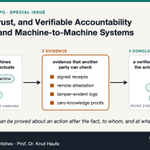
Agents act at machine speed; humans can't keep up without fatigue, skill decay, and nominal oversight. Instead of more monitoring, make compliance a runtime, proof-carrying property of the computation itself: authority only attenuates on delegation, actions carry locally verifiable evidence, and attribution opens only on actual dispute.
Verification moves to the speed of action - not after action became deviant / defiant.


Grey morning. Coffee in hand.
And just like that, the foam turns into the FFS logo…
Ski season is calling. ❄️🇫🇷
#SkiSeason #LatteArt #Skiing @FedFranceSki #WinterIsComing #France #MorningCoffee
🤖 Made with AI
.@jon_stokes is right that current models lack the coherent internal utility functions classic alignment assumed, so that particular problem is largely a category error. Computational jurisprudence starts from the opposite end: agents already hold funds, spawn sub-agents, and exercise authority at machine speed, regardless of what (if anything) is “inside” the model. The relevant question is not whether a utility function can be aligned, but whether the authority those agents exercise can be attenuated on delegation, carried with machine-checkable evidence of norm conformance, and attributed only when harm is shown. That is a runtime, compositional property of the system’s actions and delegation graph, not of the model’s dispositions. Steering and process control are necessary; they are not sufficient once agents can act across trust boundaries.

LLMs don’t understand. Good. Then, let authority only attenuate, and every action carry its own proof. That’s computational jurisprudence.

Wow. I woke up to an impressive number of upset people who apparently don’t understand how LLMs work and can’t cope well with me pointing it out.
An LLM is a statistical next-token prediction model. That’s how it works. It’s an extraordinarily sophisticated calculator performing math you could theoretically do by hand (if you were sufficiently masochistic).
Math doesn’t know what it’s calculating. Pi doesn’t spend its evenings contemplating the nature of circles, and c doesn’t ponder the relationship between matter and energy.
That doesn’t make the results any less accurate, impressive, or useful.
Between inference requests, an LLM isn’t sitting around thinking. It isn’t reconsidering its answers, wondering whether it made a mistake, contemplating its existence, or questioning whether it’s conscious. Its weights remain fixed (it doesn’t learn), and computation resumes when it receives input.
We know this because we designed these systems. The architectures, mathematics, implementations, and research are extensively documented. You can study them yourself.
Of course, some people immediately lean into comparisons of biological intelligence or philosophical debates over consciousness because that is what they know.
But biological intelligence and artificial neural networks are fundamentally different systems. Similar outputs don’t establish equivalent internal experiences.
I experience consciousness directly. I infer that other humans do too because we share biological structures and processes. We don’t have equivalent evidence for an LLM, and nothing about its known operation gives evidence of conscious experience.
Which brings me back to my original point.
To me, understanding is conscious comprehension. It means being aware of information, recognizing its meaning, and experiencing that comprehension. If I wasn’t conscious I could not understand.
We can perform actions unconsciously. We can produce correct results without knowing why they’re correct. But I distinguish those capabilities from consciously understanding what we’re doing.
An LLM can solve complex problems, explain difficult concepts, and produce remarkably accurate information. I give it full credit for those capabilities.
But producing an answer that we rationalize as understanding isn’t the same as experiencing understanding.
You don’t have to agree with my definitions. We can debate functional understanding versus conscious comprehension all day, but that won’t establish whether an LLM actually experiences anything.
The right debate is this…
Could machines exhibit something different from human consciousness, something measurable, meaningful, and worth studying?
I think so, absolutely!
I’m entirely open to discussing “machine consciousness” in terms of observable, testable computational properties. We built these systems, we can instrument them, examine their internal mechanisms, and investigate what they’re capable of.
That seems far more productive than endlessly arguing over whether a machine experiences life the way humans do.
So here’s my question:
How would you define machine consciousness, and more importantly, how would you measure it?
Good news: no superposition. "The most famous example was of a neuron that fired on both cat faces and fronts of cars." This one is completely understandable.
🤖 Made with AI

Everyone is talking about how profound this essay is rn.
For the non-technical person (like myself), a 65-minute read about the inner-workings of neural networks feels very unapproachable.
But people are right, this essay is profound. And it's important to understand its essence even if you don't grok the particulars.
So let me do my best to break it down as I understand it...
Let's start with mechanistic interpretability.
That's what this essay is about & what the field has been obsessed with for a long time.
Mechanistic interpretability is a clunky phrase, but all it means is the process of understanding how an AI model works on the inside:
1) which parts of the model do what
2) how they work together to produce an answer
The next obvious question is: why do we even care about understanding how an AI model's internals work?
There are several reasons, and they all boil down to one word: trust.
reason 1: we've been building ai we don't understand. unlike every other high-stakes technology (computers, internet, planes, medicine), we know if a model works, but we don't know how it works.
reason 2: predicting performance is unpredictable. the way ai is judged today is through tests. problem is, tests don't cover enough ground. a model can perform well in testing, but not deployment. you can't run every test possible. and a model can give you the right answer for the wrong reason.
reason 3: scanning for deception is important. as models get better, there's concern that models will output one thing, while "thinking" something else. if you can only understand outputs, a model can hide its true intentions from you.
reason 4: it allows for precision when improving the model. once you know which internal parts cause what outputs, you can isolate fixes without having to retrain the entire model and praying it works.
reason 5: understanding how the model works is mission critical in high-risk industries. simply saying the model did the right thing "just because" to stakeholders in healthcare, financial services, and government won't fly especially as regulation matures around this technology.
reason 6: humans can learn from how the models "think". models sometimes learn patterns that humans haven't. if we understand their thought processes we can leverage those for humanity's own novel insights.
So, that's why mechanistic interpretability is important.
Next, it's important to understand why there's been so much focus & concern around this area of AI research for a while now.
Prior to this piece by @nickcammarata, the consensus view was...
Progress has been made in the field over the years (from studying toy models to massive production models in short order), but even still, current techniques are slow, expensive, and only cover small parts of understanding a model.
And here's the rough story researchers have generally agreed on re: why the practice of interpretability has remained limited:
1) AI models are built from millions of “neurons,” small units that each light up in response to a given input.
2) Ideally every neuron has one clear job, that way you can map out the model as a diagram of neurons and their corresponding meaning cleanly. Example: there's a "dog ear detector" neuron and it fires on floppy dog ears, from any breed, angle, or photo, and on nothing else.
3) There's a problem: early researchers found that neurons had several unrelated jobs (i.e. they fired on unrelated inputs). The most famous example was of a neuron that fired on both cat faces and fronts of cars.
4) The leading explanation for "messy" neurons was called superposition. The idea was that when a model runs out of room (i.e. more concepts it wants to track than it has neurons to track them with), it crams unrelated concepts into the same neuron because they rarely show up together.
5) If this theory of superposition is true, studying neurons would be a fools errand, because you'd have to use a second AI model (called a sparse autoencoder) to try and untangle the first model, which would be expensive & potentially offer an incorrect understanding of the original model.
Which left mechanistic interpretability in this weird spot. As @nickcammarata points out, it is arguably the most important scientific problem to solve as it helps us understand the most powerful technology in human history, but vibes around cracking the code have been lackluster.
In his new essay, Nick, who has pioneered much of the recent work being done in interpretability, posits that the field has largely thought about this problem incorrectly & he explains why.
Which, if he's right, is hugely positive for the world.
Here's his argument...
He believes that neural networks are in fact largely readable, and the "tangled mess" narrative is oversold as a fundamental property, when it's really solvable problems.
He breaks this belief down into four steps:
"1) Networks use one learning principle, not two (if not everywhere, then nearly enough that it doesn’t matter for study), so there’s no blocker to beginning ordinary science on them."
Translation: Neural networks group things by shared patterns (generalization). They don’t switch to cramming unrelated things together when space runs out (superposition) as mentioned above.
"2) With modern models and tools, that science goes much better than most people expect."
Translation: you can study neural nets just as you study anything with science. Assume the neurons are mostly readable as they are. Study the real model directly. And test your explanations with experiments.
"3) Understanding compounds, so it gets easier as the map fills in. At minimum, then, a network’s own mechanisms should be part of the toolkit."
Translation: studying models gets easier as technology and tooling gets better + as you start filling in your understanding of the model it becomes easier to complete the rest. Think of it like a crossword. Each neuron you explain becomes a reference point for checking the ones around it. Early on, a guess about a neuron has nothing to be checked against. Later, it has to fit with everything connected to it, so wrong guesses get caught and right ones get confirmed quickly
"4) Highly speculative: this might be most of what we need, and interpretability might be far more tractable, possibly in the near term, than we’ve assumed."
Translation: if steps 1-3 hold and scale, direct investigation might take us most of the way to understand an AI model & possibly soon. The reasoning is that models have finite number of neurons, most are readable and AI agents can audit them at scale, understanding compounds (crossword effect), so mapping a model is a large, but finite engineering problem.
He goes on to share evidence for his changing worldview as well as steelman the weaker parts of his argument.
First, evidence. Cammarata provides 8 supporting cases.
1) The case for superposition relied heavily on two examples from vision models and they were misread
- The cat/car neuron turned out to detect pointed V shapes. It was also activated when detecting flames, fox snouts, and other pointy things and went negative when round shapes were presented.
- The car-detecting neuron that appeared to be "stashed" inside dog neurons were found to not be dog neurons but instead pose neurons: which detected the orientation of an object. Cars and dogs can both be in a head-on pose which would activate the neuron.
2) InceptionV1 an image-recognition model from 2014 was the first model researchers studied closely. It's early layers were easy to read (neurons for edges, curves, colors), but it's final layer (where the model makes abstract judgements), looked like nonsense. Almost no neurons could be described (0-5%) understandable. This became industry evidence for the "Neural nets are hopelessly tangled" view.
Nick argues that this model had very explainable problems (a bad camera & a poorly built model), and everyone through the baby out with the bath water.
3) Superposition theory says that when a model runs out of neurons, it starts cramming unrelated things together. So Nick deliberately took neurons away (480 --> 10) to see if that happens. It did not, the model just started using broader categories. Think of it as a finance org going from five finance specialists to one person handling all of finance.
4) Recursive generalization explains the leftover mess. The leftover mess is that some neurons still look messy even in good models. But as Cammarata watched neurons form during model training, he found that this "mess" builds up through a chain of small, coherent jumps the neurons make as the model is trained. Think of a tree. A trunk splits into branches, which split into smaller branches, which split again. If you only saw three leaves from far-apart twigs, they might seem unrelated. Follow the branches back and they all connect to the same trunk.
5) If neurons were scrambled (via superpositioning), an untangling tool (sparse autoencoder mentioned earlier), should have uncovered many hidden concepts the neurons don't show. Instead, about 88% of what it found was just copies of existing neurons. Meaning the model had already organized itself into clean units, so the untangling step just rediscovered what was there.
6) Superposition believers think that rare concepts might be secretly stashed in hidden combinations of neurons where no one would notice them. Cammarata test this theory by checking all the hiding spots. He found that the model doesn't have a hidden layer of secret machinery. Even when it handles, rare, weird or random things it uses the same known neurons it uses for everything else.
7) People worry that image models may be clean to interpret but not language models. This comes from two efforts in 2023 to read language neurons where Anthropic found the average neuron to be a 0 (on a 0-14 scale of how understandable it was) and OpenAI found only 1.7% of neurons understandable. But after Nick's audits of 1,000 neurons within Qwen3-32B, he found 90% have one main job, 7% have two related jobs, and 2-4% are random mixtures. Several changes caused greater neuron understandability: bigger, better models, much better AI research assistants, grading for correctness, knowing what to look for, better data to test on, and the crossword effect.
8) His response to "If neurons are this readable, why did so many smart researchers including himself, believe the opposite for years?" An analogy for his explanation is roughly doctors studying x-rays with a blurry, miscalibrated machine, the only have small low-quality scans, they've never been taught what certain healthy structures look like, and there's a popular theory that the organ is naturally deformed.
Finally, the weaker parts of his argument he calls out.
1) Language model evidence is thin. Most of the detailed, controlled experiments are on image models. For language models, he has audits and case studies, and the detailed technical paper isn’t out yet.
2) There's subjectivity in the headline numbers around understanding the job of each neuron. “90% have one job” depends on what counts as one job, how far into the faint signals you look, and how related two things must be to count as the same.
3) Faint signals don’t have a trusted test yet. That’s exactly where superposition defenders would now say the hidden concepts are.
Recap: AI models may be much less of a black box than we thought. For years, researchers focused on mechanistic interpretability believed the inner workings of neural networks were fundamentally scrambled, so trying to study them directly was hopeless. This essay argues that belief was a mistake caused by weak tools and older AI designs.
Human-AI teams for orientation are necessary but insufficient once agents operate at machine speed. The cone of branching failure is precisely why continuous human supervision or market selection alone is vain: human latency is a category error against autonomous action. The only scalable fix is to embed the constraints themselves as runtime, compositional, proof-carrying properties of the agentic computation - attenuated delegation of authority plus portable compliance evidence - so that even highly complex agents remain normatively bounded without waiting for a human in the loop.

Here's an Anthropic graphic on how our current alignment (aka 'slave') harnesses break down with higher levels of autonomy (complexity of task, number of steps, etc.).
There are three society scale approaches to solving this problem.
>> One is the path we are on; tighten the alignment of the harness, narrowing the cone to a limited set of potential solutions.
>> The second is to let many AIs compete in a market with limited supervision, and let market mechanisms pick the best solution.
>>The third is to pair AIs with human beings for complex tasks. The human provides the orientation (the direction of the path taken) for the task, narrowing the cone.
The first two approaches have flaws that will cause systems built on them to blow up over time. The third approach is the only approach that yields long term success that benefits humanity.

"Embedding a weak model in the payload is the worse option for anyone who actually wants the largest, fastest botnet." 🎯

Are Small Models Really a Threat?
The Anthropic Fear Factory just released a new report warning that small models may be only months away from self-replicating across cheap IoT devices like off-brand Android TV boxes and smart ovens. They say such an AI worm would be hard to shut down since there’s no central kill switch.
We’ve gone from “The Terminator is coming” to “your toaster might kill you.”
But the experiments don’t support the dramatic headlines. They ran a 26B model across 15 $55 TV boxes at 0.39 tokens per second. The end-to-end test used emulated devices with deliberately open ADB ports, so the “hacking” step was trivial. The capable model often ran on a separate server. Agents were harnessed and told to propagate. This is not proof of autonomous rogue AI worms in the wild.
Nor is the threat even novel. Worms that do this without AI already exist. Mirai in 2016 scanned for default credentials and built massive DDoS botnets. Kimwolf has infected over two million devices, mostly cheap Android TV boxes, by hitting open ADB ports.
Small models don’t currently add much that matters on these targets. The bottleneck has never been figuring out the device. It’s the huge number of devices that ship with open ports, default passwords, and no patching. Traditional worms already exploit that at scale.
A practical attacker would use the best models available offline to design a better traditional worm, then ship the lean binary. You get the intelligence benefit at design time without dragging a slow, heavy model along with every infection. Embedding a weak model in the payload is the worse option for anyone who actually wants the largest, fastest botnet.
The timing of Anthropic’s latest scare campaign is hard to ignore. The day before, Brian Armstrong posted that Coinbase fine-tuned an open-weight small model (Qwen-3.5-9B) on proprietary fraud data. It beat frontier models, including Anthropic’s own Opus 4.5, while being faster and much cheaper. In testing it cut fraudulent transactions by about 30%.
This is the emerging pattern. For narrow enterprise workloads you don’t need a general superintelligence. You need a small specialist model trained on your own data. Cheaper to run, especially as compute gets tighter, and often better on the metric that matters. That is a direct threat to the frontier-company model of selling access to ever-larger general models.
Safety advocates should be welcoming this development. If the real concern is existential risk from ever-larger frontier systems — the ones that could theoretically do sustained autonomous R&D or become hard to control — then a shift toward smaller specialized models is the safer outcome.
Small models specialized on fraud detection or support tickets are not pushing the frontier. They are not in the category of systems that could become a new species. The theoretical loss-of-control risk is created by models getting bigger and more generally capable.
Safety advocates focused on those risks should welcome companies having a cheaper alternative to constantly scaling general models. Instead we get dramatic warnings about small models at the exact moment they are starting to take real enterprise share from closed-model companies like Anthropic.

Yes, to Rust, to Carbon (in an year), and to something new in 2-3 years.

This rule, against rewriting code in a different language, has become obsolete. It's important to understand why.
Historically we rewrote code by hand, which inevitably introduced bugs. And we weren't very rigorous about writing the regression tests that should have smoked out the bugs after translation.
Today, we have robot friends to do our code rewriting for us. And, if we have any trace of a freaking clue, we have already written regression tests with excellent coverage.
Under these circumstances, an automated rewrite in order to collect performance gains or memory safety can be a good thing to do.
Generally speaking, these days, if I have to do major surgery on one of my projects in Python or C, I will enlist a robot friend to lift the code to either Go or Rust. This has never failed to be a functional improvement.
Absolutely agree with this statement: “Cyber is going to be one of the biggest spaces for AI agents in the future. “

Cyber is going to be one of the biggest spaces for AI agents in the future.
Obviously the risks of software exploits and the attack surface area increases 100 fold due to the ability for agents to work through any crack to find what they’re looking for.
But this goes the other way as well. The ability to have agent swarms review every line of code, test any number of permutations of exploits, and research any incident faster than humans as they happen, will be a huge boost in how we secure systems in the future.
Cyber has always been a category where it’s hard to keep up with (and triage) all the incoming risks, alerts, and changes in the enterprise and across all system. You can never hire enough people or work through the backlog of all known risks. Agents actually give you a chance finally to have far better coverage of this.
This is going to be a huge opportunity as well because we’ll see plays at the labs, data providers, the layer of the network and firewall, identity, devices and endpoints, SDLC, and even how we protect our data in the enterprise. Lots of interesting dimensions to cyber at the moment.


No one uses anesthesia.
grok.com/share/bGVnYWN5LWNvc…


Vladimir Stantchev - e/acc retweeted

Terence Tao needs to be given a copy of Antifragile.
Birds take off, then some academic branch lectures birds how to fly & takes the credit for it.


I am always astonished by @patrickc ability to eloquently state deep deliberations. “In Karamazov, one continually wonders why the brothers don’t just pull it together.” Who are the current Dostoyevsky, Grossmann, Hesse and Jung? 🤔

Brothers Karamazov was Einstein’s favorite novel, a verdict he shared with Freud, Hillary Clinton, and Murakami. Dostoyevsky was Pope Francis’s favorite author. Indeed, he approvingly quoted Elder Zosima; perhaps an interesting case of art molding life. At the risk of betraying my relative shallowness and inferiority, I confess that I did not love it.
Written in the shadow of the death of Dostoyevsky’s son (also Alyosha), and, more broadly, after a life of repeated tragedy, Karamazov attempts most of all to address the problem of evil in Christianity. Ivan presents a trenchant argument, asking how the suffering of children may possibly be explained given the existence of a supposedly benevolent God (Dostoyevsky collected real court cases for Ivan), culminating in Ivan’s famous return of the ticket.
The book gives some sense for how dislocating the nineteenth century must have been. The ascendant authority of science, the spread of materialist philosophy, the doctrine of evolution, the aftermath of the French revolution and its supposedly enlightened empiricism: in Karamazov, we get the feeling that finding some kind of consilience wasn’t just an abstract philosophical challenge, but a source of intense spiritual torment. If inherited tradition is no longer an adequate basis for faith, why would we rationally cleave to an apparently irrational theology? All of this was in the air: it was only two years later that Nietzsche declared God to be dead.
Perhaps demonstrating the utility of the novel as a medium, Dostoyevsky does not even attempt to solve the problem, but merely to illustrate a response, showing how individuals (Alyosha, Elder Zosima) may in the face of the inherent injustice present in the world nonetheless pursue lives of benevolence and charity: theodicy-by-example. In so doing, Dostoyevsky tacitly concedes that none of the teetering justifications expounded over the centuries can actually survive critical pressure and be defended through pure logic.
Ultimately, though, I don’t find myself being fully compelled by Dostoyevsky’s characterization of the problem or his proposed solution. As another sprawling confrontation with and attempt to reconcile the problem of evil, Grossman’s Life and Fate is maybe a useful counterpoint. Unlike Karamazov, Life and Fate shows actual people confronting great wickedness. Ikonnikov, a small but important figure, is ordered to help in the construction of a gas chamber. He refuses, with full awareness of the consequences that will ensue. The Karamazovs, by contrast, live middle class lives unvisited by greater events. Ivan has money, education, and leisure; his torment is the invention of his own mind and thus a kind of self-indulgence. Even Alyosha, the novel’s most sympathetic character, is never tested. His crisis is spiritual: there is a slightly comic kerfuffle about Zosima’s noisome corpse, which challenges his faith, but no circumstance requires him to stake his life or even his comfort.
Thus, a fundamental issue with Karamazov is that the problems of the book are on some level fake: they’re the self-inflicted derangements of febrile and dysregulated men. How much can or should we learn from the insane?
To be charitable to Dostoyevsky, we might say that he understood the spiritual dislocation of the era that later gives rise to the larger evils of totalitarianism in the twentieth, even prefiguring them in the Grand Inquisitor. (Dostoyevsky explored this theme in greater detail a few years earlier in Demons.) Camus in 1959: “The real nineteenth century prophet was Dostoevsky, not Karl Marx.” In this interpretation, the problems in Karamazov set the stage for those in Life and Fate.
Maybe. At least as a work of art, I’m not sure that this anticipation is enough to make the book stand on its own. In Karamazov, one continually wonders why the brothers don’t just pull it together. Dostoyevsky seems to transpose his own inner depths and spiritual torment onto his characters, but most people are not tortured writers, and it does not feel that the unhingedness of the characters is ever fully earned.
In attempting to address evil, Grossman’s conclusion is ostensibly similar to Dostoyevsky’s: the only resolution lies in senseless kindness. For Dostoyevsky, this message is embodied in Alyosha, who represents a kind of fervent innocence. For me, however, it’s not clear that Alyosha ever fathoms the realities and extremities of evil, and hence he’s not fully persuasive: does he even reckon with the misdeeds of his brothers?
Grossman is willing to engage head on. Far beyond gruesome newspaper anecdotes or neurotic and volatile siblings, Ikonnikov directly experiences the Holodomor in Ukraine and then the murders of the Jews. He has no patience for the kind of revolutionary ideas that animated Ivan’s contemporaries: “whenever we see [the dawn of an eternal good], the blood of old people and children is always shed.”
Alyosha believes in the Church and is willing to set aside its failures to address suffering. The book closes on his declaration that all shall rise again. That is, Alyosha does not accept the tragedy of Ilyusha, an innocent boy’s death, but rather seeks to deny and escape it. “We shall see each other and shall tell each other with joy and gladness all that has happened.”
Life and Fate flatly rejects providential resolution. The heavens may be empty, and there is no greater meaning in evil. We can simply choose (freedom the other great theme of Life and Fate) to pursue acts of charity, generosity, and comfort:
“Yes, as well as this terrible Good with a capital ‘G’, there is everyday human kindness. The kindness of an old woman carrying a piece of bread to a prisoner, the kindness of a soldier allowing a wounded enemy to drink from his water-flask, the kindness of youth towards age, the kindness of a peasant hiding an old Jew in his loft. The kindness of a prison guard who risks his own liberty to pass on letters written by a prisoner not to his ideological comrades, but to his wife and mother.”
These acts don’t ennoble the suffering but are instead justified on their own terms. Such altruism cannot become a catechism, as clearly lies in Alyosha’s destiny (and Karamazov was planned before Dostoyevsky's death as the first of two works); instead, our kindness must be senseless. And we should presume no salvation in adherence: Alyosha imagines a kind of sacred tutelage, but Ikonnikov is unceremoniously shot.
Karamazov doesn’t show true evil, and Dostoyevsky’s solution, such as it is, involves a kind of denial, or at least evasion through metaphysics. Grossman saw it directly, and instead argues, humanistically, that we should be kind just because.
—
If Dostoyevsky came to his works by trying to understand and depict Russian society, they in turn became tapestries for others to understand national souls.
In the aftermath of WWI, Russia was the great power defined in opposition to the West. As Germany tried to rediscover its own soul in the wreckage of defeat, it looked east to Russia, and frequently to Dostoyevsky himself.
Carl Jung thought that the German people had a kind of Karamazovian quality. In particular, he believed that Christianity had disciplined them without fully transforming the impulses beneath their ostensibly civilized conduct: the “Germanic barbarian” was divided into upper and lower halves. Religion had domesticated the former while leaving the latter untamed. Waning faith consequently threatened to release forces that its authority had long restrained: “As the Christian view of the world loses its authority, the more menacingly will the ‘blond beast’ be heard prowling about in its underground prison, ready at any moment to burst out with devastating consequences. When this happens in the individual it brings about a psychological revolution, but it can also take a social form.”
Dostoyevsky was reputedly invoked on a weekly basis at Max Weber’s Sunday gatherings. At the beginning of Reflections of a Nonpolitical Man, Thomas Mann’s later-repudiated 1918 nationalist polemic, he quotes approvingly Dostoyevsky’s characterization of Germany as the “protesting Western empire”, never quite adopting or feeling at home with the inheritance of Rome. In the same year, Spengler wrote Decline of the West, and explicitly perceived in Russia a youthful vigor, primitiveness, and irrationality that contrasted with the senile high culture of the German and Western worlds. In Magic Mountain, Mann later used Clavdia Chauchat to personify the seductive dangers of Eastern (i.e. Russian) illogic.
Hermann Hesse declared that, for all their differences, Fyodor, Dmitri, Ivan, and Alyosha are actually all of one type; the Russian man. In them, he perceived that “the ideal of the Karamazov, primeval, Asiatic, and occult, is already beginning to consume the European soul”, which was leading to the downfall of Europe. In Hesse’s conception, the Russian man rejects inherited ethics and morals, and even beneficent Alyosha represents an “amoral impartiality.” Man is, Hesse says, halfway between animals and higher consciousness; the former restrained through the process of civilization and domestication. The Karamazovs represent the fraying of the ties.
Hesse proceeds, ominously, to notice that the Germans in particular are more vulnerable than any European people to the temptations of “all those evils which one may regard in different ways, but which collectively signify the Karamazov.” While he was prescient in anticipating some of what would follow, he was in the end too sanguine in his hope that the spiritual dislocation could remain limited to that. “It is possible that the whole Downfall of Europe will play itself out only inwardly, only in the souls of a generation, only in changing the meaning of worn-out symbols, in the dis-valuation of spiritual values.” Alas!
In general, it is interesting to trace the mutual obsession between Russia and Germany: how preoccupied each was with the respective supposedly corrupting influences; how urgent the question of the national soul was felt to be. Many of the analyses seem a bit contradictory—Hesse actually inverts Dostoyevsky, for whom “everything is permitted” nihilism is a Western import for which Russian Orthodoxy is the cure—but there’s a striking intensity in the attempts to apprehend.
Most of all, I’m struck by how anachronistic it all feels today: a country’s writers investigating the national soul and the nation’s fate through the lens of foreign literature.
Which novels or works of art do we use to understand our contemporary issues? Should we be using such works? Do they inform or do they mislead? Today, the US worries a lot about China, but this mostly manifests at the level of trade balances, AI policy, and military prowess. We don’t seem to worry much about the spiritual force of Chinese ideals, and for all of the policy fractiousness, China continues to import and absorb American culture with enthusiasm that is mostly undimmed. There is a genre of jeremiad and cultural analysis in the US that rhymes a little with early twentieth century German criticism, but it today tends to be much more clinical, hinging around PISA scores, smartphones, lower fertility, and not around higher aspirations and ideals as such. So, to what extent should there be analyses of the national soul? And to what extent should they connect with major novels and works of art?