

Web3 community builder and content creator, with a strong focus on AI and decentralized technologies
Joined May 2026
- Tweets107
- Following234
- Followers171
- Likes5







What if participation could become something bigger?
From access to participation.
From contribution to recognition.
From the digital world to real-world impact.
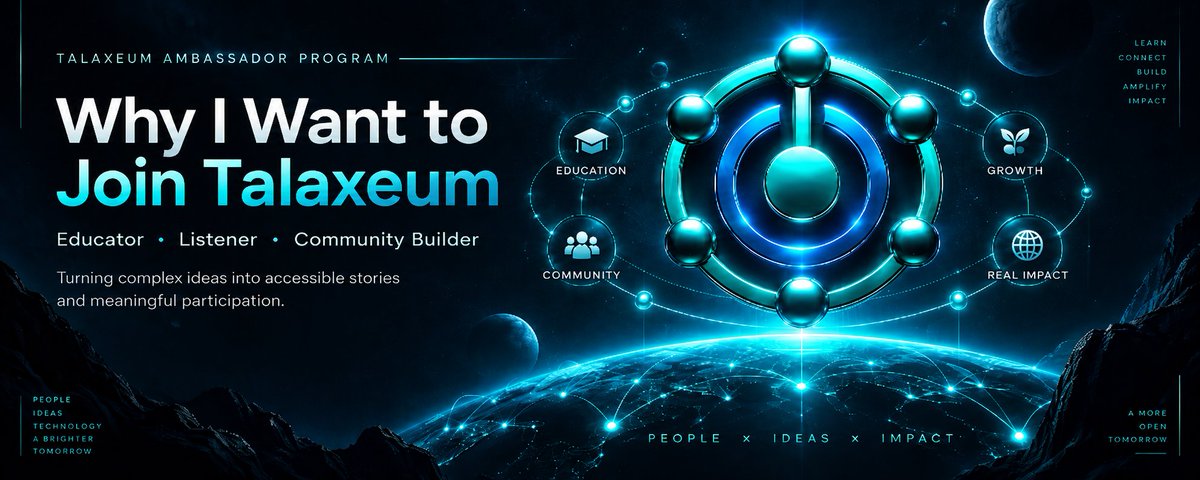
That’s the journey I wanted to capture in this 60-second look at the Talaxeum ecosystem.
TALAX NetCard opens the door.
Talaverse creates the environment.
The community brings the ecosystem to life.
But the bigger idea is what happens when individual actions begin to connect.
One action.
Many participants.
Collective momentum.
Participate. Contribute. Create impact.
Welcome to @TalaxeumEco 🌱
🤝 Paid partnership · 🤖 Made with AI
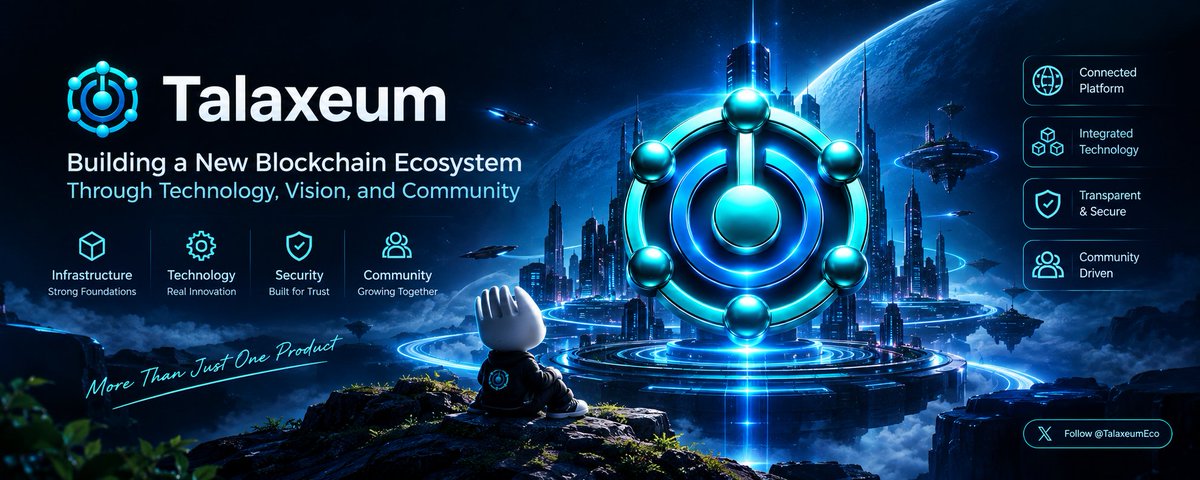
I spent some time reviewing @TalaxeumEco and its documentation to better understand the project direction.
My rating: ⭐⭐⭐⭐/5
Talaxeum is building a blockchain-based ecosystem focused on creating a connected platform with its own infrastructure, technology, and community-driven development approach.
What caught my attention is the project's focus on building a structured ecosystem rather than only a single product. The documentation presents the vision, roadmap, and development direction in a clear way, showing the team's effort to create a long-term foundation.
I also appreciate the importance placed on transparency, security, and community participation, which are important factors for any growing Web3 ecosystem.
Of course, every project needs continuous development and real progress over time, so I will continue following Talaxeum's updates.
Looking forward to seeing how @TalaxeumEco evolves in the future.
#Talaxeum
🤝 Paid partnership


One thing I keep noticing in online communities is how easily meaningful contributions disappear.
Someone explains a complex idea, helps a newcomer, translates useful information, starts a thoughtful discussion, or connects the right people. A few days later, most of that effort has been buried beneath the next wave of content.
That is why Talaxeum caught my attention.
@TalaxeumEco is building an ecosystem that connects identity, access, participation, contribution, recognition, utilization, and real-world impact. Instead of treating participation as a single click or an isolated campaign, it looks at the wider journey behind how people engage and contribute over time.
What interests me most is this sense of continuity. Community activity should not be reduced to likes, impressions, or a temporary leaderboard. The context behind a contribution matters too: what someone did, how it helped, and how it connects with everything that follows.
I want to explore how Talaxeum turns that idea into something practical and whether its model can help communities recognize consistent, useful participation without reducing people to raw activity numbers.
It is a much harder problem than simply launching another platform—and that is precisely why I think it is worth following.
🤝 Paid partnership


Void Reaper retweeted

The $RLS flywheel starts with real institutional activity on Rayls.
→ Institutions use Rayls
→ Network activity generates fees
→ Fees are used to buy $RLS from the open market
→ 50% of purchased $RLS is permanently burned
→ The remaining 50% flows into the Network Security Pool
→ The pool supports validators and ecosystem growth
As institutional usage grows, more fees flow through the mechanism, increasing $RLS burns while strengthening network security.
Track network activity, fee flows, and $RLS burns through the Rayls Transparency Portal: dapp.rayls.com/transparency

🚨 BREAKING: @linera_io officially ceases operations, effective immediately.
• Public sale on Sonar failed to reach minimum target; all funds refunded.
• Emergency VC fundraising efforts were unsuccessful.
• Points program, testnet app, and Discord are being wound down.
8+ months of testnets and node running down the drain. A brutal reminder of how harsh the current market is for Web3 infrastructure. 🥀

Void Reaper retweeted
Something big is coming to Rayls.
On 15th October, Rayls Vaults go live.
We’re starting with AmFi-powered receivables, following the extended agreement reached during Febraban Tech.
More details on the Vaults, the assets, and what’s next will be revealed over the coming days.
Stay tuned.


Seriously, are the two big guys really not gonna let us upgrade our GPUs? 🥲
According to leaked information, AMD and NVIDIA have reportedly delayed the launch of their next-generation GPUs until 2028, with one exception: an AT2 chip based on the RDNA 5 architecture, which is expected to launch in 2027.

Void Reaper retweeted
DLT is moving from experimentation to infrastructure.
The latest DLT in the Real World 2026 report makes the shift pretty clear:
→ 56% of financial institutions expect to tokenise securities in 2027
→ Tokenised collateral is becoming a major institutional use case
→ 77% of DLT users are already seeing meaningful improvements in their workflows
However, 92% still cite client and counterparty adoption as a major obstacle.
The opportunity is no longer proving that assets can move onchain. It’s building infrastructure that lets institutions move them privately, compliantly, and at scale, while still accessing onchain liquidity.
That’s the problem Rayls is built to solve.
With Rayls, institutions can issue and manage tokenised assets within their own sovereign environment, transact privately with counterparties, and connect those assets to public onchain markets when they’re ready.
Private where they need control. Public where they need liquidity. EVM-native throughout.
The next phase of institutional tokenisation is all about making onchain finance work for the institutions that already move the world’s capital.


Void Reaper retweeted
55% boosted staking is officially closed.
When we launched a 55% APY staking opportunity, the goal was simple: get $RLS into the hands of the people who wanted to help build and secure Rayls from the very beginning.
The response was stronger than we could have hoped for.
We thank everyone who participated in this campaign.
You took a chance on Rayls early. You locked your $RLS, supported the network, and helped turn the first phase of staking into a reality.
Starting tomorrow, your boosted staking position will transfer to the ~18% APY staking.
By continuing to delegate your $RLS, you can:
→ Help secure the Rayls Public Chain
→ Support the network’s validator set
→ Continue earning staking rewards
We look forward to seeing more of the community put their $RLS to work securing the network.

Void Reaper retweeted
Powered by Rayls Enygma, Rayls makes private transactions verifiable without exposing the underlying data.
- Transaction details remain private.
- The network verifies that transactions are valid.
- The resulting proofs can still be publicly audited.
Enygma provides the cryptographic layer behind the Rayls Sovereign Ledger, handling zero-knowledge proofs, encryption, and key management.
Private by design. Publicly verifiable. Built for institutional finance.

Void Reaper retweeted
More voices are finding their way onto The Rail.
700+ creators from over 80 countries have already applied - researching, writing, sharing ideas, and bringing new perspectives to the Rayls ecosystem.
Together, The Rail generated close to 200,000 impressions in a single month, with more than 600 pieces published so far.
There’s still time to join the journey.

Void Reaper retweeted
The 55% APY staking tier will remain open until Tuesday, 15th September.
We will give continued access to the yield to our early supporters as we make changes to the staking mechanism.
Further updates to staking and the broader tokenomics, including burns, will be announced soon.

Void Reaper retweeted
Privacy and auditability don’t have to be opposites.
For regulated finance, the question isn’t simply whether data is public or private.
It’s who can see what, under what conditions, and how that access is enforced.
That’s where Enygma comes in.
Rayls’ cryptographic framework enables mathematically enforced selective disclosure, allowing institutions to give regulators and counterparties access to what they’re entitled to see, without exposing everything else.
Our latest deep dive explores what it means for institutional finance onchain.

Void Reaper retweeted
The Rayls Public Chain has already processed $9.4M+ in transaction volume, with an average transaction cost of just $0.002.
With sub-second finality and ultra-low transaction costs, Rayls gives financial institutions the performance they need to operate onchain at scale.
Learn more about the Rayls Public Chain below 👇
