

just another technology nut & student of life.
Tampa, FL
Joined September 2009
- Tweets10.5K
- Following924
- Followers1.1K
- Likes759





So in other words: we are carrying more extinction risk from AI alone than most analysts assign to all other known threats combined across the whole 21st century? Ohhhkaaay.

Vijay Swami retweeted

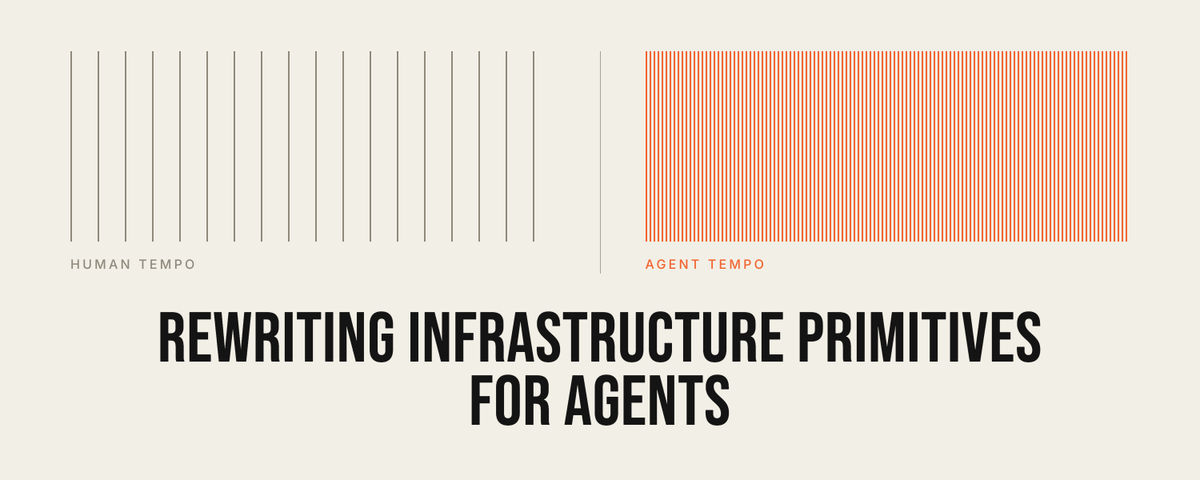
I've been thinking a lot about what software infrastructure looks like in a world where agents use software more than humans do. Wrote this post as an expression of this curiosity-- hope its a fun read!
The ppl selling you tokens told you that you should measure your productivity based on your token consumption…. and you believed them?
NGMI
i.e., if your workflow has n sequential steps, and each step independently succeeds with probability p, then the probability that the whole workflow succeeds is p^n
that means: a step that is right 95% of the time might sound great, but with 5 steps the workflow has a 77% chance of success, with 10 steps 60%...and so on.
identifying where to make things deterministic vs LLM calls is going to be a big skillset of FDE, Applied AI Engineering,
you don't want to just count on "smarter models", you need to push to make the per-step reliability as close to 1.0 as possible

Use coding agents to make your agentic workflows as deterministic as possible (in the right places, of course…)
That’s it, that’s the tweet.
Vijay Swami retweeted

writing your own AI harness is still one of the best ways to understand how and where agents of the future interact at different layers of abstraction
making it multi-agentic will teach you more about frontier engineering topics than anything else
Vijay Swami retweeted
IME as someone who has worked as an L7 AE at AWS & GCP, the acceleration for AEs in the AI wave comes in the following forms:
- more time w/ customers: 2x max
- moving the sales motion from persuasion (meetings, slide decks, meetings…) to proof (meeting -> prototype -> production): in a qualified opp can be 2x-5x IME
The latter is the more impactful acceleration in the sales cycle because it short cirrus not only time, but the coordination tax internally to move the sales stage along.
Of course, this also depends on what you’re actually selling. But I’m talking about complex enterprise deals.
Vijay Swami retweeted

Here’s the honest read. Here’s the real consideration. This is the genuine tradeoff. Here’s the honest answer. Here’s the key insight. This is the crux of the question. It’s worth flagging this. It’s not one or the other. Here’s what’s actually happening.
Shut the fuck up.
Extended thoughts on the buy vs build debate and the impact on SW in the AI era...
I think the software companies most immediately vulnerable are infrastructure software companies and thin SaaS products that sit close to technical execution. Infra software is bought by technical teams to help build, deploy, secure, monitor, move, or operate technology AND the purchase maps closely to a technical capability AND the buyer is usually a technical person who can decide whether to keep buying, use OSS, build internally, consolidate into the hyperscaler, or have an MSP operate something more tailored. We have already seen this movie in cloud. Hyperscalers take open source projects, operationalize them, and sell them back as managed services. In AWS land: RDS, ElastiCache, EMR, OpenSearch, etc. That pattern will likely continue with MSPs starting to do this themselves, and AI makes it easier for more infra capabilities to be rebuilt, wrapped, automated, or operated locally.
But business application SaaS is a different animal. SAP, Salesforce, Workday, ServiceNow, Epic, etc. are not primarily bought because an enterprise cannot technically build it, they are bought because the business wants a trusted system to operate an important process: finance, HR, revenue, support, procurement, clinical operations, supply chain and they want to transfer that risk (operational, compliance, etc) completely to the SW vendor. They are generally business operating model decisions not pure SW decisions. The budget owner is often the business, the risk owner is often the business, and when something goes wrong the buyer wants institutional trust and vendor accountability. They want to be able to tell the board, “We picked Salesforce like every other top company,” not “we vibe-coded our own CRM workflow and Bob from IT is maintaining it.” I saw this at AWS: Customers would often move SAP last, not because SAP was technically impossible to move, but because the business risk was so high that the board was often involved.
The cost of writing lines of code may trend toward zero, but the cost of operating software is still very real. Uptime, security, compliance, permissions, integrations, data quality, support, change management, upgrades, audits, and accountability do not go to zero. And the typical enterprise still does not have the structure, talent model, or operating discipline to run software at scale like a software company. Maybe that changes over time, but I do not see it changing quickly. Cloud was already a massive opportunity for enterprises to modernize how they thought about software, and most did not become cloud-native software companies. They moved what made sense to cloud, kept some things on-prem, and went SaaS for the rest. I think AI follows a similar pattern: it compresses the cost of building around the edges, but that is different from saying the trusted system of record goes away.
cc: @glbeaty
Vijay Swami retweeted

Private equity firms when the EBITDA doesn’t improve by 20% just because the excel model said so

Vijay Swami retweeted

This is what we've been seeing with every company we work with.
Try justifying spending 100k on token spend when only 18k even makes it to a stable prod feature.
In the rush to maximize AI token spend, companies are wasting over 44% on bug fixes


Uber’s COO has said that it’s getting “harder to justify” its AI costs because there was no way to show a link between AI spend and any meaningful increase in useful features. This is the first time I’ve seen a company say this directly.
businessinsider.com/uber-coo…


Looking forward to trying this out. I have the perfect test for it in a Healthcare project.

Over 1 billion PDFs are created every day, but your agents still can’t read them reliably.
Today we’re releasing Parse 2.0, the most accurate document parsing API in the world.
Extend already processes millions of pages daily for leading AI teams like Brex, Mercury, Opendoor, Flatiron Health, and hundreds of others. Now, its even better.
Parse 2.0 is SOTA quality on RealDoc-Bench, our open source benchmark that measures agent success rate on real world docs that agents actually encounter in production.
We trained Parse 2.0 on 1M+ pages of the hardest documents seen in production. Here’s how it stacks up:
- #1 in healthcare, real estate, logistics, and financial services
- 95.7% agent Q&A accuracy on 581 docs (next best: 92%)
- 0.847 F1 on layout (next best: 0.759)
Give it a try today and build production-ready document agents with Extend.
Vijay Swami retweeted

Burnout isn’t caused by hard work.
Instead, it’s a decoupling of effort and outcome.
You push as hard as you can and nothing moves. Your company has become a supertanker with its own inertia.
This is called outcome based account management (OBAM) and IMO it’s the only way to do strategic selling. AWS introduced it to its salesforce in ~2015 and it was a key unlock for us to get a seat at the table in those conversations. I’m super passionate about this style of selling.

Founders often ask me what to listen for in customer calls to know if they have a hair-on-fire problem.
This is the wrong question.
Can you run their business? If you were CEO, would this be a top 2 priority? Because most businesses never get to #3.
Rather than pitching your idea, learn the business so well you could run it yourself. You'll know exactly how big the problem is and what they'd pay.
And if this is going to 100x their business and they still won't buy? You just discovered the AI version of their company.
Yes the “consulting” industry is going to have to change, but one thing I’m 100% confident on is there is no AI w/o professional services. It’s just that the services will look, feel and be priced like software.
Vijay Swami retweeted

Agree with Vijay that enterprises want and need help with task automation.
I also agree with the sentiment that solving for these mundane/repeatable tasks creates the ability for a knowledge worker to do more or different work, rather than eliminate the need for that knowledge worker.
The real tension for enterprises right now is that there is little ROI in solving for those tasks - despite the fact that it’s great for personal productivity. @chamath rightly keeps calling this out. AI usage in the org is expensive, and it either needs to drive more revenue or lower costs. Right now for most enterprises it is just incremental cost.
“…. while you get to focus on the big picture and critical thinking, which are the more fun parts of the role anyway”
Yep. I often frame it like when selling to folks who are reticent on AI, i.e. most clinicians: “what if you were able to just do the parts of the job you love” and it clicks for them immediately.

From my personal experience, AI has made it 10x more fun to work in finance and look at potential investment opportunities
All of the grunt work that used to take up hours of time is now being automated. Instead of having to aggregate data from various sources, I am having Claude or ChatGPT complete these tasks and do research overnight
By the time I wake up, I essentially have work ready to be reviewed and then I send the agent back on the hunt for new information and analysis
It is literally like having a bunch of qualified interns and analysts under you doing the job, while you get to focus on the big picture and critical thinking, which are the more fun parts of the role anyway
My excitement and capacity to do more work have literally 10xed because of agentic AI. Truly amazing.
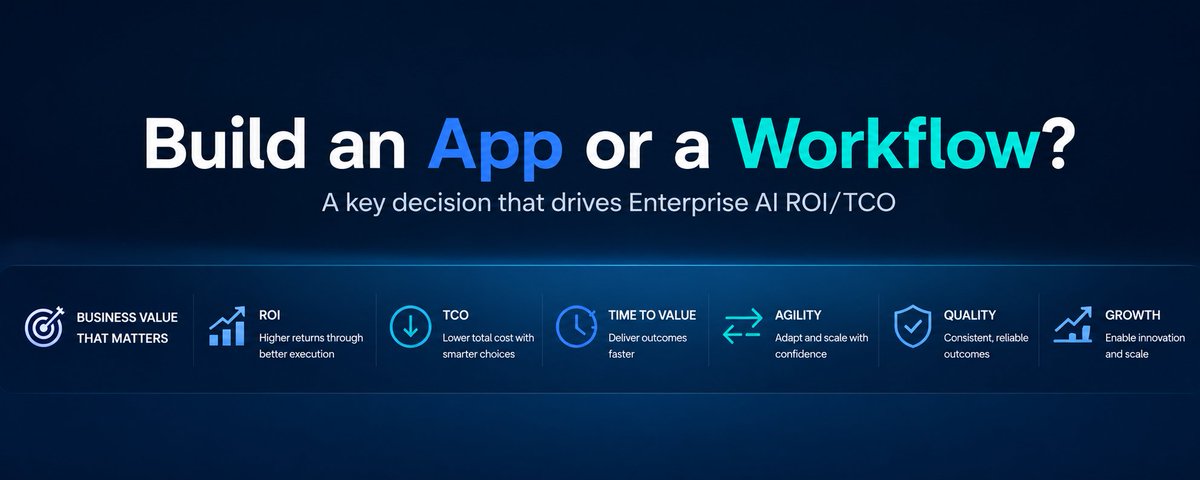
I’ve been spending a lot of time thinking about & discussing the correct implementation of “AI “in Enterprises. The decision to build an app or build a workflow with AI is going to be something every enterprise faces in perpetuity.
Long form thoughts below…..
cc: @matt_slotnick
Great insights from Matt as always. The enterprise diffusion of AI will be interesting to watch. My POV is that we will see the same thing happen that did in cloud:
1- Enterprises will “do AI” like they “did cloud” early on.. ie board will ask for a cloud strategy so the customer consumes cloud even if the workload isn’t a fit
2- cloud sold as a panacea
3- Then questions came on why the bill is so high, what value are we getting
4- customers then level up on understanding cloud first principles, architecting for the cloud, why static workloads need care, org re-design, new skills needed
5- new mental models established to understand how to extract real value
There is a parallel to the above with inference spend that is taking place right now in the early stages (1-2) of the above. By the end of this year the inference spend vs value delivered questions will be in full swing (3). Meanwhile enterprises that leaned in early will be iterating on 4-5 in a loop and be far ahead.

