

Economist | MBA | Experto en Business Cycles Podcast Spotify https://xitter.cf/t.co/UkbdHUf2gc Newsletter Economics Latam https://xitter.cf/t.co/vAOJNa2TFR
Canada
Joined April 2011
- Tweets1.6K
- Following183
- Followers1.3K
- Likes652




Pinned Tweet
Oil shocks are exogenous, private credit is endogenous. The first can be resolved or ended “rapidly” in the same way it began but the second cannot.
Valentin Teruggi retweeted

Five days ago the credit market was pricing CoreWeave and Oracle.
Now it's pricing Meta and Nvidia.
Meta's 5-year CDS: 108 bps, a record.
Nvidia: 101, a record.
Alphabet and Amazon at all-time highs.
Even Microsoft is climbing.
AI-linked CDS trading went from under $2B a week in July to $9B+ in September. AI debt raised this year is $466B, against $101B at this point last year.
And Goldman's prime book shows hedge funds cutting tech at the fastest pace since 2016.
When the "safe" names need default insurance, it isn't a neocloud problem anymore….. it’s straight up a funding problem.
And funding problems always end up on the headcount line.
Listen for "efficiency" on the Q3 calls. H127 looks to be bad for the workforce.

Credit just put a number on my March thesis.
Reuters also confirms today's figures: CoreWeave above 1,000 bps and Oracle at 288 bps, up from 260 a week earlier.
Back in March, I argued that when infrastructure becomes the primary asset of the business, labor gets repriced... and now we're watching the other side of that equation.
The workforce gets restructured to fund the buildout. The buildout gets financed with debt. And the credit market starts asking whether the cash flow can support either.

The KOSPI index's forward P/E ratio at the peak of the bubble was 7x. When the market had its first bad week, it fell to 5x (oh, super cheap!).
Now the KOSPI is down 40%.
Price always leads. Keep using forward estimates as a reference. It is a completely useless valuation metric.
Valentin Teruggi retweeted

SOUTH KOREA: one of the biggest stock market bubbles in world history has now crashed -39% from its #MOAB Peak

Valentin Teruggi retweeted

US CPI shows the stupidity of rate hikes.
The entire impact comes from refined products.
Rate hikes will not create more barrels nor increase refining, but they damage families and businesses.

Valentin Teruggi retweeted

China has ultra low interest rates because their economy is bad and real estate market has collapsed. It’s not because they have incredible fiscal discipline.


Valentin Teruggi retweeted

Canada 68K job loss.
Trimmed CPI 1.9%
Housing market frozen.
Companies leaving for the US
Economic elites demand rate hikes.
Insanity.


Valentin Teruggi retweeted

The U.S. mortgage market is in its biggest recession in U.S. history.
Applications to purchase a home are down 58% from the pandemic peak in 2021.
Today's mortgage purchase index of 145 today is lower than at any point in the 2009-2012 housing bust.
And is now back the same level as 1995.
Not only that, mortgage applications are also down 15% from last year, indicating a further short-term weakening is occuring.
Roughly 70% of U.S. home purchases are financed with a mortgage.
So declining mortgage applications are going to be a big problem for sellers.
Track the areas with the biggest negative forecasts at: reventure.app/map/inriPyNjei


Valentin Teruggi retweeted

I just love all the accounts competing in pointing out any new high on bond yields 😄
And then the inevitable... "It will go higher".
Nobody apparently understands the relationship between Labor Market and Bond Market...
Sigh!!
Valentin Teruggi retweeted
The Fed Is Hiking Into a Mirage
What exactly is the Fed tightening against?
The Fed’s shifting standards, cutting 50 basis points before an election with trimmed-mean inflation at 2.81%, then hiking with it at 2.28%, make its reaction function look political rather than principled.
The Fed has raised rates on the premise that growth remains too strong and inflation risks are broadening. But the composition of the economy tells a different story.
The construction boom is overwhelmingly an AI-and-power story. Data centers, grid capacity and related infrastructure are expanding rapidly; outside that complex, residential building, commercial real estate, manufacturing construction and ordinary private investment are weakening. The same is true more broadly: housing, consumer durables, small-business borrowing and credit-sensitive sectors are absorbing the force of restrictive financial conditions, while cash-rich hyperscalers continue to build regardless of a marginal increase in the funds rate.
Meanwhile, the Dallas Fed’s trimmed-mean PCE measure, one of the cleanest gauges of persistent underlying inflation, has declined from 2.81% in August 2024, immediately before Powell’s 50-basis-point cut, to 2.28% today. Inflation expectations remain anchored. There is no persuasive evidence of a wage-price spiral, unanchored expectations, or broad second- and third-order inflation effects.
The Fed cannot lower oil prices, reverse tariffs, create transformers, expand grid capacity, or alter other supply constraints by raising rates. It can only weaken domestic demand and it will do so most aggressively in sectors already under pressure.
The relevant question is therefore not whether headline inflation remains above target. It is whether the Fed is mistaking concentrated, supply-expanding AI investment for generalized excess demand. If so, it is tightening into a negative growth shock, depressing the very rate-sensitive investment needed to broaden productive capacity, while leaving the AI buildout largely untouched.
A central bank should not use broad demand destruction to solve relative-price shocks. The Fed needs to show evidence that inflation is propagating through wages, expectations and broad credit growth, not simply point to aggregate GDP inflated by data centers.

Supply always finds a way.


Valentin Teruggi retweeted
Much is made of the supposed 'housing shortage' in the U.S.
However, little attention is paid to the fact that builders now have the 2nd most homes for sale they've had.
Ever.
Currently, there's 488,000 homes for sale on builder lots.
The long-term norm is 333,000. Indicating we're 47% above average for builder inventory.
We're also not that far off from the peak of the mid-2000s building bubble in terms of supply.
Adjusting for sales, builders have over 9 months, which is also a very high figure.
Proving that there is no more 'U.S. housing shortage'.
In fact, some markets are now heavily oversupplied.
To see inventory levels in your market, head to reventure.app/map and search your ZIP.

Valentin Teruggi retweeted
The dollar is not king because it is sound money. There is no alternative.
FX turnover 89.2%. Reserves 57.1%.
Payments 51%. Foreign-currency bonds 62.9%.
The renminbi? 2% of reserves and a closed capital account.
De-dollarization is a narrative, not a number


La estrategia de Scott Bessent con los buybacks. No está intentando controlar la curva, es reducción de deuda.
open.spotify.com/episode/4xi…

Valentin Teruggi retweeted

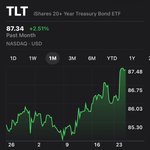
The long end is please with the short end hike.
It's setting up a nice tailwind for when oil prices crash back down to $40.


Subir las tasas no imprime petroleo. La tasa de interes encarece el credito, pero la inflacion no viene por ahi. open.spotify.com/episode/4mS…