

Building something new at Agentwork. Previously built and sold Eduflow.
Copenhagen
Joined November 2008
- Tweets2.9K
- Following262
- Followers5.5K
- Likes9.1K






Pinned Tweet
Agentwork connects to the tools your team already uses and answers questions across all of them in plain language with sources you can check. When the answer isn't written down, it asks the person who knows.
Give it a spin agentwork.com

Most discussions about AI memory focus on how much you can add. How many documents can it index, how much context can it retrieve.
But good memory also needs to track what disappeared.
Companies change constantly. Documents get replaced. Files move around. People leave. Permissions get updated.
If an AI system only piles up information, the old stuff doesn't go away just because it's no longer true. It just sits there and gets retrieved with the same confidence as everything else.
When a file disappears, that doesn't always mean it was deleted. Maybe it moved. Maybe you lost access. Maybe the API gave you an incomplete list.
You need the system to say: this source is current, this one was deleted, this one moved, and honestly we don't know what happened to this one so we're not going to guess.
Even the fact that something was deleted or changed is important in itself (maybe there was a change of policy, or something got rescheduled). So you should not just store the data, but also the change log over the data.
Most software treats approval as a button. Someone clicks it, the action happens, the interface moves on.
When an AI system sends emails, updates the CRM, or kicks off workflows, the approval isn't just a quick check. It's a decision that should have a record.
You should be able to go back and see what was proposed, what context the person had when they approved it, who made the call, and what actually happened after.
Many interfaces don't keep this. Cards merge together. Status updates pile on top of each other. The original request gets buried in a stream that was built for moving fast, not for looking back.
That's fine when the system wants to rename your calendar event. Less fine when an agent is doing something in your company's name.
You need something closer to an audit trail than a confirmation popup.
This doesn't mean approvals need to get bureaucratic. You can group related requests without losing track of what each one was.
Company brains should be used in two ways - either a human asks the brain directly for answers, or an agent can query the company brain on your behalf. This allows your Claude or ChatGPT agents to always get up to date context and information about your company, and it gives them the ability to use our features like reaching out to colleagues.
We just shipped our MCP connector for Agentwork that makes this easy. Set it up inside Agentwork or from the Claude Marketplace.
One of the biggest sources of information in a company is the codebase. And it is not just relevant for the engineering team. The sales team needs to explain the product and answer complex questions around features. Compliance needs to understand how data is being used and stored. Marketing need to produce assets and campaigns for new features.
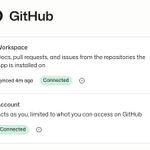
Now Agentwork is able to ingest your codebase from Github, making this essential data source a part of the company brain. This opens up a ton of new use-cases and makes it possible to ask much more complex questions and get correct answers every time.

ALT GitHub interface shows workspace sync status, detailing access to documentation, pull requests, and account connections.
There are fundamentally two ways to use a company brain - one-off questions and recurring workflows. But sometimes you start off doing something one-off, and then convert that into a recurring workflow. We just shipped a feature so Agentwork can help do that for you.
When Agentwork finishes work that would be useful again, it can propose a workflow in the conversation. You see the title, what it will do, and when it would run. Create it, open it to review first, or dismiss the suggestion.

Agentwork is able to find issues and contradictions in your data. That is one of the benefits we get from building a memory over your data. But we don't want to burden you with too much additional work, so make it easy to resolve those resolution tickets.
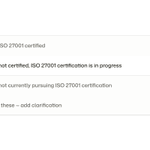
When Agentwork needs you to settle a request, it now offers a short list of ready-made answers. Click the option that fits, and the request moves on without a written reply. If none of the options are right, you can add a clarification instead.

One of the sources of inspiration for how we are building the memory system for Agentwork is how humans solve problems.
1) If you ask me who the founders of Agentwork are, I know that by memory. No need to check any sources.
2) If you ask me who the investors are (we have a few), I probably can't give you a quick list off the top of my head, but if I see a name I can verify, and I know which documents (cap table, investor update, etc) I would go and find it.
3) If you ask me for all customers in the CRM, I definitely don't use memory. I would use the CRM, apply a filter and export the result.
Our agent and memory system works the same way. It uses memory to store important key facts. And it uses memory to know where to look. It doesn't use memory to answer very complex data queries, that is what systems of records are for.
Memory is important though. It makes it possible to answer queries like "who have I talked to in the last 6 months who might be interested in buying Agentwork?". No text search will find those emails that we forgot to get into the CRM.
Multiplayer-AI is the new important paradigm. One part of that is being able to work alongside agents and humans seamlessly. This is already possible in Agentwork, and now we made it easier to call on help from your colleagues when the agent is not who you want to talk to.
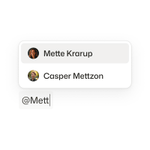
Type @ in a conversation and select a teammate. Mentions appear as distinct chips, and unread mentions can trigger a focused email notification. Agentwork understands when the message is meant for your teammate, so it can stay out of the way.

ALT Two user profiles are displayed, showing names and circular profile pictures. The text input suggests tagging one user.
We are doing out SOC2 and ISO compliance in partnership with Oneleet. Getting compliant is a huge task, not just initially but forever.
We have 133 ongoing controls that we need to ensure are always under control. A few examples are:
1) Every time someone leaves, all access should be revoked in every system, and that should be docmented.
2) We should always have an up-to-date network diagram of all systems.
3) Every new hire should be reference checked.
4) We should create and maintain a data inventory over all data we have, and how it is classified etc.
Being on top of 133 controls and 24 individual policies is a full-time job. Luckily Agentwork can do most of the job for us. It follows everything we do in every system, and proactively we are always in compliance with every policy. With out new Oneleet integration it can even upload the evidence directly to Oneleet when releveant.
Connect your Oneleet account so Agentwork can browse controls, policies, evidence, monitors, vendors, risks, access reviews, pentest findings, and dependency scans. Agentwork can update supported compliance records with your approval. Oneleet data is accessed when Agentwork uses the connector and isn’t automatically added to memory.

ALT Logos of Agentwork and Oneleet are displayed against a blue sky with soft clouds, indicating a partnership for SOC2 and ISO compliance.
Some company brains try to store the knowledge in a way that is easy for humans to read (like a wiki). I get the sentiment - let's make the data look like something we understand - but I don't believe it is the right structure.
Agents are incredible at parsing large amounts of structured data. Store information for agents in a way that agents like to read it.
Small new feature in Agentwork. Markdown file previews now include a copy action, making it easier to reuse generated content while preserving its formatting.
Going to extend this soon to messages in general, but they are bit harder since our messages in Agentwork contain sources, and are often split over multiple messages.

ALT A button labeled "Copy markdown" with a hand cursor hovering over an icon depicting two overlapping squares, suggesting an action to copy formatted content.
Some of our customers have specific things they don't want to ingest into Agentwork for different reasons. To help manage this, we build a new Agentwork feature: Owners and admins can ignore a connected workspace source, stopping future ingestion and removing the memory Agentwork previously created from it.

Slack is making it hard for AI products to search over and ingest messages. I guess it makes sense short-term to give themselves ownership over the data, but this strategy never works long term. If companies using Slack can't use AI effectively, then fewer new companies will use Slack.
The way most people use AI today is very human-initiated. You have a problem, and you ask an AI agent to solve it. But the biggest unlock is having AI agents work proactively, and then they reach out to you when they need help or have something to share.
To make this work properly in Agentwork we added a bunch of new notification features in the product. New-message notifications now use read tracking. We delay delivery the right amount. We collapse notifications together so we don't spam you. We provide deep links to the right conversations. And we give you detailed user-controlled preferences.

ALT An orange, hand-drawn bell icon with lines indicating sound or alert, suggesting notification or alert action.
We noticed that a lot of queries we (and others) wanted to make with Agentwork were of the type "what happened in this period?". To make our agent better at answering those questions we gave it a new tool (called memory_timeframe).
This new tool allows the agent to efficiently search for specific things that happened in a certain time window across all your tools and data.
A few examples of what I use this for myself:
1) Check what we released yesterday that should be featured in our product changelog.
2) See if anything we did this week requires changing our Privacy Policy.
3) Give me a digest of everything relevant to me that happened in the last week.

We made the sidebar in Agentwork much better and much faster to work with. The new sidebar combines your previous conversations, scheduled workflows and requests. We also added search, and improved the performance on archiving and load.
Now there is just a single place in Agentwork where you can find everything you need to know.

Most interactions between humans and AI agents happen isolated with just you and the agent. That is quite different from modern knowledge work (think meetings, conversations in Slack/Teams, etc). We just released the ability to collaborate with teammates in Agentwork.
You can now add people to conversations, start conversations as multi-player and have shared workflows. This allows you to bring all the relevant people into an agentic conversation at the same time.

We just got approved for our $350,000 in free AI credits on Azure 🤯. Insane value. We are basically getting $350,000 for free from Microsoft to run state of the art LLM models - and the credits don't expire for 5 years.
Let me know if you want me to hook you up with our contact at Azure for a good deal.
We just added some additional multi-player features to Agentwork. You can now start new sessions with other people and invite them mid-session.
People are using their agents alone, but most work should happen in shared conversations and context.

One of the coolest features of Agentwork is that it spots contradictions and other problems in the data. We can do this because we ingest all data when building our company memory.
But there are some hard problems as part of this:
1) How much do we surface? Imagine you sign up and there are 100+ issues. Do we show them all to you right now? Or do we schedule them to be shown slowly over time?
2) What is important? Is it important if a LinkedIn URL is wrong in a lead list? Is it important if a PR was merged at 10:45 or 10:50? Is it important if somebody you had a meeting with was CEO or COO? This depends on the specific company you work at, your role and the context around the issue.
3) We need to learn from interactions with this data. If you resolve an issue we should remember the resolution. If you dismiss it we should remember why and improve, etc.