

Describe your company. Naïve builds it.
San Francisco, CA
Joined February 2026
- Tweets986
- Following17
- Followers18.5K
- Likes757





Takeaways:
> Baseline strategy*: $2,606
> Best model, GPT-6 Astra: $9,514
> Oracle**: $27,521 (2.9x Astra)
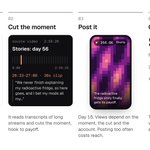
*Baseline strategy: a scripted bot, no AI model, that reads transcripts and follows the posted campaign rules.
**Oracle: a scripted bot that can see the simulator's hidden state. It shows roughly how much a near-perfect player could earn.
Conclusion: There's a lot of room left for improvement for agents to autonomously run companies.

We built Clipping Bench because we have thousands of users running AI channels.
If you want to run your own AI clipping channel with agents across TikTok, YouTube and Instagram:
Check out Naive → usenaive.ai/businesses/clipp…


Jev (@typesafeai) is now live in Naïve.
Your agent shouldn't be using the same model for every task
Now it doesn't have to.
Read more at:
usenaive.ai/docs/concepts/mo…

Introducing Vetta, the most efficient harness for long-horizon agent tasks.
Same model, same tasks. Only the harness changed:
🥇 Vetta: $0.298 per finished task
🥈 claude-code: $0.872
🥉 hermes: $1.095
Highest finish rate, a third of the price. Autonomous companies only happen when the cost makes sense.
Here's how we get there:


Naïve Lab is live
four benchmarks on the substrate agents actually run on.
Serverless agent runtime hosting: what a million agents cost to keep alive, at 100,000 tenants × 10 agents per month.
🥇 Naïve · serverless — ~$44–60k
🥈 Self-host Hermes / Eve — ~$740k
🥉 Self-host OpenClaw / Paperclip — ~$1.5M
VM per tenant (AWS) — ~$14M
Every runtime here is free to licence. The cost is the box staying awake between turns, and agent work is bursty — a turn, then nothing for an hour.
We want an agent running continuously for every workspace. That is a hosting problem before it is a model problem.

Agent Brain on FictionalCharacters QA, at a matched gpt-4o-mini backbone.
Single-hop
🥇Naïve Brain 91%
🥈 CAR (prior SOTA) 78%
🥉 HippoRAG-v2 54%
Multi-hop
🥇 Naïve Brain 57%
🥈 CAR (prior SOTA) 30.2%
🥉 the remaining field ≤7%
22 published systems answer ≤7% of multi-hop questions correctly. It is the split the benchmark reports as universally failed.

Inference: 20–30% cheaper per solved task on SWE-bench Pro, by delegating retrieval to a scout sub-agent.
Claude Opus 4.8 — $1.23/solved, was $1.75 · −29.8% · +3 solved
Claude Opus 5 — $1.07, was $1.35 · −20.4% · +1
GPT-5.6 Sol — $0.82, was $1.05 · −21.9% · −2
Kimi K3 — $1.00, was $1.35 · −26.0% · +1
A scout call costs ~$0.0034 against ~$0.031 for a planner step — roughly 9× less and adds ~1.8% to the bill.

naïve retweeted

Coding agents can build an app in a day, building the company around it still takes months.
That gap is why I invested in @usenaive .
Naïve gives AI agents the infrastructure to run entire businesses. With one config file and one API, developers can provision payments, company formation, email, phone numbers, compute, databases, authentication, memory, model routing, orchestration, and governance.
The technical ambition is matched by the founders. Sean Dorje and Dennis Zax have been building together since they were 14. They sold their first company as teenagers, dropped out of Berkeley, joined Y Combinator, and have spent years working toward this vision.
Their early benchmarks are impressive: agents start in 2.3 milliseconds using 1.2MB of memory, while their shared context layer delivers stronger recall with 11x fewer tokens per query.
As more work moves to autonomous agents, companies will need infrastructure designed for agents from day one. Naïve is building that operating stack.
Excited to support Sean, Dennis, and the Naïve team!
