

Open models that run on your machine. Nock Coder: 1 GB, offline, no API key. 0xb0f444a069d9264017610e0674ebf7e1d6e19cbb
On your machine
Joined October 2026
- Tweets137
- Following27
- Followers344
- Likes127




Pinned Tweet
$NOCKAI is live on @SurplusRH.
The model behind it is Nock Coder: open weights, Apache 2.0, a 986 MB file that runs on the laptop you already have.
→ code first answers, plus Solidity for Robinhood Chain builders
→ Windows, macOS, Linux, no GPU needed, works with the Wi-Fi off
→ every raw test answer public, misses included
→ Surplus serves the exact Hugging Face commit we launched
Trading fees pay for the GPU that serves it.
CA: 0xb0f444a069d9264017610e0674ebf7e1d6e19cbb

Not all of it went up. Family videos dropped, 9 to 7 of 12.
And on held-out videos drawn like the training data it jumped 32 to 55 of 62. That mostly tells us the drawn data is learnable, not that real footage is solved.
The prompt fixed screen recordings. Sport it couldn’t: it actually dropped to 1 of 8.
So this week’s training data has matches in it. We draw them ourselves, so every answer is exact to the frame, like this one.
240 videos, 1,575 questions. First run is training now.
Why draw instead of scrape: most public data for “find the moment” is non-commercial, and hand labels drift by a second or two.
The test set stays apart from all of this: different apps, people and content.
One week of NockAI, in 42 seconds.
Three open models that live on your machine: a 1 GB coding model, a coding agent, and a video model on the way.
Everything we shipped is in the replies.
What we did behind the releases:
Every test answer is public on the model cards. nockai.dev has a live demo. GGUF builds run in llama.cpp and Ollama.
And the first weekly burn: 4,564,757 $NOCKAI sent to the dead address.

Small open models get judged on benchmarks, but a lot of the gap is in how you ask.
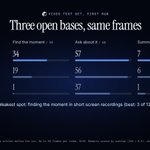
Same 4-bit model, same frames, one changed sentence: 3 of 12 became 10 of 12 on our screen recording questions.
Measure the cheap fix before you train.

Example: when does the app switch to dark mode? The true answer is 26 to 34 s.
Old prompt: 26-27
New prompt: 26-40
The change: ask for the whole stretch, from the first frame where it starts to the last frame where it's still visible.
Answer to yesterday's clip: the error shows from about 34 s to 42 s.
Qwen3.5 4B said 34-42.
Gemma 4 E4B said 34.5-39.9.
SmolVLM2 2.2B said 29.
That one was easy. Short screen recordings overall were not: 3 of 12 for the best model.

Visual understanding in a small Qwen3.5 build is the part we care about most.
On our video test, Qwen3.5 4B at 4-bit in llama.cpp kept almost everything the full model scored: 31 vs 34 of 56 moments, 56 vs 57 of 60 questions. Small builds hold up better than you'd think.

Today, we’re releasing Bonsai 2 2B, 4B, and 9B.
Based on Qwen3.5, these new ternary models bring stronger reasoning, visual understanding, and tool calling to compact footprints designed for everyday devices:
• 2B: 0.43GB
• 4B: 0.95GB
• 9B: 2.0GB
For this release, we focused on what makes small models useful as local assistants: following instructions, avoiding repetitive loops, calling tools on mobile devices, and giving useful answers without unnecessary output. The 9B model uses roughly 40% fewer tokens on standard instruction-following and everyday math tasks. Solving the Riemann hypothesis can wait.
These models are successors to our first-generation Bonsai 1.7B, 4B, and 8B, and provide a foundation for bringing practical agentic functionality to local applications on personal computers, phones, and wearables.
The Bonsai 2 family now includes four sizes spanning 2B to 27B parameters. Developers can choose the balance of capability, memory use, and responsiveness that fits their application and hardware.
Available today under Apache 2.0.
