

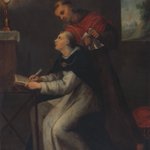


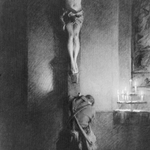


"St. Thomas Aquinas was one day paying a visit to St. Bonaventure and asked him from what book he had drawn all the beautiful lessons he had written. St. Bonaventure showed him the image of the Crucified, which was completely blackened by all the kisses that he had given it...


I could find a tragedy involving a Protestant church and use it as ammunition against Protestantism, but I’m not so mentally depraved as to stoop to the level of this spiritual son of Satan.


𝖚𝖗𝖝𝖊𝖘𝖚𝖘 ♰ retweeted

The woman is the Blessed Virgin Mary, the woman who gives birth to the child. Those who are persecuted are her followers. This will include many Jews who get baptized and join the Catholic Church, and Mary herself is the greatest Jewish woman to ever live, but it will no way be exclusive to Jews.
The one who persecutes them is the false messiah who stands in the temple of God. Since he will claim to replace the true messiah Jesus in all things, he will almost certainly be from the Jewish people. This is the universal testimony of the early Christians. Jesus himself told the Jews that if they do not receive him, they will receive another who comes in his own name (John 5:43).


𝖚𝖗𝖝𝖊𝖘𝖚𝖘 ♰ retweeted

What shall we call thee, O Apostle? Heaven, for thou hast declared the glory of God; radiance, for thou illuminest the world with light; cloud which drops divine water as rain; most divine cup of wisdom pouring on us the wine that gladdens men’s hearts. Pray for the salvation of our souls!
How shall I name thee, O eloquent one? Disciple, annoucning to us the glad tidings of Christ; physician, healing the passions of the soul; luminary, revealing noetic light to us; foundation and ground of the Faith, for thou hast written for us a most precious Gospel. Pray for the salvation of our souls!
What title shall we give thee, O glorious one? Strong treasury of heavenly gifts; renowned physician of bodies and souls; fellow laborer of Paul and his companion, writer of the Acts of the Apostles. Many are thy names, O Luke, and greater still re thy gifts. Pray for the salvation of our souls!
—Stichera from Vespers, October 18

𝖚𝖗𝖝𝖊𝖘𝖚𝖘 ♰ retweeted

Αs I have said before, consider the Scholium to III Sent., d. 3, a. 1, q. 1: the defenders of the doctrine were the promulgators of the Feast of the Conception, if the Seraphic Doctor was as it seems approving of that same feast and "corrected" despite poor formal arguments, he was approving the sentence.
Otherwise his approval of the Feast being celebrated would be unintelligible.

𝖚𝖗𝖝𝖊𝖘𝖚𝖘 ♰ retweeted
St. Bonaventure's Approval of the Immaculate Conception
Bartholomew Barbieri O.F.M. Cap. writes that, though in the earlier phase of his career, he deemed it less probable (III Sent., d. 3 q. 1 & 2), later in his life, praising the Feast of the Conception for the Franciscans, and teaching so (serm. 1 & 2 de B. Virgine ; in op. de contemplatione, Opuscula II, in flore quinto; Specul. Virginis lect. 2), St. Bonaventure affirmed the Immaculate Conception.
The Seraphic Doctor initially left the question open but underdetermined in the Sentence Commentary before, later, approving of the Franciscans celebrating it. Thus approving of the doctrine before it was dogma:


𝖚𝖗𝖝𝖊𝖘𝖚𝖘 ♰ retweeted

Anyone in mortal sin should make an act of perfect contrition: love for God destroys sin and restores grace. For Catholics, this includes the resolution to sacramentally confess all mortal sins later. But should one die before being able to do so, one will still be saved.


𝖚𝖗𝖝𝖊𝖘𝖚𝖘 ♰ retweeted
I don't know why Catholics are dunking on this. St. Jerome also went to rabbis to study Hebrew and get copies of biblical texts to produce the Vulgate translation. Many of our greatest exegetes (like Nicholas of Lyra, Conelius a Lapide, St. Lawrence of Brindisi, among others) drew on later rabbinical commentaries, especially on matters of Hebrew grammar.
It would be silly to draw the conclusion from this that one cannot criticize Rabbinic Judaism, but that the Jews played an important historical role in transmitting the Hebrew language and texts is not something denied by our own authorities.
This should not be surprising given that the traditional role ascribed to the Jews by St. Augustine is that they bring with them the scriptures that testify to the truth of the Catholic faith. They are blind to the true spiritual meaning of the text, but that's not what is at issue here.
When we put forward bad arguments against Judaism or Protestantism, we actually bring dishonor to the Church because Jews and Protestants will realize these are bad arguments and may end up rejecting the true faith if they think it depends upon erroneous arguments.

Without post-70 AD, rabbinic Judaism, the Protestant church does not have a Bible.
First, the manuscript tradition that all of our modern translations are based on is the Masoretic text. The Masoretes were the rabbis that followed after the Tannaim and the Amoraim. They worked from the 7th to the 10thcentury AD and their main focus was the preserving of the Hebrew text of the Old Testament and developing the vowel and accent system that we use today when we read the Hebrew text. Delete the work of the Masoretes and you delete the text that we use for our Old Testament. No rabbis, no Bible.
Second, the Protestant recovery of the ability to read the Old Testament in the original Hebrew language was made possible by relying on the work of late medieval rabbis, primarily the grammarians, along with the assistance of 16thcentury Jews who either were willing to teach Hebrew to their Christian neighbors or who actually converted to the Christian faith themselves and brought their rabbinic knowledge of the Hebrew text with them. For instance, in the early thirteenth century, David Kimhi composed the Miklohl, a basic grammar of the Hebrew language, and the Hashorashim, a Hebrew dictionary. When sixteenth century Christians began returning to the Hebrew language, these texts provided their entrance into Hebrew fluency.
Additionally, the grammarians produced a series of commentaries on the text of the Old Testament, commentaries which developed something very similar to what we now refer to as the historical-grammatical method. These commentaries served as tutors to early protestant exegetes, trying to make their way through the Hebrew text for the first time. For instance, from 1517-1519, the Christian publisher Daniel Bomberg, working in Venice, published what we now refer to as the Bomberg Rabbinic Bible. It contained the Masoretic text of the Old Testament, surrounded by the corresponding Targum (Aramaic translation/interpretation of the Hebrew text), and commentaries by grammarians such as Rashi, Kimhi, Ibn Ezra, etc.
Bomberg’s Rabbinic Bible became an essential tool in the libraries of Reformed exegetes. If you have spent any time in Bucer’s commentary on the Psalms, you know how heavily he relied on Bomberg’s sources for his own understanding of the text. What is harder to notice, but which is equally true, is how much weight Calvin himself gave to these sources. At one point Calvin singles out Kimhi as the best of the Jewish exegetes. This reliance on the assistance of the grammarians permeates the works of sixteenth and seventeenth century, Protestant exegesis. Delete the Rabbis, and you delete the Protestant ability to read and translate the Hebrew text.
This reliance on Jewish sources was not without its pitfalls. The anti-trinitarian controversies that plagued the Reformed church in the 16th century were largely a result of Protestant reliance on Jewish commentaries. For instance, Kimhi’s commentary on the Psalms included critiques of the Christian reading of the messianic Psalms. Some young exegetes were not ready to go up against Kimhi’s work and found themselves succumbing to heterodox views on the deity of Christ, etc.
Nevertheless, the vast majority of the Reformed church figured out how to make good use of Jewish sources without losing their minds. For instance, it is not a coincidence that many of the contributors to the formation of the Reformed political tradition, men like Franciscus Junius and John Selden, were also great Hebraists, steeped deeply in the works of medieval rabbis. They drew from that tradition for much of their work. There were movements to burn all the Jewish sources that rose up at various moments, but these movements were primarily driven by the Papists, not the Reformed, who generally opposed this mania.
To repeat my opening claim - without post-70 AD, rabbinic Judaism, the Protestant church does not have a Bible. The Jews were still wrong about Jesus. But without them, you don’t have Bible.
