

theory of machine learning and inference on random graphs - PhD candidate @KCLDisorder 🌻
London, England
Joined March 2018
- Tweets30
- Following263
- Followers126
- Likes163






Heading to #NeurIPS23! Come say hi:
- at poster session 5 on Thu, presenting "Classification of Heavy-tailed Features in High Dimensions: a Superstatistical Approach" arxiv.org/abs/2304.02912v3, work with supervisors @gabrielescr @PierpaoloVivo at @KCLDisorder

- at the Maths for Modern ML (M3L) workshop, presenting arxiv.org/abs/2306.07104, spearheaded by @maha81193, F. Behrens, @MolecularRobot

Another succesful PhD information event for our UG and MSc students at @kclmathematics under the umbrella of the @_Piscopia initiative 💅🏻 Big thanks to fellow PhD students L. Servius, A. Borkowski and @ShahpoOmar for their time!

Urte Adomaityte retweeted

🚨POSTDOCTORAL POSITION AVAILABLE🚨 in Complex Systems Modelling, Quantitative Modelling of Legal Complexity and Infonomics under my supervision in the [quantlaw.co.uk/] Lab at @KCLDisorder @kclmathematics. Competitive salary, fixed term (27 months). Deadline 10th Jan 👇
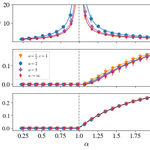
my first submission to #NeurIPS2023 was accepted !! + additional results on Bayes-optimal performance and a separability threshold formula
big thanks to @gabrielescr and @PierpaoloVivo !
@KCLDisorder @kclmathematics

fat tails alert!!! latest preprint on theory of machine leaning with @gabrielescr and @PierpaoloVivo at @KCLDisSyst : arxiv.org/abs/2304.02912 1/
Urte Adomaityte retweeted

The past two weeks were a blast in Cargèse at "Statistical Physics & Machine Learning Back Together Again" cargese2023.github.io/. Around 100 of the top people in the field, including the next generation, discussed a lot of great science. I will miss you guys. We will be back!

fat tails alert!!! latest preprint on theory of machine leaning with @gabrielescr and @PierpaoloVivo at @KCLDisSyst : arxiv.org/abs/2304.02912 1/
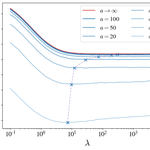
Data separability/MLE-existence threshold? Computationally extracting with logistic loss: fatter tails -> more samples one can correctly classify; the threshold approaches known Gaussian data formula as a->inf. Infinite variance: Cover's result n_samples=2*dim is recovered 8/


Urte Adomaityte retweeted

And now published on @PhysRevE!
journals.aps.org/pre/abstrac…
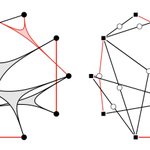
(1/N) First preprint alert! Here is a hyper-twist on planted matching problems for anyone interested in statistical physics methods for inference 🧵
In collaboration with @gabrielescr @zdeborova @toshniwal8
Link: arxiv.org/abs/2209.03423
@KCLDisSyst
(1/N) First preprint alert! Here is a hyper-twist on planted matching problems for anyone interested in statistical physics methods for inference 🧵
In collaboration with @gabrielescr @zdeborova @toshniwal8
Link: arxiv.org/abs/2209.03423
@KCLDisSyst
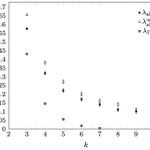
(8/N) As coordination k of the hyperedges grows, we have easier recovery — the partial recovery phase shrinks. Also, the region in which it is information-theoretically impossible to fully reconstruct the signal (hard phase) rapidly shrinks to zero.

