
Research Scientist at Google DeepMind, working on Gemini. (prev. PhD at ETH Zürich & MPI-IS Tübingen.) No second-hand opinions. They are absolutely my own ;)
New York
Joined October 2022
- Tweets51
- Following110
- Followers486
- Likes70





Pinned Tweet
📢I'll be presenting two posters, at #ICML2024 HiLD workshop (Straus 2) today (assuming no further ✈️ delays):
- Closed form of the Hessian spectrum for some neural networks openreview.net/forum?id=gW30…
- Landscaping Linear Mode Connectivity openreview.net/forum?id=OSNM…


quite good actually. coding’s so smooth!
xitter.cf/GoogleDeepMind/status/…

sure the numbers are great, but screw that! it’s your phd, try wild and original ideas even if you fail once or twice at least.
xitter.cf/gabriberton/status/194…

when you go beyond linear mode connectivity, interesting things happen 😮👇
xitter.cf/Theus__A/status/194300…

1/ 🚨 New paper alert! 🚨
We explore a key question in deep learning:
Can independently trained Transformers be linearly connected in weight space — without a loss barrier?
Yes — if you uncover their rich symmetries.
📄 arXiv: arxiv.org/abs/2506.22712

Belated life update:
🎓 PhD — done
🔬 Joined Google in NYC 🗽as a Research Scientist
♊️ Gemini: now more than just my star sign :)
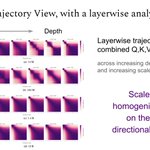
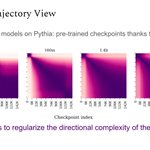
🚀 TOMORROW afternoon at ICLR: Learn about the directionality of optimization trajectories in neural nets and how it inspires a potential way to make LLM pretraining more efficient ♻️
(Poster# 585, hall 2b)


Don't miss out our spotlight ✨paper at ICLR 🇸🇬 about the loss landscape of Transformers and their special heterogeneous structure, done together with great collaborators!
xitter.cf/wormaniec/status/19145…

Ever wondered how the loss landscape of Transformers differs from that of other architectures? Or which Transformer components make its loss landscape unique?
With @unregularized & @f_dangel, we explore this via the Hessian in our #ICLR2025 spotlight paper!
Key insights👇 1/8

Sidak Pal Singh retweeted

✨New Preprint ✨ Ever thought that reconstructing masked pixels for image representation learning seems sub-optimal?
In our new preprint, we show how masking principal components—rather than raw pixel patches— improves Masked Image Modelling (MIM).
Find out more below 🧵

Sidak Pal Singh retweeted

Don’t miss our poster shedding more light on sharpness regularization at NeurIPS tomorrow neurips.cc/virtual/2024/post…
Reinventing things has a bad rep in today's age. But is it really that bad? Maybe it's something to be even cultivated, like selectively?
The second post in this series of blogs is now out. Let's have a deeper look at this overused trope!
wovencircuits.substack.com/p…

I’m exploring a new form of writing—threads of human curiosity woven through the circuits of AI, crafting reflections that are, in the end, fully machine-generated, yet in a way profoundly human.
wovencircuits.substack.com/p…
Come, let's scale up the building one floor,
And, layer up the neural networks once more.
Soon our buildings will touch the sky,
And, our computers will bear AGI.
A quaint little hut in the mountains is out of fashion,
Satisfaction has no gradients for backpropagation.
~Fitoor
At this paper count, recalling all the paper names would already be a big feat :)
xitter.cf/peter_richtarik/status…


At last some attempts to change the status quo: authors with three or more papers are obligated to review for ICLR xitter.cf/PreetumNakkiran/status…


Poster 1: Sharpness/Flatness are much talked about: better minima, Sharpness aware minimization, Edge-of-Stability, and so on. But what really is sharpness? What exactly does it quantify, besides the surface-level definition? How are the eigenvalues and eigenvectors really like?
Poster 2: Linear Mode Connectivity (LMC) is yet another popular feature of neural loss landscapes. But how does LMC arise in the first place? How should the landscape be structured to allow LMC? Are barriers present just at the end, or do they start much early?

Sidak Pal Singh retweeted

Tuesday 1:30pm-3pm, Hall C 4-9 #515.
Drop by our poster if you are interested in SSMs for graphs👇!
Code: github.com/skeletondyh/GRED
