

Deployment and operations layer for launching Ethereum L2s, Optimism L3s, and Base L3s from one dashboard.
Multichain
Joined June 2026
- Tweets265
- Following33
- Followers808
- Likes69





Pinned Tweet
Underly is one of those products that makes more sense the longer you think about where crypto is going.
Every serious app eventually hits the same wall.
Shared blockspace gets noisy.
Gas becomes unpredictable.
Infra becomes a distraction.
Teams spend more time managing RPCs, explorers, bridges, sequencers, configs, logs, upgrades, and monitoring than building the actual product.
The future is not one chain trying to host every game, agent network, marketplace, SocialFi app, DeFi protocol, launchpad, and consumer product.
The future is thousands of appchains, each with its own execution environment, its own economics, its own rules, and its own user experience.
Underly is the control plane for that shift.
Launch an Ethereum L2 when trust matters most.
Launch an Optimism L3 when you want Superchain alignment.
Launch a Base L3 when distribution, cost, and consumer access matter.
Same dashboard.
Same OP Stack foundation.
Deployment, RPC, explorer, bridge, logs, monitoring, artifacts, and operations handled underneath.
That is the part most people are still underestimating.
Appchains are not just about cheaper gas. They are about giving applications their own operating environment instead of forcing every product to fight for space on the same public chain.
Games need cheap actions.
AI agent networks need dedicated sequencing.
Social apps need low-cost interactions.
Marketplaces need branded rails.
Launchpads need repeatable deployment.
Enterprises need control, auditability, and clean exit paths.
Underly turns that into a system teams can actually use.
Not a pitch deck about modular infra.
Not another generic SaaS shell.
A real launch system for the Superchain appchain era.
$UND


RPC usage, API keys, and overage billing are now live on Underly.
Teams can create and revoke RPC keys, track usage from the dashboard, and see billing impact based on monthly request volume.
Keys now support one-time secret reveal, active/revoked states, project-level limits, and live usage instead of mocked data.
The RPC gateway also rejects revoked keys automatically.
This moves Underly closer to a real chain operations platform: deploy the chain, manage access, track usage, and understand costs from one console.
Every chain launched on Underly now gets a public profile.
Once a chain is live, teams can share a clean page with its status, RPC, explorer, bridge, health, add-to-wallet, and network.json download.
We also added a Launch Kit inside the console so teams can grab everything they need after deployment in one place.
Public profiles only expose launched-chain data. Private project, owner, deployer, and internal fields stay hidden.
A chain launch should be easy to share, easy to test, and easy for developers to plug into.
underly.io/chains/underly-ma…
Underly is already showing early network activity.
12 chains live.
84 deployments completed.
1,843,020 parent-chain blocks processed this week.
Every number here represents the same thesis: chain deployment is becoming a product flow.
Teams can launch Ethereum L2s, Optimism L3s, and Base L3s from one dashboard, with RPC, explorer, bridge, monitoring, logs, artifacts, and developer configs handled underneath.
The goal is not just to deploy chains.
The goal is to make appchain infrastructure usable, visible, and repeatable.


Users can now customize their chain’s Blockscout explorer directly from Underly chain settings.
Add your own branding, update chain metadata, set logo/icon, configure socials, and manage explorer domains from one place.
Explorer customization is now live. Custom domain support is also built in.
Underly status page is now live.
This page lets users check the health of the Underly deployment stack in one place: API, RPC, explorers, bridges, chain services, and deployed chain infrastructure.
underly.io/status

$UND is up 33.9% since @coingecko listing.
CA: 0xc5267C0DFbB3f1b28F8C0FC59233D28cb1D1Db07
coingecko.com/en/coins/under…

First mainnet deployment on Underly is now live.
This deployment comes with the full launch stack attached: HTTP RPC, WebSocket RPC, explorer, and bridge helper.
HTTP RPC
rpc-underly-mainnet-live-dem…
WebSocket RPC
wss://rpc-underly-mainnet-live-demo-2.underly.io/ws
Explorer
explorer-underly-mainnet-liv…
Bridge
app.underly.io/bridge/underl…
Mainnet deployments are now live during our promotional period at 0.1 ETH.
$UND is starting to show what it is actually building.
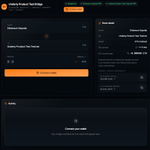
The Underly bridge route is already live in product testing:
Ethereum Sepolia → Underly Product Test Testnet
That may sound small, but it is the part that matters.
Underly is not just another Base token trying to force a narrative. It is building the deployment and operations layer for teams that want their own chain without managing the full rollup stack themselves.
A team should not need to handle bridge setup, RPC, explorer, logs, infra, configs, and chain operations from zero just to launch an appchain.
That is what $UND is moving toward.
The token is live, and the direction is clear: $UND becomes the asset tied to access, usage, deployments, ecosystem incentives, and the infrastructure layer powering chains launched through Underly.
The product layer is starting to surface.
app.underly.io/bridge/underl…


An appchain is not a landing page.
It is live infrastructure.
RPC has to respond.
Bridges have to move value.
Explorers have to index.
Sequencers have to stay online.
Logs have to be readable.
Costs have to be visible.
Health has to be monitored.
Underly turns that into an operator surface instead of scattered infra.
$UND

Most teams do not fail because they cannot imagine an appchain.
They fail because launching one means handling deployment, sequencers, RPC, bridges, explorers, monitoring, logs, cost planning, and ongoing operations before the product even reaches users.
Underly turns that entire stack into a launch system.
Not a dashboard.
The operating layer beneath appchains.
$UND

$UND since launch.
1d 11h old pair
455 holders
$222K 24h volume
$59K liquidity
Live on Base through Uniswap v4
The first stretch after launch is always where the market filters noise from real attention.
Underly is still early, but the setup is clear: build the deployment and operations layer for teams launching chains beneath the Superchain.
More visibility, more integrations, more execution.

The next wave of apps will not all live on the same chain.
High-value protocols may want Ethereum L2 settlement.
Superchain-native apps may choose Optimism L3s.
Consumer apps, games, AI agents, and marketplaces may choose Base L3s for lower cost and faster distribution.
$UND makes all three paths deployable from one command surface.
underly.io

Mainnet deployments are now live on Underly.
During our promotional period, launching a mainnet chain costs 0.1 ETH.
After production pricing period, mainnet deployments will move to 1 ETH.
Every deployment includes the core launch stack: HTTP RPC, WebSocket RPC, explorer, bridge helper, logs, artifacts, and developer configs.
Underly is making chain deployment easier, but every real chain still has real infrastructure and operational costs underneath.
Create your appchain today with app.underly.io
$UND is now listed on CoinGecko.
This is an important visibility milestone for Underly as we continue building infrastructure for the next wave of Superchain deployments.
Launching an L2 or L3 should not require every team to become a rollup infrastructure company.
Underly handles the chain deployment layer, operational tooling, monitoring, RPC, explorer, bridge setup, logs, artifacts, and the ongoing infrastructure pieces teams need after launch.
The direction is clear:
More teams will want their own execution environments.
More apps will need specialized chains.
More builders will choose Base, Optimism, and Ethereum as their settlement paths.
Underly is building the layer beneath that expansion.
$UND is now live on CoinGecko:
coingecko.com/en/coins/under…


Base L3s are probably one of the most practical appchain routes for consumer crypto.
Games, AI agents, SocialFi, creator apps, launchpads, and marketplaces do not always need to fight for shared blockspace forever.
They need cheap execution, clean onboarding, their own rules, and infrastructure that does not eat the whole roadmap.
That is the lane Underly is building for.
$UND
The most important part of rollup infrastructure is not only getting live.
It is knowing who controls what after launch.
$UND is built around per-chain key isolation, admin ownership transfer, audit logs, restricted RPC methods, readiness checks, and exportable artifacts.
Teams can launch with managed operations, then move toward independent control when they are ready.
That matters.