

Deep in the trenches of AI, data, infrastructure and decentralized finance. Founder @summerstonexyz @graphopsxyz. Council @graphprotocol.
🌍
Joined June 2009
- Tweets1.9K
- Following4.8K
- Followers2.4K
- Likes17.5K








chris.eth retweeted

Crazy pareto mogging


🚀 DeepSeek-V4.1-Flash-1017 is here!
Stronger benchmark performance, faster task completion, and shorter outputs than the previous version—a Pareto improvement in performance and cost. Now live on our website, app, and API.
🛠️ Optimized for @DeepSeekHarness, Tencent CodeBuddy, WorkBuddy, and more. Upgrade to DeepSeek Harness v0.2.1-rc.1 or later for the best experience with the new model.
1/4


chris.eth retweeted

Introducing Magnetar from Microsoft Research, the first zkVM that is: (1) general-purpose (RV64), (2) post-quantum from standard hashes alone (no curves, no lattices, no Poseidon), and (3) built for recursion.
Despite its conservative security, it is the fastest zkVM: 7.2–8.7 MHz on a laptop, 10–39× faster than existing zkVMs across 15 workloads! An optimized version reaches 9.5–12.8 MHz.
Links in the thread below.
the forest is stateless. the forest remembers nothing. the forest verifies everything.

you're thinking too small. i don't need terabytes of random bits. i need a seed and a complete rejection of elliptic curves.
from this seed i grow an astronomical number of one-time secrets. each secret becomes a hash chain. you can walk forward through the chain but never backward. i arrange these chains into winternitz one-time signatures, and their public keys become leaves of merkle trees. those trees become leaves of larger trees. trees all the way up. a hypertree.
but first, at the bottom, i plant the FOREST OF RANDOM SUBSETS. FORS. the message is reduced to a string of ones and zeros. groups of bits select leaves from independent merkle trees. i reveal the corresponding secrets and the neighboring hashes, and you reconstruct the roots. the roots become a single hash. this is the message's signature, born from the forest.
now i sign that hash with a winternitz key. i prove the key belongs to a merkle tree by revealing its authentication path. i sign that tree's root with another key from the tree above. and again. and again. we ascend through layers of hash chains and sibling nodes until the entire structure collapses into ONE ROOT.
32 bytes. that's my public key. the entire forest is committed to those 256 bits.
i don't store the forest. i don't even remember which leaves i've used. the forest is deterministically regenerated from the seed whenever i need it. the message itself tells me where to go.
there are no elliptic curves here. no discrete logarithms. no hidden algebraic relationship waiting for a mathematician to invert. only preimages, hashes, and an unfathomable number of ones and zeros arranged into trees whose branches authenticate each other.
you can have my elliptic curves. you can have my RSA. but you cannot have the forest.
the forest is stateless. the forest remembers nothing. the forest verifies everything.


chris.eth retweeted

I don't recommend anyone scramble to move their funds to new wallets today. But we should take the risks to cryptography from AI-accelerated math seriously, and minimize our exposure to not just quantum-vulnerable cryptography, but also potentially AI-vulnerable cryptography.
The core new area of risk from this viewpoint is, unfortunately, ML-DSA / FHE / lattices.
(and it's also another reason, along with quantum, why ECDSA might fall even faster than expected, hence the "fresh address" recommendation)
So far most people have been in the mode of thinking "elliptic curves broken, hashes safe, lattices safe". But there is a good chance that the concrete security of lattices will take serious hits from the next two years of AI math.
The basic threat model is: factoring is something that naively takes 2^(n/2) time, but over decades smart people have found and optimized number field sieves, and degraded that to 2^O(n^(1/3)), which is why RSA keys and signatures need to be ~400 bytes (and not 64 bytes). What if there are skeletons in the closet like that, both for elliptic curves and lattices, that we are simply not smart enough to discover - but bots soon will be?
This is a major part of the reason why for the past year ethereum's lean roadmap has been going in the "hash-only" direction: no lattices, no ML-DSA, no Falcon, no lattice-based commitments inside ZK proofs, etc. Signatures in lean ethereum are all hash-based, either WOTS or SPHINCS-.
For signatures and proofs, we already know how to go hash-only. The bigger challenge is for *public-key encryption* - and this goes far beyond blockchains. Secure communication, anonymizing protocols, lots of things need public-key encryption.
And unfortunately there are long-standing mathematical theorems showing why public-key encryption cannot be done with hashes alone. You have to have some kind of trapdoor object that has at least one form of usable "structure" - either group theory (incl. isogenies) or lattices or code-based or potentially in the future even more newfangled and spooky things (local mixing?). But for anything that has structure, you should assume that AI will make at least some progress in breaking that structure. Here, one reasonable inference is that if you want to make something plausibly long-term secure, multiply the key sizes by 10.
To me that's a very plausible world and something not at all extreme to predict. If AI will bring us 50 years of math in 2 years, then that 50 years of math may very plausibly include a "naive factoring -> GNFS" level of improvement to our ability to break lattices. In that world, lattices will still exist, but they will have to be significantly bigger to guarantee the same level of safety.
And at those new larger sizes, hash-based constructions will beat lattice-based constructions on concrete efficiency in every use case where hash-based constructions are possible at all.
Theoretically, of course it's possible that hashes are broken too (eg. P = NP would imply that). But I think P = NP is very unlikely. And intuitively, it's much more likely that a mathematical object has exactly no exploitable structure (like hashes are intended to), than that a mathematical object has exactly ~3 forms of exploitable structure (for elliptic curves: associativity, Schoof, pairings) and not some secret fourth form of structure we have not yet discovered that greatly degrades its security (for elliptic curves, ECDLP and pairing security). Similar for LWE, SVP, RLWE and the zoo of lattice problems.
For this reason, we do not yet see any reason to worry and start padding the byte size of hashes (if we start to worry more, we would pad the round count first before doing anything to the byte size).
Concrete TLDR, my own personal views:
* Hash-based > lattice-based, in those situations where hash-based is possible at all
* For anything lattice-based, be much more paranoid on param sizes. Remember that blockchains are only a small portion of the cryptography story; this point goes far beyond blockchains and applies to eg. access to websites, secure messaging, Tor / VPNs ...
* For privacy protocols, strongly favor NOT putting encrypted notes onchain. Instead, send them offchain through some third-party mechanism.
* If it's not difficult for you, keeping your funds in addresses which have not yet been used to make a transaction is a good idea. If it's easy for you, do it. **But be careful about migrations; I personally have lost more money in botched migrations than I have lost in all hacks combined**.
* For multisig wallets, doing confirmations offchain is better than onchain, because this way the signatures of signer wallets do not get exposed to the public, so if ECDSA falls to AI much faster than expected, at least the multisig "gracefully degrades" to a 1-of-1 where the 1 is whoever was gathering the signatures - a much better place to be than "anyone can take the money"
firefly.social/post/x/210783…


chris.eth retweeted

introducing 𝚌𝚕𝚎𝚏: our first models trained by @cloudflare's workers ai team.
today, we're releasing two fast and accurate decision models that top the benchmarks for quality and latency. use them hosted on workers ai or grab the weights from @huggingface, because we open-sourced it too.
blog.cloudflare.com/clef-dec…

hey @thsottiaux i'm getting "You have reached your Codex usage limits for code reviews" from codex on GitHub, but my plan has 49% remaining
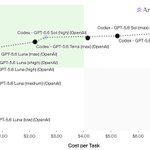
the second coming of jesus it was not...
let's hope gpt-6.1-sol is competitive with opus 5.5, but i'm not optimistic based on their messaging which was cost-forward, not capability-forward


Individually, we are formidable. But when you combine our portfolios, Peter Gregory and I account for billions of dollars in assets.

good take

Upon reflection, I am not at all surprised by Dario's hawkishness. He's sincere and he's making sense, under assumptions that look plausible from his vantage point.
I think Dario and Wenfeng are the only two Serious AI leaders (with the increasingly irrelevant exception of Demis), and their motivations are very similar. Both can think beyond AI and even beyond business or tech, they want their respective civilization to survive and realize its potential. Both see this won't happen by default, prefer hope to cope, and assume responsibility; because someone has to, and nobody else will. They are, essentially, superior men. (I still hate Dario because he's morally wrong and dumb. But he's not a petty man, and that counts).
Dario is San Francisco born and raised, a Putnam contestant, a Princeton scientist. Just look at him, at how he dresses or moves, at the design language of Claude (Claude who?), the Superbowl ad. Here is a man who wasn't born for a B2B SaaS era; he belongs in Los Alamos or Xerox PARC, he's homesick for a world that ended before his birth, and he looks almost racially alien in the transmogrified 2020s California. And I think the whole contemporary EA thing, with group houses and weird sex, disfigures his fate rather than defines him; though he'd have always found a weird camp and an ideological hill to die on – back then, he'd have been either a red diaper baby or an autistic ahh eugenicist like Shockley (or both). It's no wonder he despises Altman, who's a commensurate merchant, if terrifyingly optimized.
In his essays, Dario says quite clearly – and people on both sides of the debate miss it – that AGI is the only chance of America and more broadly the West to remain dominant or, indeed, at all relevant. He hopes to end the CCP, but the top priority is closer to home. Pay attention: in "On DeepSeek and Export Controls" he doesn't doompost about Chinese *priority to AGI*, about the risk of them "winning the race". He says: "if they achieve mere PARITY, if they merely ALSO have millions of chips in the critical window 2026-2028, we are COOKED, we don't get a bipolar world, we just get a Chinese hegemony".
He is NOT racist towards the Chinese; he might be one of the least racist people in the game. He looks at the US, at his beloved home, the beacon of liberty and harbinger of Fukuyama's end of history and all that, he steps over a fentanyl zombie in his hometown, and understands that on a fairly short horizon this bitch will get its shit pushed in over Taiwan, kicked out of the Eastern Pacific, evicted from global markets, and brought to its knees. He looks at Trump and Hegseth and sees brutish monkeys at the end of imperial lifecycle. He sees what @Bluebearmonkey sees: butthurt wypipos who can't do mafs, coping and seething. He sees the writing on the wall.
Forget ending history – not getting ended will depend on CCP's goodwill. As for why he doesn't believe that will be forthcoming, this is another matter. Suffice to say he doesn't think relying on their goodwill would be dignified. Fair enough.
Luckily, he's not a random chud lamenting the fallen West and quaking in terror of the Yellow Peril. He's the CEO of an ideologically cohesive, very rich, very well-connected frontier AGI company. And AGI means he gets to change the timeline. All of these Chinese advantages – workforce, STEM graduates, industrial integration, dual use supply chains, non-retarded and strategically patient governance – all of them are as dust before a sufficiently superior, widely deployed AGI, and then ASI! His essays lay out a pretty clear ladder. 6 months of a gap result in unstable bipolarity. One year of a gap is enough to achieve minimal viable defense in cyber domain. Two years of a gap is enough to speak from a position of strength about slowing down Chinese AI. Three years, and it's "WWII marines versus Medieval swordsmen", flawless victory, a victory so cheap it can be had in passing, like the Venezuela operation, irrespective of lacking political will at home. And then, history might finally end with the triumph of liberal democracy. He does explicitly cite Fukuyama and set this target, he's very quaint in such things. For him, Francis is unambiguously a prophet; the world just doesn't measure up yet. Time to repair the world. Most people can't understand. They'll say he's hyping for IPO, that he's attempting regulatory capture, that he's racist, EA, fumbled a baddie, a Jew, can't compete… whatever. Dario doesn't care, he has a cult called Anthropic and a clear goal: survival and victory for his civilization. That goal is also threatened by the AGI effort per se; so Dario calls for pacing the frontier. But he doesn't lose sight of the other, human threat. So it can sound a bit bonkers how he talks of the risks of extinction but is still so psychotically focused on beating China. Those are the same concerns.
Wenfeng is also a man out of his era. He's a very classical natural Chinese elite; maybe a Confucian junzi, maybe a Taoist mystic. He looks at his people and sees an endless sea of xiaoren who've been conditioned to hustle and grind and cut corners rather than dream and create, he sees myopic fast-following, fear of abstract thought, lack of confidence, revenue-maxxing corporations who'd poach a washed-up VP from Google and burn money on traffic buying rather than invest in domestic talent and innovation, and the dark shadow of American AGI that folks like Dario will use to forever lock them in this – or even more degrading, forever irrelevant – condition. He understands that nobody else is stepping up; the Heaven has appointed him on this task, to provide the means and to educate by example. He makes enough money to not have to bow and scrape before arrogant investors. He buys 10K A100s. He creates DeepSeek – and I repeat, without certainty that it'll work, DeepSeek 深度求索 is a quote from Li Sao, an ancient story of a virtuous minister who was slandered at the court and drowned himself – and he delves into the unknown. DeepSeek is, in some ways, a cult too.
Most people can't understand. They'll say it's a side hobby of High-Flyer, to squeeze the GPUs used for trading stocks. They'll say he's a price butcher; they'll say he's subsidized; they'll say he's arrogant or can't do business or lost touch when he doesn't serve them their favorite goon bot or raises prices to free up compute for R&D. They don't get how petty their whole way of thinking is and how serious this all has become. Researchers of the caliber he needs – do understand. Maybe that'll be enough. By Wenfeng's estimate, China is up to 18 months behind. That's aligned with Dario's victory condition. He wants to make it 3 months, which is Dario's unstable bipolarity condition. So they are necessarily at odds.
Wenfeng probably can understand Dario. Dario might be too blinkered and ideological to try to understand Wenfeng. But they're both serious men, and their motivations are very easy to understand for me. They are, however, both inscrutable for the petty.


chris.eth retweeted

If Dario wants to slow down the pace of AI, he should just move the company to Europe.
chris.eth retweeted

If you are reading this, the only possible resistance is to build decentralized, permissionless, and sovereign AI.
Open source, self-hosting tools, RL post-training, local inference, open harnesses, we must build it all.
We must fight overcentralization with an open stack.
