

The UNCA Office of Academic Accessibility seeks to collaborate with students with disabilities to ensure meaningful access to the campus and curriculum.
- Tweets93
- Following77
- Followers19
- Likes15



ALT Text reading: "Access is not optional, an afterthought, too expensive, too time consuming, too daunting. Access is a CIVIL RIGHT." The Accessibility symbol of a person using a wheelchair is used for decoration.

ALT Text Reading: 31 years ago today.... The Americans with Disabilities Act was signed into law by then-president George H.W. Bush. No matter who you are-- or the barriers you may face, access is a Civil Right.

ALT Text reading: Fast Facts: Disability in Higher Education. Did you know that 504 plans or IEPs (Individualized Education Plans) don't automatically follow a student from high school to college? While the barriers a student faces may be similar, the student will need to apply for accommodations through the College's Disability Resource Center. Image of a mortarboard and diploma for decoration.

ALT Text: "How do we talk about disability? Effects of disabilities can manifest in different ways. A behavior like being easily startled, for example, could be related to a disability. Be respectful of a person's actions, and requests, even if you don't understand them." Image of two people chatting via social media.

ALT Text reading: "How do we talk about disability? Did you know? The Americans with Disabilities Act defines disability as a 'physical or mental impairment that substantially limits one or more major life activities.' Though not an exhaustive list, a major life activity could be: walking, talking, breathing, seeing, hearing, concentrating, etc." Clip art images of a man using a wheelchair holding hands with another person, a woman in a hijab interpreting, and two women with their arms around each other are shown for decoration.

ALT Text reading: How Do We Talk About Disability? Did you know? Two people may have the same disability, but be affected differently. Listen to a person's experience, even if it does not match your understanding of a certain disability. Clip art image of a male-appearing man using a wheelchair listening to a clip art female-appearing person using a wheelchair as she speaks. A chat bubble is placed between the two figures to indicate listening and speaking.

ALT Text reading: "How do we talk about disability? When speaking with a person with a disability, always direct your communication to the individual. Even if a caregiver or interpreter is assisting, speak directly to the person with a disability." Image of three female appearing woman speaking and eating.

ALT How Do We Talk About Disability? Service Animals are dogs that perform an action or specific task. Service Animals may go anywhere the public goes. Emotional Support Animals are domestic Animals are domestic animals that do perform a service, but provide comfort. ESAs, typically, stay within the residential environment. Clip art image of a man in a wheelchair hugging a yellow dog.

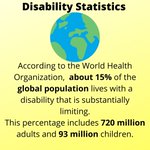
ALT Text reading: "Disability Statistics: According to the World Health Organization, about 15% of the global population lives with a disability that is substantially limiting. This percentage includes 720 million adults and 93 million children." Decorative image of a blue and green colored Earth is used for decoration.

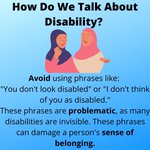
ALT Text reading: "How Do We Talk About Disability? Avoid using phrases like: "You don't look disabled" or "I don't think of you as disabled." These phrases are problematic, as many disabilities are invisible. These phrases can damage a person's sense of belonging." Image of two women in hijabs chatting is used for decoration.

ALT Text Reading: "How Do We Talk About Disability? Don't assume a person with a visible disability needs help. Ask if the person needs assistance. Respect their choice. Always have a person's consent to touch them, an assistive device, or service animal. Clip art scene of a woman using a wheelchair and a service dog speaking to a man.

ALT Text reading: How Do We Talk About Disability? When speaking with a person who is blind or has low vision, identify yourself before beginning your conversation so the person knows who is speaking to him/her/them. Clip art icon of a female-appearing person wearing a headset and speaking into a microphone.

ALT Text reading: "Did you know? Using the puzzle piece to symbolize Autism is problematic. The piece implies that a person is "missing something." Instead, use the infinity symbol, which highlights infinite diversity. June 18 is Autistic Pride Day." Images in the post: A group of primary colored puzzle pieces with a "no" symbol overtop. The multi-colored infinity symbol.

ALT Text reading: Disability Statistics! 26% of adults in America live with a disability. 1 in 4 women report a disability. 2 in 5 individuals age 65 or older report a disability. Data courtesy of the Center for Disease Control. Image of a clip art of two male-appearing men, one older and one younger, and two female-appearing women, one older and one younger, standing together.

ALT Text Reading: Digital Accessibility Tip: Did you know? Enabling Google Chrome Auto-captions on your device will provide automated captions for all audio played through a Chrome browser. An image of a phone with the Google Chrome symbol on the home screen is shown for decoration.

ALT Text Reading: Specific Disability Statistics! At least 80% of the disabilities reported to post-secondary institutions, nationally, are invisible. A disability does not have to be visible to be real! A clip art image of students gathered around a white board.

ALT Text reading: How Do We Talk About Disability? Did you know? Disability can occur at any point in a person's life. Disabilities can be temporary or life long. A clip art image of a young woman holding a baby while using using a wheelchair is used for decoration.

ALT Text reading: How do we talk about disability? Did you know? Not all disabilities are visible. Nationally, at least half of the disabilities reported to post-secondary institutions are invisible. An invisible disability is just as valid as a visible one. A clip art image of four people talking is shown for decoration.

ALT Text on blue background reading: How Do We Talk About Disability? Avoid terming people with disabilities as "inspirational" or "brave" simply for existing as a person with a disability. A clip art image of a woman using a wheelchair reading architectural blueprints is used for decoration.