

A research institute that aims to empower Muslims toward the realization of a unified Islamic civilization for the benefit of the Umma and humanity at large.
Joined February 2022
- Tweets2.1K
- Following1
- Followers6.8K
- Likes888




Pinned Tweet
Future Studies and the Ummatic Horizon - Dr. Hamdija Begović | Sarajevo Conference 2026
"One might think of [future studies] as a civilizational muscle, and like any muscle it develops through use. The more a community engages in long-term thinking, explores alternative futures, and reflects on the consequences of present choices, the stronger its capacity for strategic action becomes."
Dr. Hamdija Begović explores how future studies can help Muslims move from reacting to global change to actively shaping it, combining strategic foresight with Islamic conceptions of time, moral responsibility, and the Umma as a unit of civilizational analysis.
Watch the full presentation here:
youtu.be/GeG9Jo0OmGM

Watch Dr. Mairaj Syed's presentation "Truth, Tolerance, and the Courage to Disagree" at the Ummatics Annual Conference here: youtu.be/9bKTPsHgstI
Theorizing the Umma: Post-Western IR and the Islamic Civilizational Paradigm
Summary & Video Recording of our Colloquium with Dr. Giorgio Shani & Dr. Amira Abou Samra
If you missed our colloquium earlier this month, be sure to catch up on the colloquium recording and summary on our website.
Link below.

Dialogue confined to elite universities changes nothing. Dr. Mairaj Syed argues that ecumenical conversations must reach TikTok and Instagram or sectarian perspectives will dominate by default. But the most durable solution is simpler than any institution: come together and eat together. The bonds of friendship do what argument alone cannot.
Watch Dr. Mairaj Syed's presentation "Truth, Tolerance, and the Courage to Disagree" at the Ummatics Annual Conference here: youtu.be/9bKTPsHgstI
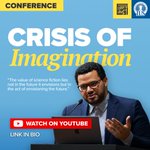
Islamofuturism: Why Muslims Should Write Science Fiction - Ahmed Elbenni | Sarajevo Conference 2026
“The value of science fiction lies not in the future it envisions but in the act of envisioning the future.”
Ahmed Elbenni makes the case for Islamofuturism, arguing that Muslims need not only the predictive tools of future studies but also the artistic and political capacity to imagine radically different futures.
Drawing on science fiction, Islamic literary aesthetics, classical traditions of wonder, and contemporary Muslim speculative writing, Elbenni argues that science fiction can function as a laboratory for political and civilizational imagination. He distinguishes Islamic science fiction, which depicts Islam or Muslims in future settings, from Islamofuturism, which places Islam at the centre of future possibility and asks how Islamic commitments might transform the future itself. He concludes that the political importance of science fiction lies less in predicting what will happen than in preserving a community’s capacity to dream beyond the limits imposed by the present.
youtu.be/UVjl5QEepfA

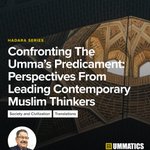
Confronting the Umma’s Predicament: Perspectives from Leading Contemporary Muslim Thinkers
📃 New Publication by Dr. Saif Abdelfattah
@saif_abdelfatah examines how four influential Muslim thinkers—al-Kawakibi, al-Sanhuri, Bennabi, and el-Bishry—understood the Umma’s civilizational challenges and proposed pathways to renewal, emphasizing political reform, Islamic unity, intellectual revival, and overcoming internal divisions. This article is part of the Hadara translations series.
ummatics.org/publications/ha…


A political regime ultimately exists to maximise human potential and that requires scale. Dr. Malik Mufti observes that the nation-state, limited by ethnicity and borders, is increasingly dysfunctional. And in the Muslim world, majorities already identify as Muslims before they identify as citizens.
Watch the full Ummatics Colloquium "Cohesion at the Wrong Scale: Why Muslim Political Unity Resists Institutional Form" here - youtu.be/icBlDFhAwSw?si=bpgp…
Watch Dr. Ovamir Anjum's presentation "Why Managing Deep Differences Is the Key Ummatic Task Today" at the Ummatics Annual Conference here: youtu.be/-0CP6F9j16w?si=3U1O…
When Musa ﷺ and his servant lost the fish on their journey to find Al-Khidr, the Quran distributes responsibility across both and even though the servant was at fault, Musa ﷺ did not deflect. Dr. Tarik Namas reminds us that shared accountability is a Quranic principle, and asks: in our current crises, who takes responsibility?
Watch the full video of the welcome and opening remarks of our 2026 annual conference held in Sarajevo here: youtu.be/AtuCF-aAevc?si=l6jT…

Beyond the Liberal “Peace”: Managing Deep Difference in the Umma - Panel Q&A | Sarajevo Conference 2026
“Your anger, your hatred is not going to eliminate the other; rather, will exacerbate tensions in society.” — Yasir Qadhi
Dr. Ovamir Anjum, Dr. Yasir Qadhi, Dr. Ahab Bdaiwi, Dr. Yasmeen Daifallah, and Dr. Mairaj Syed discuss the limits of tolerable disagreement, sectarianism, agonistic politics, justice and mercy, institutional incentives, and how dialogue and ordinary human encounter can help Muslims manage deep differences without demanding uniformity.
Watch the full presentation here: youtu.be/wjUj_Tcvcg4

Once a Deobandi scholar lead the janaza of a Barelwi scholar. In the aftermath, a fatwa declared every Barelwi who prayed behind him an apostate — their marriages dissolved, their faith requiring renewal. Dr. Ovamir Anjum shows that this is a reality check for us if we think sectarianism is simply a distant problem between, for example, Saudi Arabia and Iran.
Watch Dr. Ovamir Anjum's presentation "Why Managing Deep Differences Is the Key Ummatic Task Today" at the Ummatics Annual Conference here: youtu.be/-0CP6F9j16w?si=3U1O…
Ummatics retweeted

Enstitümüz ve Ummatics Enstitüsü işbirliğinde düzenlediğimiz "İslam Dünyasını Yeniden Düşünmek" konuşma serimizin ilkinde Prof. Dr. İsmail Kara'yı ağırlıyoruz.
📅 Tarih: 21 Ekim 2026 Çarşamba
🕒 Saat: 14:00
📍 Yer: Nihat Sayar Toplantı Salonu, 1. Kat

Watch Dr. Ovamir Anjum's presentation "Why Managing Deep Differences Is the Key Ummatic Task Today" at the Ummatics Annual Conference here: youtu.be/-0CP6F9j16w?si=3U1O…