
Retro console systems & development. PCE dev stuff, but pretty much any retro console dev stuff! https://xitter.cf/t.co/BraUOFb0nb https://xitter.cf/t.co/THbAknbfO8
Sonoras desert
Joined February 2020
- Tweets3.8K
- Following292
- Followers942
- Likes12.3K





#PCエンジン #pcengine #tg16 #retrogaming
I did some testing the other weekend on the Turbo Everdrive Pro. It supports 8megabyte rom images using the SF2 full mapper range. Pretty easy to use.
The Pro has 16megabytes of ram, so hopefully we can get a future update for SF2 implementation that supports that range for it. I have a personal build of Mesen that supports it.
And hopefully in Mister as well (need to have some working support for it first, before going around asking for updates). I need to unpack my Mister and see what it currently supports. I'm not sure if it supports any of the extended ranges of the SF2 mapper.
It needs a better name than "SF2 extended mapper". Turbo Mapper? HuMem mapper? HuGe mapper hahah.
turboxray retweeted

Est ce qu'il existe un jeu d'arcade 2D avec un framerate plus mauvais que Metal Slug 2?
La série Metal Slug à déjà un handicape rare pour du jeu d'arcade 2D. C'est une série qui est capé en 2 VBL soit 30 fps. Je connais seulement OutRun comme jeu d'arcade 2D capé en 2 VBL et...
#PCエンジン #pcengine #tg16 #retrogaming #rondo #draculax #castlevania #retrodev
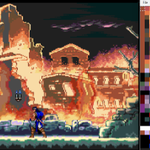
Time to show some progress on this PC-Engine Dracula-X demo that has been over a year now in coding development. The fire effect and most of the foreground sprites were done a while ago. All these little things to make it feel like a game now, and not just a graphics demo.. way too much time. It's the little things that are time sinks. This still isn't the final version - need some more polishing.
I ended up doing more than I had originally planned.. and having more detail and things that were originally not calculated for. Yes, this is a PC-Engine.. no graphic chips or SuperGrafx here. But I did end up using more LUTs for the added detail, and expanded beyond my memory budget (512k CD RAM). I'm converting it over to Arcade Card for the required memory budget and to just make things a lot easier on me hahah.
Some interesting things here; the translucent fire layer and house layer take up the LEAST amount of CPU resource here. To the point where I would have so much cpu resource left, that I wouldn't know what else to do with it. But see that large wall section with the stairs? THAT part eats up soo much CPU resource. Part of that is my own fault because I wanted more detail than I had planned for that part (and I made the sin-wave effect more aggressive than it was supposed to be). You see how the background has all that sin-wave effects? The foreground in that large wall section.. is dynamically counter acting every single offset! I'm not gonna lie.. the idea is a little crazy. I'll post a video showing the tilemap section in a reply. On average, the cpu cost is like 55%.. but heavy areas like this average 70%.. and heavy spikes as much as 90% cpu usage! But it's still a rock solid 60fps.
Anyway.. this has been what.. 16 years in the making? I designed and spec'd everything you pretty much see here back in 2010. All the number crunching, total costs, design, effects.. everything you basically see here, I had already figured out back then. That's how I work.. without writing a single line of code.. I design the graphic effects and cpu costs all upfront. From there, it was just a matter of coding it up (the boring part haha).
Feels good to have it in a playable state. A proof-of-concept on paper.. to a proof-of-concept in action. 3 layers of parallax, translucency, and 60fps on a 1987 "8bit" console. Not bad.
FYI: If this was on the SuperGrafx.. this would be a cake-walk. By far. Maybe I'll do an upgraded SGX version too.
Here's a look at the large wall part I was talking about. Left side is the game screen, right side if just the tilemap view (there are no sprites to cover up the edges).
You can see how I'm animating the tiles on the foreground layer to cancel out the sin-wave effect is affecting the entire BG layer. It's because they are all on the same BG layer. The fire effect with its vertical sin-wave is all pure software, so it has no impact on any tiles or screen positioning.
#PCエンジン #pcengine #tg16 #retrogaming #rondo #draculax
I was looking more closely at the differences between SNES Dracula X and PC-Engine Rondo.
The walk animation in the SNES one is slower; it scrolls 1 pixel per frame, while the PCE scrolls 1.25 pixels a frame. But the SNES Drac-X animates twice as fast as Rondo. Slower scrolling, faster sequence in the animation. It's feels weird - almost like walking in place.
The attack is slight slower on SNES Drac-X too. The two starting wind-up frames hold at; 3f, 3f, 2f, 2f... while Rondo is; 2f, 2f, 2f, 2f...
The other area is jumping. If the walking is 1px per frame on the snes, the jumping is closer to the PCE at 1.3125 pixels a frame. So the difference from walking to jumping is kinda jarring/weird in the SNES port: 1.0px vs ~1.3125. PCE: 1.125px vs ~1.3125px. It feels a little more dis-jointed in the SNES Drac-X because you get more of a noticeable speed boost from transitioning from walking to jumping.
But the jump arc and frame sequence is different. Rondo has more hang time on the frame at peak (hold for 16 frames).

turboxray retweeted

Examples of Megadrive FM based music, automatically converted to MOD format. The converter can produce multi-channel MODs, or condense to 4-channels (with a simple config). Example 1/3: Green Hill Zone [Sonic The Hedgehog]


turboxray retweeted

PicoPak for #MasterSystem gets REWIND!
World's first real hardware Rewind in a flashcart. No one else does it anywhere for any console.
Give this a like and repost if you want to see this same thing brought to the PCEngine and TurboGrafx16.
turboxray retweeted

Forever fast, in gosu blue.
ソニック・ザ・ヘッジホッグ有田焼「Infinite Blue」
ソニックの「世界最速の青」を、色褪せることのない「永遠の青・呉須(ごす)」で表現。音速の青い閃光が描く一瞬の軌跡を、職人の手によって、時を超えて受け継がれる磁器へと封じ込めました。
ソニック生誕35周年を記念して制作された、唯一無二の磁器クラフト作品です。全世界限定50体。
10月9日より、池袋PARCO「SONIC the Exhibition -ACROSS GENERATIONS-」にて会場先行販売、オンライン抽選の応募受付を開始します。
Sonic the Hedgehog Arita Ware “Infinite Blue”
Sonic's “world's fastest blue”, rendered in gosu, the eternal blue of Arita ware that never fades. A fleeting trail of supersonic blue, captured by the hands of artisans in porcelain made to last for generations.
Celebrating 35 years of Sonic. An edition of 50 worldwide.
From October 9: venue sale at SONIC the Exhibition, Ikebukuro PARCO, and online lottery entries open.
Details:yoyoyo.work/products02
Craft Process Film:youtube.com/watch?v=DzCJw-H7…
©SEGA
@SEGA_OFFICIAL @SonicOfficialJP @SEGA @sonic_hedgehog
#SonicTheHedgehog #ソニック #YOYOYO #Craftsmanship #有田焼
turboxray retweeted

お待たせしました!🚀『Battle Princess Overdrive』公式ティザートレーラーを今すぐ公開!ド迫力のアクションとピクセルアートの世界へ飛び込もう。今すぐウィッシュリストに追加!🔥👑
@realMonsterBath @tokyo_game_show #TGS2026 #東京ゲームショウ #インディーゲーム #ピクセルアート #ランアンドガン #BPO #ティザー #トレーラー解禁
This is a great read-through post! Love hearing the details of stuff under the hood.

Otimizei os códigos de Thunder Spirits do SNES!
Meu maior desafio até então, visto que esse jogo é BRUTALMENTE mal otimizado.
kandowontu havia feito uma conversão pra FastROM e ainda assim o jogo era puro lag.
Agora ele está muito mais leve!
mediafire.com/file/8vweoppny…
#PCエンジン #pcengine #ai #ai_slop #slop_manager
I think the debate about AI in related to programming/development is pretty interesting. But the one that sticks out to me the most.. is coding.
TLDR; "vibe coding" isn't just development without hands-on coding. People are using "vibe coding" to do a lot more than just "coding". Skip to the end for the point of this post (tldr).
As in, defenders of vibe-coding seem to have the perspective that coding is a "means to an end". I think for most modern software.. they're not entirely wrong. Even before AI, there has been this push to do as little coding as possible.. and just "configure" what you need. I mean, Salesforce built an entire billion-dollar platform and motto on it: clicks over code. Tho the irony there, is more complex projects still need coders haha (at the time). But even then, when I saw "frameworks" for front-end stuff.. the pattern I saw was "write as little code as humanly possible". I'm not a full-stack or web-dev "developer". But I did spend more than a year doing full-stack full-time about 7 years ago (Vue was one of the frameworks). Anyway, the trend and pattern was already there. And from a business model it makes sense - why should I hire and pay more for someone with a CS degree.. when I can pay less for a scrapy boot-camp dev - that does "code lite". That is not me saying that.. those were the words of the director on a project I worked on. Her view was CS degree devs always asking for more money, more likely to job hop for better opportunities, etc. Always causing a risk to the projects that ran with a lean crew. And she wasn't wrong. I did exactly that haha - complained and got a big raise.. and then left for better opportunities no long after.
But when it comes to retro systems, what does it mean to take code out of the loop (AI does your coding)? Because outside of counting cycles, there are a lot of "high" level optimizations you still need to apply. There are constraints of the system.. as a system design challenge. Nothing is free. You can have the best/fastest code.. but if you high level design is hot garbage.. code won't fix it (performance, capability, whatever). But a high level optimization can overcome garbage (but functional) code.
So if you take code out of the equation, you're still left with all sorts of things you still need to understand and optimize on a high level - all around the hardware itself. For example, there's only so much bandwidth for updating VRAM on these system (unless you're the NES haha), right? SMS, PCE, MD, SNES - there is only so much you can upload in a frame. So what happens when you have use case scenarios that blow your bandwidth budget? Do you just take the hit and slowdown the game? Well, if your code is already optimal.. then that level of work is on the system design level. Start with converting the dumb schedular for uploads.. to a smart scheduler. Or start imposing new rules for upload slots. Or Partial streaming and lowest priority drops. Etc. You have all these things that need to update.. what can be delayed that won't have a visual or control-feedback impact? If you have a priority system, how do you avoid starvation of lower priority uploads in the queue? Do you implement a gradual priority increment over time for stuff waiting in the queue? This is what high level optimization looks like.
That kind thing, where even if the code was average - your performance optimizations come from a higher level domain - system level design. And I don't mean "system" as physical game system.. I mean system in engineering terms. You could apply this to all sorts of aspects of a game.
My point being, you could be a systems architect - principle or senior principle, and not write any code.. but have the biggest impact on performance and execution. In that respect, code IS just a means to an end. As in, you have that deep understanding, knowledge, and skill.. you're just not writing any code. And.. I have found a few people like this - that have NEVER written any code in their life, but just intuitively understand systems at this level.. and can come up with clever solutions that even experienced codes didn't think of (I'm talking a retro game development here). Not everything is code.. and I say that as someone who has cut their teeth in writing crazy "clever" assembly code that takes into account every cycle.
But vibe-coding without this system level knowledge/experience/understand.. means you're also vibe-"system engineering" and vibe-"system architecting".. not just vibe "coding". I think the general public just sees or thinks only about the coding part of it.. but a lot of it is vibe-"do everything for me".. and not just code. There's a difference between a "tool" and a "genie". Turning on god-mode in a game doesn't make you better at the game.. and skill atrophy sets in, it makes you worse. Or you never had the skill/experience to begin with.
There is a difference between someone who knows what they are doing, has that deep understanding, experience, knowledge and real capability.. and using AI as tool to develop the code. Vs someone that "vibe-coded" a project into existence - with minimal or no experience. Think of it like a veteran Lead that's been given a team of AI workers to perform the tasks, VS the junior engineer that got asked to lead a project with the same AI team. The real Lead is going to be in control of the system design/arch - making corrections, giving thorough directions. The junior SWE is going to be dependent on AI making most (if not all) of those decisions.
(tdlr)
I have been running some experiments on this over the past couple of months. From the systems-engineering and systems architect perspective.. I'll post some interesting findings for what hands-off "vibe-everything" has produced (from the top models on high effort). To be fair, I used the PC-Engine as the platform of choice... since I know it inside and out.. like the back of my hand. I needed to be able to fully 100% properly assess things/results. I think the results are pretty interesting (and not all of it good way, for sure).
I'll post the results in an update. FYI - this isn't "AI sucks", or "AI is great".. just an academic-ish perspective of AI performance with experienced guidance vs hands-off "do it all". If you're a SWE right now in the field, you probably already have some experience with this anyway. But this still might be interesting. At least, I found the results interesting.
Note: Those YT videos where they give it a long prompt to make a game - is a lousy way to evaluate any model hahah. This also doesn't deal with art and music - that's a whole 'nother topic.
turboxray retweeted
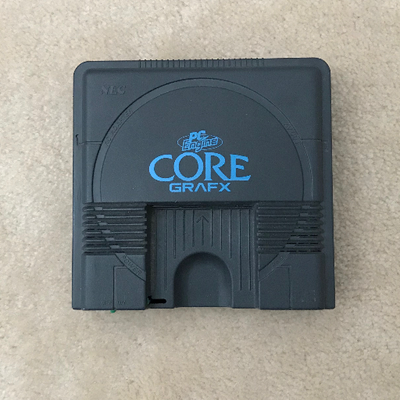
A follow-up to the recent PC Engine ADPCM discussion:
Mesen2 and Geargrafx have updated ADPCM speed to 32100 in their codebases, although you may need to wait for a formal release.
TurboEverdrive Pro updated firmware this week:
krikzz.com/pub/support/turbo…
turboxray retweeted

Axelay (SNES) is a great shmup that slows down a lot. My FastROM patch takes almost all of it away.
NEW comparison video: youtube.com/watch?v=nhdXR-MF…
Axelay patch 1.1 is out, download: github.com/VitorVilela7/fast…
turboxray retweeted

A run through all Z-out levels for #megacd #megadrive
This port from the Amiga version has 3 difficulty levels, parallax effects, and still some bugs i'm working on :)
youtu.be/Alwf8CYA-Gk

#retrogaminghistory #losinghistory #sms #nes #br
"If you talk to any Brazilian gamer who grew up in the late '80s or early '90s, they will tell you the 8-bit era was a fierce, neck-and-neck war between Tectoy (Sega) and Gradiente/The Clones (Nintendo)."
If this is true, why don't we hear about this? The narrative I've been fed for years.. is that Nintendo was completely absent in Brazil.. SMS dominated.. and only a few NES clones existed but was a tiny shadow of the SMS popularity. So, I always figured Brazilian gamers just missed out on NES games.
What is the real story here?