

Ditto is building motion-capture gloves at scale, and the largest corpus of mocap data that has ever existed.
Joined June 2026
- Tweets59
- Following210
- Followers20
- Likes53



Pinned Tweet
Planning on starting a series on this page highlighting important papers relating to action segmentation in 4D point clouds, sensor calibration, new multi-modal data configurations for training robotics policies, using world models for sample-efficient reinforcement learning, and anything else that seems exciting on the frontier of intelligent robotic systems
ditto retweeted

repeat after me
"no moat"
now, this is doubly true when you are actively hostile to all your customers, have your models secretly sabotage themselves, and are aggressive with things that don't matter like claude code being closed source
good luck w/ the IPO!


ditto retweeted

Researchers built a soft floating robot for indoor interaction.
It uses helium and flapping fins instead of propellers.
The result is quiet, lightweight, and safe to touch.
It can follow people, give reminders, and act as a study buddy.
Published at ACM DIS 2026.
ditto retweeted

Just finished north of 200 meetings in Europe with customers and technologists. The conversations were primarily around AI, common questions include:
1. Are there examples of organizations who have been able to demonstrate production level systems and do those developments show a return in lower cost, efficiency or better top line?
2. What do you think about agents? How will we discover, govern and stop agents if need be. Perhaps the biggest security concern ATM.
3. The frontier AI models are expensive, what's the business case at these token prices to embed AI in our customer facing products? Where will token prices be in the future.
4. What are the longer term implications of Mythos like models? Do we need to update cyber infrastructure or all IT infrastructure?
5. What do you think of Chinese opensource models? Are they secure and what is the downside of using them if they can be secured and they are cheaper?
The parts that surprised me were:
1. The pausing of Mythos and Fable 5 caused more consternation and concern in Europe both short term and raised longer term concerns on single model reliance or reliance or models not in ones control. I hadn't seen it from their POV.
2. Sovereignity which was always a topic and still is, is getting more nuanced - they want data residency, data localization and local resources, but there seems to be more willingness to accept global services on clouds. Classified systems continue to be an issue.
Net net - we need to ensure we continue to build trust both on our Frontier models and their consistent availability, we need to get the right economics in place and spend more time in Europe communicating and building presence if we want AI adoption to keep pace with the US.

ditto retweeted

We’re sharing the next major milestone in our non-invasive brain-to-text decoder research: Brain2Qwerty v2.
Building on v1, which was published today in @Nature, Brain2Qwerty v2 is the highest-performing end-to-end pipeline capable of real-time sentence decoding from raw brain signals. It advances beyond character-level performance to decoding words and semantics, enabling accuracy for overall communication.
We believe this research has the potential to make a real difference for the millions of people who suffer from brain lesions or disorders that prevent them from communicating.
🧵👇
ditto retweeted

HOI-DETR (Hand-Object Interaction) is a new zero-shot framework that integrates hand-object and object-object interaction
-Hand + tool detections
-Interaction links (+secondary object)
Huge for robotics training 🔥🔥


ditto retweeted

Working in robotics right now is what I imagine working with language models felt like in 2023. Everyone throwing things at the wall to see what sticks
Pixel prediction (Cosmos), action prediction (VLA), reward prediction (TD-MPC), and representation prediction (JEPA). Different paths for the same problem
The recipe that won in language was self-supervised pretraining at internet scale then light finetune on top. Only representation prediction runs that playbook. It learns from action-free video data so you can pretrain on YouTube and egocentric data then add a control layer. Everything else needs action-labeled data that doesn't scale
As an RL maximalist, I used to hate LeCun's cake. Turns out he was right all along which is how I ended up a JEPA truther
ditto retweeted

Today, we enable AutoResearch in the physical world for the first time! Introducing ENPIRE: we give 8 Codex agents a fleet of robots, an allocation of GPUs, and generous token budget. We set them free with a simple goal: solve the task as quickly as possible, keep the robots busy but stay safe, don't waste precious compute. Make no mistake.
Then humans step aside and our watch begins. The robot fleet starts to come alive: they learn to look for visual clues, reset the scene, practice novel skills, tinker with control stack, read papers online, debate, reflect, get stuck, and try again directly on the hardware. All we did is to give Codex an API to the world of atoms, and the rest is emergence.
ENPIRE is able to solve high-precision tasks like tying zip-ties, organizing fine pins, and installing GPUs all by itself. We also discovered a new type of "physical scaling": 8 robots exploring in parallel improves significantly faster than fewer ones.
A part of our NVIDIA GEAR lab now self-improves tirelessly over night. We just read the reports in the morning.
/goal: we all take a holiday and Jensen wouldn't even notice ;)
We will be open-sourcing everything, so you can host your self-running robot lab at home too! Deep dive in the thread:
Align then Adapt: Rethinking Parameter-Efficient Transfer Learning in 4D Perception
arxiv.org/pdf/2602.23069
given a static 3D pre-trained model, this adapts it to dynamic 4D point cloud video tasks without full fine-tuning. It uses a two-stage "align, then adapt" pipeline over a frozen 3D backbone

(6/7) RESULTS -
matches or beats full fine-tuning across the board — 97.21% on MSR-Action3D recognition, +8.7% accuracy on HOI4D action segmentation, 84.06% mIoU on Synthia4D, plus gains on SHREC'17 gesture and KITTI scene flow.
Also, ~35% quicker inference + ~17% fewer GPU hours. On HOI4D it notably cuts the over-segmentation that plagues P4Transformer
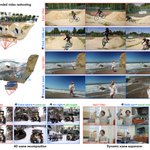
Vista4D: Video Reshooting with 4D Point Clouds -
given an input video, this re-synthesizes a scene with the same dynamics, from a different camera trajectory and viewpoint. appears to be a promising approach. Uses retargeting over a fixed 4D point cloud representation of a scene.
eyeline-labs.github.io/Vista…
