

This account is no longer active. Visit https://xitter.cf/t.co/vgU4cwjFnM or connect with us on LinkedIn.
United Kingdom
Joined February 2025
- Tweets121
- Following11
- Followers7
- Likes167






Pinned Tweet
Sustainability reports are everywhere — but how many can actually be trusted?
That’s why we launched @truMRK: an independent review and transparency score designed to bring rigour, clarity, and accountability to your next sustainability report.
#Transparency #ESG #truMRK

RT @theagcharter: Tis the season to be speaking 🎤 So, it's just as well Charlie loves it!
Though, as you can see, his fellow panellist Lou…
@EastmanChemCo built an AI tool to screen its own marketing for greenwashing. A good first filter. But self-screening only raises the floor. It cannot tell you how a regulator or litigator will read the claim. That needs an independent view.
#Greenwashing #truMRK


truMRK retweeted

One percent of building demolition materials are reused. The sector has a £1.5 trillion circular prize on the table. The gap is not a knowledge problem.
In this episode, Charlie speaks with Amira Damji, chartered structural engineer and Director of Additive Sustainability. Her argument is simple but precise: embodied carbon is committed before most designers get involved, reclaimed timber and steel cost more than virgin supply, and contracts expire at handover before anyone is left accountable. If circularity is optional, she says, people are not going to do it.
Additive Sustainability intervenes before procurement takes over. It assesses existing structures, redirects physical stock from strip-out sites, and sets carbon budgets contractors must procure within. Asset maintenance, not circular economy. The language matters because it changes who is responsible.
💡 The article discussed
Publisher: @wef · Author: Fleming Voetmann
The article makes the investment and policy case for circularity. Amira's view is that it does not go far enough. Procurement still prices virgin material below reclaimed. No contract requires anyone to care what happens after they leave site.
🎯 Who's this for?
Structural engineers, project managers and sustainability leads trying to move circular commitments out of strategy documents and into procurement decisions.
#CircularEconomy #BuiltEnvironment #EmbodiedCarbon #ConstructionSustainability
We interested to know how many people in our network have actively thought about their organisation's approach to building trust?
👉 Read more: trumrk.com/how-to-be-believe…
#Sustainability #Transparency #truMRK

Our founder Charlie recently sat down with Andrew Levy of @AteliersVerts for their Green Room series. It was a conversation about why credible sustainability communication matters more than ever.
Read the full interview 👇
ateliersverts.com/blogs/the-…
truMRK retweeted
So, another Earth Day comes around.
We don’t know about anyone else, but for us it’s always a moment to reflect on impact and, if we're honest, to question whether the work we’re doing is really making a dent.
Then, out of nowhere, you receive a message like this:
“I’ve just discovered your podcast. It’s absolutely brilliant… thank you for giving me a way to find excellent people and ideas.”
A big thank you to Philippa Hann of Paradigm Norton Financial Planning for sharing those kind words.
And it reminds us that even our small contribution still matters.
@ResponsibleEdge was created to raise awareness of the work we’re doing at @truMRK and @theagcharter to improve standards in sustainability communications. But also to highlight the environmental and social issues we face, and explore possible solutions with people who are thinking deeply about them.
I wonder how others are feeling about the impact of their work this Earth Day?
#EarthDay

truMRK retweeted

We hear a lot about greenhushing these days but how does the trend end?
When organisations realise that saying less doesn’t reduce risk, it erodes trust, and that credible, consistent communication is the signal stakeholders are actually looking for.
Read our latest piece here 👉 antigreenwashcharter.org/tru…
#AntiGreenwash #SustainabilityComms #Trust #GreenClaims

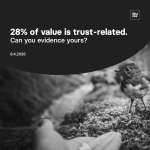
The latest UK Reputation Valuation Report 2026 by @EchoResearch shows that 28% of FTSE 350 market value is driven by reputation. That is £841 billion.

Download Echo Research's full report here: echoresearch.com/news-events…

Good piece by @trellisgroup_, highlighting that comms and sustainability teams can build trust when they work as allies within a systematic approach to communication. This is the approach we are building @truMRK to support. Read the full piece here: trellis.net/article/its-time…

truMRK retweeted
We rightly talk a lot about misleading words in sustainability. But what about misleading design?
Soft greens. Leaf icons. Earth imagery. “Natural” textures. Clean, minimal layouts that signal purity. None of these say “sustainable” outright. But together, they strongly imply it.
That’s where things get tricky.
This @Design_Week piece breaks down the specific visual cues that can encourage consumers towards believing a product or brand is more environmentally responsible than it really is. Not through false written claims, but through familiar design tropes we’ve come to associate with “green”.
At @theagcharter, this is something we’re actively addressing. All of our signatories already reference design and visual cues directly in their green claims policies.
If we want to tackle greenwashing fully, we need to look beyond the wording and interrogate the full creative. What are we implying? What are we signalling? And is it actually true?
Really appreciated the chance to contribute to this, so thanks to Design Week and to @davecoveney for pulling it together.
Read it here 👇
designweek.co.uk/six-design-…
#AntiGreenwash #SustainabilityComms #GreenClaims #Trust #DesignEthics #BuiltEnvironment #ClimateAction

truMRK retweeted
What does it take to eliminate edible food waste within a live production system without undermining cost, quality, or operational flow?
On @ResponsibleEdge, Charlie speaks with Charlie Bigham, Founder of @CharlieBighams.
The discussion focuses on how waste emerges in practice. Meals are produced in components. Protein. Sauce. Starch. Each operates on slightly different timelines. When one element runs short, surplus accumulates elsewhere. Waste is not a single event. It is a systems outcome.
The response at Bigham’s was operational. Waste was segmented into edible and non-edible, then tracked at ingredient level across each stage of production. That visibility changed behaviour. Over three years, edible food waste was eliminated and surplus redistributed through partners including @FareShareUK and @CityHarvest.
Crucially, the same process exposed smaller inefficiencies. Approximately 800kg of food was being lost weekly on the factory floor. Immaterial in percentage terms. Significant in absolute terms. This is where operational discipline becomes measurable.
The commercial tension remains constant. Packaging, ingredients, and procurement choices all present lower-cost alternatives. Plastic is simpler. Cheaper inputs are available. The question is whether responsible decisions can be maintained when they introduce friction into the system.
Charlie's position is clear. Responsibility follows competence. It is expressed through consistent operational choices, particularly when the alternative is easier.
💡 The article discussed
@UNEP: Food waste breakthrough launches to help cities halve food waste cut. The article outlines a global, data-led effort to reduce food waste at city level. The episode brings this into operational context. Measurement only has value if it drives change within production systems, not just reporting frameworks.
🎯 Who’s this for?
Food manufacturing operators, procurement leads, retail buyers, and ESG teams managing waste, packaging, and margin trade-offs.
#FoodWaste #FoodManufacturing #OperationalDiscipline #ProcurementStrategy
@BrandFinance’s How to Build Trust in an Increasingly Distrustful World by Paula Oliveira shows that trust is built through consistent delivery, strong relationships, and integrity, supported by clear measurement of how experiences shape behaviour and brand value.


truMRK retweeted
Communicating sustainability in the built environment has become a high-stakes, complex balancing act. As we know, many are starting to step back from the conversation altogether.
Why? It relies on modelling, supply chains, evolving standards and accurately forecasting future performance. And as scrutiny from regulators, investors and the public increases, organisations are being forced to rethink not just what they say, but how they say it.
Our new article reflects on findings from the Australian Built Environment Communications Report, developed following a December 2025 industry roundtable.
The session brought together leaders across sustainability, communications and design to unpack how organisations are navigating rising scrutiny on green claims in the region.
What emerged is less of a comms challenge and more of a governance one, where three pressures have to align:
• technical complexity
• legal defensibility
• the need to show progress
The organisations in the room, including Tzannes, Karndean Designflooring ANZ, @SefianiComms, @ArchitectusMelb, ResiLoop, the Office of the @Global_Vic Architect (OVGA) and @nswdphi, are all confronting the same reality: sustainability comms are no longer just about ambition, they need clear evidence, internal alignment and the confidence to stand up to scrutiny.
A huge thank you to the individuals who contributed their insight: John Pabon, Alec Tzannes, Anita P, Julia Hoy, Nigel Justins, Sophi MacMillan, Stefan Preuss and Abbie Galvin.
John, the author of the full report, builds on this in his recent op-ed in @FifthEstateAU, calling for radical transparency. Not perfect claims, but honest ones that reflect the reality of progress.
If trust is becoming the most valuable sustainability asset, we believe this is where it starts. What do you think?
#AntiGreenwash #SustainabilityComms #BuiltEnvironment #GreenClaims #Trust #ClimateAction

At the core, the idea behind truMRK is simple.
A third party transparency check for sustainability communications.
A simple idea, with a potentially enormous impact.
If you're interested in learning more about the vision, head to: trumrk.com/how-trumrk-will-s…
#truMRK
“Business remains the most trusted institution globally — with a trust score of around 62% — but confidence is narrow and conditional.”
Read the full article: trumrk.com/what-the-last-12-…

truMRK retweeted
If a company has the certification, who is checking whether the underlying practice actually improved?
On @ResponsibleEdge , Charlie speaks with Pooran Desai, Founder of @OnePlanet and creator of the One Planet Living framework, about the limits of sustainability standards.
Drawing on his experience building sustainable forestry enterprises, Pooran describes how certification shifted authority from practitioners to auditors. Knowledge was replaced by documentation. Stewardship became box-ticking.
His view is clear: standards should set the floor, not define leadership.
💡 The article discussed
Charlie and Pooran also reflect on the @ISEALalliance article written by Vidya Rangan, How are sustainability standards driving real world change?, which presents evidence of measurable gains from certification schemes.
Pooran’s counterpoint: evidence only reflects what we choose to measure.
🎯 Who’s this for?
ESG leaders, procurement teams and sustainability strategists questioning whether certification is driving real system change.
#ESGGovernance #SustainabilityStandards #SystemsThinking #ResponsibleBusiness
Sustainability communication today sits between accusations of greenwashing and the caution of greenhushing, all within a wider erosion of trust. @truMRK was created to change that by making evidence, clarity and context visible standards.
#TransparencyMatters


truMRK retweeted
Last week, @pabloheplo joined us to record an upcoming episode of @ResponsibleEdge and kindly brought along a copy of his new book, The @FinancialTimes Guide to Business Ethics.
What we did not expect was his generous note to Charlie:
“Charlie, in appreciation of your principled leadership and in support of @truMRK and your transformative work.”
When you are building something new, encouragement like that really matters. We have spoken to many founders who say support at the right moment can be the fuel that keeps you going.
It is also great to see Pablo receiving strong backing for the book, with endorsements from leaders including Charles Conn, Dame Sally Dicketts DBE, @RonanDunne, @AllisonQTaylor, @SeanWilliamsTw1, @MarkMalcomson, Sarah Gillard, Michael Davis, Katherine (Kate) Marshall, @HaydenTaylorUK, Laura J. Spence FAcSS, Guido Palazzo and @pgwalkersmith.
We feel fortunate to be part of a growing community of people who care about doing business the right way.
Stay tuned for the episode. We will be exploring the key themes from the book very soon.

