

🇧🇷 15y Public Equities (ex-Head of Research @ top Brazil fund). Experience w/ Alternatives & Illiquids. Former Public Co. Board Member. Tech enthusiast.
Rio de Janeiro
Joined October 2012
- Tweets3.2K
- Following2K
- Followers3K
- Likes8.8K





I was hoping for AI, but I got a Druckenmiller fireside chat as well!
I will be spending the week at Austin, TX, for the @TomorrowXSummit - DM me if you want to grab a cup of coffee and talk about AI and investments.

Taking the stage at @TomorrowXSummit: Stan Druckenmiller (@standuquesne), Chief Executive Officer of Duquesne Family Office, and Iliana Bouzali (@ilianabouzali), Global Head of Derivatives at Morgan Stanley (@MorganStanley) $MS.
November 17-18 at the Moody Center in Austin. Hosted with @GavinSBaker and @atreidesmgmt, @antoniogracias and Valor Equity Partners, @rbiscardi and @iconnections_io.
Registration link below.

Uma IA que monta o modelo de valuation em dois minutos não desintermedia o investidor, porque o modelo nunca foi a parte que determinava o retorno. O caminho tradicional na carreira ensina a planilha primeiro: back-office para demonstrar resiliência, investment banking ou sell-side para aprender a estruturar modelos de valuation e apresentações, e só depois o buy-side, onde se aprende a monetizar todo esse ferramental.
Eu comecei como estagiário da mesa proprietária de trading de um banco. Meu primeiro mentor não me ensinou a modelar. Ele me ensinou que existem no máximo três coisas numa ação que determinam se você ganha ou perde dinheiro.
Meu segundo mentor me desincentivou a fazer o CFA, mas me colocou para trabalhar numa biblioteca com mais de 4.000 livros, separados por tema. A cada semestre eu escolhia uma pilha sobre um tópico para me aprofundar, e conversava por horas com ele sobre o que estava lendo. Ele me ensinou a selecionar e a pensar criticamente. Um dos seus ensinamentos ele repetia sempre: "Capital não se aloca sozinho. Pessoas alocam recursos, sejam eles humanos ou financeiros."
Repare: uma ferramenta de IA que faz a parte braçal do modelo de valuation não desintermedia o investidor. Ela libera tempo. Se todo mundo tem o mesmo modelo em dois minutos, o modelo vira consenso e o preço já o carrega; o que sobra de diferencial é escolher os modelos mentais certos para pensar a empresa, isolar as três variáveis que importam e entender como elas se movem até a ideia virar dinheiro.
Abaixo, cinco livros que influenciaram minha formação. Nenhum deles ensina a montar uma planilha, e é por isso que continuam valendo depois que a IA passou a montá-la. Por que cada um, abaixo:

if you're into "financial models", pivot to ontologies. You need to think about firms as networks of complementary knowledge and know-how, not as a bunch of numbers on a spreadsheet. Accounting doesn't give you any view into the thing that actually matters (and will matter more and more going forward): how intangibles combine to create economic value.
Firms with economically valuable configurations of knowledge / know-how can deploy capital at attractive returns. Those with a differentiated ability to learn from deployment (accrue more economically valuable knowledge/know-how) absorb more capital over time.
Organisms / species with adaptive mutations absorb energy at high rates and use that energy more efficiently (become more selectively adaptive).
Are you getting it now?
4. The Craft of Research (Booth, Colomb e Williams)
Ensina a diferença entre um tema ("estou estudando a empresa X") e um problema ("quero descobrir por que X reinveste a retornos acima do custo de capital, para saber quanto tempo isso dura"). A maioria dos pitches é um tema com uma planilha anexada.
goodreads.com/book/show/2543…

5. Streetlights and Shadows (Gary Klein)
As regras clássicas de decisão, como juntar mais informação, seguir o procedimento e reduzir a incerteza antes de agir, funcionam sob o poste de luz, nas situações bem ordenadas, e falham na sombra, onde a ambiguidade é alta. Para quem investe a consequência é direta, porque onde a luz já está o preço também já está.
goodreads.com/book/show/6470…


One of the big issues with Muse? Retention.
The bearish side of these agents is that consumers don't have much incentive to stick to them. What is the switching cost? None.
I believe Muse will do great, but a major work in progress still. Retention matters.
$META


This captures the current disconnect perfectly: OpenAI and the frontier labs keep winning the benchmark race while losing the user experience.
Closing the gap between model capability and productized UX is the only mechanism that converts speculative datacenter buildouts into durable enterprise ARR, and allows public equity markets to underwrite demanding IPO multiples. Why?
Labs spent billions chasing raw frontier intelligence while treating product and UX as an afterthought. A superintelligent genie in a chat box is great for a prompt engineer; it is useless for the broader market. As Karpathy highlighted, 5,000 engineers have infinite access to unreleased weights, and 20 million enthusiasts tinker with public models. That 20M (0.2%!) is a rounding error. The remaining 98% of the global workforce still views AI as an unreliable chat toy that occasionally hallucinates, but that will certainly take their jobs one day.
Muse proved the counter-thesis: wrap accessible intelligence in a frictionless, autonomous harness (the OpenClaw paradigm), and consumer adoption inflects overnight.
With public listings approaching and hundreds of billions in physical capex to justify, the labs **MUST** pivot from publishing papers to capturing workflow utility. The playbook requires three immediate pivots:
- Kill the monolithic prompt box: Stuffing every capability, from Decision APIs to new model tiers, inside the legacy ChatGPT window is a dead end. Labs must unbundle into specialized, zero-prompt execution apps that execute background tasks natively without requiring a chat session.
- Own the state and execution harness: Stop operating as a stateless API that hands high-margin workflow capture to third-party wrappers. The moat is persistent contextual memory, deterministic tool-calling, and local file access.
- Shift from "chat" to System of Action: Build deterministic guardrails and compliance auditing directly into enterprise tools. If a CFO cannot budget the token spend or audit the output, enterprise diffusion stalls.


Platform defense against horizontal agents extends well beyond e-commerce. YouTube just cut off Muse on my daily podcast digest.
Every major distribution endpoint is aggressively shutting the door to ring-fence proprietary inventory and stop unmonetized scraping.


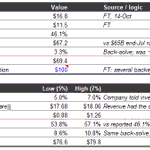
8/ Scorecard:
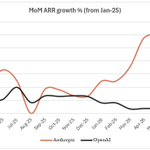
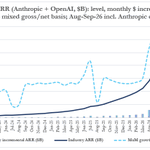
Headline QoQ understates underlying growth by 8-11pts Industry demand compounding at ~12.5% MoM The $100B bogey was a straight line drawn off a 2x quarter
Every figure here is reported and pre-S-1. The filing settles it.