

Custom-fit Covers for Shipping and Storage
Elkhart, IN
Joined August 2009
- Tweets1.6K
- Following84
- Followers241
- Likes92
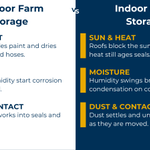






Finished tractors and combines can wait months to sell, and every week outdoors chips away at condition and margin. Indoor storage isn't risk-free either.
Here's how to keep inventory factory-fresh: bit.ly/4eGS9Dy

Wind, hail, and salt each damage equipment a different way. Storm season brings all three at once, and one storm can take out dozens of units.
Here's how to protect your fleet: bit.ly/4jrlSDT

Corrosion weakens metal, voids warranties, and drops an asset's value while it sits. Bare metal plus moisture is all it takes, and storage and transit are the riskiest stretches.
Here's how to prevent heavy equipment corrosion: hubs.ly/Q04xP1MB0

Large machinery loses performance and service life fast without a real storage plan. Corrosion, UV, dust, and condensation threaten it indoors and out.
Here's how to store large equipment safely in both settings: hubs.ly/Q04xN_Nc0

Every asset a company owns spends part of its life in storage, and downtime is where corrosion, UV, and dust do their damage. Here's how to build a storage plan that keeps high-value equipment ready: inventory, location, prep, and cover: hubs.ly/Q04xN-bw0

Wind turbine parts, crane arms, custom machinery. Their odd angles and exposed brackets are exactly where a generic tarp leaves gaps, and gaps are where corrosion starts.
Here's how to protect oversized equipment in transit and storage. hubs.ly/Q04xNXNF0

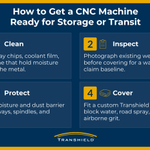
A CNC machine leaves the plant perfect. On an open trailer it faces road spray, humidity, and grit, and a thin film of rust throws off the accuracy your customer paid for. Damage in transit lands on you.
Here's how to protect it. bit.ly/4rhlY2N

Tarps, shrink wrap, wood crating. Every common way to protect equipment shares one blind spot: none protect the metal itself, and some actually trap in the moisture that corrodes it. Here's how Transhield custom covers compare: hubs.ly/Q04tM6sQ0

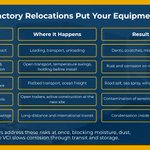
Relocating a factory means taking each machine off the floor, moving it to the new plant, & putting it back in service. That trip is where damage happens, & the wait before install adds even more risk. Here's how to protect your equipment during the move: hubs.ly/Q04tJG6H0

Ship equipment by intermodal and it rides sealed in a container across truck, rail, and ocean for weeks. The container blocks rain, but not the trapped humidity that corrodes machinery inside. Here's how to protect your load: hubs.ly/Q04tLldl0

Permits and escorts get an oversized load moving legally. They don't protect the machine on the trailer. Days on the road mean more exposure to salt, rain, and debris. Here's how to protect high-value equipment in transit: hubs.ly/Q04tJJB-0

Construction equipment can be worth as much as a house, and on an open trailer, it takes the full force of the road. Salt, debris, and vibration start damage before it ever reaches the site. Here's how to protect your machinery in transit: hubs.ly/Q04tM2jT0

Hail causes $10-15B in US damage every year. In our testing, unprotected aircraft aluminum dented badly. Panels under Transhield covers? No damage. Protect grounded aircraft & military assets before the storm: hubs.ly/Q04sYVGR0

Shrinking a cover over machinery calls for a propane gun, not the electric one on the shop bench. Here's how to pick a heat gun by power, weight, and budget: hubs.ly/Q04sY8pm0

An RV front cap takes rocks, hail, and grime for thousands of miles, and one mark shows on a surface that large. Here's how to protect fiberglass in transit: hubs.ly/Q04sYV4f0

A unit ships with immaculate paint and arrives with scratch marks. The cover is usually the reason. Here's what causes etching and scratching in transit and how to prevent it: hubs.ly/Q04sYX990

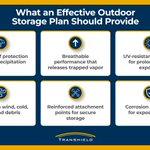
Outdoor storage is the practical option for most operations. It works when you approach it with a plan. Here's how to prepare the site, prep each unit, and cover it so it stays factory-fresh: bit.ly/45rkxol

Berry Amendment compliance isn't optional on a DoD contract. Transhield builds for it. Our military covers are USA-made and manufactured on our own lamination line, so domestic origin is straightforward to document. Here's how we meet the standard: hubs.ly/Q04mNgQZ0

Vehicle inventory rarely moves the moment it's ready. A unit can sit weeks or months on the lot, and the whole time, the elements keep working on it. Here are the fleet storage best practices to keep every unit factory-fresh: hubs.ly/Q04lC5Cp0

A custom protective cover has one job: keep equipment safe in storage and transport. The manufacturer you choose decides how well it gets done. Here are the six things to look for when comparing cover suppliers: hubs.ly/Q04lD2PL0
