

Money, markets, AI, power. Explaining how the world actually works — not how it’s sold. For thinkers and sovereign minds.
New York, USA
Joined October 2011
- Tweets28.1K
- Following4.7K
- Followers3.6K
- Likes9.1K







Anthony D retweeted

“Just cut back” is the economic advice everyone gives.
Okay.
Restaurants are gone.
Vacation is gone.
New car is gone.
Hair appointments are gone.
Home renovation is gone.
New phone can wait.
Entertainment got trimmed.
Shopping got trimmed.
At some point you have to ask:
What exactly is left to cut?


WHO REALLY GOVERNS THE MONEY?
The Federal Reserve is often described as public, but its structure contains private banking power. The twelve regional Reserve Banks are, by law, owned in stock by their member banks — the private commercial banks of each district — which are required to subscribe to that stock as a condition of membership and which receive a statutory dividend on it. Those member banks elect the Class A directors, who represent the banks, and the Class B directors, who are supposed to represent the public.
The Federal Open Market Committee, which sets monetary policy, is made up of the seven Fed governors, the New York Fed president, and four rotating regional Fed presidents. The institution funds itself as well. It does not live on taxes appropriated by Congress; it pays its own way out of the interest earned on the very securities it acquires when it creates money, covers the member-bank dividends first, and remits what is left to the Treasury. Because it is self-funded, its budget never passes through the appropriations process that constrains ordinary federal agencies — the one lever the public holds over the rest of the government, the power of the purse exercised through elected representatives, was never built to reach it.
And yet the arrangement is not beyond the reach of the public’s representatives — which is exactly why they cannot disown it. Congress created the Federal Reserve. It wrote the Federal Reserve Act that called the institution into being, it set the mandate the Fed now cites, and the Senate confirms the governors who run it. What one Congress built, another retains full authority to change or to end. They will answer with a single word — independence. Strip that word of its flattery and see what it means for the ordinary citizen: the one institution with the firmest grip on the value of his labor has been placed, on purpose, beyond his vote. That is not a safeguard for the citizen. It is a wall built around the money power.
And it settles nothing about who is responsible — the power was delegated by elected government, it remains authorized by elected government, and it continues for one reason: because elected government, session after session, chooses to preserve it. So when a representative hides behind the Fed’s independence to explain why nothing changes, remember who is entitled to change it, and has chosen not to. That means the institution that governs money is not directly controlled by ordinary citizens. It is a technocratic system, funded from within, with private banking interests embedded in its structure.
Yes, the Fed publishes audited financial statements. Those statements report assets, liabilities, and operations. But two things are true at once, and the second is rarely said aloud. The first is that the books are audited. The second is that the audit is not permitted to reach the decisions that matter. Federal law — 31 U.S.C. § 714(b) — specifically exempts the Fed’s monetary-policy deliberations, its transactions with foreign central banks and governments, and the discussions of the Federal Open Market Committee from the Government Accountability Office’s audit authority. The exemptions were written into the statute, and they cover precisely the decisions that set the cost of credit and the value of the dollar.
In 2014 the House of Representatives voted 333 to 92 to remove those exemptions. It did not become law. The carve-outs still stand. So a financial audit does not answer the deeper civic question: Who benefits from the system? A balance sheet can be clean while a society is being drained — and the part of the ledger that would show how the draining is decided is the part the audit is forbidden to open. The deeper evidence is not only in hidden ownership records. The evidence is in the outcome: permanent public debt, household debt dependence, inflation, bailouts, asset bubbles, and a growing gap between those who own assets and those who work for wages.
Whether one believes the system is controlled by specific old banking families, modern Wall Street institutions, political insiders, asset managers, or a broader elite financial class, the practical result is the same: ordinary people are governed by monetary decisions they do not vote on, do not fully understand, and cannot easily escape. That is the issue. This is not about left versus right. This is not about party politics. This is not about blaming one group of people. It is about asking whether a debt-based monetary system can truly serve the common citizen when its repeated outcome is dependency, inflation, and financial pressure on families.
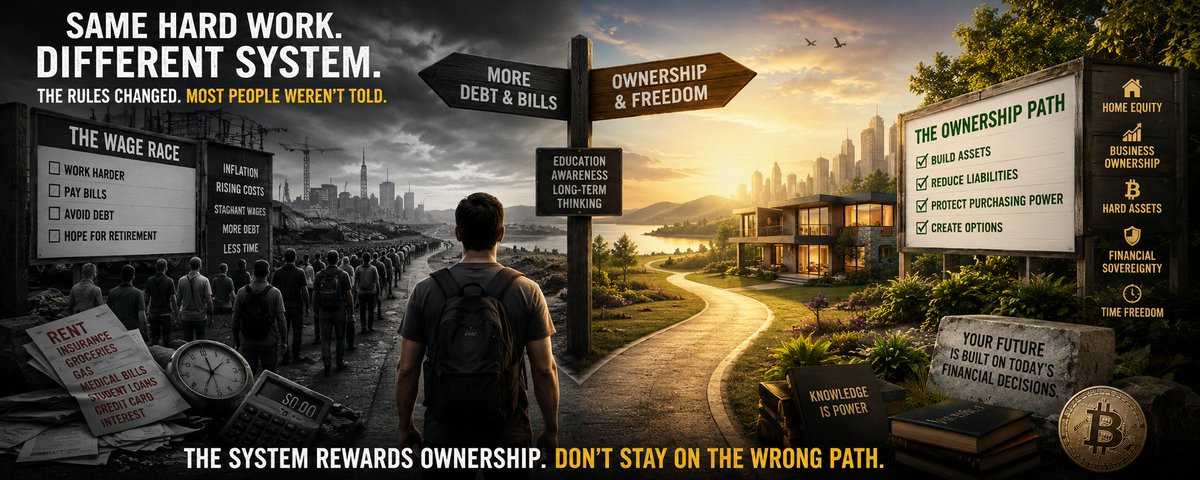
The public should educate itself on how money is created, who benefits from credit expansion, why government never pays down the debt, why banks are rescued when they fail, and why the average citizen is told to budget harder while the system itself borrows without limit. A republic cannot remain free if its people do not understand the money. And a citizen cannot be fully independent if every road to survival runs through debt. The question is no longer whether the system is working. The question is: Who is it working for? That question does not have to end in despair, and it does not end the book. It begins the rest of it.
You did not consent to this arrangement, you were not asked, and you cannot vote it out — but you are not required to keep storing your life’s work inside it. The chapters ahead trace exactly how the money is made, who stands nearest it, and why every road they left you runs through debt — and then they show the one road that does not. You cannot govern their money. You can stop being governed by it.
To The Ones We Chose
A reminder, from the many who lent you the power — and remember the lending.
We are the ones who do the work. We rise before the light and come home after it. We lay the brick and drive the road, stock the shelf and tend the sick, and raise the children who will do the same. We keep the world running while it sleeps. We are ordinary, and we have never once been ashamed of the word. We are law-abiding — not because we fear you, but because we believe in the order that honest people build together. We do not ask to be celebrated. We ask only to be counted, fully, and no less than anyone who governs us.
Understand what we are, because it seems you have forgotten. A society does not stand on the ones who rule it. It stands on the ones who feed it, build it, mend it, and carry it. Take away the men who govern for a season, and the world goes on turning. Take away the hands that labor, and there is nothing left to govern.
We are not the bottom of your order. We are the ground the whole of it rests upon. And understand what you are, because you seem to have forgotten that too. You are not a higher kind of person. You are not stronger than us, nor wiser, nor cut from finer cloth. You bleed as we bleed, and you will be laid in the same earth. There is exactly one thing that lifts you above your neighbor, and it is not virtue and it is not gift. It is that we chose you. We took the power that was ours, and we lent it to you — on trust, for a purpose, and for a time. That purpose was never you. It was us. It was all of us.
A ruler is a worker’s invention, made by the many to keep the many safe and fairly dealt with — to lead an honest, fruitful society that serves everyone in it and lifts no one above the people who made him. You were meant to be the first among equals, not the master of servants. The hour you began to believe your seat was a birthright and not a loan, you stopped being the thing we sent you there to be. You were not born above us. We stood you up. And what the people stand up, the people may sit back down.
We see how you have kept your place. Not by leading us better. Not by loving us more. You have kept it by your hand on the one lever that reaches into every life at once — the money our labor is measured in. You thin the very unit that holds a worker’s worth, quietly, in rooms we are not permitted to enter, and you call the result prosperity. Our hours buy less with every passing year, and you speak of it as though it were the weather — an economic condition that simply arrived. It did not simply arrive. Human beings govern the money, write the rules, expand the credit, and decide who is protected when the consequences come. When those choices weaken the purchasing power of completed labor, the loss is not abstract. It is a hand in the pocket of every working family in the land.
And when the same structure allows those closest to money, assets, credit, and political power to protect themselves first while everyone else is told to absorb the loss, it helps preserve the distance between those who govern the system and those who live beneath its consequences. Take that lever away and you are what you always were: one neighbor among many, holding a job the rest of us gave you.
We have done our reading. We have followed the rules that shield the ledger, and the ones that hide the vote, and the ones that let your silence stand in for our consent. We are not confused, and we are not a mob. We are the most numerous people in this country, and we are simply learning, at last, to read the machine that was built to be read by no one but you.
So hear us plainly, and hear that our hands are open. We do not come with torches. We come with arithmetic. We are not asking to tear down the house — we built the house. We are asking for the return of what was ours before we lent it, and what you have been provably taking while we were not looking. We will ask it in the open. We will ask it with evidence, with patience, and without a single fist raised. But we will not stop asking, and we will not ask for less than what is ours. Know this last thing, and let it sit with you.
A government that turns upon the people who made it has made itself a stranger in the house that welcomed it — an occupier standing on ground that was never his, living off the labor of the very people he has learned to look down upon. That is not rule. That is a guest who forgot he was invited, mistaking the key we handed him for a deed to the home. We remember who we are. We are the work, and the worth, and the will that put you where you sit. It is time you remembered too.
We chose to be led. We never agreed to be owned.


Leavitt: Democrats ‘Want to Talk About Affordability — They Voted to Raise Your Taxes’ - go.shr.lc/3Uy7jny via @Shareaholic

A country that can mobilize contracts, logistics, financing, and legislation rapidly for conflict
should be asked why healthcare, housing, resilient infrastructure, and skilled-trade education
encounter decades of delay. The question is not whether every domestic proposal deserves
approval. It is why institutional emergencies can make government move at once while
household emergencies are treated as permanent background noise.
Artificial-intelligence data centers, electrical grids, manufacturing, housing, transportation,
and energy systems require electricians, plumbers, welders, line workers, technicians,
construction workers, and small suppliers. Those same forms of labor and material capacity are
affected by military mobilization. Opportunity cost is not a slogan. It is the future that could not
be built because the nation committed its urgency somewhere else.
The working class does not need more speeches about opportunity. It
needs the infrastructure of opportunity.


AOC Called Him Old — What Senator Kennedy Said Next Destroyed Her Whole ... youtu.be/_gNPUrwl7Lc?si=Geoa… via @YouTube Junior needs some schooling:


Is This The BEST Bitcoin Speech in History?! (Jack Mallers EXCLUSIVE) youtu.be/rOkr5PhRr_8?si=VKvn… via @YouTube


