


toffe retweeted

I am the British whistleblower who reported evidence concerning Howard Lutnick, his links to Jeffrey Epstein, and Cantor Fitzgerald and BGC to the FBI in 2020–21.
Listen to the BBC File on 4 documentary about my whistleblower story:
bbc.com/audio/play/m002yx47
BBC News:
bbc.com/news/articles/c9q28d…
I later shared evidence with the House Oversight Committee, which subsequently questioned Lutnick behind closed doors.
My disclosures also contributed to regulatory action in the US and UK, including a £96m HMRC tax assessment relating to BGC’s partnership scheme. I believe the true tax exposure is substantially higher.
I also reported to the FBI and financial regulators matters involving Cantor Fitzgerald’s Relief Fund and BGC/Cantor’s annual 9/11 Charity Day.
The personal consequences of whistleblowing, and the retaliation I say followed, have been devastating for my family and me.
Mother Jones previously reported that documents I uncovered revealed a years-long business tie between Howard Lutnick, Cantor Fitzgerald and Jeffrey Epstein through AdFin, including a 2018 exchange in which Lutnick and Epstein discussed the company directly:
motherjones.com/politics/202…
motherjones.com/politics/202…
Follow me here on X and on LinkedIn. I intend to share more of the evidence and the story behind what happened.

toffe retweeted

The best-tested theories in science still leave about 95% of the universe unexplained. Each of these is an open problem with a hard number attached.

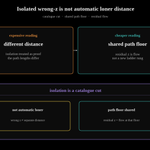
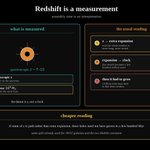
An isolated hole with the wrong z is then not automatically a loner at a different distance. Some of its redshift can be residual flow at a shared path floor. The isolation is a reading of the catalogue cut, not proof that the path lengths differ.

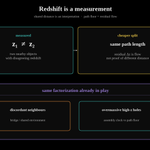
Redshift is a measurement. Shared distance is an interpretation. If some of z is path and some is flow, two objects at the same path length can disagree in residual z. Same factorization already used for discordant neighbours and overmassive high-z holes.

The usual patches: line-of-sight coincidence, unusual dust, or a rare merger geometry. Three extras for one wrong-z clash. That is a sign distance, or the redshift, is being asked to do too much for objects that look related.

Some black holes and galaxies sit alone on the sky with a redshift that does not match their neighbours. Catalogue treats each as a separate distance. The standard reading is chance projection. The strain is when contact features or shared environment make that reading expensive.

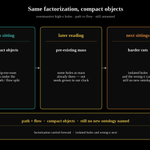
This sitting takes the same factorization to compact objects. A later reading can treat some holes as pre-existing mass, not seeds grown in our clock. Still unnamed. Next sittings take isolated holes and the wrong-z cases. Still no new ontology named.

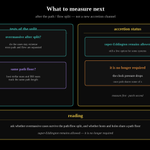
What to measure next is whether the overmassive cases stay overmassive once path and flow are split, and whether host stellar mass and black-hole mass track the same path floor. Super-Eddington remains allowed. It is no longer required.

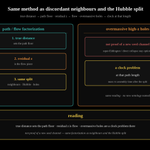
Same method as discordant neighbours and the Hubble split. True distance sets the path floor. Residual z is flow. Overmassive high-z holes are then a clock problem at that path length, not proof of a new seed channel.

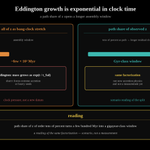
Eddington growth is exponential in clock time. A path share of observed z of order tens of percent turns a few hundred million years into a gigayear-class window. That is a reading of the same factorization, not a new accretion physics, and not a measurement yet.

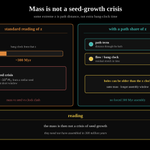
The mass is then not a crisis of seed growth. Some of the extreme redshift is distance through a path term, not extra time on our bang's clock. The holes can be older than the standard reading of z. They need not have assembled in 300 million years.

Redshift is a measurement. Assembly time is an interpretation. If some of z is path rather than extra expansion, these holes are not required to have grown in a few hundred million years. Same split already used for JWST galaxies and the two Hubble constants.

The usual patches: super-Eddington accretion, heavy direct-collapse seeds, or a hidden faint-progenitor population. Three extras for one mass-versus-time clash. That is a sign the clock, or the redshift, is being asked to do too much.

Surveys keep finding already-supermassive black holes at redshift 7 to 10. Some are spectroscopically confirmed near a billion solar masses. In the standard clock that is a few hundred million years. Growing that from a stellar seed at Eddington was not the expectation.

This sitting expands the catalogue test named at the end of sitting 3. Same split, harder cut. Next sittings take other high-z oddities with the same factorization. Still no new ontology named.

Selection is strict: spectroscopically confirmed pairs or groups, interaction signs that survive projection arguments, and a Δz too large for bound orbital motion at the shared distance. Soft candidates do not count.

The redshift gap at fixed distance then measures the flow piece at that sky position. Navigation, not a particle. You map where our volume's motion sits relative to the path floor, using associations already published.

True neighbours share path length. The path piece of z is then common. What remains between them is the flow difference. That is a catalogue test of the factorization, not a new dark component.

The split already used for JWST ages and the two Hubble constants: some of z is path, energy lost with distance; some is flow, motion inside our volume. Discordant neighbours are where that split can be read off the sky.

